0 views
I was thirty-one when she had her first stroke. I drove back to the yellow house and sat beside her in the hospital and held her hand, and she squeezed back — still herself, still sharp in the eyes, still Ruth.
“Don’t fuss,” she said.
“I’m not fussing. I’m sitting.”
“You’re fussing with your face.”
I laughed despite everything. “Your doctor says—”
“I know what my doctor says. I’m old, Maya. Not deaf.”
She came home. I stayed for two weeks and went back to my apartment and called every Sunday and also Wednesdays. For a while, things were stable. For a while, it seemed like she might simply be one of those people who outlast their prognoses through sheer stubbornness.
She wasn’t. The second stroke, in March, was different. She slept more than she woke. She lost words. She reached for my hand sometimes without opening her eyes, just to confirm I was there.
“You turned out so well,” she told me, on one of her clear days. She said it with genuine satisfaction, the way you might admire a garden that had survived a difficult season. “You know that, right? You turned out just right.”
“You had something to do with that,” I said.
“I just kept the door open.” She smiled. “You walked through it yourself.”
She died on a Tuesday in April. I was with her. The room smelled like the lotion she’d used for fifty years and the yellow curtains I’d brought from her house because I thought she should have something familiar, something hers.
I held her hand until it stopped being warm.
I drove home in a rain that felt personal. I sat in my car in the parking garage for twenty minutes without being able to move. Gerald met me at the door and butted his enormous orange head against my shins, which is the most affection he has ever voluntarily offered anyone, and I sat on the floor of my hallway and let myself come apart at the seams.
The woman who had mothered me was gone. And I was, in the most exact and specific sense, alone.
Part Three: The Knock
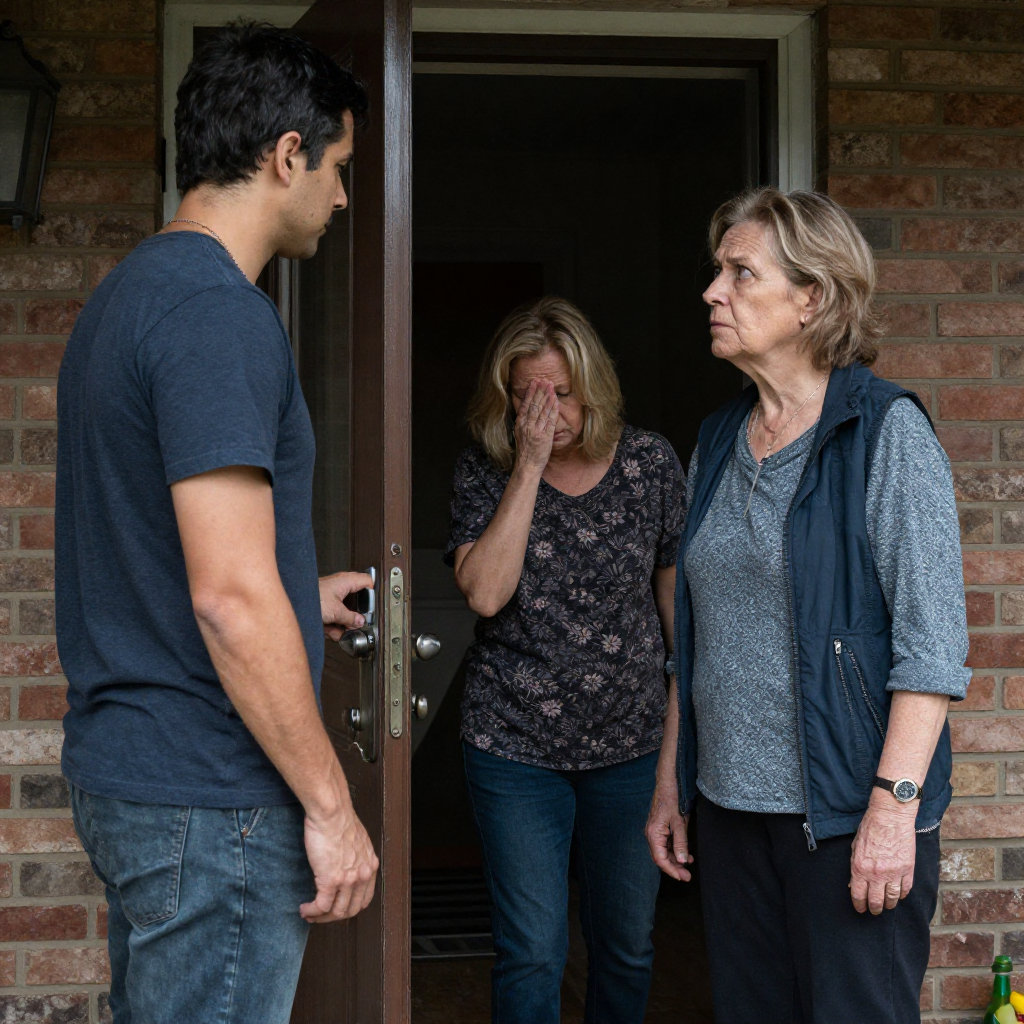
Three days later, the knock came.
I had spent those days in a fog of logistics — the funeral home, the neighbors who kept bringing food I couldn’t eat, the long terrible process of someone’s life contracting to a list of arrangements and phone calls and paperwork. I had called Dr. Osei. I had not called anyone else because there was no one else to call, which is a thing you don’t fully reckon with until it’s suddenly, precisely true.
The knock was light. Tentative.
I was still in my pajamas at two in the afternoon. I had been sitting at my kitchen table with a cup of tea that had gone cold, holding it with both hands for the warmth that was no longer there, staring at nothing in particular.
I opened the door.
My mother was sixty-three now. I would not have known her immediately on the street — the social polish had softened or eroded, the carefully maintained hair gone gray and cut short, and something about her posture had changed, had gone inward, made her smaller. She was wearing a gray coat and holding her own hands in front of her as though she wasn’t sure what else to do with them.
She looked at me. I looked at her.
Twenty-one years. In twenty-one years I had grown from an eleven-year-old holding a homemade card to a thirty-two-year-old who had just buried the woman who saved her. And my mother looked, if anything, like someone who had aged badly inside herself — who had perhaps discovered, somewhere in the intervening years, that having everything you want is not the same as being full.
“Maya,” she said.
I didn’t say anything.
“I heard about Ruth.” She stopped. Tried again. “I heard about your grandmother. I wanted to come.”
I stood in my doorway and felt the cold air move between us.
“Why?” I said.
She flinched. “Because she was my mother.”
“She was,” I said. “She was also mine. More mine than you were, for most of my life.”
She opened her mouth and closed it. Her hands shifted against each other, a small wringing motion she seemed unaware of.
“I know,” she finally said.
That surprised me more than I can explain. I had prepared, somewhere in the back of my mind, for deflection. Justification. The careful architecture of self-protection I had watched her construct whenever the past came too close. I had prepared for I was going through a difficult time or you have to understand what it was like for me. I had not prepared for I know.
I stepped back from the door. Not an invitation, exactly. More like an absence of refusal. She took it as the invitation it was, and came inside.
She sat at my kitchen table and I made fresh tea because I needed something to do with my hands and because the old tea was cold and because some part of me, against all reason, defaulted to hospitality. Gerald appeared on the counter and observed her with the deep suspicion he extends to all newcomers and most furniture.
Outside, the late afternoon light came through the windows in the way it does in April, golden and a little sad, the kind of light that makes everything look like a memory of itself.
“How did you find out?” I asked.
“One of her neighbors. Mrs. Pellegrino. She had my number from a long time ago. She thought I should know.” A pause. “She said it had been a peaceful passing. I’m glad.”
“It was.”
Silence settled between us like something physical.
My mother looked around my apartment — the plants, the books, Gerald, the accumulated evidence of a life she hadn’t been part of building. I watched her look at it. I wondered what story she was telling herself about it. Whether she was adding it up and arriving at something like guilt, or something more complicated, or nothing much at all.
“Ethan is well,” she said. “In case you wondered.”
“I’m glad,” I said, and I meant it. He had always been innocent.
“He has children. Two girls.” Something almost like a smile moved through her face. “Your nieces, I suppose.”
The word sat strangely. Nieces. People I had never met, growing up in a family that knew about me only vaguely, the way you know about a place you’ve never been. Two small girls who had a grandmother I had never been given access to.
“That’s wonderful,” I said.
More silence.
“I’ve been thinking,” my mother said carefully, “about a lot of things. For a while now. But especially since—” Her voice caught. She gathered it. “Your grandmother wrote to me. Two years ago. She wrote me a letter.”
The tea was very hot. I held the mug anyway.
“I didn’t respond.” She looked at the table between us. “I’ve regretted that every day since. She said — she said things I didn’t want to hear but that I’ve never been able to forget.” She looked up. “She said you were kind. That you were generous. That you had become someone she was incredibly proud of, and that she hoped — before it was too late for all of us — that I would find the courage to show up.”
My grandmother. Working quietly until the end, through whatever doors she could find.
“She never told me,” I said.
“I know. She said she wouldn’t. She said it was my choice to make.” A pause, long and difficult. “She also said — and I’m telling you because I think she would want you to know — she said that you had forgiven me more than I deserved, simply by not spending your life hating me. That the way you’d grown up whole and kind was the most generous thing anyone had ever done for her.” Her voice was very controlled, but only barely. “She said you were the best thing she’d ever been given.”
I pressed two fingers to my eyes for a moment. Breathed.
Grandma Ruth. All the way to the end, still trying to open doors.
I want to tell you there was a clean moment of grace. That something broke open in the April light and twenty-one years dissolved and we cried and forgave and became, finally, what we might have been. That the knock on the door was the beginning of a second story, simple and redemptive.
That is not what happened.
What happened was longer and slower and harder and, in certain ways, more true.
What happened was that I looked at this woman — this stranger who was also, inescapably, my mother — and I understood something I had spent years trying to understand in the abstract: that she was not a villain. She had never been a villain. She was someone who had been young and overwhelmed and seduced by the promise of a clean new life, someone who had not had the emotional vocabulary to hold two loves at once and had let the older, quieter one go. She had failed me with the specific, devastating casualness of someone who simply did not understand what they were doing. She had handed my card to a baby because she genuinely, in that moment, could not conceive of what she owed me.