0 views
More than 700 employees attended.
I stood on stage and looked across the crowd.
I talked about the company’s turnaround.
I talked about the warehouses.
The employees.
The clients.
The mistakes.
The future.
Then I said something that wasn’t in my prepared speech.
“Success is often misunderstood.”
The room became quiet.
“People see the title at the end and assume the journey was easy. They don’t see the nights when you were afraid. They don’t see the failures. They don’t see the people who told you that what you were doing wasn’t important.”
I paused.
“And sometimes, the hardest part of building your future isn’t proving yourself to other people.”
I looked across the room.
“It’s learning that you don’t need their permission to become who you were meant to be.”
The audience applauded.
I smiled.
But I wasn’t thinking about them.
I was thinking about a 20-year-old girl sitting beside a broken copier, correcting invoices after everyone else had gone home.
That girl had no idea what her future would look like.
She only knew she wanted something better.
And she had kept going.
That evening, I returned home.
There was an envelope waiting beneath my apartment door.
No return address.
I opened it.
Inside was a photograph.
My family.
Years earlier.
Me, Brittany, Mom, Dad, and Grandma Evelyn.
On the back, someone had written:
She always knew.
I recognized Grandma’s handwriting.
My throat tightened.
I turned the photograph over.
A second note was attached.
Rachel,
If you ever doubt yourself, remember that I saw you before the titles did.
You were never difficult.
You were never ordinary.
You were simply surrounded by people who had become comfortable with your sacrifices.
Don’t spend your life convincing them otherwise.
Build something they cannot take from you.
Love, Grandma.
I sat down.
For the first time in years, I cried.
Not because I was hurt.
Because I finally understood.
Grandma had known.
Maybe she had always known.
Three years passed.
Alderpoint grew.
The board renewed my contract.
We expanded into two new markets.
Employee turnover fell.
Warehouse efficiency improved.
And the company became known for promoting people based on performance rather than connections.
I made one rule during my first year as CEO.
No employee would ever be treated differently because of who their family was.
Ironically, that rule began because of my own family.
Brittany eventually built her own career.
She never returned to Alderpoint.
She didn’t need to.
She became a marketing manager at another company and, years later, started her own small consulting business.
Mom and Dad slowly rebuilt their relationship with me.
Not immediately.
There were awkward dinners.
Long silences.
Apologies that sometimes came too late.
But eventually, Dad said something I had never heard from him.
“I was wrong about you.”
I looked at him.
“You were.”
He nodded.
“I thought success was something you could see.”
“What do you mean?”
“I thought successful people drove expensive cars and lived in big houses.”
He looked down.
“You were successful while sitting at our kitchen table helping me recover from surgery.”
I didn’t know what to say.
So I simply reached across the table and held his hand.
Not because everything was forgotten.
But because some wounds don’t need to disappear before people can move forward.
Mom apologized too.
She admitted she had compared me and Brittany for years.
She admitted she had mistaken my independence for arrogance.
She admitted that she had relied on me so much that she eventually stopped seeing my sacrifices as sacrifices.
That was the closest thing to closure I ever received.
And it was enough.
Years later, I returned to the old house.
My parents no longer owned it.
A young family lived there now.
I stood outside for a moment.
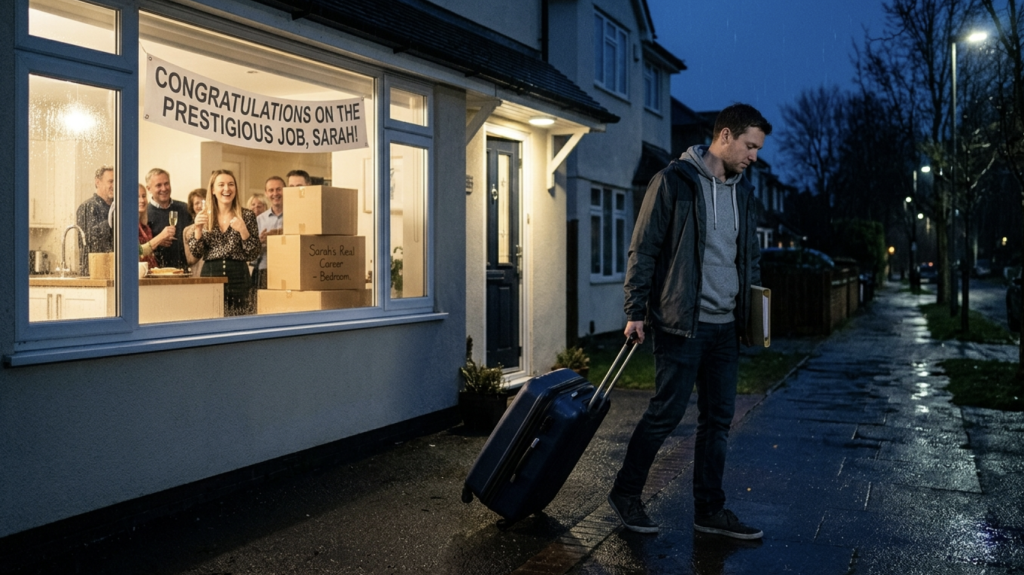
I remembered the night I had dragged my suitcase down that driveway.
I remembered Brittany saying:
“Maybe Alderpoint is hiring cleaners.”
I smiled.
Not because the insult was funny.
Because I no longer felt anything when I remembered it.
That was how I knew I had healed.
I walked away.
My phone rang.
It was Brittany.
“Where are you?”
“Near the old house.”
She laughed.
“Why?”
“Just remembering.”
“Don’t stay there too long.”
“I won’t.”
She paused.
“Rachel?”
“Yes?”
“I got the contract.”
“What contract?”
“The biggest client I’ve ever landed.”
I smiled.
“Congratulations.”
“I wanted you to be the first person I told.”
That meant more than she knew.
“I’m proud of you.”
“Thanks.”
Then she said something that made me stop walking.
“You know what I realized?”
“What?”
“You didn’t become successful when they made you CEO.”
I waited.
“You were successful the night they threw you out.”
I looked down at the sidewalk.
For years, I had believed that night was the moment my family rejected me.
But she was right.
It was the night I finally stopped waiting for their approval.
I smiled.
“Yeah,” I said. “I think I was.”
I hung up.
Then I kept walking.
No suitcase.
No bitterness.
No need to look back.
Just me.
Rachel Carter.
The woman who had once been told she needed to leave because her sister needed her bedroom.
The woman who had spent fourteen years quietly building a future nobody in her family bothered to notice.
The woman who eventually sat at the head of the company they thought she barely worked for.
And the woman who finally learned that sometimes being underestimated isn’t the end of your story.
Sometimes it’s the freedom to build it without anyone watching.
I had spent my whole life trying to make my family see me.
In the end, I realized something much more important.
I didn’t need them to see me.
I had finally learned to see myself.
And that was enough.
THE END