0 views
I put the document in a folder, filed it in my home office between Medical—Mom and Property—Mom, and tried not to think about it as anything other than a formality.
Mom recovered. This is the part of the story that should be uncomplicated and joyful, and for a while it was. She regained her strength, her appetite, her capacity for strong opinions about how I loaded the dishwasher. She joined a book club. She started attending the senior center on Tuesday mornings. She was, by any measure, herself again—which was a gift so large I sometimes forgot it was fragile.
My brothers drifted back into orbit once the crisis had passed. Patrick flew in for a weekend that summer and took Mom to dinner twice. Marcus started calling more regularly. Brendan visited on her birthday and fixed the screen door that had been hanging loose for two years, and Mom praised him for it as though he had built the house from raw timber with his own hands.
I said nothing. I watched. I paid her October heating bill and said nothing.
The change in atmosphere began about eight months before the will announcement. Mom became vague about certain subjects—her finances, her plans for the house, her conversations with her attorney. She deflected questions with the practiced ease of someone managing information she wasn’t ready to release. I noticed but didn’t press. She was entitled to her privacy. She was entitled to make her own decisions.
I told myself this.
I told myself this right up until the Sunday afternoon in September when she sat the four of us down in her living room—Patrick home for a visit, Marcus there with his wife, Brendan slouched on the couch with the particular confidence of a man who has never expected bad news—and announced that she had updated her will.
Equal shares. Twenty-five percent each.
The room received this information in different ways. Patrick nodded slowly, the nod of a man performing thoughtfulness. Marcus said, “That seems fair,” in the tone of someone agreeing that a restaurant had been overpriced. Brendan smiled, and in his smile I saw something I had not seen in years of watching him accept things he hadn’t earned—I saw awareness. He knew what this meant. He knew what I had given. And he was smiling anyway.
I said, “Mom. I’ve spent two hundred thousand dollars taking care of you.”
The room changed temperature.
Mom said, “Your brothers are family too.”
Brendan said, “Fair is fair.”
And that’s when I stood up.
The folder was in my car. I had not brought it into the house with any intention of using it that day—I had been carrying it for weeks, moving it between my car and my office and back again, because some part of me had known that this conversation was coming and had wanted to be ready for it without being the kind of person who walked into his mother’s house ready for battle.
I set the folder on the coffee table and opened it.
Twelve years of receipts. Bank transfer records organized by year and category. Medical billing statements. The physical therapy invoices. The grocery delivery confirmations. The rent supplement checks with Mom’s signature on the memo line. A ledger, printed and annotated, showing every dollar, every date, every purpose.
And underneath all of it, the promissory note.
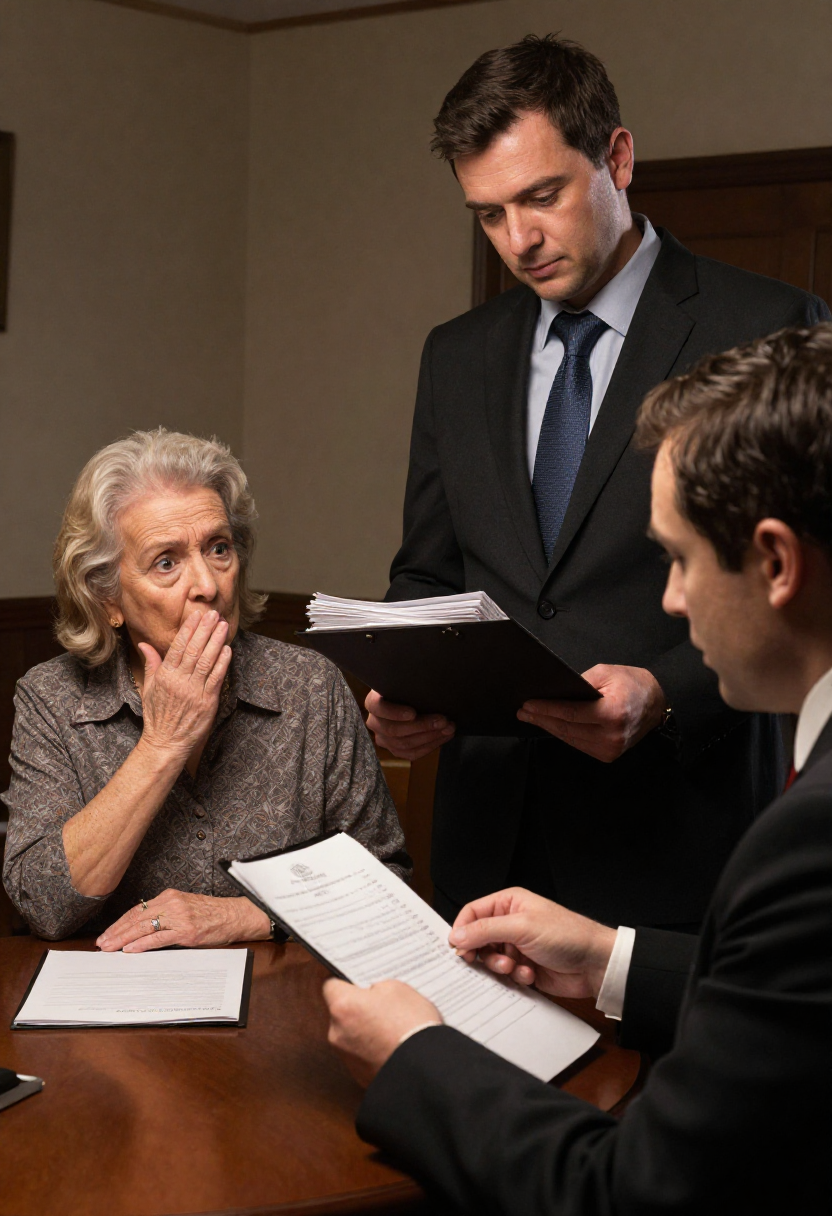
Mom’s attorney—a woman named Sandra Holt who had driven over to help explain the will revisions to all of us and was now sitting in the armchair by the window with the expression of someone who had witnessed this kind of scene before and had not enjoyed it then either—leaned forward when I placed the promissory note on the table. She picked it up. She read it carefully. Her expression did not change, which I recognized as the professional mask of a person whose expression wanted very much to change.
Mom had gone pale the moment she saw it.
“Where did you get that?” she asked, though I think she already knew.
“You signed it,” I said. “After your surgery. In the rehab facility. Gerald Okafor drafted it. There were two witnesses and a notary.” I said this quietly. I had promised myself I would say it quietly, without heat, the way you state a fact that doesn’t require the assistance of your emotions to be true.
“I was sick,” Mom said. “I was—I wasn’t myself.”
Sandra Holt looked up from the document. “Mrs. Marsh, at the time of signing, were you on any medications that would have impaired your judgment? Were you under duress?”
Mom opened her mouth and closed it again.
“I can answer that,” I said, “because I was there and I kept notes. She had been off pain medication for six days at the time of signing. She was alert and oriented. She asked two specific questions about the interest rate and the collateral valuation, which Gerald answered directly before she signed. She was not impaired. She was grateful, and she wanted to do the right thing, and she did it.”
Silence.
Patrick was looking at me with an expression I hadn’t seen from him since we were teenagers—something close to respect, though it was tangled up with unease. Marcus was very still. Brendan had stopped smiling.
“Danny,” Mom said, and her voice had gone small in a way that hurt me, genuinely hurt me, because I had not come here to hurt her. I had come here because for twelve years I had kept my word to a dead man while three other people had kept nothing, and I was no longer willing to be the person who absorbed the cost of everyone else’s indifference and called it love. “Danny, I didn’t think you’d—”
“I know you didn’t,” I said. “That’s what I need you to understand.”
Sandra Holt asked us to take a short break. She stepped outside to make a phone call. When she came back in, her expression had settled into something professionally grave.
She explained, carefully and without editorializing, that the promissory note appeared to be a valid legal document. That it created an obligation that would, in the event of Mom’s death, constitute a claim against the estate before any distribution to heirs. That the house listed as collateral was, in practical terms, the primary asset of the estate. That she would need to consult with a colleague to fully assess the implications, but that her initial read was that this document significantly complicated the equal-division plan.
Patrick said, “Can she contest it?”
Sandra said, “She can attempt to. It would require demonstrating incapacity or duress at the time of signing, and from what I’m hearing, that will be a difficult case to make.”
Brendan stood up and said he needed some air. He went to the kitchen. I heard him open the refrigerator, close it, open it again. The sound of a man recalibrating.
Marcus looked at me with an expression I couldn’t entirely read. Not anger, exactly. Something more complicated—the face of a man who has, for the first time, been asked to see himself clearly in a mirror he has spent years avoiding.
“How much did you actually spend?” he asked.
“Over twelve years? The documented amount is $201,400 and some change. That’s what’s on the note—I rounded down.”
Marcus nodded once. A slow, reluctant nod.
Mom was crying. Not dramatically—she wasn’t a dramatic woman—but steadily, the way it rains in October, without urgency, just the long gray fact of it. I sat down beside her and I took her hand, and I hated the fact that I had made her cry, and I also knew that if I walked out of this room without having said what needed to be said, I would be making a different kind of promise to a different dead version of myself—the version who kept his head down and wrote the checks and told himself that his reward was the private knowledge of his own goodness.