Part 1: The Funeral They Chose to Miss. When I called my parents from the hospital chapel, there was still ash on my hands from the crash site. My husband Ethan had been driving our children along Interstate 95 outside Richmond that morning when a truck driver fell asleep, crossed the median, and crushed their SUV before Ethan had any chance to avoid it.
Lily was seven. Noah was four. All three of them died.
I survived only because I had stayed behind that morning, and that fact kept cutting through everything else. I was alive because I had not been in the car with the people who mattered most to me.
I called my father first.
Music and laughter spilled through the phone before he answered. I could hear plates clinking in the background and my sister Melissa telling everyone to gather around while she prepared to blow out her birthday candles.
“Dad,” I whispered. “There’s been an accident.” “What happened?” he asked, sounding distracted. “Ethan is gone.” My throat tightened so badly that I almost could not finish. “Lily and Noah too.”
There was silence for several seconds. Then my mother took the phone. “What do you mean, gone?” “They died this morning,” I said. “The funeral is Friday. Please. I need you there.” My father came back on the line.
“Friday?” “Yes.”
He exhaled slowly, as though I had just created a scheduling problem. “Claire, Friday is your sister’s birthday dinner. That reservation has been booked for weeks.”
I had thought the accident had already removed every part of me that could still hurt. Somehow, his words found something the crash had left behind.
“Dad, my husband and my children are dead.”
“I understand,” he replied in the same calm tone he used to discuss ordinary things. “But today is your sister’s birthday. We can’t come.”
The call ended before I could beg again.
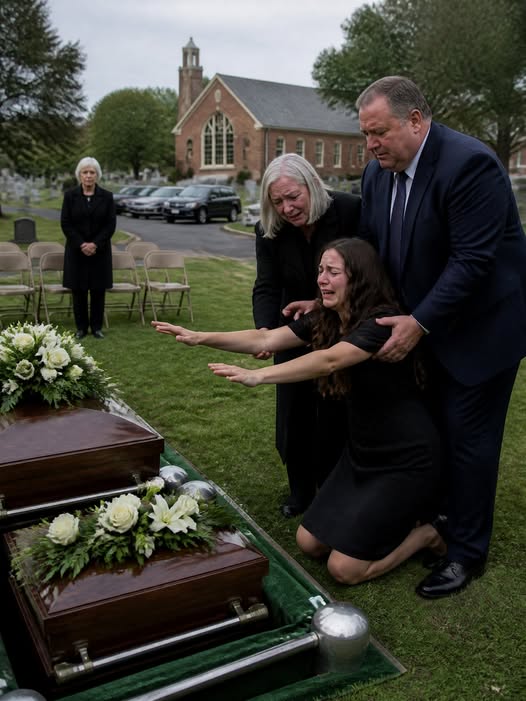
At the funeral, I stood between three caskets while Ethan’s parents held me upright. Margaret, his mother, cried so violently that she struggled to breathe, while his father kept one hand firmly on my shoulder as though he was afraid I might collapse beside them.
My side of the church was almost empty.
My parents did not come.
Melissa did not come.
None of my cousins came either.
Only Aunt Ruth appeared. She drove six hours after hearing about the accident from a neighbor because apparently no one in my immediate family had considered telling her.
Three days later, my mother finally texted me.
“Hope you’re managing. Melissa felt hurt that you didn’t call her on her birthday.”
I stared at the message until the words blurred.
Something inside me became quiet after that. It was not peace and it was not numbness. It was the feeling of something ending.
For the next six months, I stopped answering my family’s calls.
There were not many.
They sent cheerful holiday pictures to the family group chat, casual messages about birthdays and dinners, and eventually an invitation to Melissa’s engagement party as though nothing unusual had happened.
Meanwhile, I spent my days collecting death certificates, meeting insurance representatives, signing medical documents, and sorting through belongings that still smelled like the people I had lost.
Ethan’s coffee mug remained beside the sink for weeks.
Lily’s school jacket stayed hanging near the front door.
Noah’s sneakers were still turned sideways beneath the bench because he had never learned to put them away properly.
My family never asked what I needed.
They never asked if I was sleeping, whether I could still enter Lily’s bedroom, or what it felt like to sign three different sets of documents confirming that the people I loved were never coming home.
Six months after the crash, everything changed because of one headline.
It appeared on a cold Tuesday morning in January.
WIDOW OF I-95 CRASH VICTIMS AWARDED $18.7 MILLION IN SETTLEMENT; ANNOUNCES CHILD SAFETY FOUNDATION.
The money did not feel like a victory.
Eighteen million dollars could not give me one more breakfast with Ethan. It could not make Lily run down the hallway or bring Noah into the kitchen complaining that his cereal had gone soggy.
But the settlement could make their names matter beyond the accident.
I decided to create a child safety foundation in Ethan, Lily, and Noah’s names. The money would support families affected by serious crashes, fund road-safety programs, and help prevent other parents from standing where I had stood.
By noon, relatives who had barely contacted me for six months were calling.
My mother called three times.
Melissa sent six messages.
Cousins who had not attended the funeral suddenly wanted to know whether I was “doing okay.”
By evening, someone began pounding on my front door.
The glass rattled inside its frame.
“Claire, open this door!” my father shouted from the porch. “We need to discuss what you’ve done!”
I stood in the hallway and looked toward the legal papers on the table.
For six months, my family had treated my grief as something inconvenient.
Now that my grief was attached to eighteen million dollars, suddenly everyone wanted to talk.
Part 2: The Money They Thought Still Belonged to Them
The pounding on my front door shook the glass hard enough to make the frame tremble. I stood in the hallway without moving, holding the final legal document that confirmed what my family had only discovered after reading the settlement headline.
“Claire, open this door! We need to discuss what you’ve done!”
During the months after the funeral, I had changed everything. I rewrote my will, removed my parents and Melissa as emergency contacts, revoked every medical authorization that would have allowed them to speak for me, and removed their names from the family trust Ethan and I had once created for Lily and Noah.
No one who had chosen a birthday dinner over the funeral of my husband and children would ever control my money, make medical decisions for me, or inherit anything simply because we shared blood. I had also transferred the eighteen-point-seven-million-dollar settlement into the foundation so it could support child-safety programs, road-accident prevention, and families living through losses like mine.
My father struck the door again, but I still refused to unlock it. Through the glass, I could see anger in his face, yet he was not asking whether I had learned to sleep again, whether I could enter Lily’s room without collapsing, or whether I still expected Ethan to walk through the door.
“You had no right to cut us out without talking to us!”
For six months, no one had wanted to talk to me. Now that my decisions had finally cost them access to something, suddenly conversation had become urgent.
“Dad, what exactly do you think I did?”
“You changed the trust. You changed your will. Your mother found out from your aunt that none of us are listed anymore.”
“So?”
His expression tightened as though the answer should have been obvious. He said we were family, but the word sounded strange coming from the man who had once calmly explained why my sister’s birthday dinner mattered more than three funerals.
“So we’re your family.”
“You already decided what family meant.”
“That isn’t fair.”
“Neither was burying three people without my parents there.”
My father looked away and said they had made a mistake. I told him that forgetting an appointment was a mistake, while choosing a restaurant over three caskets was a decision.
Before he could answer, another car pulled into the driveway. My mother stepped out first, followed by Melissa, who walked toward the porch with the same expression she had worn throughout childhood whenever she believed I had taken something that belonged to her.
“Claire, seriously? You’re doing all of this because of my birthday?”
“No. I’m doing this because of what all of you chose.”
“You’ve spent six months acting like I killed them.”
Her words hit harder than I expected, but I did not raise my voice. Instead, I asked whether she knew what Lily had been wearing when we buried her, what Noah had been buried with, or which song Ethan’s brother had played during the service.
“Do you even know what Lily was wearing when we buried her?”
“What?”
“What color was her dress?”
Melissa could not answer. My mother looked down, and when I asked what Noah had been buried with, Melissa accused me of being cruel.
“Claire, this is sick.”
“You don’t know because you weren’t there.”
My father tried to say they had apologized, but I corrected him. They had explained their decision, and explanations were not the same thing as accepting responsibility.
“We’ve apologized.”
“No. You’ve explained. That is not the same thing.”
My mother finally spoke and said they had assumed Ethan’s parents would be with me. I stared at her because that was apparently their defense: I had not been completely alone while burying my husband and two children, so their absence had somehow been acceptable.
“We thought Ethan’s parents would be there with you.”
“They were.”
“You weren’t alone.”
Melissa then complained that I had never acknowledged her birthday afterward. I walked to the hallway table, opened the text my mother had sent three days after the funeral, and held the phone toward the glass.
“Do you remember this?”
I read the message aloud even though my mother’s face had already changed. It was the same sentence I had stared at until the words blurred six months earlier.
“Hope you’re managing. Melissa felt hurt that you didn’t call her on her birthday.”
My father said dragging up old messages was not helping, but six months did not feel old to me. I told them they were not standing on my porch to repair anything; they had come because a newspaper had printed a number beside my name.
“We are trying to repair this.”
“No. You came here after a newspaper printed a number.”
“That has nothing to do with it.”
“Then why today?”
No one answered immediately. Finally, my father admitted they had learned I transferred nearly all of the settlement into the foundation.
“We learned you transferred nearly everything into that foundation.”
That was the first honest sentence anyone had spoken since they arrived. I asked whether they had expected part of the money to remain available to them, but my father tried to avoid giving a direct answer.
“You were expecting something.”
“That is not what I said.”
“What were you expecting?”
Melissa answered before he could stop her. She said they had assumed I would keep some of the settlement within the family.
“We assumed you would keep some of it in the family.”
My father turned toward her, but she refused to take the words back. I asked how much of the money connected to Ethan, Lily, and Noah’s deaths they had already decided should belong to them.
“What? Everyone was thinking it.”
“How much?”
“That’s not the point.”
My mother insisted no one had said the money belonged to them. I asked why they were angry about being removed from my will if they had never expected to receive any of it.
“No one said it belonged to us.”
“Then why are you angry that you can’t inherit it?”
The silence that followed was answer enough. Eventually, my father admitted they had assumed there might be enough money to help Melissa with her wedding and possibly a house.
“We thought there might be enough to help Melissa with the wedding and maybe the house.”
For a moment, I forgot how to breathe. Melissa had skipped the funeral because of her birthday, and now she wanted money created by those deaths to help finance the next celebration in her life.
“Did you ask them?”
“Ask who?”
“Lily and Noah.”
Melissa’s face twisted and she accused me of cruelty. I told her cruelty was standing in a church deciding which photographs belonged beside three caskets while she ate birthday cake.
“That’s cruel.”
“No. Cruel was making me choose which photographs to place beside their caskets while you were eating birthday cake.”
My father struck the porch railing and told me enough was enough. For the first time in my life, I realized I was no longer afraid of disappointing him.
“Enough.”
“No.”
I told them they had come because they discovered there was nothing left for them to control. My father insisted the foundation money was technically still mine, but I told him it belonged to the work now.
“That foundation is still your money.”
“No. It belongs to the work now.”
“You gave away eighteen million dollars?”
“I gave it somewhere useful.”
Melissa stared at me as if I had confessed to destroying something valuable. She asked whether I had truly given almost all of it to strangers.
“You gave almost all of it to strangers?”
“No. I gave it to children who still have a chance to make it home.”
That finally silenced her. Then my father said something that cut through me more sharply than anything else he had said that day.
“Ethan would never have wanted you to abandon your own family.”
He had invoked my dead husband to argue for access to money created by his death. I stepped closer to the glass and asked him which family he meant.
“Which family?”
Ethan had been my family. Lily and Noah had been my family, while the three people standing outside my house had chosen to be somewhere else when I buried them.
“Ethan was my family. Lily was my family. Noah was my family.”
“The three of you stood somewhere else while I buried them.”
My mother began crying, and my father finally admitted they had made the wrong decision. He said they had believed Melissa needed them that day.
“We made the wrong decision.”
“Yes.”
“We thought Melissa needed us that day.”
“And I didn’t?”
No one answered. I looked at Melissa and noticed that beneath her guilt there was something else, something closer to fear.
“What happened that night?”
“What are you talking about?”
“Why was that birthday dinner so important that no one could leave?”
My mother immediately looked toward Melissa. That reaction told me there was more to the story, and when I demanded the truth, my sister finally admitted she had not wanted them to cancel the dinner.
“I didn’t want them to cancel.”
“What?”
“I had invited everyone. The restaurant required a deposit. My friends were coming.”
I asked whether that was really enough to justify what they had done, but Melissa shook her head. There had been another reason.
“That’s why?”
“No.”
“Mark was going to propose.”
I stared at her as she explained that she already knew about the proposal. She had expected the evening to become one of the most important nights of her life and believed my parents leaving would ruin everything.
“I knew he was doing it that night. I knew everyone was waiting. I told Mom and Dad that if they left, the whole evening would fall apart.”
My mother covered her mouth while I asked what Melissa had said to convince them. My father quietly tried to stop her, but my sister was already crying.
“What exactly did you tell them?”
“Claire…”
“What did you say?”
Melissa finally looked at me and admitted she had told them I would understand. Then, almost too quietly to hear, she revealed the sentence that had apparently made my husband and children easier to abandon.
“I said you would understand.”
“They were already dead.”
“My birthday only happens once a year.”
For six months, I had imagined there must have been some complicated explanation behind their decision. Instead, there had only been a dinner reservation, a planned proposal, and the belief that grief could wait because the dead were not going anywhere.
I raised the legal document in my hand and looked directly at my father through the glass. Then I asked the question none of them could hide from anymore.
“You wanted to know why I removed you from everything?”
“If that headline had said I was broke instead of worth eighteen million dollars, would you be standing on my porch right now?”
Part 3: What They Really Lost
For several seconds after I asked the question, no one answered. My father stood on the porch with his mouth slightly open, while my mother stared down at the wet concrete and Melissa wiped at her face without looking at me.
“If that headline had said I was broke instead of worth eighteen million dollars, would you be standing on my porch right now?”
My father finally said the money had nothing to do with why they came. He claimed they were worried about me, worried about the foundation, and shocked that I had made major legal decisions without discussing them first.
“The money has nothing to do with this.”
“Then why didn’t you come six months ago?”
He had no answer to that. The silence lasted long enough that even Melissa stopped crying and looked toward him.
Before anyone could speak again, another car pulled into the driveway. Aunt Ruth stepped out carrying a folder beneath one arm and walked toward the porch with the expression of someone who had already heard enough excuses for one lifetime.
“What is she doing here?” my father asked.
“I asked her to come.”
Ruth stopped beside my parents and looked directly at her brother. She reminded him that she had driven six hours to the funeral after hearing about the crash from a neighbor, while he had stayed at a restaurant celebrating Melissa.
“You didn’t miss a funeral. You chose where you wanted to be.”
My father immediately said the situation had been complicated, but Ruth refused to let him rewrite it. She had stood in the church herself, had watched Ethan’s parents support me between three caskets, and had seen the empty pews where my family should have been sitting.
“We thought Claire had people around her.”
“She had people around her because strangers and in-laws showed up after her own parents decided they were busy.”
Melissa looked toward the driveway and muttered that everyone was making the birthday sound worse than it had been. Ruth turned toward her and asked whether she had ever visited Lily, Noah, or Ethan’s graves.
“Have you ever been to the cemetery?”
Melissa did not answer.
“That is what I thought.”
I opened the door just enough to step onto the porch while keeping the screen locked between us. In my hand was the document confirming that the settlement money had already been transferred into an irrevocable charitable trust connected to the foundation.
I told them the eighteen-point-seven million dollars was no longer sitting in an account waiting for me to divide it among relatives. The foundation would use it for child passenger safety, support for families affected by catastrophic crashes, and programs designed to reduce preventable deaths on the road.
Melissa stared at me as though she still expected me to say I had kept a large portion aside.
“You really gave almost all of it away?”
“No. I put it somewhere it could still do something good.”
My father’s face hardened. He said Ethan would never have wanted me to hand millions of dollars to strangers while my own family could use the help.
“Ethan would have wanted you to take care of your family.”
“Which family?”
He stopped speaking.
I told him Ethan had been my family, along with Lily and Noah. The money existed only because they were dead, and I would not allow anyone to treat their deaths like an inheritance opportunity.
My mother began crying harder and said they had made one terrible mistake. I reminded her that the mistake had continued for six months through every unanswered question, every cheerful family photo, every invitation sent as though my life had not been destroyed.
“We didn’t know what to say.”
“You could have started with their names.”
No one responded.
Ruth opened the folder she had brought and handed me several copies of the foundation documents. She had agreed to serve as one of the independent trustees, which meant even I could not simply withdraw the money later and hand it to relatives if guilt became stronger than judgment.
Melissa’s expression changed when she understood what that meant.
“So there’s really no way to undo it?”
“That’s the point.”
My father accused me of making the decision while grieving and said I might regret permanently removing the family from my estate. I told him grief had not made the decision for me; six months of clarity had.
“You think this is punishment.”
“Isn’t it?”
“No. Punishment would be taking something that belonged to you. None of this ever did.”
The anger drained from his face, leaving something older and more tired beneath it. For the first time that evening, he looked less offended by what he had lost and more aware that he had no argument left.
Melissa suddenly began crying again and admitted she had already spoken to a realtor. She and Mark had assumed that if I received millions from the settlement, I might help them with a down payment after the wedding.
“We weren’t trying to steal from you.”
“You were making plans with money tied to three people you couldn’t even make time to bury.”
She looked away.
My mother asked whether there was anything they could do to repair the relationship. I told her there was, but it would not begin with lawyers, money, apologies made on my porch, or demands to be added back into documents.
“If you want to start somewhere, go visit them.”
“Claire…”
“Learn where they are buried. Learn what Lily wore. Learn what Noah took with him. Learn what song played for Ethan. Then decide whether you came back because you missed me or because you missed what you thought I could give you.”
No one argued after that. My father looked toward the car, Melissa covered her face, and my mother stood quietly beside Ruth while the rain gathered along the edge of the porch roof.
I told them the will would remain unchanged. None of them would regain medical authority, control of the trust, or an automatic right to inherit anything from me.
“That doesn’t mean I hate you.”
My mother looked up.
“Then what does it mean?”
“It means blood is not a substitute for showing up.”
They left without another argument. Ruth stayed behind, and once the driveway was empty, she came inside and sat with me at the kitchen table while I finally allowed myself to cry.
Several weeks later, the Ethan, Lily & Noah Road Safety Foundation held its first public event. Ethan’s parents sat in the front row beside Ruth, and behind me was a large photograph of Ethan holding Noah on his shoulders while Lily laughed beside them.
I spoke about what the settlement could never replace and what I hoped the foundation might prevent. I did not mention my parents or Melissa because for once I wanted the day to belong entirely to the people whose names were on the banner.
After the event, I drove alone to the cemetery with three bouquets. I placed one beside Ethan, one beside Lily, and one beside Noah before sitting on the cold grass between them.
My phone vibrated in my coat pocket.
The message was from Melissa.
“I went to see them today. I’m sorry it took me six months to learn where they were buried.”
I read the message twice but did not answer immediately. An apology could begin something, but it could not erase the distance between the restaurant where they had celebrated and the cemetery where I had stood alone.
I placed the phone beside Lily’s headstone and rested my hand against the cold stone. Six months earlier, my family had chosen a birthday over three funerals, and now they finally understood that the eighteen million dollars had never been the inheritance they lost.