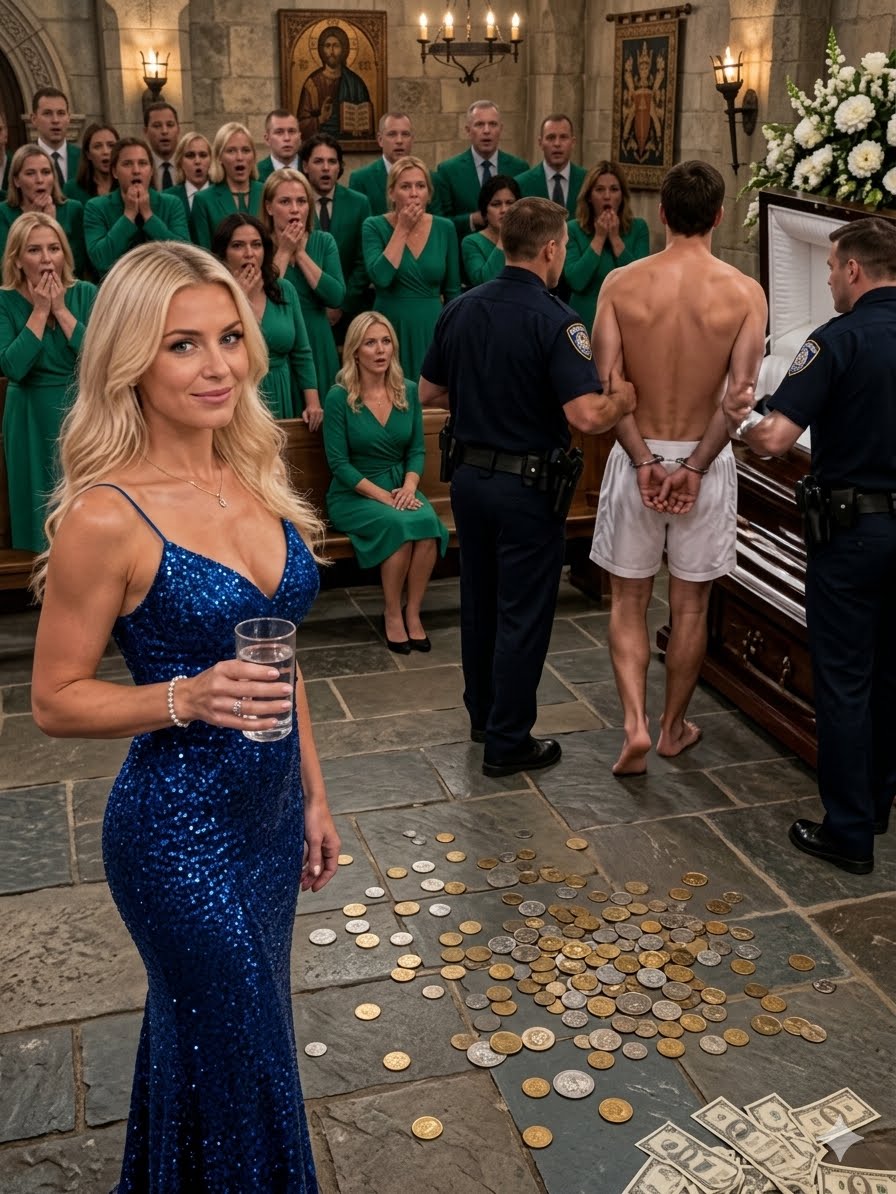
PART 1: THE DAUGHTER THEY PLANNED TO ERASE
At my father’s funeral, my brother announced in front of nearly forty mourners that our family home would be sold immediately. He presented the decision as a practical necessity after Dad’s death, but I already knew what he was desperately trying to hide: Marcus owed $340,000 in gambling debts.
I sat several rows from the mahogany casket and watched my brother perform grief with the polished confidence he had carried his entire life. Minutes earlier, he had delivered a sentimental eulogy filled with fishing trips and father-son lessons, some of them so polished that they barely sounded like memories I recognized.
Instead of returning to his seat, Marcus remained behind the podium and gripped its edges. His voice became solemn as he addressed the relatives and friends gathered inside the chapel.
“As many of you know, Dad’s passing has left us with some heavy logistical burdens. After discussing it with Mom, we’ve decided the best way to honor his memory and ensure Mom is taken care of is to sell the house on Maple Street immediately. To cover… family obligations.”
Whispers spread through the room because everyone understood that something important had just been announced. What most of them did not know was that those “family obligations” were really Marcus’s enormous gambling debt, which my mother, Eleanor, had been desperately trying to conceal.
Then my mother rose from her seat and looked directly at me rather than at my father’s casket. Her expression remained remarkably calm as she publicly explained what would happen to me once the house was sold.
“Your father would understand. Marcus needs the support. Briana is independent; she has her own life in the city. Your sister can find somewhere else to live.”
The chapel became painfully quiet as dozens of people turned toward me. Some looked embarrassed on my behalf while others simply watched as though there were nothing unusual about my mother publicly removing me from the family before my father had even been buried.
I said nothing because being treated as less important than Marcus was hardly new. In the Henderson family, my brother had always been considered an investment in the future, while I had repeatedly been reminded that daughters eventually left and belonged somewhere else.
When I was eighteen, I had placed acceptance letters from Penn State, Temple, and Drexel across our dining room table after graduating with a 3.9 GPA. I had expected my parents to be proud, but my mother barely glanced at the Temple letter before setting it back down.
“Why would we spend that kind of money on you? You’re a girl. You’ll get married. You’ll be a guest in someone else’s house. Marcus, however, needs an education that reflects his potential.”
I looked toward my father and waited for him to defend me, but he stared silently into his coffee. His refusal to speak hurt almost as much as my mother’s words, and for years afterward, I interpreted that silence as agreement.
I eventually built my life without their help, working two jobs while taking out loans that made me nervous every time I checked the balance. I earned my CPA license, established a career in Philadelphia, and became the independent daughter my mother later used as an excuse whenever Marcus needed something more than I did.
For two years, I barely spoke to my family, not because I wanted to punish them, but because being around them constantly reminded me of the place they had assigned me. Eventually, I allowed occasional phone calls and holiday visits back into my life, although I never truly returned to the family dynamic I had escaped.
Then, at two in the morning, I received the call telling me Dad had collapsed. By the time I reached Jefferson Memorial, Marcus’s Mercedes was already outside, and when I entered my father’s hospital room, he was gone.
Our final conversation had happened three months earlier and lasted barely ninety seconds. Dad asked whether I was doing all right, I told him I was, and neither of us found the courage to say anything meaningful before the conversation ended.
After his death, I kept returning to all the questions I had never asked him. I wondered why he had remained silent while Mom treated me like a temporary member of the family and whether he had truly believed Marcus deserved everything while I deserved nothing.
The morning after Dad died, I returned to the Maple Street house expecting to find a grieving family. Instead, Marcus already seemed to be preparing the property for liquidation, with designer luggage, expensive golf clubs, and luxury purchases scattered throughout a house he apparently considered his.
Marcus had been unemployed for eight months, yet he continued living as though money would always appear whenever he needed it. When I entered my childhood bedroom, I discovered that my bed had disappeared and the room had been filled with his luggage, electronics, and expensive belongings.
I focused on arranging Dad’s funeral because someone had to handle the actual work. I contacted the funeral home, prepared the obituary, coordinated the programs, and dealt with practical details while Marcus concentrated on appearing appropriately devastated whenever relatives or neighbors visited.
Behind closed doors, however, I repeatedly heard conversations about selling the house as quickly as possible. One evening, I passed the kitchen and heard Marcus speaking urgently on the phone.
“I know, I know! Just give me until after this week. I’ll have the money. The house is as good as sold.”
He noticed me and immediately ended the call before casually claiming it had been related to work. Marcus had not worked in eight months, so I knew better than to believe him.
“Work stuff.”
I chose not to confront him and went downstairs to Dad’s basement office instead. Years of accounting had taught me that paperwork often revealed more than arguments ever could, and sorting through his files also gave me something useful to do while I tried to process his death.
One cabinet contained years of tax returns, while another held a folder labeled IMPORTANT DOCUMENTS. Inside were family records, old photographs, my birth certificate, and a document bearing the unfamiliar name Farwell Family Holdings LLC.
The paperwork was dated 2009, and as I read more carefully, I discovered my own name inside it. When I reached the final page, I found a signature that was unmistakably mine.
The memory returned slowly. Shortly after I finished college, Dad had called me home, placed several papers in front of me, and described them as routine administrative documents.
“Administrative business stuff. Sign here.”
I had trusted him enough to sign without asking questions, and nearly fifteen years later, that forgotten signature was sitting inside a folder he had deliberately preserved. I slipped the document into my purse, but before I could leave the basement, my mother called down from the top of the stairs.
“Briana? What are you doing in your father’s files?”
I told her I was looking for insurance paperwork and left it at that. The following morning, however, I casually mentioned Farwell Family Holdings LLC and noticed how quickly her expression changed before she dismissed the subject.
“That business dissolved years ago. Don’t waste your time digging into old paperwork. We have enough to deal with.”
Her answer should have reassured me, but instead it convinced me that keeping the document was the right decision. Something about the speed with which she wanted me to forget it felt wrong.
Three days after the funeral, Marcus organized what he called a family meeting and invited fifteen relatives to the Maple Street house. He placed a document titled Disclaimer of Interest in Estate Property in front of me, while Mom calmly explained what they expected me to do.
“It’s simple. You sign this and formally give up any claim to the house. It keeps everything clean for the buyer. Marcus needs this resolved fast.”
I looked at the document and immediately noticed the contradiction in their demand. If I truly had no legal interest in the property, there should have been no reason for them to need my signature.
“If I don’t have any rights to it, why do you need my signature?”
Marcus’s expression tightened because he clearly had not expected me to question the paperwork. Instead of answering directly, he attempted to pressure me into signing.
“Because we want this resolved without some estranged daughter showing up six months from now claiming she deserves a cut. You have twenty-four hours.”
I refused to sign and contacted Gerald Whitmore that same night. He had served as my father’s attorney for decades, and when I entered his downtown office the following day, I placed the old LLC document on his desk and asked him to explain what I had found.
“I found this in Dad’s files. I don’t know what it means.”
Gerald studied the document carefully, and recognition immediately crossed his face. When he finally looked up, his expression carried something I had not expected to see: relief.
“The house on Maple Street is not part of your father’s estate.”
I stared at him, certain I had misunderstood.
“What?”
Gerald explained that in 2009, my father had transferred the Maple Street property into Farwell Family Holdings LLC. The house therefore belonged to the company rather than to Dad personally, which meant Marcus and my mother could not simply sell it as part of the estate.
I asked the only question that mattered.
“Then who owns the company?”
Gerald looked directly at me before answering.
“You do, Briana. You are the sole member of Farwell Family Holdings LLC. You have been for fifteen years.”
For most of my life, my mother had insisted that daughters were only guests who eventually left the family home. Marcus now believed Dad’s death had finally given him the right to sell that home to rescue himself from the consequences of his gambling.
But fifteen years earlier, while I believed my father was silently choosing Marcus over me, he had quietly placed the Maple Street house somewhere my brother could never reach it. He had transferred control of it to me.
Before I could fully process what Gerald had revealed, he opened a drawer and removed a sealed envelope with my name written across the front in my father’s handwriting. He placed it carefully on the desk between us.
“He wrote this three months ago. Right after the diagnosis.”
I stared at the envelope, realizing that the ownership of the house might not be the only truth my father had hidden from us. Whatever he had written before his death could finally explain why he had protected the property for fifteen years and why he had chosen me to control it.
PART 2: THE SECRET MY FATHER LEFT BEHIND
I did not open Dad’s letter until I returned to my studio apartment. I sat on the edge of my bed and stared at my name written across the envelope, knowing that whatever was inside might finally answer questions I had carried for most of my life.
Dad’s handwriting was unsteady, but his message was painfully clear. He admitted that he knew Mom and Marcus had treated me unfairly, and he acknowledged that he had failed me by remaining silent when I needed him to defend me.
He wrote that he had never been brave enough to say those things aloud while he was alive. Instead, he had tried to protect something important for me in the only way he believed he could, because I was the one person he trusted to preserve what truly mattered.
I expected learning the truth to make me feel vindicated, but it did not. Mostly, I felt an overwhelming sadness for a father who had apparently loved me enough to protect me financially, yet had never learned how to protect me emotionally while he was alive.
Friday morning brought the formal reading of Dad’s will. Marcus arrived wearing an expensive Tom Ford suit and greeted Gerald Whitmore with the confidence of someone who still believed the meeting was nothing more than a formality, while Mom sat near the front dressed in black Chanel and accepted condolences from the relatives gathered around her.
Marcus leaned toward me shortly after I sat down.
“Brought a pen?”
I ignored him. He clearly assumed I would eventually sign away whatever rights he believed might interfere with selling the Maple Street house.
Gerald began with the straightforward provisions of Dad’s estate. Marcus received Dad’s vehicle, while Mom inherited savings accounts totaling approximately $47,000, and the atmosphere in the room gradually relaxed because everyone assumed the important decisions were unfolding exactly as expected.
Then Aunt Dorothy asked the question Marcus had been waiting to hear.
“And the house? What about Maple Street?”
Gerald explained that there was an important legal distinction involving the property. The Maple Street house was not part of Richard Henderson’s estate because it had belonged to Farwell Family Holdings LLC since 2009.
Marcus immediately straightened in his chair.
“What the hell is that?”
Gerald remained calm as he explained that Dad had legally formed the company fifteen years earlier. The property transfer had been properly recorded, and the necessary taxes and compliance fees had been maintained every year since then.
Marcus’s confidence weakened, but he still believed the answer would eventually benefit him.
“Fine. Then who owns the company? Mom, right?”
Gerald looked toward me, and everyone else followed his gaze. He then explained that the LLC’s operating agreement identified only one member with complete authority over the company and every asset it owned.
“That person is Briana Henderson.”
For several seconds, nobody spoke. Then Marcus jumped to his feet and immediately accused me of manipulating Dad while he was dying.
“She manipulated him! She got to him when he was sick!”
Gerald corrected him without hesitation. The documents had been executed in 2009, when Dad was fifty-three years old and in excellent health, and the agreement had been witnessed by his accountant.
“It is completely binding.”
Marcus grabbed the paperwork and began scanning it, but there was nothing on those pages that could give him the answer he wanted. The company was legitimate, the transfer had been completed years earlier, and Dad’s death had not changed my ownership.
“This is fraud! This can’t be real!”
Gerald looked directly at him.
“It belongs to your sister, Marcus.”
Mom had remained unusually quiet throughout the exchange. When she finally spoke, the anger I expected was replaced by disbelief because she had apparently known nothing about Dad’s decision.
“He never told me. Twenty-five years, and he never told me.”
Gerald explained that Dad had specifically instructed him to keep the arrangement confidential. He had honored that request for all those years, which meant neither Mom nor Marcus had ever possessed the authority they assumed they had over the house.
For the first time in my life, my mother looked at me differently. I was no longer the daughter she could dismiss as a temporary guest, because I was now the person legally controlling the property she and Marcus had planned to sell.
Her voice began to crack.
“Briana, we need that money. Marcus owes people… dangerous people.”
The room immediately filled with murmurs as relatives began looking toward Marcus. Aunt Dorothy appeared stunned, while Uncle Frank stared at my brother as though he were finally seeing the person behind the expensive clothes and practiced confidence.
I already knew the number, but I wanted Marcus to hear it spoken in front of everyone.
“How much?”
I looked directly at him.
“Three hundred and forty thousand. Is that right, Marcus?”
Marcus did not answer. The panic on his face was enough, and Mom finally began admitting how long she had been protecting him.
“I’ve been covering for him for years. I gave him everything I had. The house was the last resort. Your father’s barely been gone two weeks, and now you’re taking our home.”
Her accusation sounded almost familiar because even after everything had been exposed, she still found a way to make Marcus’s choices my responsibility. I stood and reminded her that I had taken nothing from anyone.
“I’m not taking anything. I’m accepting what Dad left me. The difference is that he made sure this part couldn’t be taken.”
Then I looked at Marcus.
“He saw what was coming. He was right.”
I had every legal right to remove Mom from the property, but I had no interest in making her homeless simply because she had spent years treating me as though I did not belong there. I told her she could remain in the Maple Street house under a formal lease costing one dollar per month, renewable each year.
There was only one condition.
“But Marcus does not live there. That is final.”
Mom immediately protested.
“You can’t—”
I stopped her because, for once, there was no question about who had the authority to make the decision.
“I can. The house belongs to my LLC. Marcus needs help. Real help. If he enters a legitimate ninety-day treatment program, I’ll support that. But I will not fund his debt.”
I picked up my bag and made it clear that I had never asked Dad to create the LLC or give me control of the house. But now that I understood why he had done it, I was not going to apologize for respecting the decision he had made fifteen years earlier.
“I didn’t ask for this. But I’m not apologizing for honoring what Dad chose to leave me.”
As I left the room, Grandma followed me into the hallway and took both of my hands. She admitted that she had known about the LLC because Dad had spoken to her three months before his death and asked whether protecting the house for me was the right thing to do.
I could not understand why she had remained silent while Mom and Marcus tried to force me into surrendering my supposed claim.
“Why didn’t you say anything?”
Grandma answered softly.
“Because I wanted to see if your mother would do the right thing on her own. She didn’t. But you did. You stood your ground without destroying anyone. That matters.”
Before I reached my car, Marcus caught up with me in the parking lot. His expensive suit was wrinkled now, and for the first time since I had returned home, he no longer looked like the confident older brother who believed somebody else would always clean up whatever he destroyed.
He finally admitted what had happened.
“I kept thinking I could win it back. One more bet, and then it would all be fixed. But it never got fixed.”
I did not offer to pay his debt because rescuing him again would only continue the same cycle that had brought us there. I offered him something different: a path that required him to take responsibility for himself.
“Ninety days, Marcus. A real program. If you commit, then we can talk about what comes next.”
Marcus lowered his eyes and nodded. Whether he would actually follow through was no longer something I could control.
Mom was waiting beside my car when I turned around. Without the relatives surrounding her and Marcus standing beside her, she suddenly looked older and more fragile than I remembered.
She asked me one final question.
“Did he leave anything for me? Any message?”
I looked at the woman who had spent most of my life telling me that daughters were temporary while sons were the people a family invested in. For once, there was no paperwork, inheritance, or argument standing between us, only the truth about the man we had both buried.
And I knew my answer was going to hurt her.
PART 3: THE HOUSE I WAS NEVER JUST A GUEST IN
I could have softened the truth for Mom, but after everything that had happened, I no longer wanted to protect her from consequences created by years of favoritism. She had spent most of my life reminding me that daughters were temporary, so when she asked whether Dad had left her any personal message, I answered honestly.
“No. He didn’t mention you.”
Mom flinched as though the words had physically struck her. For thirty-five years, she had built her identity around being Dad’s wife and Marcus’s protector, yet the letter he wrote before dying had been addressed only to me.
“Thirty-five years. I gave him thirty-five years.”
I looked at her and tried to explain that Dad’s decision had not been about loving one person more than another. He had protected the house because he believed Mom would eventually sacrifice it to rescue Marcus, and the events after his death had proven him right.
“He left the house to me not because he loved me more, but because he knew you and Marcus would destroy it. And he was right.”
Mom stood quietly for several seconds before finally admitting something I had heard indirectly throughout my childhood. Her preference for Marcus had never been accidental; it came from beliefs she had inherited and never bothered to question.
“I raised him the way I was raised. Sons are investments. Daughters are temporary.”
I thought about Grandma, who had apparently understood what Mom never had.
“Grandma seems to have learned something different.”
Mom gave a bitter laugh.
“She always liked you better.”
I shook my head.
“Maybe she just saw me clearly.”
I left Mom standing in the parking lot and drove back toward Philadelphia. For the first time, I did not feel obligated to repair her disappointment or Marcus’s crisis simply because we shared the same last name.
Two weeks later, Marcus checked himself into a legitimate treatment program in New Jersey. I did not visit him immediately, but I sent him a short letter because supporting his recovery was different from rescuing him from the consequences of gambling.
I’m rooting for you.
Ten days later, his reply arrived.
Thank you.
That small exchange meant more to me than any apology Marcus could have offered while panicking over his debt. For the first time, he was attempting to solve a problem without demanding that someone else sacrifice everything to make it disappear.
In December, I began spending weekends at the Maple Street house again while keeping my Philadelphia apartment for work. The first thing I reclaimed was my childhood bedroom, which Marcus had turned into storage for designer luggage, unopened electronics, and expensive purchases he could never truly afford.
I moved everything that belonged to him into the garage and repainted the room sage green. It was the color I had always wanted as a teenager but had never felt entitled to choose.
Mom remained in the house under the one-dollar annual lease I had offered. We did not suddenly become close, but the constant conflict between us gradually disappeared because she could no longer use ownership of the house as a weapon against me.
It was not forgiveness, and it was not exactly peace. But for the first time, our relationship existed without me constantly trying to prove that I deserved a place in the family.
Grandma began joining us for dinner on Sunday evenings. She told me stories about my grandfather and repeatedly pointed out that I had inherited far more of his stubbornness than I had ever realized.
I also began learning small things about Dad that I somehow missed while he was alive. An old neighbor told me that yellow roses had always been his favorite, so I started keeping a fresh bouquet beside his photograph on the mantel.
One evening, I sat alone on the porch holding Dad’s old mug filled with ginger tea. His letter was folded inside my pocket, the paper already soft from how many times I had read it.
One sentence remained with me more than anything else he wrote.
You’re the only one I trust with what matters.
For most of my life, I had interpreted Dad’s silence as proof that he did not care enough to defend me. I had watched him remain quiet while Mom favored Marcus and assumed that his refusal to speak meant he agreed with every decision she made.
The truth was more complicated. Dad had grown up believing that feelings were weaknesses and that actions carried more meaning than words, so instead of telling me directly that he believed in me, he had spent fifteen years maintaining an LLC, paying its fees, protecting its paperwork, and keeping the Maple Street house beyond Marcus’s reach.
I still wished he had spoken.
I wished he had defended me at eighteen when Mom dismissed my education. I wished he had told me I belonged in that house instead of allowing me to spend years thinking of myself as someone temporarily passing through it.
But I could no longer say he had done nothing.
Dad had protected the one asset he believed would survive our family’s worst instincts, and when the time came, he had placed control of it in my hands.
I used to believe strength meant confronting people loudly enough that they could no longer ignore you. What Dad left behind taught me something different: strength could also mean quietly building something secure, protecting it for years, and trusting that one day the truth would stand on its own.
My father never told me directly that I was the daughter he trusted.
He never said I deserved the house.
He never apologized aloud for all those years of silence.
But he wrote my name onto every document that mattered.
For fifteen years, while Marcus believed the family future belonged to him and Mom treated me like a guest, Dad quietly made sure there was one place they could never erase me from.
The house on Maple Street had never needed me to fight for a place inside it.
Legally, it had been mine all along.