At Easter Dinner, My Aunt Gave Every Kid $500—Except Mine, Then She Learned What “Family” Really Meant
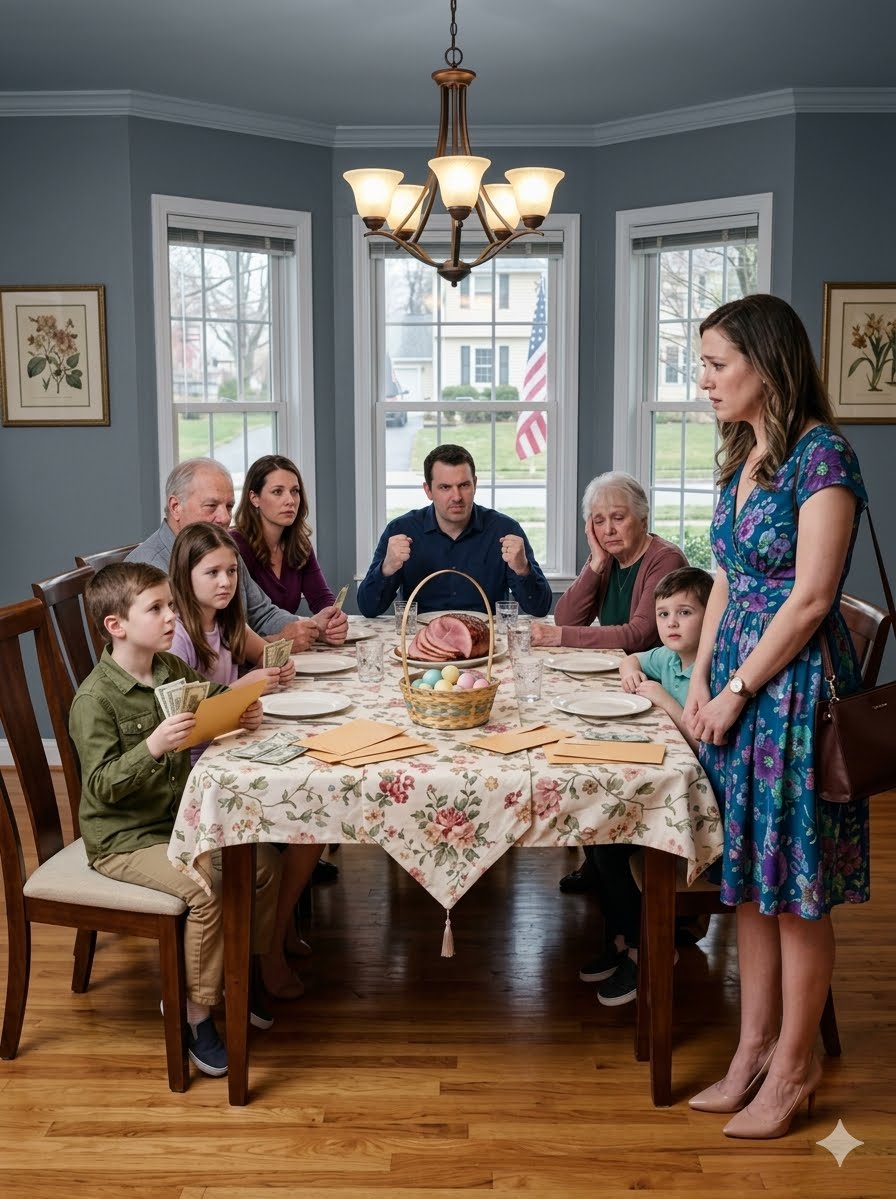
Easter dinner at my parents’ house always smelled like brown sugar glaze, coffee, and my mother’s lemon candles burning too close to the window. Sunlight streamed across the dining room table, soft and bright, catching the floral linen, the glass pitcher of sweet tea, and the pastel eggs my kids had helped hide outside in the yard.
From the outside, it looked like family.
My wife, Marianne, had been there since midmorning, sleeves rolled up, rinsing serving spoons, refilling paper cups for the kids, and carrying coffee to my father because he still moved carefully after surgery. She never asked anyone to notice. She simply showed up, the way she had shown up for eight years.
She had sat with my grandmother through difficult nights. She had arranged birthdays nobody else remembered. She had driven my mother to appointments when everyone else was too busy. She had made this family easier to love.
But to my Aunt Carol, Marianne was still only “the woman Ryan married.”
Carol arrived in her pastel floral dress with a designer purse tucked beneath one arm and that polished smile she used whenever she wanted the room to belong to her. She was the aunt everyone walked carefully around because she managed the family trust and the commercial properties my grandfather had left behind.
Money makes some people generous. It makes other people audition for royalty.
After lunch, when the plates had been scraped clean and the kids were still flushed from running around the yard, Carol stood by the table and tapped her nails against the clasp of her purse.
“Alright, kids,” she said brightly. “Come here. I’ve got something special for you.”
Lucas came first. Then Emily, Noah, and Sophie. Carol handed each child a thick envelope, saying their names like she was handing out awards.
“For Lucas.”
“For Emily.”
“For Noah.”
“For Sophie.”
The envelopes were torn open quickly.
“Five hundred dollars?!” one cousin shouted.
The adults laughed in that surprised way people do when a gift is large enough to change the whole mood of a room. Phones came out. Someone said, “Wow, Carol.” Someone else clapped.
Five hundred dollars was not casual Easter money.
It was a statement.
My son Ethan stood just behind the others, tugging once at the hem of his shirt. He was ten, old enough to pretend he was not excited. Lily, seven, leaned against my leg with her small hand wrapped around two of my fingers, watching Carol’s purse with her whole face lit up.
They waited.
Carol closed the purse.
The room changed so quietly it almost hurt.
Lily tugged my sleeve.
“Daddy… did she forget us?”
Forks stopped moving. My father froze with his coffee cup halfway to his mouth. My mother stared at the table runner like the flowers stitched into it had suddenly become very important. Across from me, Marianne’s hands went still in her lap.
I looked at Carol, waiting for the fake laugh, the little reach back into her purse, the “Oh, sweetheart, of course I didn’t forget.”
Carol smoothed the front of her dress instead.
“Carol,” my mother whispered. “You skipped Ethan and Lily.”
Carol waved one hand, light and careless.
“I didn’t skip anyone. This money comes from the family trust earnings. I gave envelopes to the family children.”
Nobody moved.
“What is that supposed to mean?” I asked.
Carol looked at me, then at Marianne.
“It means exactly what it means, Ryan. The trust is for blood relatives. Marianne isn’t family. She’s just someone you married. Why should her children benefit from our family’s hard work?”
“Our children are blood relatives,” I said, my hand tightening on the edge of the table. “They are my son and daughter.”
Carol’s smile sharpened.
“Adopted or not, it’s different, and you know it. If Marianne wants her kids to have five hundred dollars, she can work an extra shift.”
The gasp that moved around the room did not protect my kids. It only proved everyone had heard her.
Marianne did not yell. She did not throw her napkin. She looked down, shoulders tight, trying to make herself small enough to absorb the cruelty before it reached Ethan and Lily.
But I couldn’t let her absorb it.
Not this time.
I stood.
“Then don’t call us family anymore.”
Carol blinked.
“What?”
“You heard me.”
I reached for Ethan’s hand. Then Lily’s.
“Come on.”
Ethan looked confused. Lily looked embarrassed. Marianne immediately stood and followed us.
My mother finally spoke.
“Ryan, please. Don’t ruin Easter.”
I turned around.
“Mom, she already did. The difference is, I’m not going to teach my children to sit quietly while someone humiliates them just because that person has money.”
Carol scoffed.
“Oh, please. You’re being dramatic over five hundred dollars.”
“It has nothing to do with the money.”
I looked at Ethan and Lily.
“It has everything to do with what she wanted them to believe about themselves.”
We walked out.
No one stopped us.
Not my father.
Not my mother.
Not one of the relatives who had spent years calling Marianne “family” when they needed help.
We drove home in silence.
Halfway there, Lily finally whispered, “Daddy, am I not family?”
My chest tightened.
I pulled the car over.
I turned around and looked at both children.
“You are my family. You are Mommy’s family. You are the most important part of our family. Nobody gets to change that with an envelope of money.”
Ethan stared out the window.
“Did Aunt Carol hate Mom?”
“No,” I said carefully. “I think she believes money gives her the right to decide who matters. That’s not the same thing as hate.”
Marianne reached across the console and took my hand.
“You didn’t have to do that,” she whispered.
“Yes, I did.”
She shook her head.
“I mean… thank you.”
That evening, after the kids went to bed, I opened my laptop.
There was something Carol didn’t know.
Something almost nobody in the family knew.
Three months earlier, my grandfather’s attorney had contacted me.
Grandpa had died two years before, leaving behind several properties and a trust. Carol had always acted like she controlled everything because she had been appointed trustee.
But she wasn’t the only person named in Grandpa’s estate documents.
I had ignored most of the legal paperwork because I trusted my family.
That night, I finally opened the documents.
And there it was.
A clause I had never noticed.
The trust was not restricted to “blood relatives.”
It specifically stated that distributions could be made to the descendants and legally adopted children of the family, with the trustee required to act without discrimination between biological and adopted descendants.
There was more.
A second clause required the trustee to provide annual accounting records to all beneficiaries.
I stared at the screen.
Then I remembered something Carol had said earlier.
“The trust is for blood relatives.”
She had either misunderstood the trust…
or lied.
I called Grandpa’s attorney the next morning.
He listened quietly.
When I finished, he said, “Ryan, I think you need to come into my office.”
Two days later, I sat across from him with a thick folder on the desk.
He showed me years of financial records.
Money had been withdrawn from the trust for “administrative expenses.”
Large amounts.
Far larger than legitimate expenses.
There were payments to companies connected to Carol.
There were property management fees paid to a company owned by her son.
And there were several unexplained distributions.
The attorney looked at me.
“Your grandfather was very specific about protecting the trust from conflicts of interest.”
I swallowed.
“What happens now?”
“That depends on what you want to do.”
I thought about Lily asking whether she was family.
I thought about Ethan staring at the floor.
I thought about Marianne spending eight years helping everyone who had just sat silently while her children were humiliated.
“I want the truth,” I said.
The attorney helped me request a formal accounting.
Carol found out.
That was when my phone started ringing.
Once.
Twice.
Then again.
I ignored her.
Finally, twenty-three minutes after I sent the request, she called for the seventh time.
I answered.
“What do you want?”
Her voice was completely different now.
“Ryan, listen to me. You don’t understand what’s happening.”
“I understand perfectly.”
“No, you don’t. We need to talk.”
“We already talked. You told me Marianne wasn’t family.”
“That was a misunderstanding.”
“No. It was your exact words.”
She went silent.
Then she said, “Please don’t involve the attorney.”
I almost laughed.
That was when I knew.
She wasn’t calling because she regretted hurting my children.
She was calling because she was afraid of what the records would reveal.
The investigation eventually uncovered enough financial irregularities that Carol was removed as trustee.
Some money was recovered.
Some wasn’t.
But the most important thing wasn’t the money.
It was the truth.
My grandfather’s actual wishes were finally honored.
He had written a letter years earlier that the attorney gave to me after the investigation.
In it, Grandpa wrote:
“Family isn’t determined by whose blood runs through your veins. It is determined by who stands beside you when life becomes difficult.”
I read that sentence three times.
Then I gave the letter to Marianne.
She cried.
Months later, our family gathered again for Thanksgiving.
Carol wasn’t there.
The trust had been placed under independent management, and everyone received the same annual distribution according to Grandpa’s wishes.
Before dinner, my mother quietly approached Marianne.
“I owe you an apology,” she said.
Marianne looked at her.
“For what?”
“For staying silent.”
Marianne smiled sadly.
“That hurt more than what Carol said.”
My mother nodded.
“I know.”
Then she turned to Ethan and Lily.
“I hope you’ll forgive Grandma too.”
Lily looked at her for a moment.
Then she hugged her.
Children have a strange ability to forgive without pretending something never happened.
Later that evening, Grandpa’s letter sat framed on the fireplace.
Ethan stood beside me.
“Dad?”
“Yeah?”
“Do you think Aunt Carol learned anything?”
I smiled.
“I hope she did.”
“What?”
“That being rich doesn’t make you important.”
Lily joined us.
“Then what makes someone important?”
I looked at my wife.
“At the end of the day,” I said, “it’s how you treat people who can’t give you anything in return.”
Marianne squeezed my hand.
And for the first time, I realized something.
Walking away from that Easter dinner hadn’t broken our family.
It had revealed which parts of it were real.
Carol thought she could decide who belonged because she controlled the money.
She was wrong.
Money can buy a house, a car, a title, even influence.
But it cannot buy love.
It cannot create loyalty.
And it certainly cannot decide who is a parent, who is a child, or who belongs at the table.
Ethan and Lily never got Carol’s five hundred dollars.
And years later, they still didn’t care.
What they remembered was their father standing up.
They remembered their mother being defended.
They remembered that when someone tried to make them feel like outsiders, their family chose them without hesitation.
That was worth far more than five hundred dollars.
And that was the real inheritance.
The End.
Moral: Never measure family by blood, money, or legal documents. Real family is built through love, sacrifice, loyalty, and the courage to stand beside one another when it matters most. Sometimes walking away from people who disrespect you isn’t losing family—it is protecting the family that truly loves you.
If you want, I can also make this more dramatic and viral-style for TikTok/Facebook storytelling, with an even stronger first 3 sentences and a bigger twist at the end.