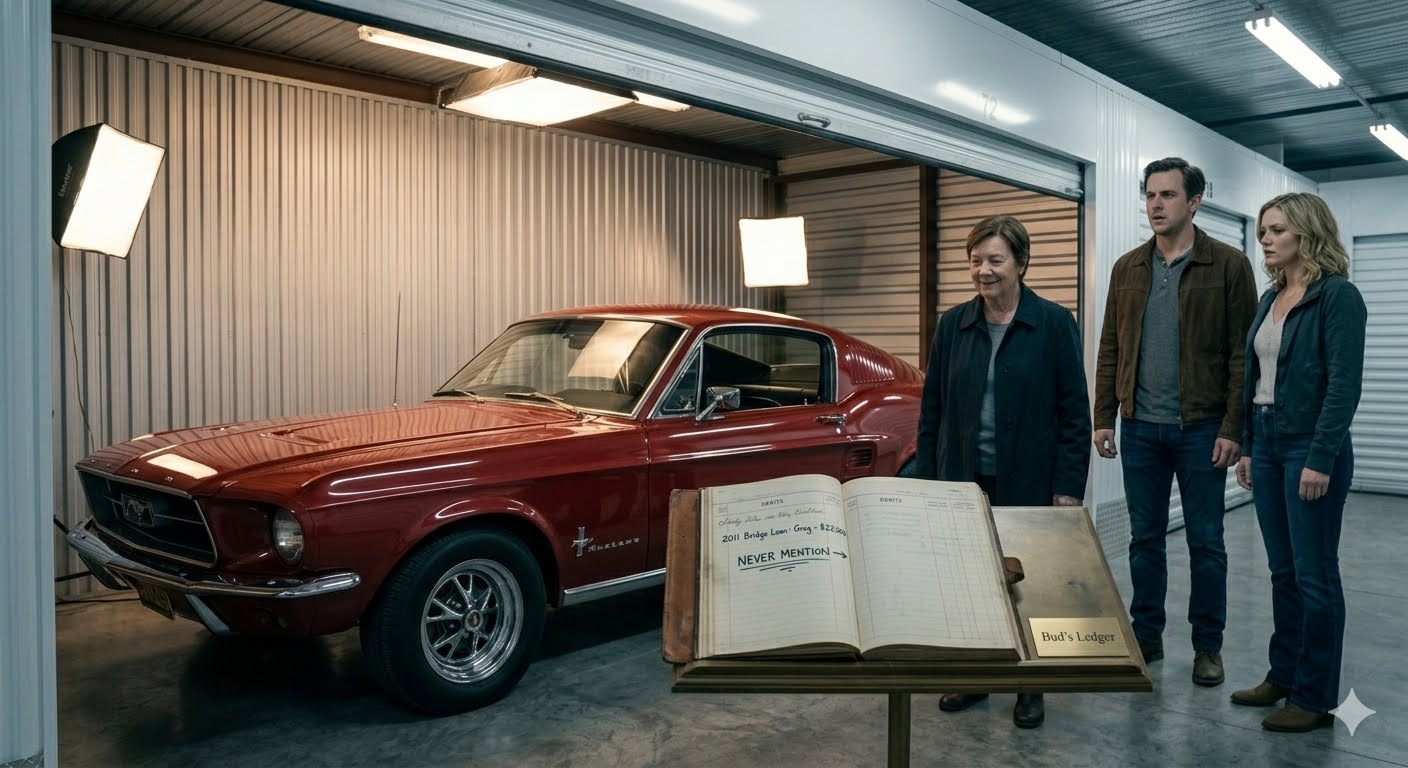
PART2 << Eli swallowed. Nobody spoke. Outside Unit 44, somewhere down the row, a metal door slammed shut. The sound echoed through the concrete corridor and seemed to make the little storage unit suddenly smaller. Eli looked at me. “Grandma?” I nodded. “Keep reading.” He looked back at the letter. “‘Before anybody leaves, son, ask your Uncle Greg what happened to the twenty-two thousand dollars.'” Greg’s face changed. Not much.
A twitch around the mouth. A tightening in the jaw. But Bud had taught Eli how to read a man’s face long before he taught him how to change the oil in a car.
Eli looked directly at Greg. “What twenty-two thousand dollars?” Greg laughed. It was the wrong kind of laugh. The kind people use when they are trying to make something sound ridiculous before anyone has decided whether it is ridiculous. “Your grandfather was sick, Eli.
He wrote a lot of things down. You don’t understand the circumstances.” Eli didn’t move. “What twenty-two thousand dollars?” Kathy looked at her husband. “Greg?”
He turned toward her. “Kathy, this is not the time.” My daughter stared at him. “Then when is?” I felt something cold settle in my chest. For four years I had known there was a debt.
I had known Bud had written it down. But Bud had never told me the whole story. He had only told me what mattered. “Not Greg.” Now, standing inside that storage unit with the Mustang shining beneath the fluorescent lights, I understood why. Bud hadn’t wanted to spend his last good years fighting with a man who wasn’t worth the fight. He had simply prepared for the day when the truth would become useful. Eli unfolded the second page.
There were three pages in all. His hands were shaking now. “‘Eli, if Greg is standing there, he is probably going to tell you the twenty-two thousand was a business loan. That is partly true.
PART3 ENDING Greg stepped forward.
“Okay. That’s enough.”
I raised my hand.
“No.”
Greg stopped.
I had spent four years being treated like a woman who needed help.
That afternoon, for the first time, I enjoyed watching him realize he might need help himself.
Eli kept reading.
“‘I gave your Uncle Greg twenty-two thousand dollars in 2011 because he said his boat business was short on cash and he had a contract coming in. He promised to pay us back within six months.’”
Kathy whispered, “Greg…”
He didn’t look at her.
“‘He paid back five thousand dollars.’”
Eli stopped.
Greg closed his eyes.
“‘Then he asked for another six months.’”
The storage unit went silent.
“‘Then he asked for another year.’”
Eli turned the page.
“‘After that, he stopped asking and started acting like we had forgotten.’”
My daughter covered her mouth.
Greg finally spoke.
“Your grandfather was confused about the accounting.”
I almost laughed.
Bud was many things.
Confused was never one of them.
He once balanced our checkbook on a paper napkin at a diner because the waitress had accidentally charged us twice for coffee.
He remembered every penny.
Every birthday.
Every tire rotation.
Every promise.
Especially promises.
Eli continued.
“‘But I hadn’t forgotten. I kept the original agreement. I kept the bank withdrawal. I kept Greg’s handwritten note promising repayment. And I kept every message he sent asking me not to tell June.’”
Kathy slowly turned toward her husband.
“Messages?”
Greg’s voice became sharper.
“That’s enough.”
“No,” I said.
It came out quieter than I expected.
But everyone heard me.
I stepped closer to him.
“Let him finish.”
Eli looked at me.
Then back at the letter.
“‘Your grandmother thinks the Mustang was simply stored after I died. She knows I wanted you to have it. What she does not know is why I put it away instead of leaving it in the garage.’”
My breath caught.
I had never known that part.
Eli’s voice softened.
“‘I put the car away because I knew Greg would come for it.’”
Greg shook his head.
“That’s insane.”
Eli read on.
“‘He had already asked me twice if June would sell it after I was gone. He told me he could get a “quick sale” and that old cars were going down in value.’”
I looked at Greg.
He looked away.
“‘What he didn’t tell us was that he had already spoken to a buyer.’”
Kathy’s eyes widened.
“Greg?”
Nothing.
“Greg, did you already have a buyer?”
He rubbed his forehead.
“It wasn’t like that.”
That sentence.
I knew that sentence.
Whenever a man says it wasn’t like that, something was exactly like that.
Eli turned the page.
“‘The buyer was going to pay forty-eight thousand dollars.’”
Kathy gasped.
Greg finally looked at me.
I could see the calculation happening again.
Not the price of the Mustang.
The price of the lie.
Because if he had arranged a forty-eight-thousand-dollar sale and convinced me to hand over the car for some lesser amount, the question wasn’t simply what he had done.
The question was where the rest of the money had gone.
Eli continued.
“‘If Greg tells you he was helping us, ask him why the buyer’s name was written in my ledger before I ever agreed to sell.’”
My heart began pounding.
The ledger.
Bud’s little black ledger.
The one I had seen him write in for years.
The one I had assumed contained grocery totals, repair costs, numbers from the bowling league, and the endless little calculations he made about retirement.
But Bud had left it somewhere.
I knew where.
And suddenly I understood why.
Eli folded the letter slightly.
Then stopped.
“There’s something else.”
Greg stepped toward him.
“Eli, give me that.”
My grandson pulled the paper away.
“No.”
It was the first time I had ever heard Eli speak to his uncle that way.
No anger.
No shouting.
Just no.
Greg stared at him.
Eli looked down again.
“‘One more thing, son.’”
His voice trembled.
“‘The Mustang isn’t worth forty-eight thousand anymore.’”
Greg blinked.
“What?”
Eli kept reading.
“‘It is worth much more than that now, because I restored something in that car that nobody knows about.’”
I felt the hair rise on my arms.
Eli looked at me.
I shook my head.
“I don’t know.”
He read the next line.
“‘Under the rear seat, beneath the original insulation, there is a small metal box.’”
Greg went completely still.
Not nervous.
Not confused.
Still.
And that was when I knew.
Whatever was in that box, Greg knew about it.
Eli folded the letter.
“Grandma.”
I looked at him.
“What?”
“Did you know there’s a box in the car?”
“No.”
Greg said nothing.
Eli walked to the Mustang.
He opened the driver’s door.
The smell hit me immediately.
Old leather.
Wax.
Gasoline.
Bud.
For one second I was seventy-five years old again, standing beside my husband in our garage while he polished that long red hood and pretended he couldn’t hear me complaining about how much time he spent with the car.
Eli reached inside.
He pulled the seat forward.
Nothing.
Then he stopped.
“There’s something under here.”
Greg moved.
I stepped between them.
“Don’t.”
He looked at me.
“June, you don’t understand what you’re doing.”
“No.”
I smiled.
“I finally do.”
Eli pulled up the edge of the insulation.
A small metal corner appeared.
He reached underneath and dragged out a rust-colored box no bigger than a cigar case.
It had a brass latch.
And scratched across the top were two initials.
B.D.
Eli looked at me.
“Should I open it?”
I stared at the box.
For four years I had paid eighty-nine dollars every month to keep a secret safe.
Now I understood that the storage bill had never really been for the Mustang.
It had been for the truth.
I nodded.
“Open it.”
The latch clicked.
Inside was a folded bank envelope.
A photograph.
A set of keys.
And one yellowed piece of paper.
Eli picked up the paper first.
His eyes moved across the writing.
Then his face went pale.
“Grandma…”
“What?”
He looked at Greg.
“There’s a date.”
“What date?”
“Three days before Grandpa’s stroke.”
Greg took a step backward.
Eli turned the paper around.
At the top was Bud’s handwriting.
I finally found out where the rest of the money went.
Nobody breathed.
Then Eli read the line underneath.
It wasn’t spent on the boat business.
Kathy slowly turned toward her husband.
“Greg…”
Greg’s eyes were fixed on the paper.
And for the first time since I had known that man, he looked genuinely afraid.
Eli reached for the photograph.
He turned it over.
His mouth fell open.
“Grandma.”
“What?”
“It’s Uncle Greg.”
I took the photograph from him.
It showed Greg standing beside a man I didn’t recognize.
Behind them was a boat.
And on the back, in Bud’s handwriting, were six words:
This is where the money went.
I looked at Greg.
He didn’t deny it.
He only whispered:
“Bud wasn’t supposed to find out.”
And that was the moment I realized the Mustang wasn’t the biggest secret my husband had left behind.
It was the key to one.
And somewhere in that little metal box was the beginning of the story Bud had taken to his grave.
The next morning, I was going to find out who the man in the photograph was.
And why Bud had been watching him.
For nearly a year.
I didn’t sleep that night.
Not because I was frightened.
Because Bud had left me a trail.
And after forty-nine years of marriage, I knew my husband well enough to understand that Bud Dunn never left a trail by accident.
At six in the morning, I was sitting at the kitchen table with the photograph in front of me.
The man beside Greg was maybe ten years older than my son-in-law. Gray hair. Thick neck. Expensive watch.
Behind them was a white cabin cruiser tied to a dock.
On the back, in Bud’s handwriting, were those six words:
THIS IS WHERE THE MONEY WENT.
Kathy came in around seven.
She looked terrible.
She had spent most of the night at my house because she didn’t want to go home with Greg.
That hurt more than I let her see.
She sat across from me.
“Mom?”
“Coffee?”
She nodded.
I poured.
For a while neither of us spoke.
Finally she said, “I didn’t know.”
“I know.”
“About the money.”
“I know.”
“About the car.”
I looked at her.
“That part I think you should have known.”
She lowered her eyes.
“Greg told me you sold it.”
“I know.”
“He said you were overwhelmed after Dad died and he handled everything.”
I stirred my coffee.
“Your father wasn’t even cold yet when Greg started handling things.”
Kathy flinched.
I regretted saying it.
Not because it wasn’t true.
Because she was my daughter, and daughters sometimes carry guilt for the sins of their husbands.
She reached across the table and touched my hand.
“Mom, why didn’t you tell us?”
I looked at the photograph.
“Because your father told me not to.”
“That’s all?”
“No.”
I folded my hands.
“Because I wanted to see what people did when they thought I didn’t know.”
Kathy looked at me for a long moment.
Then she whispered, “And what did you see?”
I smiled without humor.
“Enough.”
At eight seventeen, someone knocked on my front door.
It was Eli.
He had the little metal box under his arm.
Behind him stood Whitey Dunn.
My husband’s old bowling friend.
Whitey was eighty-one, walked with a cane, and had the permanent expression of a man who had been disappointed by humanity but was willing to give it another chance.
He sat down.
“June,” he said, “Bud told me you’d eventually need me.”
I stared at him.
“What?”
Whitey sighed.
“Your husband came to me three weeks before his stroke.”
My stomach tightened.
“He told you?”
“He told me everything he could.”
“Why didn’t you tell me?”
Whitey looked at Eli.
Then back at me.
“Because Bud made me promise.”
I laughed softly.
“That sounds like him.”
Whitey nodded.
“He said, ‘June will want to fix it. She’ll want to confront people. She’ll want to protect everybody. Don’t let her.’”
Kathy almost smiled.
“That sounds exactly like Mom.”
Whitey leaned his cane against the table.
“Bud knew what was coming.”
“What was coming?”
Whitey reached into his jacket.
He pulled out a folded piece of paper.
“I’ve had this four years.”
He placed it in front of me.
I unfolded it.
There were three names.
The first was Greg.
The second was the man from the photograph.
The third name I didn’t recognize.
Under the names Bud had written:
WATCH. DO NOT WARN.
I stared at the third name.
“Who is this?”
Whitey shook his head.
“I don’t know.”
Eli picked up the photograph.
“But Grandpa knew.”
Whitey looked at it.
His face changed.
“You found this?”
“Yesterday.”
Whitey leaned closer.
“That’s Carl Mercer.”
“Who?”
“Boat dealer.”
Kathy looked toward the hallway.
“Like Greg?”
Whitey nodded.
“Except bigger.”
I remembered Greg’s business.
Boats.
Loans.
Contracts.
Men who liked talking about investments.
Suddenly the twenty-two thousand dollars didn’t feel like an old family debt anymore.
It felt like one piece of something much larger.
Eli opened the metal box again.
“There’s another key.”
He held up the small brass key we had found inside.
Whitey stared at it.
Then he said something that made all three of us go quiet.
“I’ve seen that key before.”
“Where?”
He pointed toward the photograph.
“At the marina.”
I looked at the picture again.
The boat.
The dock.
The man.
The key.
Everything was suddenly connected.
Eli stood.
“Then we’re going to the marina.”
Kathy shook her head.
“Absolutely not.”
I looked at her.
“Why?”
“Because Greg will know.”
“Good.”
She stared at me.
“Mom, what are you doing?”
I stood slowly.
“What your father asked me to do.”
“Which is?”
I picked up the photograph.
“Wait until somebody tries to take something from us.”
I looked toward the garage.
Then at Eli.
“And now somebody has.”
The marina was forty minutes away.
Whitey drove.
I sat beside him.
Eli and Kathy followed in my car.
Nobody spoke much.
When we arrived, the place looked ordinary.
Boats.
Trailers.
Men in work shirts.
Sunlight flashing across the water.
But Whitey didn’t go toward the main office.
He took us down a narrow service road behind the marina.
At the end stood a weathered gray building with a faded sign:
MERCER MARINE STORAGE
Whitey pointed.
“That.”
Eli held the brass key.
“What’s inside?”
Whitey looked at me.
“Bud never told me.”
We walked to the door.
The key fit.
The lock clicked.
Inside was darkness.
Eli found the light switch.
One fluorescent tube flickered on.
There were boxes everywhere.
Old paperwork.
Boat parts.
Tool cases.
And along the back wall were metal filing cabinets.
Kathy whispered, “This is private property.”
Whitey shrugged.
“So was Bud’s Mustang.”
I almost laughed.
Then Eli noticed something.
A filing cabinet with a handwritten label.
DUNN — 2011
He pulled the drawer.
Locked.
He held up the key.
It fit.
Inside was a folder.
On the front, in Bud’s handwriting:
GREGORY — $22,000
My knees almost gave out.
Eli caught my arm.
“Grandma.”
“I’m fine.”
I opened the folder.
There were copies of bank statements.
A loan agreement.
Emails.
Photographs.
And one document that made my hands begin to shake.
It was a purchase agreement.
For a boat.
The buyer’s name was Greg.
The seller’s name was Carl Mercer.
Price:
$22,000.
Date:
2011.
But that wasn’t the strange part.
At the bottom was Greg’s signature.
And beneath it, in Bud’s handwriting:
Paid with our money.
Kathy sat down hard on a wooden crate.
“Oh my God.”
Eli looked through the papers.
“Grandpa knew.”
“Yes.”
“He knew Uncle Greg bought a boat with the loan.”
“Yes.”
Then Eli found another page.
He stopped.
“Grandma.”
“What?”
“This isn’t the same boat.”
He handed me the paper.
It was another purchase agreement.
Same year.
Same marina.
Same amount.
But a different boat.
Two twenty-two-thousand-dollar purchases.
Both connected to Greg.
My heart began pounding.
“Where did the second twenty-two thousand come from?”
Nobody answered.
Then we heard footsteps outside.
Slow.
Heavy.
Coming toward the door.
Whitey turned off the light.
Kathy grabbed my hand.
Eli whispered:
“Someone’s here.”
The door handle moved.
Once.
Twice.
Then stopped.
A man’s voice came through the door.
“June?”
I knew that voice.
Greg.
Kathy looked at me in disbelief.
“How did he know?”
I didn’t answer.
Because I was looking at the paperwork.
At the bottom of the second purchase agreement was an address.
And beside it, written in Bud’s handwriting:
Ask Greg who really owns this boat.
The door opened.
Greg stepped inside.
He looked at the four of us.
Then at the open filing cabinet.
For a few seconds, nobody spoke.
Then Greg looked directly at me.
“June.”
I held up the document.
“Who owns the boat?”
His face went pale.
“You don’t understand.”
“I’ve been hearing that a lot lately.”
He swallowed.
“It wasn’t mine.”
“Then whose was it?”
He didn’t answer.
Eli stepped forward.
“Grandpa knew, didn’t he?”
Greg closed his eyes.
“Yes.”
Kathy stared at him.
“You lied to all of us.”
Greg opened his eyes.
“I was trying to protect this family.”
I laughed.
“Funny.”
He looked at me.
“What?”
“Your father-in-law once told me that whenever a man says he’s protecting the family, I should check what he’s protecting himself from.”
Greg’s jaw tightened.
Then he said the one thing none of us expected.
“Bud wasn’t investigating me.”
He looked at the photograph in my hand.
“He was investigating Carl Mercer.”
Whitey whispered:
“Why?”
Greg looked toward the door.
“Because the twenty-two thousand wasn’t the first payment.”
He paused.
“It was the last.”
My heart stopped.
“The last payment for what?”
Greg looked at Eli.
Then at me.
And finally he said:
“For the night Bud’s stroke happened.”
Nobody moved.
The fluorescent light above us buzzed.
Kathy whispered, “What are you saying?”
Greg didn’t answer.
He simply looked at the folder in my hands.
Then he said:
“Your father didn’t have a stroke by accident.”
And in that moment, the little storage unit, the Mustang, the twenty-two thousand dollars, and four years of silence suddenly became something much darker.
Something Bud had spent his final months trying to prove.
Something my husband had apparently been afraid would happen again.
And when Eli opened the final page of the folder, we found a handwritten note that made my blood run cold:
If anything happens to me, do not trust the man who tells you it was an accident.
For a long moment, nobody moved.
Then Kathy whispered, “What do you mean, Dad’s stroke wasn’t an accident?”
Greg looked at her.
“I mean I don’t know.”
I stared at him.
“That’s a strange answer from a man who just told us your father-in-law’s stroke wasn’t an accident.”
Greg swallowed.
“I know what it sounds like.”
“It sounds like you’re finally scared enough to tell the truth.”
He looked away.
Eli held the folder against his chest.
“Grandpa wrote this.”
He pointed to the note.
“If anything happens to me, do not trust the man who tells you it was an accident.”
Whitey stepped closer.
“June.”
I looked at him.
“Don’t let Greg leave.”
Greg immediately turned toward him.
“Whitey, you don’t understand.”
“No,” Whitey said. “I understand more than you think.”
He reached into his pocket and pulled out his phone.
“Bud called me the night before his stroke.”
My mouth went dry.
“What did he say?”
Whitey looked at me.
“He said, ‘I found the missing piece.’”
“Missing piece of what?”
“I asked him.”
Whitey hesitated.
“He said, ‘The money isn’t the crime. It’s what the money bought.’”
Nobody spoke.
Eli looked down at the papers.
“What did it buy?”
Whitey shook his head.
“Bud wouldn’t tell me over the phone.”
“Why?”
“He said somebody might be listening.”
Kathy looked at Greg.
Greg said nothing.
I walked toward him.
“Did you know my husband was investigating you?”
Greg rubbed both hands over his face.
“Yes.”
“Did you know he suspected something about the stroke?”
“Yes.”
“Did you cause it?”
Greg looked at me.
“No.”
The answer came quickly.
Too quickly.
But there was something in his face I hadn’t seen before.
Not guilt.
Fear.
Real fear.
He reached into his jacket and pulled out his phone.
“There’s something you need to see.”
He opened a photograph.
It was a scanned copy of a handwritten note.
Bud’s handwriting.
I recognized it immediately.
The note said:
Greg, I know what you did. I also know you weren’t alone.
Below it was a date.
The day before Bud’s stroke.
Kathy stared at the screen.
“Who wasn’t he alone with?”
Greg shook his head.
“I don’t know.”
I looked at him.
“You expect me to believe that?”
“No.”
He put the phone away.
“I expect you to believe that I was stupid, greedy, and scared. I borrowed money. I lied about where it went. I tried to sell the Mustang. I deserve every bit of anger you’re giving me.”
He looked at Kathy.
“But I did not hurt your father.”
Kathy’s eyes filled with tears.
“Then who did?”
Greg whispered:
“Carl Mercer.”
Whitey stiffened.
“The boat dealer?”
Greg nodded.
“Bud found out Carl was using boat purchases to move money between businesses.”
Eli frowned.
“Money laundering?”
Greg didn’t answer directly.
“Something like that.”
I looked at the folder.
“And our twenty-two thousand?”
“Was used as part of it.”
My stomach turned.
“So Bud found out.”
“Yes.”
“And then he had his stroke.”
Greg nodded.
“He was going to report Carl.”
“What happened?”
Greg stared at the floor.
“Carl found out Bud knew.”
The room seemed to grow colder.
“How?”
Greg hesitated.
“Because I told him.”
Kathy slapped Greg across the face.
The sound echoed through the building.
“You told him?”
Greg didn’t defend himself.
“I was scared.”
“You put Dad in danger!”
“I know.”
“You put Mom in danger!”
“I know.”
“You lied to us for four years!”
“I know!”
His voice cracked.
And suddenly he looked less like the confident boat salesman who had sat at my kitchen table with a folder titled financial oversight and more like a frightened man who had spent four years running from the consequences of his own choices.
But I wasn’t finished.
“Where is Carl now?”
Greg looked at me.
“He’s dead.”
Whitey whispered, “When?”
“Three years ago.”
I stared at him.
“How?”
“Boat accident.”
The room went silent.
I thought about Bud.
About his ledger.
About the Mustang.
About the envelope waiting on the windshield for four years.
Then something occurred to me.
“If Carl was dead, why did Bud leave all this evidence?”
Greg looked at me.
“Because Bud didn’t trust the police.”
“Why?”
“Because one of the people involved was a police officer.”
Eli’s eyes widened.
“Who?”
Greg shook his head.
“I don’t know his name.”
I looked at the note again.
Then I noticed something.
At the bottom of the page was a tiny mark.
Three numbers.
417.
I recognized them.
Everyone in our family did.
“That’s your father’s bowling lane number,” Whitey said.
I looked at him.
“Lane 417?”
He nodded.
“Bud used it as a code.”
Eli grabbed the ledger.
He flipped through the pages.
Then stopped.
“Grandma.”
“What?”
He showed me a page.
Every few weeks, Bud had written the same number:
417.
Sometimes beside it was a date.
Sometimes a dollar amount.
Sometimes just one name.
Greg.
Mercer.
And one name I had never seen before.
Harlan.
Whitey went pale.
“No.”
I looked at him.
“You know him.”
Whitey didn’t answer.
“Whitey?”
He finally sat down.
“That’s the police officer.”
My heart sank.
“How do you know?”
“Because he was my brother-in-law.”
Nobody spoke.
Then Whitey began to cry.
Not loudly.
Just one tear.
Then another.
“I should have told Bud.”
I sat beside him.
“What happened?”
Whitey looked at me.
“Harlan died six months after Carl.”
“And you think he was involved?”
“I know he was.”
He took a breath.
“But Bud didn’t have enough proof.”
Eli opened the ledger again.
“Maybe he did.”
We all looked at him.
He turned to the final page.
There, beneath a list of dates, Bud had written:
The proof is not in the ledger.
Then below it:
The proof is where Greg never thought to look.
Eli looked toward the Mustang.
My heart began beating faster.
“The car.”
I nodded.
“The Mustang.”
We went back to the storage unit.
Eli opened the trunk.
Nothing.
Under the spare tire.
Nothing.
Behind the side panels.
Nothing.
Then Whitey stopped him.
“Wait.”
He walked around to the passenger side.
“Bud always hated replacing original parts.”
He pointed beneath the carpet.
“Lift that.”
Eli pulled it back.
There was a second compartment.
Hidden under the factory flooring.
Inside was a small cassette recorder.
An old one.
The kind Bud used to carry when he recorded interviews for his union work.
Eli looked at me.
“Do we play it?”
I nodded.
He pressed the button.
Static.
Then Bud’s voice.
Weak.
But unmistakable.
“June.”
I closed my eyes.
For four years I had wanted to hear that voice again.
Even if it was only a recording.
Bud continued.
“If you’re hearing this, then Eli got the Mustang.”
I laughed through my tears.
“That’s my boy.”
The recording continued.
“I need you to know something. I never wanted you to be afraid.”
Static.
A cough.
Then:
“Greg made mistakes. Big ones. But he’s not the man you need to fear.”
Greg lowered his head.
Bud’s voice continued.
“The man you need to fear is the one who convinced Greg that twenty-two thousand dollars could disappear without consequences.”
The recording crackled.
Then Bud said:
“Harlan.”
Whitey closed his eyes.
Bud continued.
“I have proof. I put it where nobody would think to look.”
There was a pause.
Then his voice became softer.
“In the Mustang.”
Eli looked around the car.
Bud laughed faintly on the recording.
“That old girl has carried me farther than most people ever will.”
I put my hand over my mouth.
Then Bud said the words that broke me.
“June, if you’re hearing this, I’m sorry I left you with so much to carry.”
I started crying.
“But you were always stronger than you knew.”
The tape clicked.
Then one final sentence:
“And if Greg ever tries to take the car, don’t give it to him.”
The recording ended.
Nobody spoke.
Greg finally whispered:
“I’m sorry.”
I looked at him.
“I know.”
He looked surprised.
I continued.
“But sorry isn’t the same as forgiven.”
He nodded.
“I know.”
Kathy stepped beside me.
“What happens now?”
I looked at Eli.
He was standing beside the Mustang, one hand resting on its roof.
I remembered Bud’s promise.
Twenty-one.
Whole.
Running.
No family discount.
No helpful guys.
I smiled.
“Now we keep our promise.”
Eli looked at me.
“Grandma?”
“Your grandfather wanted you to have her.”
His eyes filled with tears.
“But he also wanted you to understand something.”
“What?”
“That a family isn’t protected by pretending nothing happened.”
I handed him the keys.
“It is protected by telling the truth when the truth is expensive.”
He closed his fingers around them.
Greg watched silently.
Then Eli turned to him.
“Uncle Greg.”
Greg looked up.
“I don’t want your money.”
Greg’s face tightened.
“I want you to tell Mom everything.”
Greg nodded.
“I will.”
“And then I want you to make it right.”
Greg swallowed.
“I will.”
I looked at Kathy.
She was crying.
But this time, she was smiling too.
The Mustang sat behind us, shining red beneath the fluorescent lights.
Bud had spent fifty years loving that car.
Four years protecting it.
And now I understood why.
It was never really about the Mustang.
It was about keeping one promise when the people around you had forgotten what promises were worth.
Three weeks later, Greg went to the police and gave them everything.
The old financial records.
The names.
The photographs.
The evidence Bud had hidden.
The investigation took months.
Some things were proven.
Some never were.
And some questions stayed questions.
But the truth about the money came out.
Greg repaid what he could.
He sold the boat business.
He apologized to Kathy.
And, eventually, he apologized to me.
I accepted the apology.
I did not forget.
Those are two different things.
As for the Mustang?
On Eli’s twenty-first birthday, I handed him the keys in our driveway.
He started the engine.
That old V8 came alive with a sound that seemed to shake four years of grief right out of my chest.
For just a second, I could see Bud standing beside me.
Hands in his pockets.
That crooked little smile.
Proud.
I whispered, “We did it.”
The Mustang rolled slowly down the driveway.
Eli waved.
I waved back.
And when the red taillights disappeared around the corner, I went inside and opened Bud’s old ledger one last time.
On the final blank page, beneath everything he had written, I found a sentence I had somehow never noticed.
Maybe because the ink was faded.
Maybe because I wasn’t ready before.
It said:
June, don’t spend your life proving you were right. Spend it making sure the people you love know what is true.
So I closed the ledger.
I put it beside his photograph.
And for the first time in four years, I didn’t feel like I was waiting for my husband to come home.
I felt like he had finally finished telling me goodbye.