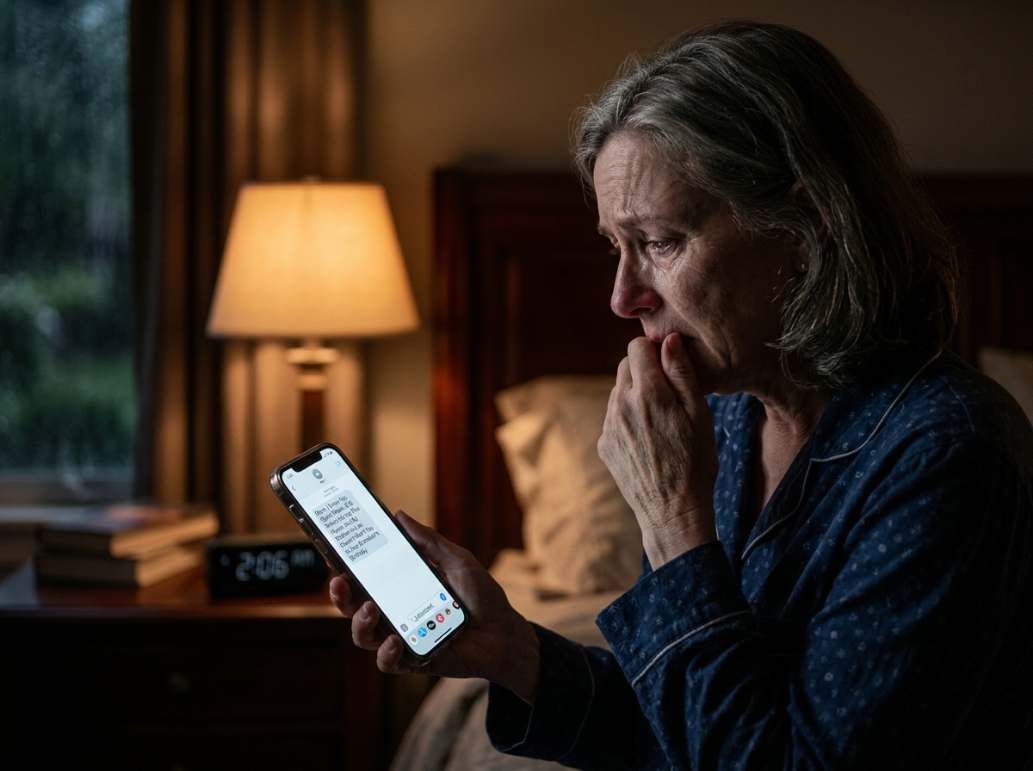
3:11 a.m. I had another sip of coffee. Then I walked into my study.
That room contained the paperwork for every major decision I had made over the last twenty years. Property documents. Investment agreements. Tax records. Contracts. Trust documents.
And, in a locked drawer, the original files relating to the house. I opened the drawer. The folder was exactly where I had left it.
Five years ago, when Caleb had called me crying, I had believed I was saving my son’s family. I had not expected gratitude. I had not expected repayment. I certainly had not expected a plaque on the wall. I had simply wanted Owen to have a stable home.
That was all. I opened the folder. The first page was an old appraisal. The second was the agreement transferring control of the property into my family holding company.
The third was the document Caleb had signed. I ran my finger down the page until I reached his signature. There it was. Caleb Matthew Whitmore. His handwriting. His name. His promise. I closed the folder.
For five years, I had deliberately avoided using the one thing that gave me leverage. I had never wanted to be the mother who reminded her son, “This house exists because of me.” I had told myself that love should never come with an invoice.
But there was something I had finally begun to understand. There was a difference between giving someone a gift… and allowing someone to use your generosity as a weapon against you.
At 4:02 a.m., I made the phone call.
Not to Caleb.
Not to Tessa.
I called Margaret.
Margaret had been my attorney for almost eighteen years.
She answered on the fourth ring.
“Is everything all right?”
“No,” I said.
There was a pause.
Then her voice changed.
“What happened?”
I looked at the folder on my desk.
“I need you to pull the Whitmore property file.”
Another pause.
“I’ll have it in front of me in ten minutes.”
“And Margaret?”
“Yes?”
“Don’t call Caleb.”
Her silence told me she understood.
“I won’t.”
I hung up.
For the first time that night, I felt something other than hurt.
I felt calm.
At 4:31, Margaret called back.
“I’ve reviewed everything.”
“And?”
“You were right to call me.”
That sentence made my stomach tighten.
“What do you mean?”
“There’s something you should know before you do anything.”
I sat down.
“What?”
“The agreement wasn’t simply a five-year financial rescue.”
I frowned.
“Explain.”
“Your son didn’t just agree to repay certain obligations.”
“What did he agree to?”
Margaret took a breath.
“He agreed that the property would remain under the holding company until certain conditions were satisfied. One of those conditions involves occupancy and family access.”
I stared at the rain.
“Family access?”
“Yes.”
My heart began beating faster.
“Margaret, what exactly does that mean?”
“I don’t want to explain this over the phone.”
“Why?”
“Because there are other documents.”
“What documents?”
Another silence.
Then she said something that I hadn’t expected.
“Documents you asked me to prepare five years ago.”
I closed my eyes.
Five years ago.
Before the house was saved.
Before Owen was born.
Before Tessa’s mother had started making decisions about where I was allowed to sit at birthday parties.
I remembered the night.
I remembered sitting across from Margaret at her office.
I had been terrified that Caleb would lose everything.
I had said something I had almost forgotten.
“I want to protect Owen.”
Margaret had apparently not forgotten.
“I’ll bring the documents to you at seven.”
“No.”
I looked at the clock.
“Come at six.”
She hesitated.
“Are you sure?”
“Yes.”
“And the birthday party?”
I looked toward the ceiling.
Somewhere upstairs, the guest room was untouched.
I had bought Owen’s birthday present weeks earlier.
A wooden telescope.
I had spent three weeks researching different models because Owen had recently become obsessed with planets.
He had told me, “Grandma, I want to see Saturn.”
I had promised him we would.
Now I wondered whether he would even know why I wasn’t there.
“I won’t be going,” I said.
Margaret didn’t respond.
“At least,” I added, “not in the way they expect.”
At 5:58 a.m., Margaret arrived.
She carried a black leather case.
She came inside without saying much.
We sat at the kitchen table.
She placed the case between us.
Then she opened it.
There were three folders.
The first contained the property agreement.
The second contained financial records.
The third was much thinner.
It had my name handwritten across the front.
I looked at Margaret.
“What is that?”
She slid it toward me.
“Open it.”
I did.
The first page was dated five years earlier.
The title at the top made my breath catch.
Family Residence Protection and Beneficiary Agreement.
I read the first paragraph.
Then the second.
Then I stopped.
“Margaret…”
“Keep reading.”
I did.
And that’s when I discovered that the house had never been the real reason I had saved the property.
The house was only part of it.
There was something else.
Something Caleb had never told me.
Something that Tessa apparently knew.
Something that had been deliberately kept from me for years.
I looked up.
“Why didn’t you tell me?”
Margaret’s expression was unusually serious.
“Because you told me not to.”
“I did?”
“You said, ‘If Caleb ever needs this information, he’ll come to me.’”
I stared at her.
“I don’t remember that.”
“You were under enormous stress. But I remember.”
I turned another page.
Then another.
My hands began to tremble.
“What is this?”
Margaret leaned forward.
“It’s a clause that activates if the family residence is used to exclude a named beneficiary from family events or if the property is transferred, sold, or controlled in a way that violates the original agreement.”
I looked at her.
“Named beneficiary?”
She nodded.
“Yes.”
“Who?”
Margaret didn’t answer.
Instead, she pointed to the bottom of the page.
I read the name.
And suddenly the entire night changed.
It wasn’t my name.
It wasn’t Caleb’s.
It wasn’t Tessa’s.
It was Owen’s.
My grandson.
I sat completely still.
For five years, I had believed I had saved a house.
I had not.
I had protected something for Owen.
Something Caleb and Tessa could not simply take away.
And apparently, five years earlier, before Owen had even been born, I had anticipated the possibility that one day my own son might forget why I had done it.
Margaret watched me carefully.
“There’s more.”
I almost laughed.
“Of course there is.”
She opened the second folder.
“This is where things get complicated.”
She removed several pages.
“The property has appreciated substantially.”
“How much?”
She told me.
I stared at her.
The number was far higher than I expected.
But that wasn’t what frightened me.
“What happened to the money I put into it?”
“That’s accounted for.”
“And Caleb?”
“He’s been paying the obligations as required.”
I frowned.
“Then why did he tell me I spent nearly ten million dollars?”
Margaret looked directly at me.
“Because that’s what you spent.”
“I know.”
“No,” she said quietly. “I don’t think you do.”
She pushed a spreadsheet across the table.
I studied it.
At first, I didn’t understand.
Then I saw the transfers.
One after another.
Small amounts.
Large amounts.
Payments.
Reimbursements.
Maintenance.
Taxes.
Insurance.
Legal fees.
Renovations.
And something else.
A series of payments I did not recognize.
I looked at Margaret.
“What are these?”
She didn’t answer immediately.
“Those payments weren’t made by you.”
“Then who made them?”
She tapped the page.
“That’s what we’ve been trying to determine.”
My throat went dry.
“Trying?”
“Yes.”
“For how long?”
Margaret looked toward the window.
“For almost a year.”
I stared at her.
“Margaret, what are you telling me?”
She reached into the folder and pulled out a bank statement.
“Someone has been moving money through an account connected to the property.”
“Who?”
“We don’t know yet.”
“Then why didn’t you tell me?”
“Because every time we traced the account, the trail ended with someone inside the family.”
The room seemed to become colder.
I looked down at the statement.
There was a name.
A name I recognized.
Not Caleb.
Not Tessa.
Not Owen.
Someone else.
Someone who had been present at nearly every major family gathering during the last five years.
Someone who had always been polite to me.
Someone who had never once raised their voice.
Someone who had repeatedly told me how grateful the family was for everything I had done.
I looked at Margaret.
“Is this why you came?”
“No.”
“Then why?”
She closed the folder.
“Because after your son’s text last night, I checked one more thing.”
“What?”
She leaned toward me.
“Someone accessed the original property agreement yesterday.”
My blood ran cold.
“Who?”
“We have the access record.”
“And?”
Margaret looked me directly in the eyes.
“Caleb didn’t access it.”
I didn’t breathe.
“Tessa?”
“No.”
“Then who?”
Margaret hesitated.
“The access came from a computer inside the house.”
I looked toward the clock.
6:27 a.m.
Outside, the rain had stopped.
The sky over Raleigh was beginning to turn pale.
I suddenly realized that the birthday party wasn’t the most important thing happening that morning.
Someone had been preparing for something.
Someone had known I might eventually ask questions.
And sometime after midnight, while my son was telling me I wasn’t welcome at my grandson’s birthday…
someone inside that house had opened the document that could change everything.
At 6:41, my phone rang.
Caleb.
I stared at his name.
I didn’t answer.
It stopped.
Thirty seconds later, it rang again.
I ignored it.
Then Tessa called.
Then Caleb again.
Then a number I didn’t recognize.
Margaret watched the phone vibrating against the table.
“Are you going to answer?”
I shook my head.
“Not yet.”
The unknown number called a fourth time.
This time, I answered.
“Hello?”
There was silence.
Then a man’s voice said quietly:
“Mrs. Whitmore?”
“Yes.”
“You don’t know me.”
“Who is this?”
Another pause.
Then he said:
“I think you should know what happened in that house last night.”
I sat upright.
“What happened?”
“I can’t say over the phone.”
“Then tell me where you are.”
He gave me an address.
I wrote it down.
Before hanging up, he added:
“And please don’t tell your son I contacted you.”
My hand stopped moving.
“Why?”
His answer was almost a whisper.
“Because I don’t think Caleb knows the whole story either.”
The call ended.
I looked at Margaret.
She had heard enough to understand that something had changed.
I folded the paper with the address and slipped it into my pocket.
Then I stood.
“Where are you going?” she asked.
I picked up the black folder.
“To find out why my grandson’s birthday became the night someone decided to open a five-year-old secret.”
Margaret rose with me.
“And the house?”
I looked toward the window.
The first sunlight was breaking through the clouds.
“The house can wait.”
I paused.
“But the truth can’t.”
At 7:03 a.m., I left my home.
I had no idea that by 9:17, my phone would be ringing so relentlessly that I would finally have to turn it face down.
And when I eventually answered Caleb’s call, he would ask me only one question.
A question that would tell me he had finally discovered that the woman he thought he had excluded from his son’s birthday…
was not the woman he should have been afraid of.
“Mom,” he would whisper.
“What did you do?”
Part 3 — The Truth They Never Expected Me to Find
The address the man had given me belonged to a small office building on the outskirts of Raleigh.
Nothing about it looked important.
There was no dramatic entrance.
No security guard.
No expensive cars waiting outside.
Just a gray building, a glass door, and a faded sign that read Henderson & Cole — Property Records and Financial Services.
I walked inside at 7:19 a.m.
A receptionist looked up.
“Mrs. Whitmore?”
I stopped.
“Yes.”
“He’s expecting you.”
She pointed toward a hallway.
At the end was a conference room.
I opened the door.
The man from the phone call was standing beside the window.
He was probably in his forties.
Dark suit.
Tired eyes.
A folder in his hand.
“I’m Daniel Reeves,” he said.
“I don’t know you.”
“I know.”
He placed the folder on the table.
“I’m the accountant who reviewed several of the property transactions connected to your family’s holding company.”
I sat down.
“Then tell me what happened.”
Daniel remained standing.
“For the last eleven months, someone has been trying to move control of the property.”
My stomach tightened.
“Move it where?”
“Into another company.”
“Whose company?”
He looked at me.
“That’s the problem.”
He opened the folder.
“The company is registered under a name that means nothing at first glance.”
He slid a document across the table.
I read the name.
Then I looked up.
“I’ve never heard of them.”
“You weren’t supposed to.”
Daniel turned another page.
“But your daughter-in-law has.”
My heart sank.
“Tessa?”
He nodded.
“She didn’t create the company. But she has communicated with the people behind it.”
I stared at him.
“You’re certain?”
“We have emails.”
He handed me printed copies.
I read the first one.
Then the second.
Then the third.
None of them directly said what I feared.
But together, they formed a picture.
Tessa had been asking questions about the property.
About ownership.
About whether the holding company could be forced to sell.
About whether the beneficiary provisions could be challenged.
And then I saw one sentence that made my hands go cold.
What happens if the grandmother is no longer willing to cooperate?
I read it twice.
Daniel watched me.
“She was planning for a future in which you would no longer control the property.”
I closed my eyes.
“Why?”
“We don’t know.”
“Money?”
“Possibly.”
“How much?”
He gave me the figure.
I almost laughed.
The property had appreciated enough that the potential profit was enormous.
But there was still something that didn’t make sense.
“Why exclude me from Owen’s birthday?”
Daniel looked at me carefully.
“Because someone needed you to react.”
“What?”
“Think about it. If you became angry, if you showed up and demanded access, if you confronted Tessa publicly, they could argue that you were unstable or interfering.”
I felt a chill run through me.
“The birthday was a trap.”
Daniel didn’t answer.
He didn’t need to.
I looked down at the documents.
Then I noticed something else.
“Where is Caleb in all this?”
Daniel’s expression changed.
“That’s complicated.”
“Tell me.”
“We couldn’t find evidence that he knew about the transfer attempt.”
I let out a slow breath.
“But?”
Daniel hesitated.
“We found evidence that he knew about the financial problems.”
“What financial problems?”
He opened another file.
There were unpaid obligations.
Credit accounts.
Business losses.
Private loans.
And a number that made me sit back.
“Caleb owes this much?”
“More than he has told you.”
I stared at the papers.
“How long?”
“About eighteen months.”
The room went silent.
Suddenly, Caleb’s message made sense in a way I didn’t want it to.
He hadn’t simply been passing along Tessa’s mother’s wishes.
He had been frightened.
Desperate.
And possibly trapped.
I stood.
“Take me home.”
Daniel looked surprised.
“Why?”
“Because my son is about to make the biggest mistake of his life.”
At 8:04 a.m., I arrived home.
My phone showed twenty-three missed calls.
Caleb had called nine times.
Tessa six.
Margaret three.
Two numbers were unknown.
I called Margaret.
“Are you all right?”
“Yes.”
“Did you find anything?”
“Enough.”
There was silence.
Then she asked:
“Do you want me to activate the clause?”
I looked at the folder in my hand.
“No.”
“Are you sure?”
“Not yet.”
“What are you going to do?”
“I want my son to come here.”
“Alone?”
“Yes.”
“And Tessa?”
“Not yet.”
Margaret understood.
“I’ll wait for your instructions.”
I hung up.
At 8:17, there was a knock at the door.
I knew who it was before I opened it.
Caleb stood on the porch.
He looked exhausted.
His hair was wet from the rain.
His eyes were red.
He looked less like the confident businessman he had become and more like the little boy who used to stand outside my bedroom during thunderstorms.
“Mom.”
I stepped aside.
“Come in.”
He entered.
Neither of us spoke.
Finally, he said:
“I’ve been trying to call you.”
“I noticed.”
He looked down.
“I’m sorry.”
I nodded.
“Are you sorry because you told me not to come to Owen’s birthday?”
His eyes filled with tears.
“Yes.”
“Or because you got caught?”
He flinched.
“I deserved that.”
I closed the door.
“Sit down.”
We went into the kitchen.
For several seconds, he stared at the table.
Then he said:
“I didn’t want to send that message.”
“Who made you?”
“Tessa’s mother.”
“And Tessa?”
He swallowed.
“She agreed.”
I felt the familiar pain return.
“Why?”
“Because they think you control everything.”
“I do control the property.”
“That’s not what I mean.”
He looked at me.
“They think if you stay involved, I’ll never really be independent.”
I almost smiled.
“Caleb, I haven’t asked you for a dime in five years.”
“I know.”
“I haven’t told you how much I spent.”
“I know.”
“I haven’t used the house against you.”
“I know.”
“Then why are you letting them turn me into the villain?”
He looked away.
“I was scared.”
“Of me?”
“No.”
His voice broke.
“Of losing everything.”
There it was.
The truth.
Not the whole truth.
But enough.
I pushed the folder across the table.
He looked at it.
“What is this?”
“You tell me.”
His face changed the moment he saw the documents.
“Mom…”
“Did you know Tessa was trying to transfer the property?”
He went completely still.
“What?”
“Answer me.”
“No.”
“Did you know she had been asking lawyers how to challenge my control?”
“No.”
“Did you know about the company?”
He shook his head.
“Mom, I swear.”
I believed him.
At least that part.
Then he whispered:
“But I knew she wanted you out.”
I looked at him.
“How long?”
“Months.”
“And you said nothing.”
“I thought I could fix it.”
“By excluding me?”
He closed his eyes.
“No.”
“Then what?”
He finally looked up.
“I thought if I made everyone happy for one day, things would calm down.”
I stared at him.
“You traded your mother’s dignity for a quiet birthday party.”
He began to cry.
“I’m sorry.”
I sat across from him.
“I don’t want your apology, Caleb.”
He wiped his face.
“What do you want?”
“The truth.”
He nodded.
“I’ll tell you everything.”
And he did.
For nearly forty minutes.
He told me about the debts.
About the pressure Tessa had been under.
About conversations he had overheard.
About her mother’s obsession with controlling the property.
And then he told me something that I hadn’t expected.
“Tessa’s mother told me the house was worth enough to solve all our problems.”
I frowned.
“How?”
“She wanted you to sell.”
I shook my head.
“I would never sell it.”
“I know.”
“Then what was the plan?”
Caleb looked at the floor.
“They wanted to make you believe the family didn’t want you.”
My chest tightened.
“They wanted me to walk away voluntarily.”
He nodded.
“And if I didn’t?”
“They had another plan.”
I stared at him.
“What plan?”
He didn’t answer.
He didn’t need to.
The documents already had.
At 9:17 a.m., my phone began ringing again.
This time, it was Tessa.
I answered.
“Hello.”
There was silence.
Then she said:
“Where are you?”
“Home.”
“Caleb is with you?”
“Yes.”
Another silence.
“Mom…”
She had never called me Mom before.
Not once.
I waited.
“I’m sorry.”
I said nothing.
“I made a terrible mistake.”
“Yes.”
“I thought…”
Her voice cracked.
“I thought you were trying to control our lives.”
“I wasn’t.”
“I know that now.”
“No,” I said quietly. “You know it because you discovered something.”
She began crying.
“What did you do?”
I looked at Caleb.
He lowered his head.
“I protected Owen.”
“What?”
“The house was never really about you or me.”
Tessa stopped crying.
“Then what was it about?”
“Owen.”
There was silence.
“Five years ago, before he was even born, I created protections around that property specifically so that my grandson would always have a stable home.”
Tessa whispered:
“You knew?”
“I knew enough.”
“And the clause?”
I looked at the folder.
“Yes.”
She began sobbing.
“Please don’t take the house.”
“I won’t.”
She went silent.
“What?”
“I said I won’t take the house.”
“But you can.”
“Yes.”
“Then why?”
I looked toward the window.
Because that was the difference between revenge and justice.
I could have forced them out.
I could have sold the property.
I could have made them feel every ounce of humiliation they had tried to make me feel.
But Owen was innocent.
And I would never punish my grandson to teach his parents a lesson.
“I don’t want your home,” I said.
“Then what do you want?”
“Boundaries.”
She whispered:
“Okay.”
“Respect.”
“Okay.”
“And the truth.”
She began crying again.
“I’ll give you that.”
I ended the call.
Caleb looked at me.
“Mom.”
“What?”
“Will you still come to Owen’s birthday?”
I smiled sadly.
“No.”
His face fell.
“Why?”
“Because I don’t need an invitation anymore.”
He looked confused.
I stood and walked toward the hall.
“I’ll see Owen tomorrow.”
“Tomorrow?”
“His birthday is today.”
He stared at me.
“The party starts at eleven.”
“I know.”
“Then why won’t you come?”
I turned around.
“Because I want him to remember his birthday, not the family argument surrounding it.”
Caleb’s eyes filled with tears again.
“You really are my mother.”
I smiled.
“Unfortunately for you, yes.”
He laughed through his tears.
It was the first time either of us had laughed that morning.
At 10:42 a.m., I received one final message.
It was from Owen.
Grandma, Dad says you aren’t coming. Are you okay?
I stared at the screen.
Then I typed:
I’m okay, sweetheart. I love you more than all the stars.
A few seconds later, his reply appeared.
I love you too. Can you still help me find Saturn?
I smiled.
Always.
Then I put the phone down.
I didn’t attend the party.
I didn’t expose Tessa’s mother in front of everyone.
I didn’t sell the house.
I didn’t threaten anyone.
Instead, I waited.
And sometimes, waiting is the most powerful thing a person can do.
Three weeks later, the property agreement was formally updated.
The house remained protected for Owen.
The financial accounts were audited.
The mysterious company disappeared from the picture.
Tessa’s mother stopped calling.
Caleb began rebuilding his finances honestly.
And, slowly, my relationship with my son began healing.
Not because I forgave everything overnight.
I didn’t.
Forgiveness isn’t a light switch.
It’s a door.
Sometimes you open it a little at a time.
Six months later, Owen came to my house carrying a cardboard box.
“Grandma!”
I opened the door.
He ran into my arms.
“I brought something.”
“What is it?”
He opened the box.
Inside was a drawing.
It showed a little boy standing beside an enormous telescope.
Above him were stars.
And beside him was a woman with gray hair.
I smiled.
“Is that me?”
“Yes.”
“Why am I so tall?”
“Because you’re the strongest person I know.”
I couldn’t speak for a moment.
Then I hugged him.
That evening, we carried the telescope into the backyard.
Owen looked through it.
“Grandma!”
“What?”
“I can see it!”
“See what?”
“Saturn!”
I looked through the telescope.
There it was.
Small.
Beautiful.
Surrounded by its rings.
Owen turned toward me.
“Grandma?”
“Yes?”
“Are you going to stay?”
I knew what he was really asking.
Not about the telescope.
Not about the backyard.
Not even about Saturn.
He was asking whether I was going to disappear like adults sometimes did when families became complicated.
I knelt beside him.
“Yes.”
“Forever?”
I smiled.
“As long as you’ll have me.”
He threw his arms around my neck.
And in that moment, I realized something.
Five years earlier, I thought I had spent nearly ten million dollars saving a house.
I was wrong.
I had spent it protecting a future.
Not mine.
His.
And when my son finally asked me that morning, “Mom… what did you do?”
The answer was simple.
I didn’t destroy his family.
I didn’t take his house.
I didn’t punish him.
I simply stopped allowing my love to be used as proof that I was disposable.
Sometimes the strongest thing a mother can do is stop begging to be included…
and quietly remind everyone that love without respect is not love they are entitled to.
As for Caleb?
He never forgot that night.
Years later, whenever someone asked him why he was so protective of his relationship with his mother, he would tell them:
“My mother once had every legal right to take everything from me.
She chose not to.
That’s when I finally understood what she had been trying to teach me my entire life.”
And whenever Owen looked through that telescope, he always remembered the same thing.
His grandmother had saved a house.
But more importantly…
she had saved a place where he would always belong.