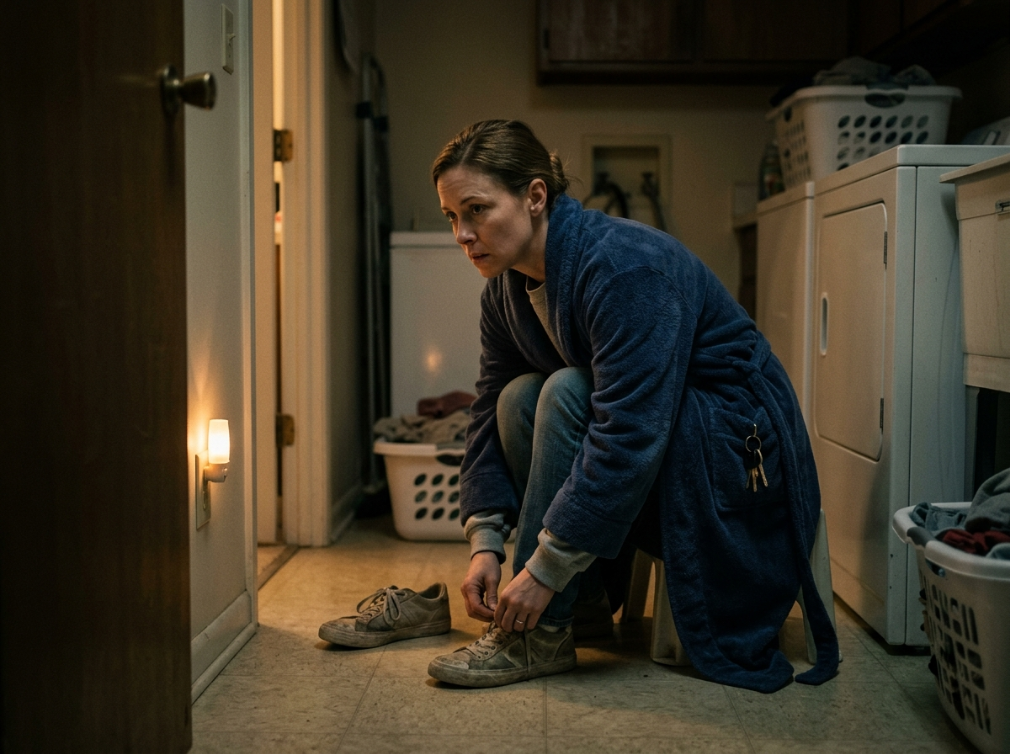
The back door stood twelve feet away. The deadbolt was already unlocked. I had practiced that part. I had practiced everything. Unlock.
Turn the knob slowly. Lift the door slightly because the bottom dragged. Step over the loose board. Shoes on outside.
Keys. Car. Drive.
I had practiced it so many times that the sequence lived inside my body. But practice was one thing. Leaving was another. A floorboard groaned behind me. I turned.
Leonard was standing in the hallway. He was wearing the gray undershirt he slept in and holding his phone in one hand. He didn’t look sleepy. That was the first thing I noticed.
The second thing I noticed was that he wasn’t looking at me. He was looking at the pantry. At the flour.
At the little white footprints I had accidentally left on the kitchen floor. Then he smiled. Not the angry smile. Not the smile he used when company was over. Something worse.
A patient smile. “Couldn’t sleep?” he asked. My throat went dry.
“No.”
He nodded. “Me neither.” Neither of us moved. Then his phone vibrated. He looked at the screen. For one second, the light from it illuminated his face. I saw something there I had never seen before.
Fear.
It vanished almost immediately.
He turned the phone face down.
“Who’s at the door?” I whispered.
He looked toward the back door.
“I was going to ask you the same thing.”
Three more knocks.
This time, Leonard flinched.
I saw it.
He actually flinched.
And suddenly I understood something.
The person outside wasn’t there for me.
Leonard was afraid of whoever stood on the other side.
He crossed the kitchen before I could stop him and put his hand on the doorknob.
I grabbed his wrist.
It was the first time in years I had touched him because I wanted to stop him.
He looked down at my hand.
Then at me.
“Gloria.”
His voice had changed.
“Don’t.”
The word frightened me more than anything else could have.
Leonard never said don’t.
He commanded.
He threatened.
He mocked.
He laughed.
But he didn’t plead.
Another knock came.
Then a woman’s voice.
“Gloria?”
My knees almost gave out.
I knew that voice.
I hadn’t heard it in twenty-six years.
“Celia?”
Leonard’s face went completely white.
He pulled his wrist out of my hand.
The woman’s voice came again, softer this time.
“Gloria, if you’re in there, don’t open the door.”
I stared at Leonard.
He stared at me.
And for the first time in thirty-eight years, I saw my husband look like a man who had been caught.
Not by me.
By the past.
“Who is that?” I asked.
He didn’t answer.
“Leonard.”
His eyes moved toward the living room.
Toward the recliner.
Toward the television.
Then he said something so quietly I almost didn’t hear it.
“She can’t be here.”
The woman outside laughed once.
It wasn’t a happy laugh.
It was exhausted.
“That’s what you said the last time.”
Leonard stepped backward.
I stepped toward the door.
He reached for me.
I moved away.
“Don’t touch me.”
He stopped.
The woman outside spoke again.
“Gloria, listen to me. I have five minutes before I have to leave. If you want to know why Leonard has been watching you, why your phone records disappear, why he knows every place you’ve gone, open the door.”
My heart was pounding.
I looked at the flour.
At the hidden keys.
At the door.
Then at Leonard.
“What does she mean, watching me?”
He said nothing.
The woman knocked once.
“Gloria, it’s Miriam.”
I didn’t know a Miriam.
At least I didn’t think I did.
Then she said:
“I knew Celia.”
Everything inside me went still.
Celia.
My sister.
Dead for twenty-six years.
Cancer, they said.
Three months after she died, Leonard began telling me I needed to stop talking about her.
A year later, he threw away the last box of her letters.
He said I was “living in the past.”
And I let him.
Because grief makes you tired.
Fear makes you tired.
Marriage, when you spend half your life walking on eggshells, makes you tired in a way sleep cannot fix.
I reached for the lock.
Leonard moved quickly.
“Gloria, don’t.”
I looked at him.
“Why?”
He didn’t answer.
“Why, Leonard?”
His eyes filled with something I had mistaken for anger for thirty-eight years.
It wasn’t anger.
It was panic.
“I was trying to protect you.”
The words almost made me laugh.
Instead, I whispered, “From what?”
He looked at the door.
“From Celia.”
The lock clicked beneath my fingers.
I opened the door.
Cold air entered the kitchen.
A woman stood on the porch.
She was older than the picture I remembered, of course, but there was something familiar about her face. Dark hair streaked with silver. A scar above her eyebrow. A brown coat buttoned all the way to her throat.
She looked at me.
Then at Leonard.
And her eyes filled with tears.
“You’re older,” she whispered.
I couldn’t speak.
She stepped forward.
Leonard moved between us.
The woman looked at him and said, “Still doing that, I see.”
He slammed the door.
I screamed.
Not because he shut it.
Because I finally understood.
He wasn’t protecting me from her.
He was protecting her from me.
Or himself.
I grabbed the doorknob, but Leonard caught my shoulder.
“Listen to me.”
I pulled away.
“Who is Miriam?”
He swallowed.
“Someone who should have stayed dead.”
The words hung between us.
Then, from outside, something slid underneath the door.
A small envelope.
Leonard stared at it.
I bent down before he could stop me.
There was no stamp.
No name.
Only one word written in black ink.
GLORIA.
My hands shook as I opened it.
Inside was a photograph.
It showed Celia standing beside a red pickup truck.
She was smiling.
But that wasn’t what made me stop breathing.
In the background was our old house.
The same house I had lived in for thirty-eight years.
The photograph had been taken recently.
Very recently.
Because behind Celia, I could see the blue swing set my granddaughter had given Leonard three years ago.
I turned the photograph over.
On the back, someone had written:
You were never the one he was hiding from.
I looked up.
Leonard was gone.
The living room was empty.
The recliner was still rocking slightly.
The television continued playing to no one.
Then I heard the garage door begin to rise.
And I knew, with a certainty that settled into my bones, that Leonard wasn’t leaving.
He was running.
I grabbed my coat.
My keys were still buried in the flour.
I dug them out.
For the first time, I didn’t care how much noise I made.
I ran outside.
The Buick was already starting.
Leonard’s headlights swept across the kitchen window.
I stood barefoot on the cold concrete, holding the photograph in one hand.
Then Miriam caught my arm.
“Gloria,” she said, “you have to come with me.”
I looked at her.
“Where?”
She glanced toward the road.
“Somewhere Leonard can’t find you.”
I shook my head.
“No.”
She looked surprised.
I held up the photograph.
“I’ve spent thirty-eight years being afraid of that man.”
My voice broke.
“But tonight, I’m more afraid of what he knows.”
Miriam stared at me.
Then she said the sentence that changed everything.
“He doesn’t know the worst part.”
“What worst part?”
She looked toward the garage.
The Buick was gone.
Then she whispered:
“Celia didn’t die of cancer.”
And somewhere down the road, Leonard’s car disappeared into the darkness.
Miriam did not say another word until we were three miles from my house.
She drove an old blue Ford with a cracked windshield and a heater that smelled faintly of dust. I sat beside her with my coat pulled tightly around me, still barefoot, still holding the photograph.
My feet were numb.
My hands were shaking.
But the worst part was how quiet my mind had become.
For thirty-eight years, I had imagined fear as something loud.
A slammed door.
A raised voice.
A fist against a wall.
I had been wrong.
Real fear was quiet.
It sat beside you in a dark car and whispered the names of people you had buried.
“Celia died in a hospital,” I said.
Miriam kept her eyes on the road.
“No.”
“I saw her.”
“You saw a body.”
I turned toward her.
She didn’t look at me.
“That’s different.”
I gripped the photograph.
“Who was in that coffin?”
“I don’t know.”
The answer frightened me more than if she had said a name.
“You were her friend?”
“We were more than friends.”
I waited.
Miriam sighed.
“Celia and I worked together.”
“Where?”
“At a company called Midwestern Records.”
I frowned.
“Records?”
“Medical records.”
She glanced at me.
“That is what they told people.”
Something cold moved through me.
“What did they actually do?”
Miriam’s hands tightened around the steering wheel.
“They kept secrets.”
We drove another mile.
Then she pulled onto a gravel road and stopped beside an abandoned farmhouse.
I stared at her.
“Why are we here?”
“Because I need you to see something.”
She opened her door.
I didn’t move.
“Miriam.”
She turned.
“If you lie to me, I will leave.”
“I know.”
“If this is some trick—”
“It isn’t.”
“Then tell me why Leonard is afraid of you.”
Miriam looked down.
“He isn’t afraid of me.”
She reached into the glove compartment and pulled out a small envelope.
“He’s afraid of what I can prove.”
Inside were photocopies.
Bank statements.
Hospital forms.
Photographs.
Names.
Dates.
At first, none of it made sense.
Then I saw one name.
Leonard Voss.
My husband.
The date beside it was forty years old.
I looked at Miriam.
“What is this?”
“Your husband didn’t meet Celia after she became sick.”
She paused.
“He met her before.”
I looked down at the papers again.
There were payments.
Small amounts at first.
Then larger ones.
Always to the same account.
The account belonged to a woman named Evelyn Marsh.
I knew that name.
I had heard it once.
Long ago.
It was written in an old address book Celia had left behind.
I had asked Leonard who Evelyn was.
He told me she was nobody.
A neighbor.
Someone from church.
Nothing important.
I felt sick.
“Who was Evelyn?”
Miriam sat back.
“She was the first woman who tried to expose them.”
“Them?”
“Leonard wasn’t alone.”
I stared through the windshield.
The farmhouse was dark except for a single porch light.
“What did they do?”
Miriam took a long breath.
“They found women who had no one.”
My stomach tightened.
“Women like me?”
“No.”
She shook her head.
“Women worse off than you.”
I didn’t understand.
Then she explained.
Years ago, the company had operated a private assistance program for women facing domestic violence, financial hardship, and homelessness.
It sounded charitable.
It wasn’t.
They collected information.
Addresses.
Names.
Bank accounts.
Medical records.
Family histories.
The women were told it was for protection.
But someone was selling the information.
Sometimes to debt collectors.
Sometimes to lawyers.
Sometimes to people who wanted to find them.
And sometimes, Miriam said, the women simply disappeared from the program.
“They made people believe they had escaped,” she whispered.
“But they hadn’t.”
I looked at the photograph of Celia.
“Why would my sister get involved?”
“Because she found the ledger.”
“What ledger?”
“The original.”
Miriam pointed at the envelope.
“Your sister discovered where the money was going.”
My mouth went dry.
“Leonard?”
“Leonard was one of the names.”
I shook my head.
“No.”
Miriam didn’t argue.
Instead, she reached into the back seat and pulled out a small black notebook.
The cover was cracked.
There was a tiny silver flower stamped into it.
I recognized it immediately.
Celia’s notebook.
I had given it to her for Christmas.
My hands started shaking.
“Where did you get this?”
“She gave it to me.”
“When?”
Miriam looked at me.
“The night before she disappeared.”
I stopped breathing.
“You said she died.”
“I said she didn’t.”
I opened the notebook.
The first pages were ordinary.
Grocery lists.
Phone numbers.
Notes about appointments.
Then, halfway through, the handwriting changed.
Celia had started writing in block letters.
Names.
Dates.
Amounts.
Addresses.
And one sentence repeated over and over:
LEONARD KNOWS.
I turned the page.
LEONARD KNOWS.
Another.
LEONARD KNOWS.
Another.
Then the final page.
There were only six words.
GLORIA MUST NEVER KNOW THE TRUTH.
I stared at it.
For a long time, neither of us spoke.
Finally I whispered:
“Why?”
Miriam reached for the notebook.
I pulled it away.
“No.”
She looked at me.
“Gloria—”
“You don’t get to tell me what my sister wanted.”
Her expression softened.
“I know.”
“You don’t get to tell me what I should believe.”
“I know.”
“And you don’t get to tell me Leonard was protecting me.”
“I never said that.”
I looked at her.
“Then what was he protecting?”
Miriam’s eyes filled with tears.
“Your daughter.”
The world seemed to tilt.
“My daughter?”
“You had a daughter?”
I laughed once.
It came out broken.
“I had a daughter.”
Miriam stared at me.
“Had?”
“She died.”
“When?”
I swallowed.
“Twenty-seven years ago.”
Miriam closed her eyes.
I watched her face.
And suddenly something inside me cracked.
“Why are you looking at me like that?”
She didn’t answer.
“Miriam.”
She opened her eyes.
“What’s your daughter’s name?”
I couldn’t speak.
She already knew.
“Tell me.”
“Anna.”
Miriam looked down.
Then she said:
“Anna is alive.”
The words did not make sense.
They were sounds without meaning.
I shook my head.
“No.”
“Gloria—”
“No.”
“Your daughter didn’t die.”
“She was four.”
“I know.”
“She had pneumonia.”
“I know.”
“She stopped breathing in the night.”
“I know.”
“Leonard found her.”
Miriam went pale.
I noticed.
And suddenly I remembered something I hadn’t remembered in decades.
Leonard had never let me see Anna’s body.
He said the doctors had taken her away.
He handled the funeral.
He chose the casket.
He told me I was too sick with grief to go to the hospital.
I had believed him.
Because grief makes you obedient.
I looked at Miriam.
“Where is she?”
Miriam reached into her coat.
She pulled out a photograph.
A young woman stood in front of a brick building.
Maybe twenty-eight.
Dark hair.
Brown eyes.
A small scar above her left eyebrow.
My knees went weak.
The scar.
Anna had gotten it when she fell against the corner of the kitchen table when she was three.
I touched the photograph.
“That’s impossible.”
Miriam whispered:
“No.”
I looked at the woman again.
She was smiling.
And beneath the photograph was a handwritten note.
Three words.
She remembers you.
I looked at Miriam.
“Where is she?”
Before she could answer, headlights appeared on the road behind us.
Miriam froze.
The lights stopped.
A car door opened.
Someone stepped out.
My heart slammed against my ribs.
Miriam grabbed the notebook.
“Get down.”
“What?”
“Now.”
We dropped below the windows.
The farmhouse became completely silent.
Then someone knocked on the hood of Miriam’s car.
Three times.
Slowly.
Deliberately.
I recognized that rhythm.
Three knocks.
The same three knocks from my back door.
Miriam’s hand closed around mine.
A shadow passed across the windshield.
Then a man’s voice came through the glass.
“Gloria.”
I stopped breathing.
Leonard.
He had found us.
But then another voice spoke from behind him.
A woman’s voice.
Young.
Shaking.
“Mom?”
Miriam looked at me.
I looked through the windshield.
A young woman was standing beside Leonard.
Dark hair.
Brown eyes.
The scar above her eyebrow.
She was crying.
And Leonard was holding a gun.
Not at me.
At her.
“Anna,” I whispered.
Her face crumpled.
“Mom.”
Leonard looked directly at me.
For the first time in thirty-eight years, he didn’t smile.
He simply said:
“Now you understand why I told you to stay home.”
For one terrible second, nobody moved.
Leonard stood beneath the farmhouse porch light with the gun trembling in his hand.
Anna stood beside him.
And I could not stop looking at her.
My daughter.
My little girl.
The child I had mourned for twenty-seven years.
She was alive.
Older.
Changed.
But alive.
“Mom,” she whispered again.
Something inside me broke open.
I pushed the car door wide.
Miriam grabbed my arm.
“Gloria, wait.”
But I was already stepping out.
Leonard raised the gun.
“Don’t.”
I stopped.
Anna looked at him.
“Put it down, Dad.”
He stared at her.
She was crying, but her voice was steady.
“You’ve been telling me my whole life that she didn’t want me.”
My breath caught.
Anna looked at me.
“I believed you.”
Leonard’s jaw tightened.
“You were a child.”
“I was four.”
“You were sick.”
“You told me my mother died.”
“I was protecting you.”
Anna laughed through her tears.
“No.”
She took one step away from him.
“You were hiding me.”
Leonard’s hand shook.
I finally understood.
He had never been afraid that I would escape.
He had been afraid that I would remember.
Miriam stepped beside me.
“Leonard, it’s over.”
He looked at her.
“You think those papers matter?”
“They do.”
“You think a few copies can destroy me?”
“No,” Miriam said.
She held up her phone.
“Thirty-seven recordings can.”
Leonard’s face changed.
Miriam continued.
“Every conversation. Every payment. Every name. Every woman you threatened.”
She paused.
“And the police are listening right now.”
For the first time, Leonard looked toward the road.
Red and blue lights appeared between the trees.
His gun lowered.
Anna stepped away from him.
He looked at her.
Then at me.
And something strange happened.
He looked old.
Not powerful.
Not frightening.
Just old.
“Gloria,” he said.
I waited.
“I’m sorry.”
I had imagined those words for years.
I had imagined them sounding different.
More dramatic.
More painful.
But when they finally came, I felt almost nothing.
I looked at the man I had spent thirty-eight years trying to survive.
“I don’t forgive you.”
His eyes dropped.
“But I forgive myself,” I said.
The police came up the drive.
Miriam moved Anna behind her.
Leonard surrendered without a fight.
As they placed handcuffs around his wrists, he looked at me one last time.
“You won’t know how to live without me.”
I almost smiled.
“I’ve been living without you for years.”
Then they took him away.
Anna stood in the middle of the road.
I couldn’t move.
Neither could she.
Twenty-seven years was too long to cross in a single step.
Finally, she whispered:
“Can I hug you?”
I covered my mouth.
Then I opened my arms.
She ran to me.
I felt her head against my shoulder.
She smelled like rain and lavender.
I held her so tightly that my arms hurt.
“I’m sorry,” I cried.
“I know.”
“I’m sorry I didn’t find you.”
“I know.”
“I looked for you.”
She pulled back.
“Did you?”
“Every year.”
She smiled through her tears.
“So did I.”
We stayed that way until the sky began turning gray.
### Three Months Later
The house felt different without Leonard.
At first, every sound frightened me.
A car passing outside.
A floorboard creaking.
The refrigerator turning on.
Even the television made my heart race.
But slowly, the house became mine.
I painted the kitchen yellow.
I took down the curtains Leonard hated.
I put photographs of Celia and Anna on the mantel.
And I bought a wind chime shaped like spoons.
Mrs. Alvarez cried when she saw it.
She pretended she had something in her eye.
“You look different,” she told me.
“I feel different.”
She nodded.
“You look like yourself.”
That meant more than she knew.
Miriam testified.
The records were turned over.
The investigation became much bigger than any of us expected.
Other women came forward.
Some had been searching for missing relatives.
Some had spent decades believing they were abandoned.
One woman brought a photograph of her sister.
Another brought a child’s hospital bracelet.
The truth didn’t fix everything.
But it gave people back something Leonard and the others had stolen.
Their names.
Their stories.
Their right to be believed.
And Anna?
She moved into my guest room.
At first, we were strangers trying to learn how to be family.
We burned pancakes.
We argued about coffee.
She laughed when I tried to understand her music.
I cried when she called me Mom for the first time.
Not because it hurt.
Because it didn’t.
One Sunday morning, she came into the kitchen holding two cups of coffee.
She placed one beside me.
Then she looked at the clock.
“Mom.”
“Yes?”
“It’s 2:13.”
My stomach tightened.
She smiled.
“Do you want to go somewhere?”
I stared at her.
For twenty-seven years, 2:13 had belonged to fear.
To silence.
To escape.
I looked toward the front door.
Then toward my keys.
They were sitting openly on the kitchen table.
Not hidden in flour.
Not wrapped in a dish towel.
Not waiting for a moment when nobody was watching.
Just sitting there.
I picked them up.
“Where do you want to go?”
Anna smiled.
“Anywhere.”
So we drove.
The same road.
The same yellow blinking light.
The same twelve miles.
But this time I turned on the headlights.
All the way.
We drove past the church.
Past the feed store.
Past the place where I had once practiced disappearing.
And I realized something.
I had spent years thinking escape meant leaving a house.
It didn’t.
Escape meant becoming someone who no longer needed permission to live.
When we reached the old shelter, Anna asked me to pull over.
We sat in the car for a moment.
Then she reached across the console and took my hand.
“Thank you for coming.”
I squeezed her fingers.
“I would come for you anywhere.”
She looked out the window.
“Even after twenty-seven years?”
I smiled.
“Especially after twenty-seven years.”
She leaned her head against my shoulder.
The sun was coming up.
For the first time in my life, I wasn’t afraid of what morning would bring.
We drove home after sunrise.
And when we reached the house, I left the front door unlocked.
Not because I was careless.
Because I was finally free.
That afternoon, I took the photograph of Celia from my dresser.
On the back, beneath the old words, I wrote something new.
You were right. She remembered me.
Then I added:
And I remembered myself.
I put the photograph beside Anna’s.
Two sisters.
One daughter.
One mother.
One family that had survived a secret designed to destroy it.
And for the first time in thirty-eight years, when the clock reached 2:13, I did not leave.
I stayed.
I opened the curtains.
I turned on every light in the house.
And I listened to the quiet.
It no longer sounded like fear.
It sounded like peace.