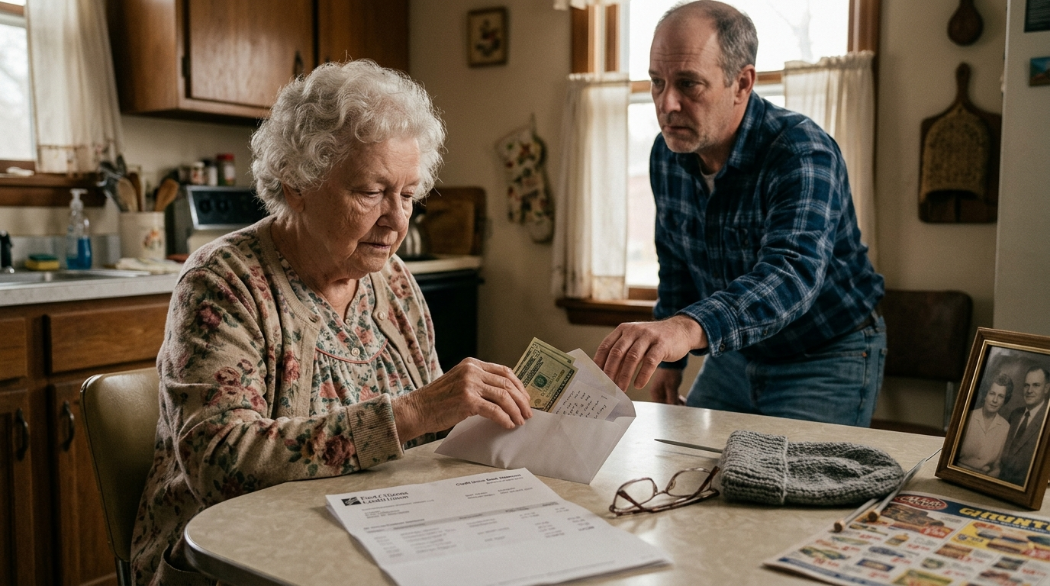
“Ma,” he said quietly. I kept looking at the shoebox. “Yes, honey?” “Did you go through my things?”
“No.”
“Did somebody tell you something?”
“No.”
“Then why are you doing this?”
The manager interrupted gently.
“She isn’t doing anything, Mr. Bennett. We’re reviewing her accounts at her request.”
He turned toward her.
“With all due respect, this is a family matter.”
The gentleman from elder services looked up from his notes.
“Not when someone else’s name appears on your mother’s bank records.”
Scott’s jaw tightened.
“I don’t know what you’re implying.”
“We haven’t implied anything.”
The manager slid a photocopy across the desk.
“This is a record of the monthly transfer.”
Scott did not touch it.
I did.
My hands were steadier than I expected.
The name was printed there in black ink.
EVELYN HARPER.
Underneath it was an account number, mostly masked.
And beneath that, the words:
Recurring transfer — authorized electronic instruction.
I stared at it.
“Who is she?”
The manager looked at me.
“We don’t know yet.”
Scott stood up so suddenly that his chair scraped against the floor.
“I’m done with this.”
“No,” I said.
He froze.
It was the first word I had spoken in several minutes.
I looked up at him.
“You’re not.”
His eyes met mine.
For a second, I saw the little boy who used to come running through the kitchen when he was eight years old because he had scraped his knee.
Then I saw the man who had been taking forty dollars from me every Friday.
I didn’t know which one was my son anymore.
He sat back down.
The gentleman from elder services said, “Mr. Bennett, we’re going to need you to explain your role in managing your mother’s finances.”
“I have power of attorney.”
The manager looked at him.
“Do you?”
“Yes.”
She turned a page.
“That’s not what our records show.”
Nobody moved.
Scott stared at her.
“What?”
“You have an authorized representative status on some of the accounts. You do not have power of attorney on file for all of them.”
He blinked.
“But I signed the paperwork.”
“Perhaps.”
“Then where is it?”
She paused.
“That’s what we’re trying to determine.”
Something cold moved through me.
“Scott.”
He didn’t answer.
“Where is my power of attorney?”
He rubbed his forehead.
“I don’t know, Ma.”
“You told me you had it.”
“I said I handled your finances.”
“You said I didn’t have to worry.”
“I was trying to help you.”
“Then why didn’t I have statements?”
His face hardened.
“Because you didn’t need them.”
The manager’s expression changed.
Only slightly.
But I saw it.
The gentleman saw it too.
Scott leaned back.
“Look, everybody is making this much bigger than it is. My mother gets confused. She’s been through a lot. After Dad died, she couldn’t even remember what day it was.”
“That was four years ago,” I said.
He looked at me.
“You still have trouble remembering things.”
“Yes.”
I nodded.
“I remember trusting you.”
That shut him up.
For a moment, nobody spoke.
Then the manager reached for another folder.
“There is one more matter.”
Scott looked at her.
She opened the folder.
“Three days ago, we received a request to close one of your mother’s certificates.”
Scott’s face went pale.
I looked at the manager.
“I didn’t request that.”
“No.”
She looked directly at Scott.
“You did.”
He swallowed.
“I was transferring it.”
“Where?”
“To another institution.”
“Which one?”
He didn’t answer.
The gentleman from elder services wrote something down.
I could hear the clock on the wall.
Tick.
Tick.
Tick.
The manager turned the paper toward me.
“This request was made yesterday afternoon.”
I stared at the signature.
It looked like mine.
But it wasn’t.
Not exactly.
My signature has always leaned slightly to the left. My husband’s name used to joke that I signed like I was trying to catch a bus.
This one was straighter.
Careful.
Practiced.
My stomach turned.
“That’s not my signature.”
Scott said nothing.
I looked at him.
“Is it?”
He stared at the floor.
“Scott.”
He lifted his head.
“No.”
The answer came so softly I almost didn’t hear it.
“No, Ma. It isn’t.”
The room seemed to tilt.
The manager closed the folder.
“Then we have a much larger problem.”
I felt Dottie’s hand touch my shoulder.
I hadn’t even realized she was crying.
I wasn’t.
Not yet.
Because something else had occurred to me.
Something that had been sitting at the edge of my thoughts since I first saw Evelyn Harper’s name.
“Miss Harper,” I said.
The manager looked at me.
“What about her?”
“Has she ever lived here?”
Scott’s eyes snapped toward me.
The manager frowned.
“I don’t understand.”
“I mean in this town.”
“I don’t know.”
“Could you find out?”
She hesitated.
“Why?”
I looked at my son.
“Because I think I know that name.”
Scott stood again.
“Ma, stop.”
There was something in his voice this time.
Not anger.
Fear.
I looked at him.
“Where have I heard it?”
“Nowhere.”
“Scott.”
“Nowhere.”
The gentleman from elder services closed his notebook.
“Mr. Bennett, sit down.”
He did.
I could hear my own heartbeat.
Then I remembered.
It wasn’t from a bank statement.
It wasn’t from church.
It wasn’t from one of Scott’s friends.
It wasn’t even from this town.
It was from a photograph.
A photograph my husband had kept in the bottom drawer of his desk.
A photograph I hadn’t seen since the week after his funeral.
My husband’s handwriting was on the back.
One sentence.
Six words.
I had forgotten the sentence.
But I remembered the name.
Evelyn Harper.
I looked at Scott.
“Your father knew her.”
He went completely still.
And that was when I understood something I hadn’t understood before.
The money wasn’t the mystery.
The money was only the trail.
I turned to the manager.
“There’s something else you need to know.”
She waited.
“My husband died four years ago.”
Scott closed his eyes.
“And the first payment to Evelyn Harper was made three days before his funeral.”
Nobody spoke.
I reached for Dottie’s hand.
The manager slowly looked at Scott.
“Mr. Bennett,” she said, “why would your mother be sending money to a woman your father knew before he died?”
Scott didn’t answer.
He couldn’t.
Because I had asked the wrong question.
And I knew it.
The right question was much worse.
I leaned forward.
“Scott,” I said.
He looked at me.
“What happened to Evelyn Harper?”
His face went white.
And for the first time in four years, my son looked at me like he was afraid of what I might remember.
Scott didn’t answer me.
He didn’t have to.
Sometimes silence tells you more than a confession ever could.
The manager watched him carefully. Dottie was still holding my hand beneath the table, her thumb moving slowly across my knuckles the way she used to when we were girls and one of us had been scolded by a teacher.
I looked at Scott.
“What happened to her?”
“I don’t know.”
His answer came too quickly.
The gentleman from elder services leaned forward.
“You said a moment ago that you didn’t know anyone named Evelyn Harper.”
Scott stared at him.
“I don’t.”
“But your mother says your father knew her.”
“I wouldn’t know everyone my father knew.”
“You were his executor.”
“Yes.”
“You handled his estate.”
“Yes.”
“And you handled your mother’s finances afterward.”
Scott’s eyes moved toward me.
“Yes.”
The gentleman nodded.
“Then perhaps you can explain why payments began to Evelyn Harper three days before your father’s funeral.”
Scott’s mouth opened.
Nothing came out.
I felt something inside me settle.
Not calm.
Something colder.
Certainty.
I said, “You knew.”
He looked at me.
“Ma…”
“You knew who she was.”
“No.”
“Then why are you scared?”
“I am not scared.”
“You are.”
He pushed his chair back.
“I need some air.”
The manager said, “Please stay seated.”
He looked at her with an expression I had never seen before.
“You’re treating me like a criminal.”
“No,” she said. “We’re treating your mother like an account holder.”
That sentence seemed to hit him harder than anything else.
My account holder.
My name.
My money.
My life.
Things I had slowly allowed other people to speak for me.
I reached into my purse.
My fingers found the folded photograph I had brought from home.
I had found it that morning in the bottom drawer of my husband’s old desk.
I had almost left it there.
Instead, I brought it with me.
I unfolded it.
It was an old photograph.
My husband was standing beside a woman I had never met.
She was perhaps ten years younger than me, with dark hair cut just below her ears and a small silver cross around her neck.
On the back, in my husband’s handwriting, were the words:
Evelyn — March 1998. Don’t tell Margaret yet.
My heart stopped.
Margaret was me.
I looked at Scott.
“Why didn’t Dad want me to know about her?”
He stared at the photograph.
His eyes filled with tears.
Not the kind of tears a guilty man uses to manipulate you.
Real tears.
That frightened me even more.
“Scott?”
He sat down slowly.
“She was my father’s daughter.”
The room went silent.
I looked at him.
“What?”
“My half-sister.”
The words didn’t make sense.
I looked back at the photograph.
Then at Scott.
“My husband had a daughter?”
“Before you met him.”
I shook my head.
“No.”
“Ma, please.”
“No.”
I stood up.
My knees felt weak.
“No, your father would have told me.”
“He wanted to.”
“Then why didn’t he?”
Scott rubbed both hands over his face.
“Because he was ashamed.”
“Of what?”
He didn’t answer.
The manager quietly closed the folder.
Dottie whispered my name.
I sat down again.
“Tell me.”
Scott looked at me.
“Evelyn’s mother was seventeen.”
I felt the blood drain from my face.
“Your father was twenty-three.”
He continued before I could speak.
“They weren’t married. They weren’t even together very long. When she got pregnant, Dad left.”
I stared at him.
“Left her?”
“He said he was going to come back.”
“And he didn’t.”
“No.”
I thought of my husband.
The man who had spent forty-three years making coffee for me every morning.
The man who never forgot my birthday.
The man who cried when our dog died.
The man I had believed I knew.
“What happened to Evelyn?”
“She found him years later.”
“Why?”
“To get money.”
Scott’s voice was barely audible.
“Dad had money by then. He owned the business. He had investments. She wanted him to help her.”
“Did he?”
“Yes.”
“How much?”
Scott looked at the table.
“A lot.”
The manager asked, “And the monthly payments?”
Scott nodded.
“Dad started them.”
I stared at him.
“Then why did they continue after he died?”
He looked at me.
“Because Dad made me promise.”
The room seemed to shrink.
“You promised your father?”
“Yes.”
“To keep paying her?”
“Yes.”
“With my money?”
Scott closed his eyes.
“I didn’t think it was your money.”
I laughed.
It came out ugly.
“Whose was it?”
“Dad’s.”
“He died.”
“I know.”
“Then his money became mine.”
“I know.”
“Then why did you take it?”
He finally looked at me.
“Because Evelyn was dying.”
That stopped me.
“What?”
“She had cancer.”
Dottie squeezed my hand.
Scott continued.
“Dad knew before he died. He told me she didn’t have much time. He said he wanted to make sure she was taken care of.”
“So you paid her.”
“Yes.”
“How much?”
“Two thousand a month.”
I stared at him.
Two thousand.
Every month.
For four years.
Eight thousand dollars a year.
Thirty-two thousand dollars.
My money.
My stomach twisted.
“Where did the rest go?”
Scott didn’t answer.
I knew immediately.
“The forty dollars.”
His face changed.
I felt something crack inside me.
“You took forty dollars every Friday.”
“I had expenses.”
“What expenses?”
“Groceries. Utilities. Your medication.”
“I pay for my own groceries.”
“I know.”
“My medication comes from my insurance.”
“I know.”
“Then what did you need forty dollars every week for?”
He looked away.
The gentleman from elder services spoke quietly.
“Mr. Bennett, I think you should answer that.”
Scott’s eyes remained on the floor.
“I was paying bills.”
“Which bills?”
“My mother’s.”
“I don’t have bills you pay.”
He looked at me.
“Not anymore.”
“What does that mean?”
He didn’t answer.
I turned to the manager.
“Can you tell me where the rest of the money went?”
She nodded.
“We can investigate.”
“No.”
Scott spoke suddenly.
“Ma, don’t.”
I looked at him.
“Don’t what?”
“Don’t make this bigger.”
I felt strangely calm.
“It is already bigger.”
“No. You don’t understand.”
“Then help me understand.”
He swallowed.
“There were other withdrawals.”
“How many?”
He didn’t answer.
The manager opened another folder.
“We found twenty-seven additional transactions that don’t correspond to the regular Friday withdrawals.”
She slid the records toward me.
I looked down.
There were checks.
Cash withdrawals.
Electronic transfers.
Small amounts at first.
Then larger ones.
$700.
$1,200.
$4,500.
$9,000.
I couldn’t breathe.
“What are these?”
Scott whispered, “Ma…”
I looked at him.
“What are these?”
He lowered his head.
“Dad’s debts.”
I stared at him.
“My husband had debts?”
“Not his.”
“Whose?”
Scott didn’t answer.
The manager did.
“Mr. Bennett’s.”
I looked at my son.
The man I had raised.
The child I had protected.
The boy whose first bicycle I had bought with money from my sewing.
The teenager whose college tuition I had worked two jobs to help pay.
The man who had told me every Friday that money was tight.
“You had debts.”
He nodded.
“And you used my account.”
“I was going to pay it back.”
“When?”
“I don’t know.”
“Four years?”
He cried then.
Quietly.
“I got in over my head.”
I looked at the statements.
“Why didn’t you tell me?”
“Because I knew you’d give me everything.”
That hurt more than the theft.
Because he was right.
I would have.
I had given him everything when he asked.
But then I saw the photograph again.
Evelyn.
My husband’s secret daughter.
And something didn’t fit.
I looked at Scott.
“If your father wanted Evelyn taken care of, why did he leave no provision for her?”
“He did.”
I froze.
“What?”
“He left something.”
“What?”
Scott looked at the manager.
She looked back at him.
Then he whispered:
“There’s another account.”
The manager’s face changed.
“What account?”
Scott shook his head.
“I don’t know the number.”
“You just said there was another account.”
“My father told me about it.”
“Where?”
“Safe deposit box.”
I felt the room go cold.
My husband had a safe deposit box.
I knew that.
I had forgotten about it.
After his death, Scott told me there was nothing important inside.
He had handled everything.
I had signed papers.
I had trusted him.
I looked at the manager.
“Is there a safe deposit box in my name?”
She checked the computer.
“No.”
I looked at Scott.
“Whose name is it in?”
He didn’t answer.
The manager looked at the screen for a long time.
Then she slowly raised her eyes.
“Margaret…”
“Yes?”
“There is a safe deposit box here.”
My heart began pounding.
“Whose?”
She hesitated.
“Your husband’s.”
I stared at her.
“But he’s dead.”
“Yes.”
“Then who has access?”
The manager looked at Scott.
And Scott looked at me.
Nobody spoke.
Finally, the manager said:
“According to our records, your son does.”
I turned toward him.
“You opened it?”
Scott’s face crumpled.
“Once.”
“When?”
He looked at the photograph.
“Two weeks after Dad died.”
“What did you find?”
He shook his head.
“I found a letter.”
“To whom?”
He looked at me.
“To you.”
My breath caught.
“Where is it?”
Scott said nothing.
“Where is my husband’s letter?”
He closed his eyes.
“I burned it.”
Dottie whispered, “Oh, Margaret.”
I stared at my son.
Then the manager said something that made every hair on my arms rise.
“Mr. Bennett…”
Scott looked up.
“The box was opened again last month.”
He went completely still.
“I didn’t open it.”
The manager checked the record.
“You’re right.”
Scott’s face drained of color.
“Then who did?”
The manager turned the screen toward us.
“There is one other authorized signature.”
I leaned forward.
“Whose?”
She looked at me.
“Evelyn Harper.”
And then my son’s phone began ringing.
He looked at the screen.
His entire body stiffened.
I couldn’t see the number.
But I saw the name.
He turned the phone face down.
I reached across the table.
“Answer it.”
“Ma, please.”
“Answer it.”
He didn’t.
The phone stopped.
A second later, it rang again.
This time, a message appeared on the screen.
Scott read it.
Then he looked at me.
And whatever color remained in his face disappeared.
“What does it say?” I asked.
He didn’t answer.
I took the phone from his hand.
The message was only seven words.
She knows what happened to your father.
I read the message twice.
She knows what happened to your father.
For a long moment, nobody moved.
Then I looked at Scott.
“What does that mean?”
He didn’t answer.
“Scott.”
His eyes were fixed on the phone in my hand.
“Who sent it?”
He swallowed.
“Evelyn.”
The manager stood.
“I think we should contact the appropriate authorities before anyone leaves.”
Scott immediately shook his head.
“No.”
It was the first time he had sounded genuinely frightened.
“No police.”
I looked at him.
“Why?”
“Because you don’t understand.”
“Then explain it.”
He sat down.
His shoulders dropped.
And suddenly he looked much older than his forty-two years.
“I didn’t kill Dad.”
Nobody had accused him of that.
But he had said it anyway.
The room became very still.
I felt Dottie’s fingers tighten around mine.
I whispered, “I didn’t ask if you killed him.”
“I know.”
Scott looked at the floor.
“But you were going to.”
“No,” I said.
Then I paused.
“Were you there when he died?”
“Yes.”
“Tell me everything.”
He took a long breath.
“Dad was sick.”
“I knew he was sick.”
“No, Ma. You knew he had heart problems. You didn’t know how bad it was.”
I remembered the last month of my husband’s life.
The hospital visits.
The tiredness.
The way he had stopped walking after dinner because he said his legs felt heavy.
I remembered Scott telling me not to worry.
I remembered him saying, Dad just needs rest.
Scott continued.
“Dad knew he was dying.”
My eyes filled with tears.
“He knew?”
“Yes.”
“Why didn’t he tell me?”
“Because he didn’t want his last weeks to be about dying.”
That sounded exactly like my husband.
I looked away.
Scott wiped his face.
“The night before he died, Dad gave me instructions.”
“About Evelyn?”
“Yes.”
“He told me she was his daughter. He told me where to find her. He told me he wanted her taken care of.”
“Then why hide her from me?”
Scott looked at me.
“Because he was ashamed.”
I closed my eyes.
All those years.
All those ordinary mornings.
All those secrets.
“What else?”
Scott hesitated.
“He also told me something about you.”
My eyes opened.
“What?”
“He said you would give everything away if you knew he had another child.”
I almost smiled.
“That sounds like me.”
“It does.”
He smiled faintly.
Then the smile disappeared.
“He was right.”
The manager quietly asked, “What happened after that?”
Scott looked down.
“I found Evelyn.”
“And?”
“She wasn’t what Dad expected.”
“How?”
“She was angry.”
“I don’t blame her.”
“Neither did Dad.”
Scott’s voice cracked.
“He had spent forty years wondering what her life had been like. He wanted to fix it with money.”
“Could money fix it?”
“No.”
He shook his head.
“She didn’t want his money at first.”
“What did she want?”
“The truth.”
I felt a chill.
“What truth?”
Scott looked at me.
“She wanted to know why he abandoned her.”
I said nothing.
“He couldn’t answer her.”
“And then?”
“She eventually accepted the money.”
“How much?”
“Two thousand a month.”
I looked at the statements.
“So those payments were real.”
“Yes.”
“Why didn’t you tell me?”
“Because Dad made me promise.”
I shook my head.
“Your father was wrong.”
Scott nodded.
“I know.”
“And you?”
“I was scared.”
“Of what?”
“Of losing everything.”
I frowned.
“What did you mean?”
He looked at me.
“The business.”
My husband’s business.
The small construction company he had built from nothing.
The company Scott had taken over after his death.
“What happened to it?”
Scott lowered his eyes.
“It was failing.”
I stared at him.
“What?”
“I borrowed money.”
“How much?”
“Too much.”
“And you used my accounts to pay it back.”
“Yes.”
“Why didn’t you sell the company?”
“Because Dad spent his whole life building it.”
I felt tears come to my eyes.
“Your father would have sold it before he stole from me.”
Scott nodded.
“I know.”
There was no defense left.
Only truth.
The manager closed the folder.
“Mr. Bennett, we will need to investigate the unauthorized transfers. But if you are willing to cooperate, that will be taken into consideration.”
Scott nodded.
“I will.”
I looked at him.
“You will?”
“Yes.”
“Even if it means losing the house?”
His eyes filled with tears.
“Yes.”
“Even if it means prison?”
He looked at me.
“I don’t want to go to prison.”
“No one does.”
“I made terrible choices.”
“Yes.”
“I hurt you.”
“Yes.”
“I know.”
He covered his face.
“I am sorry, Ma.”
I didn’t hug him.
Not then.
Some wounds need air before they can be touched.
The manager asked whether I wanted to proceed with a formal investigation.
I looked at the shoebox.
At the statements.
At the photograph.
Then I said yes.
But I also said something else.
“I want my son to have a chance to make things right.”
The gentleman from elder services nodded.
“That is your decision.”
It took months.
There were meetings.
Lawyers.
Bank records.
Tax records.
The truth came out slowly, like a room being cleaned after years of darkness.
Scott had taken far more than I knew.
But not everything was gone.
The credit union helped recover some funds.
The rest came from the sale of his truck and the deck he had built with borrowed money.
He sold the house.
He paid what he could.
And he entered into a repayment agreement for the remainder.
It wasn’t easy.
There were consequences.
There should have been.
But something unexpected happened during those months.
Evelyn came to see me.
In person.
She was sixty-three.
She wore the same silver cross from the photograph.
When she stood on my porch, I knew immediately who she was.
She looked at me for a long time.
Then she said:
“You must be Margaret.”
I nodded.
“And you must be Evelyn.”
She smiled sadly.
“I’ve wanted to meet you for forty years.”
We sat at my kitchen table.
I made tea.
Neither of us drank it.
She told me about my husband.
About the years before I knew him.
About the letter he had written to her.
And then she gave me something.
An envelope.
My name was written on the front.
My husband’s handwriting.
The letter Scott had burned wasn’t the only copy.
Evelyn had kept hers.
I opened it with shaking hands.
It said:
Margaret,
If you are reading this, then I have failed to tell you something I should have told you years ago.
Evelyn is my daughter.
I was young and selfish and afraid, and I made a choice that I spent the rest of my life regretting.
You deserved the truth.
She deserved a father.
I cannot change the past.
But I hope you can forgive me.
And I hope, someday, you will forgive her too.
I couldn’t read the rest.
I pressed the letter against my chest.
Evelyn reached across the table.
“You don’t have to forgive him today.”
I looked at her.
“I already did.”
She began to cry.
So did I.
That was the beginning.
Not the ending.
The beginning.
Evelyn and I became friends.
Slowly.
Carefully.
We discovered that we both hated raisins in cookies.
We both sang slightly off-key at church.
We both liked old mystery novels.
And we both had a habit of saving wrapping paper because it seemed wasteful to throw away something still perfectly good.
It turned out that grief had given me a sister I never knew I had.
As for Scott, he worked.
He started over.
He went to counseling.
He apologized without asking me to make his guilt easier for him.
That mattered.
One Friday, almost a year after the day at the credit union, there was a knock on my door.
It was Scott.
He stood there holding an envelope.
I knew what it was.
He held it out.
“Your money, Ma.”
I took it.
“How much?”
“Forty dollars.”
I smiled.
Then I handed it back.
“Keep it.”
He looked surprised.
“I don’t need it.”
“I know.”
“Then why?”
“Because I want you to buy your daughter something nice.”
He smiled.
“She’s thirteen now.”
“I know.”
“She still likes your knitting.”
I laughed.
“She has excellent taste.”
He laughed too.
Then he looked at me.
“Can I come in?”
I stepped aside.
“Yes.”
He entered.
And for the first time in years, he didn’t walk through my house like the person in charge.
He walked through it like my son.
That Sunday, my granddaughter opened her birthday present.
It wasn’t a knitted sweater.
It was a little silver locket.
Inside was a photograph of me and her together.
She hugged me so hard I nearly lost my balance.
“Grandma,” she said, “this is perfect.”
I looked across the room.
Scott was watching us.
Evelyn was beside him.
Dottie was eating cake she had promised not to touch until after dinner.
For a moment, I thought about the shoebox.
One hundred and ninety envelopes.
I still have them.
I don’t keep them because I want to remember what Scott did.
I keep them because I want to remember what I did.
I opened my own bank statement.
I asked questions.
I walked into that credit union.
I sat at that table.
I said no when I needed to say no.
And I learned something I wish someone had taught me years earlier:
Being a good mother does not mean giving your children everything.
Being a good mother does not mean protecting them from every consequence.
And loving someone does not require you to become invisible.
These days, my statements come to my house.
They arrive in my mailbox with my name printed clearly across the front.
I open every one.
Sometimes I understand every number.
Sometimes I don’t.
But when I don’t, I call someone.
And I ask.
Because the strangest thing about getting older is realizing that independence isn’t about doing everything alone.
It’s about knowing you still have the right to ask where your own life is going.
Last spring, I entered another quilt in the church raffle.
My name wasn’t drawn this time.
Evelyn’s was.
When she won, she laughed so hard she cried.
Then she handed me the quilt.
“I think this belongs to you.”
I shook my head.
“No.”
“Yes.”
“Why?”
She smiled.
“Because it took forty years to get here.”
I looked at the quilt in my hands.
It was blue and white.
Small pieces sewn together.
Some pieces didn’t match.
Some were old.
Some were new.
But somehow, together, they made something beautiful.
I thought about my marriage.
My son.
My husband’s secret.
The money.
The lies.
The truth.
The woman who had arrived at my door carrying the missing piece of my husband’s past.
And I finally understood.
Not every broken thing has to be thrown away.
Sometimes you repair it.
Sometimes you let it go.
And sometimes, if you’re very lucky, you discover that what looked like the end of your family was actually the moment your family finally learned how to tell the truth.
I folded the quilt over my arm.
Then I went home.
My own home.
My own mailbox.
My own bank account.
And for the first time in four years, I didn’t feel poor.
I felt free.