0 views
He had started writing the confession that night. Eleven months of drafts.
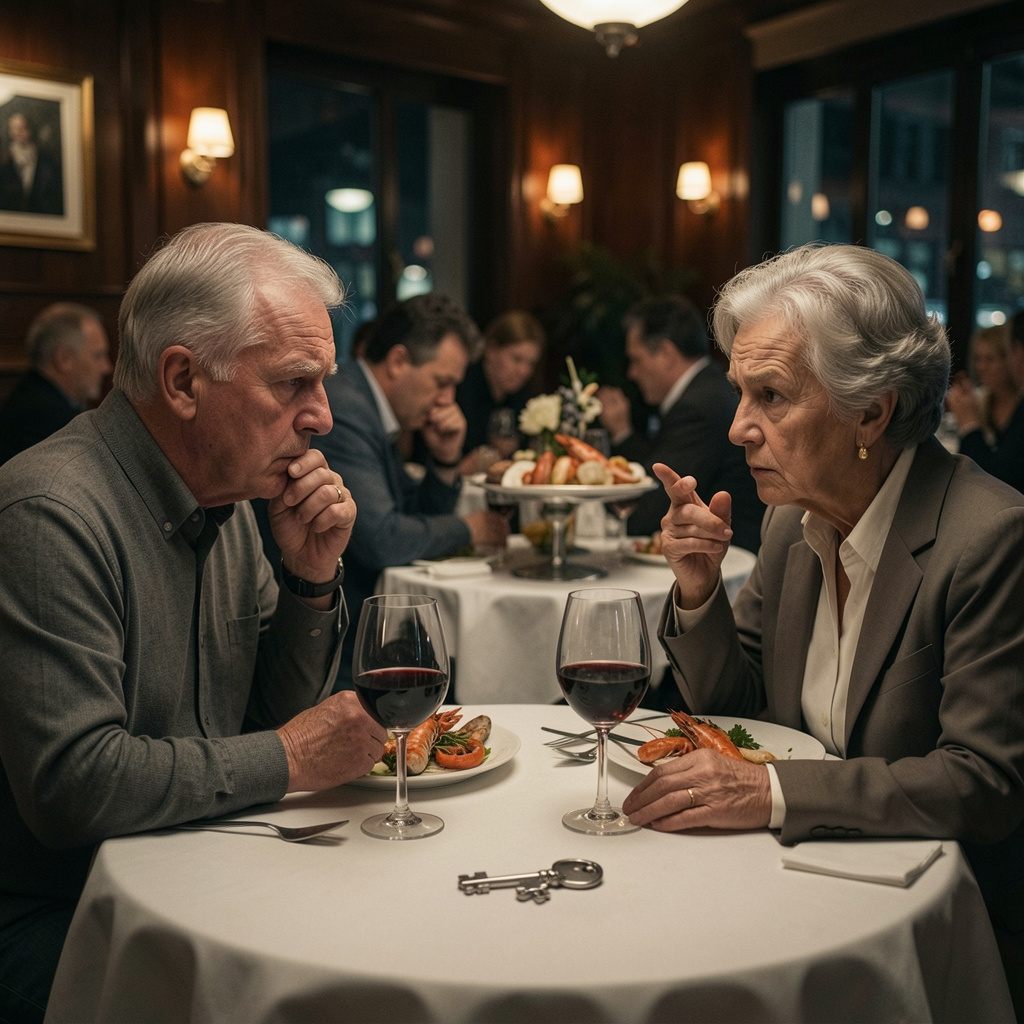
He had chosen Red Lobster because it was ordinary. Because he had been afraid of a beautiful setting, afraid that beauty would make the thing feel romantic or dramatic, when what he wanted — what he owed her — was the truth delivered in the plainest possible room.
She reached out now and touched the key. Just touched it. Didn’t pick it up.
“Last Tuesday,” Margaret said, “I added something new to those papers.”
He went still.
She let the sentence breathe for a moment, in the manner of someone who has waited eight years and can afford a few more seconds.
“Would you like to know what it is?”
He would learn what was in the box. But not yet. Because Margaret, who had spent thirty years teaching twelve-year-olds that a story’s power lived in what you delayed, understood timing in a way he never quite had.
“Not here,” she said. She picked up her fork and returned, with almost aggressive normalcy, to the shrimp scampi. “Eat your dinner, Daniel.”
He could not eat. He watched her instead. The way she pulled a napkin corner through her fingers between bites, the habit of twenty years of paper-grading. The reading glasses pushed up into her silver-brown hair. The thin scar on her left wrist from the ice-skate accident of 1998, the one he had been there for, at the rink, holding her hand while the EMT wrapped it, twenty-one years old and already understanding he would love this woman for a very long time. The person sitting across from him had once been that woman and was still that woman and was also someone else entirely, someone who had sat in a hotel lobby with a paper cup of tea and held a set of papers for eight years and said nothing.
He ate three bites of lobster tail. He didn’t taste them.
They drove home in his car. She had ridden with him to the restaurant and now she sat with her purse in her lap, the key somewhere inside it, and looked out the window at the Friday-night street life of their town — the pizza place they ordered from every other week, the library where she volunteered on Thursday mornings, the park where they had walked a dog that had died in 2020. Their life, arranged along the route home.
Inside the house, she did not turn on the overhead light. She turned on the lamp by the bookcase, the warm-toned one they had bought at an estate sale in Bucks County. The light made the living room look the way it did in winter, intimate in the way that rooms get when the nights come early.
She sat in her chair — it was genuinely hers, the green armchair she had recovered twice, the one he never sat in without permission somehow — and set her purse on the floor beside it and looked at him.
He sat across from her on the couch. The couch where they had watched a thousand hours of television and had the measured, careful argument about Portugal’s itinerary and where she had curled against him during the three nights after her mother died. He felt the history of the couch under him like a physical pressure.
“The box,” she said, “is at First National. You know the branch on Orchard.”
He nodded.
“In it there are two things. Gerald’s papers — eight years old now, but he drew them up well. The terms hold. I’ve had them reviewed twice since.” She crossed her ankles. “And a letter.”
“From you?”
“To you.” She looked at the lamp. “I wrote it in November 2016. The night after I sat in that lobby.” She paused. “I’ve added to it. Over the years. Not often. Four or five times, when something felt important enough to put down.”
He thought about what she might have written. The day her mother died. Portugal. The kitchen renovation, during which they had fought badly and he had slept in the guest room for two nights. His promotion, the dinner she had cooked to celebrate it.
“Last Tuesday,” she said, “I added a final entry.”
“What happened last Tuesday?”
She looked at him then, and for the first time that evening he saw something shift behind the steadiness. Not grief, exactly. Something older than grief, something that had been living alongside grief for a long time and had started to resemble it from a distance but was in fact its own separate country.
“I went back to Gerald’s office,” she said. “The firm, rather. He has a partner, Diane, who took over his caseload. I’d worked with her a few times over the years, keeping things current.” She let that register. Keeping things current. “I told her I wanted to make a decision.”
“What decision?”
“Whether to file.” She said it simply. “I’ve been deciding, Daniel, for eight years. Every year, I’ve decided to wait one more year. To hold the option.” She touched the arm of the chair. “Diane suggested I ought to consider what I was waiting for.”
“And what were you waiting for?”
The question came out before he could consider it, and the moment it was in the air between them he understood it was the right question, perhaps the only question, the one that had been waiting inside all the others.
Margaret was quiet for what felt like a long time.
“I was waiting for you to tell me,” she said. “I think. I was waiting to see whether you were the kind of man who would tell me, eventually. Whether you had it in you.” She looked at her hands. “Eleven months ago, Gerald died, and I thought — well. I thought either it happens now or it never happens. So I gave you time. The length of a school year. September to June. That felt like a fair unit of time.”
The school year.
“Our anniversary,” he said.
“The end of June.” She nodded. “Yes.”
He understood, then. The reservation at Red Lobster had been his idea, or he had thought it was his idea — let me take you somewhere, Margaret, for our anniversary, somewhere we haven’t been in a while. And she had agreed easily, too easily, and he had booked the table and spent eleven months composing his confession, and she had known. She had set a deadline without telling him what it was. She had waited to see whether he would arrive at the table with the truth in his hands or with a card and a toast and another year of silence.
He had arrived with the truth.
She was watching him understand this.
“What did you add to the letter?” he asked. “Last Tuesday.”
“I wrote that I had made an appointment to meet with Diane.” She paused. “And that I was going to cancel it if you told me the truth by the end of June.” She looked at him steadily. “I was going to cancel it and open the box and burn the papers and give you the letter to read. Everything I wrote. All of it.”
“And if I hadn’t told you?”
“I was going to send you to the box alone.” Her voice didn’t waver. “With the key. And let you read the letter before the papers were filed.”