the man in my husband’s green cardigan.
He stood when he saw me.
That was when I recognized him.
Not his face.
His hands.
Long fingers. A crooked little scar across the left thumb.
My husband’s hands.
Except my husband had been dead for five years.
The man took one step toward me.
“Evelyn?”
My fingers tightened around the pie boxes.
I knew that voice.
Not from five years ago.
From thirty-two years ago.
From a winter evening when Daniel was six years old and had a fever so high I was afraid to sleep. A man had knocked on our apartment door carrying a paper bag of oranges and a little wooden train for my boy.
His name was Thomas.
Thomas Bell.
My husband’s younger brother.
I had not seen him since the funeral.
I had been told he was living overseas.
I had been told he wanted nothing to do with the family.
I had been told a great many things.
Thomas stared at me as if he had seen a ghost.
Then he looked past me.
At the bakery truck.
At the four pie boxes.
And something changed in his face.
“You’re the baker,” he whispered.
I nodded.
“Yes.”
Melissa appeared behind my son.
She was holding a serving spoon.
Her mother stood beside her, confused.
“Evelyn?” she said.
I looked at her.
“I’m sorry. Have we met?”
Her mouth opened.
Melissa closed her eyes.
“Mom,” she said quietly.
Her mother turned toward her.
“Melissa.”
There was something in that one word.
Not anger.
Recognition.
The kind that comes when a person suddenly sees the shape of a lie.
I stepped inside.
Nobody stopped me.
I set the pies on the sideboard.
“One pumpkin. One pecan. One apple. One sweet potato.”
My voice sounded very calm.
Almost cheerful.
“Four pies, as ordered.”
Daniel still hadn’t moved.
“Mom, I don’t understand.”
“I know.”
I reached into my coat pocket.
The three folded tickets were there.
I had carried them all night.
I placed them on the table.
The first one.
November 24.
Party of twelve.
The second.
November 23.
Party of thirteen.
The third.
November 22.
Party of fourteen.
Daniel picked them up.
His eyes moved over the handwriting.
Then to Melissa.
“What is this?”
She didn’t answer.
I did.
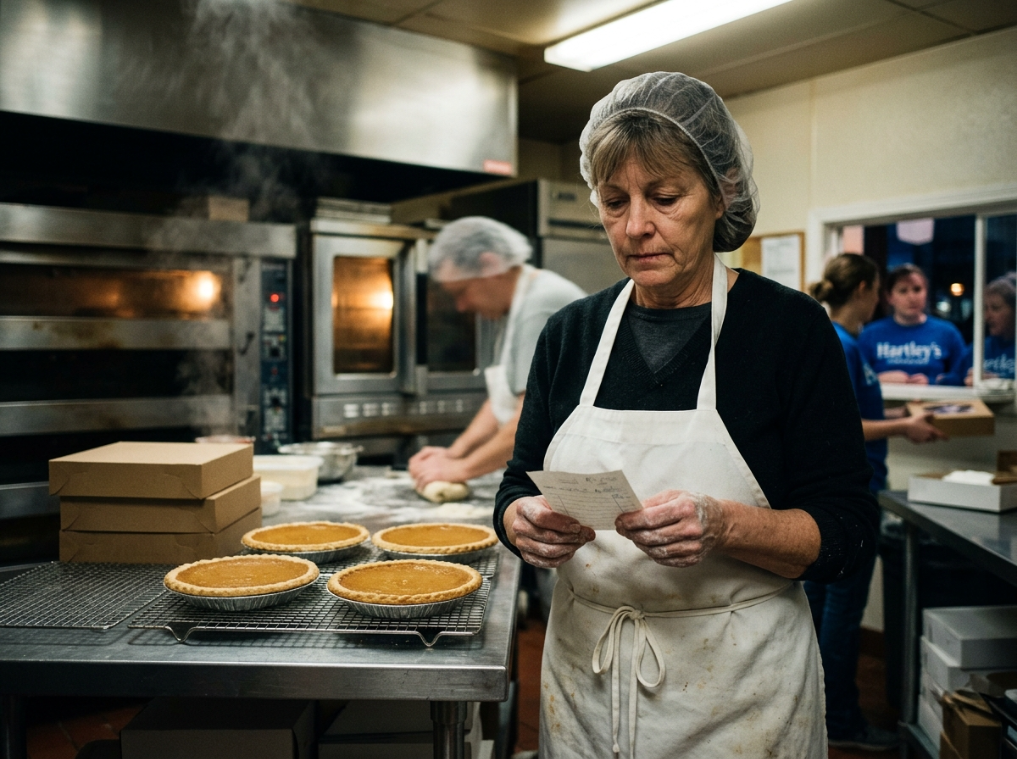
“These are the Thanksgiving orders your wife placed at Hartley’s for the last three years.”
Daniel looked at me.
“We didn’t have Thanksgiving parties.”
I smiled sadly.
“I know.”
“No,” he said. “Mom, we invited you.”
His voice cracked on the last word.
“Every year.”
I looked at Melissa.
She was crying now.
Not dramatically.
Just silently.
Tears running down her face while she stared at the floor.
I had imagined this moment a hundred times.
In every version, I was angry.
In every version, I had something sharp and perfect to say.
But standing there, looking at my son, I discovered the strange thing about finally getting the truth.
It doesn’t feel like victory.
It feels like grief arriving late.
Daniel came toward me.
“Mom, I swear to you, I never told you not to come.”
“I believe you.”
His face crumpled.
“Then why did you keep saying you wanted to be alone?”
I looked at him.
“I never did.”
He stopped.
The room became so quiet I could hear the clock over the kitchen door.
Tick.
Tick.
Tick.
Melissa’s mother sat down.
Her father remained standing.
“Melissa,” her mother said, “tell us what happened.”
Melissa shook her head.
“I didn’t—”
“Tell us.”
That was when Thomas spoke.
“She wasn’t the one who started it.”
Everyone turned.
I looked at him.
“What did you say?”
Thomas swallowed.
“I said she wasn’t the one who started it.”
Daniel stared at his uncle.
“Started what?”
Thomas looked at me.
There was shame in his face.
Deep shame.
The kind that had been carried so long it had become part of the bones.
“I need to explain something.”
I folded my arms.
“I’ve waited five years.”
Thomas nodded.
“I know.”
He reached into the pocket of the green cardigan.
And pulled out an envelope.
Old.
Yellowed.
My name was written across the front.
Evelyn Hart.
I knew the handwriting immediately.
My husband’s.
My knees nearly gave way.
Daniel caught my elbow.
“Mom?”
I took the envelope.
My hands were shaking.
“Where did you get this?”
Thomas looked down.
“Your husband gave it to me the week before he died.”
The room disappeared for a moment.
There was only the envelope.
My husband’s handwriting.
His name.
The past, suddenly alive in my hands.
“Why,” I whispered, “didn’t you give it to me?”
Thomas closed his eyes.
“Because he asked me not to.”
Daniel’s voice was barely audible.
“Dad asked you to keep a letter from Mom?”
“Yes.”
“Why?”
Thomas looked at him.
“Because your father knew something was going to happen.”
I looked at the green cardigan.
Then back at the envelope.
“What was going to happen?”
Thomas didn’t answer.
Instead, he looked at Melissa.
And she whispered:
“Grandma knows.”
I turned.
Her grandmother was crying.
Her mother covered her mouth.
“Knows what?” I asked.
Nobody spoke.
Then my granddaughter stood.
“Grandma,” she said.
I looked at her.
She was nineteen now.
The last time I’d seen her properly, she was fourteen.
She walked toward me slowly.
“I tried to tell you.”
My heart tightened.
“What?”
She reached for my hand.
“I sent you the picture.”
“I know.”
“No. I mean the other picture.”
“What other picture?”
She looked at her mother.
Melissa shook her head.
My granddaughter’s eyes filled.
“The one with Grandpa’s cardigan.”
The room seemed to tilt.
“You sent that?”
“Yes.”
“Why?”
“Because I wanted you to know he was here.”
I stared at her.
“Who?”
She whispered the answer.
“Uncle Thomas.”
I looked at Thomas.
He nodded.
“I’ve been here every Thanksgiving.”
“For five years?”
“Yes.”
“But why?”
He looked at Daniel.
Then at me.
“Because your husband asked me to watch over the family.”
I almost laughed.
Not because it was funny.
Because it was too strange to believe.
“My husband is dead, Thomas.”
“I know.”
“And you think he left you instructions to spy on us?”
“No.”
He took a breath.
“He asked me to find out why you were being kept away.”
Daniel stepped forward.
“Kept away?”
Thomas nodded.
“Your father suspected someone was lying to you.”
Daniel turned slowly toward Melissa.
She began crying harder.
“I didn’t know it would go this far.”
My voice came out very softly.
“What didn’t you know?”
Melissa wiped her cheeks.
“I thought it would be one year.”
Daniel stared at her.
“One year of what?”
She looked at him.
“I thought I was protecting you.”
“From what?”
“From your mother.”
The words landed harder than shouting would have.
Daniel stepped back.
“Protecting me from my mother?”
“She hated me,” Melissa whispered.
I shook my head.
“I never hated you.”
“You did.”
“I didn’t.”
“You made me feel like I was never good enough for your family.”
I stared at her.
And suddenly I remembered.
The first Thanksgiving after my husband died.
Melissa had called me two days before.
She had sounded nervous.
She had said, “Maybe it would be easier if you stayed home this year.”
I had cried afterward.
I had never told Daniel.
The following year, the same thing.
Then the next.
Except now I understood.
There had been more.
Every invitation I never received.
Every phone call I never got.
Every holiday I thought my son had forgotten me.
A thousand tiny doors closing.
And I had blamed myself for every one.
Daniel looked at his wife.
“Why?”
Melissa couldn’t answer.
Her mother did.
“Because she was afraid.”
Everyone looked at her.
She was staring at the gravy boat.
My mother’s gravy boat.
White porcelain.
Gold rim.
My initials were still faintly visible underneath.
E.H.
Her mother whispered:
“Melissa was afraid that if you came, Daniel would find out.”
“Find out what?”
She looked at me.
“That you weren’t the problem.”
Nobody moved.
Then Thomas spoke.
“The real problem was the inheritance.”
My stomach dropped.
Daniel looked confused.
“What inheritance?”
Thomas looked at me.
“Your husband changed his will six weeks before he died.”
I gripped the back of a chair.
“What did he change?”
Thomas looked toward the envelope in my hand.
“Everything.”
And suddenly I understood why my husband had asked him to wait.
Why the letter had never reached me.
Why the Thanksgiving table had been filled with people I had never been invited to meet.
Why my daughter-in-law had spent three years pretending I wanted to be alone.
And why someone had been wearing my husband’s cardigan at the head of my son’s table.
The mystery was never about Thanksgiving.
It was about what my husband had left behind.
And someone in that room already knew exactly where it was.
I looked down at the envelope.
Then at my son.
“Daniel,” I said quietly, “before I open this, I need you to answer one question.”
He nodded.
“Did you know your father had changed his will?”
“No.”
I looked at Melissa.
She closed her eyes.
That was answer enough.
I turned the envelope over.
The seal was still intact.
My husband’s handwriting stared back at me.
And for the first time in five years, I felt afraid of what my husband might have known about the people sitting around that table.
I slipped my thumb beneath the seal.
And opened the letter.
The paper inside the envelope was folded twice.
I knew before I opened it that my husband had written it himself.
He always pressed too hard with a pen.
The letters left little grooves in the paper, as if he were trying to make sure his words survived him.
I unfolded the first page.
Evelyn,
Just my name.
Nothing else.
And somehow that hurt more than anything.
Daniel stood beside me.
“Mom?”
I held up a hand.
“Let me read it.”
My voice sounded strange.
Older.
I began.
If Thomas has finally given you this letter, then I am no longer there to explain what I should have explained years ago.
I stopped.
Thomas lowered his eyes.
I continued.
First, I need you to know that none of this is your fault.
My vision blurred.
I blinked hard.
The next sentence was worse.
I have discovered that someone in our family has been taking money from the business.
Daniel whispered, “What?”
I kept reading.
I don’t know how much has been taken. I only know that the records have been altered, and the person doing it has access to accounts and signatures that should have been protected.
Daniel looked at Thomas.
Thomas shook his head.
“Keep reading.”
I did.
I suspect the person is close to Daniel. Closer than I am comfortable saying in a letter.
My hands began to tremble.
Daniel stepped closer.
“Mom, who was Dad talking about?”
I looked at the page.
There was another paragraph.
If you are reading this after my death, do not accuse anyone until you have seen the blue ledger.
I stopped.
“The blue ledger?”
Thomas nodded.
“I knew about that part.”
“Where is it?”
He didn’t answer.
I looked at him.
“Thomas.”
“It isn’t with me.”
“Then where is it?”
He looked toward Melissa.
Everyone followed his eyes.
Melissa went pale.
“I don’t have it.”
Thomas said quietly, “You had it.”
“I gave it back.”
“To whom?”
She said nothing.
Daniel’s voice hardened.
“Melissa.”
She looked at him.
“I didn’t know what it was.”
“You had Dad’s ledger?”
“I found it in the attic.”
“When?”
She swallowed.
“Four years ago.”
The room erupted.
Her father stood.
“You told me there was nothing in the attic.”
“I didn’t know it mattered.”
Thomas laughed once.
There was no humor in it.
“You knew exactly what it was.”
“I didn’t!”
My granddaughter suddenly spoke.
“Yes, you did.”
Everyone turned.
She was crying.
“I saw you.”
Melissa stared at her daughter.
“What?”
“You were in Grandma’s house.”
The room became silent.
My heart stopped.
“My house?”
My granddaughter nodded.
“Four years ago. After Grandpa died.”
I looked at Melissa.
“You came to my house?”
She didn’t answer.
“When?”
“The week after the funeral,” my granddaughter said. “Mom told me to stay in the car.”
I remembered that week.
The boxes.
The packing.
My husband’s clothes disappearing.
The china cabinet.
The missing gravy boat.
I looked at Melissa.
“You took it.”
She whispered, “I didn’t know what I was taking.”
“The ledger?”
“No.”
“The gravy boat.”
She started crying.
“I took that because…”
“Because?”
She looked toward her mother.
Her mother looked away.
Melissa finally said:
“Because there was something inside it.”
My skin went cold.
I stared at the gravy boat.
The white porcelain bowl sat in the center of the Thanksgiving table.
My mother’s gravy boat.
The one I had searched for after the funeral.
“What was inside?”
Nobody answered.
Thomas walked toward the table.
He lifted the gravy boat carefully.
Then turned it upside down.
There was a tiny seam underneath.
I had never noticed it.
He pressed his thumb against the gold rim.
A small piece of porcelain shifted.
My breath caught.
Inside was a narrow compartment.
Empty.
I stared.
“Where is it?”
Melissa began shaking.
“I don’t know.”
Thomas looked at her.
“You knew it was there.”
“I knew something was there.”
“What did you do with it?”
“I gave it to him.”
Daniel stared at her.
“Who?”
Melissa didn’t speak.
Her mother did.
“My husband.”
I looked at her.
“Your father?”
She nodded.
My mind raced.
“What was in it?”
“A key.”
Thomas answered.
“A small brass key.”
I looked at the envelope in my hand.
“Key to what?”
Thomas said, “Your husband’s safety deposit box.”
Daniel stepped backward.
“Dad had a safety deposit box?”
“Yes.”
“Where?”
Thomas looked at me.
“That’s what we don’t know.”
I suddenly understood the purpose of the letter.
The blue ledger wasn’t the only thing my husband had hidden.
He had left a trail.
And someone had been following it.
I looked at Daniel.
“Did your father ever tell you about a safety deposit box?”
“No.”
“Did he ever mention money?”
“No.”
“Property?”
“No.”
“Accounts?”
“No.”
Daniel looked devastated.
“I thought I knew my father.”
I reached for his hand.
“You knew the man who was your father.”
He looked at me.
“That isn’t always the same thing as knowing everything he carried.”
Thomas returned to the table.
“There is something else.”
I closed my eyes.
“Of course there is.”
He gave me a sad smile.
“Your husband didn’t trust the bank.”
“Why?”
“Because the bank manager was one of his closest friends.”
I looked at him.
“And?”
“He died three months after your husband.”
Daniel’s face changed.
“How?”
“Car accident.”
I felt a chill.
“Accidents happen.”
Thomas nodded.
“Yes.”
“But you don’t believe it was an accident.”
“No.”
Nobody spoke.
Then the front door slammed.
We all turned.
A man stood outside.
He was wearing a dark coat.
He hadn’t been invited to Thanksgiving.
Thomas went completely still.
Daniel stepped toward the door.
“Can I help you?”
The man looked past him.
Straight at me.
Then he said my name.
“Mrs. Hart?”
I nodded slowly.
“Yes?”
He reached into his coat.
Thomas grabbed Daniel’s arm.
“Don’t.”
The man stopped.
“I’ve been trying to find you for five years.”
My heart began pounding.
“Who are you?”
He slowly removed a photograph from his pocket.
He held it out.
I took it.
It was old.
My husband stood beside another man.
The bank manager.
And beside them was a woman I recognized immediately.
Melissa’s mother.
I looked up.
She had gone completely white.
“No,” she whispered.
I turned the photograph over.
There was a date written on the back.
November 18.
The day before my husband changed his will.
Underneath the date were four words.
Ask Margaret about Thomas.
Margaret.
Melissa’s mother.
I looked at her.
She sat perfectly still.
Her hands were folded in her lap.
And for the first time that morning, she wasn’t pretending to be confused.
She looked at me with the tired expression of someone who had been waiting years for a door to open.
Then she said something that made the entire room fall silent.
“Your husband didn’t leave you an inheritance, Evelyn.”
She looked at Daniel.
“He left you a warning.”
I tightened my grip on the photograph.
“What warning?”
Margaret stood.
And then she looked at Thomas.
“He wasn’t protecting Evelyn from us.”
Her voice broke.
“He was protecting us from Thomas.”
Thomas’s face hardened.
Daniel stepped between them.
“Uncle Thomas?”
Thomas didn’t answer.
I looked at the man at the door.
“Who are you?”
He finally stepped inside.
“My name is Samuel Bell.”
Thomas looked at him.
And for the first time since I had seen him that morning, Thomas looked frightened.
Samuel continued.
“I’m Thomas’s son.”
I stared at him.
Thomas had a son?
I had never known.
Samuel looked directly at me.
“Your husband asked my father to disappear.”
Thomas whispered, “Sam.”
But Samuel didn’t stop.
“He knew what my father had done.”
Daniel’s voice was barely more than a whisper.
“What did he do?”
Samuel looked at me.
“He didn’t steal your husband’s money.”
He glanced at the gravy boat.
“He stole something much worse.”
My fingers tightened around the letter.
“What?”
Samuel took one final step into the room.
“He stole your husband’s identity.”
Nobody moved.
And then, from somewhere inside the house, a phone began ringing.
Three times.
Then stopped.
A moment later, Melissa’s phone rang.
She looked at the screen.
Her face drained of color.
I didn’t need to ask who was calling.
Because the caller ID showed a name I hadn’t seen in five years.
Arthur Hart.
My dead husband’s name.
Melissa dropped the phone.
And the room went silent.
The phone lay on the floor between us.
Arthur Hart.
My husband’s name.
For several seconds, nobody breathed.
Then Samuel bent down and picked it up.
He looked at the screen.
The call had ended.
“It’s a spoofed number,” he said.
Daniel stared at him.
“What does that mean?”
“It means someone wanted you to see that name.”
I looked at Thomas.
He had tears in his eyes.
“Who?”
Thomas shook his head.
“I don’t know.”
For the first time that morning, I believed him.
Not because I trusted him completely.
Because he looked as frightened as the rest of us.
Samuel stepped closer.
“My father made terrible choices,” he said. “But your husband knew he wasn’t beyond saving.”
Thomas looked at his son.
“Sam…”
“You should tell her.”
Thomas lowered his head.
Then he looked at me.
“I did something unforgivable.”
I waited.
“I took the key from your house.”
My throat tightened.
“You took it.”
“Yes.”
“And the ledger?”
“I hid it.”
“Why?”
“Because I was afraid.”
“Of my husband?”
“No.”
He looked at Margaret.
“Of her.”
Margaret closed her eyes.
Daniel turned toward her.
“What did you do?”
Margaret finally spoke.
“I was the one who found the missing money.”
Nobody moved.
She continued.
“I found it before Arthur did.”
I stared at her.
“You knew?”
“Yes.”
“How much?”
“Enough to know that someone was moving money through accounts connected to the family business.”
Daniel looked confused.
“Who?”
Margaret looked at Melissa.
Melissa began crying.
“No,” she whispered.
Margaret nodded.
“Your brother.”
Daniel froze.
“My brother?”
“You don’t have a brother.”
“I had one.”
Daniel looked at me.
I remembered.
His older half-brother.
Michael.
My husband’s son from his first marriage.
He had disappeared years ago.
We had always been told he wanted nothing to do with the family.
Margaret said quietly, “Michael was drowning in debt.”
Thomas nodded.
“He took money from the company.”
“But why did everyone lie to me?” I asked.
Margaret’s face crumpled.
“Because Arthur wanted to protect Daniel.”
I shook my head.
“That doesn’t explain my Thanksgiving table.”
“No,” she said.
“It doesn’t.”
Melissa wiped her face.
“That part was me.”
Daniel looked at her.
She came toward me.
“I was ashamed.”
“Of what?”
“That I had been helping Michael.”
Daniel stared at her.
“You helped him?”
“I didn’t know at first what he was doing. I thought he was borrowing money. Then I found out. By then I was afraid.”
“Afraid of what?”
“That if Daniel knew, he’d leave me.”
Daniel looked heartbroken.
“You lied to my mother to keep me from finding out.”
“Yes.”
“And you told her I didn’t want her?”
Melissa nodded.
“I thought if you were angry with her, you’d stay with me.”
I looked at my daughter-in-law.
For three years, I had imagined her as cruel.
But standing there, I saw something different.
Not innocence.
Not an excuse.
Fear.
Fear could explain a lie.
It could never make the lie right.
“I forgive you,” I said.
Melissa looked up.
“But forgiveness doesn’t erase what happened.”
“I know.”
“You owe me three years.”
She began crying.
“I know.”
“No,” I said gently. “You owe me three years with my son.”
Daniel looked at me.
Then he crossed the room.
He wrapped his arms around me.
I held him like I had when he was six.
Like I had when he was sixteen.
Like I had wanted to every Thanksgiving for three years.
“I am so sorry, Mom.”
I closed my eyes.
“I know.”
“I should have asked you.”
“Yes.”
“I should have listened.”
“Yes.”
He laughed through his tears.
“You’re still my mother.”
I smiled against his shoulder.
“Unfortunately for you.”
He laughed.
And then my granddaughter came running into my arms.
That was when I finally broke.
I cried.
She cried.
Daniel cried.
Even Thomas turned away so nobody would see his face.
For a few minutes, there were no secrets.
No lies.
No missing invitations.
Just family.
Eventually, I pulled away.
There was still one thing left.
I walked to the table.
I picked up my mother’s gravy boat.
It was warm from the food inside.
I turned it over.
The hidden compartment was empty.
I looked at Margaret.
“Where is the key?”
She hesitated.
Then reached into her purse.
She placed a small brass key in my palm.
I stared at it.
“You kept it?”
“I was going to give it back.”
“When?”
“Today.”
I looked at the key.
Five years of secrets.
All reduced to something that small.
Thomas whispered, “The safety deposit box is at First National.”
Samuel shook his head.
“No.”
Everyone looked at him.
“It’s not.”
Thomas frowned.
Samuel smiled sadly.
“My father spent five years looking in the wrong place.”
He reached into his coat.
And pulled out another envelope.
“This was mailed to me six months ago.”
He handed it to me.
My husband’s handwriting.
Again.
I opened it.
There was only one sentence.
The box is wherever Evelyn keeps the things she cannot bear to throw away.
I stared at the words.
Then I laughed.
Everyone looked at me.
I wiped my eyes.
“My recipe tin.”
Daniel smiled.
“Of course.”
We found it that afternoon.
At my little house.
Behind the recipes for apple cake and Sunday biscuits.
Inside the old tin was a second key.
And with that key, we opened a small metal box hidden beneath the loose floorboard in my kitchen.
Inside was not money.
It was photographs.
Letters.
The original business records.
And one final note from my husband.
I read it aloud.
Evelyn,
If you are reading this, then I failed to tell you everything while I was alive. I am sorry.
But I know you. You will think this is about money. It isn’t.
The greatest thing I ever built was not the business. It was the family we made around our table.
Do not let anyone convince you that you are unwanted at that table.
You are the table.
I couldn’t continue.
Daniel took the paper from me.
He finished reading it silently.
Then he looked at me.
“Mom?”
“Yes?”
“Come home with us.”
I smiled.
“I have a home.”
“I know.”
He took my hand.
“I mean come home with us for Thanksgiving.”
I looked at the family standing around my kitchen.
My granddaughter was holding the gravy boat.
Thomas was looking at the old photographs.
Melissa stood beside her mother, both of them crying quietly.
And for the first time, I understood something.
A family isn’t a place where nobody hurts you.
A family is the place where, after the hurt, people choose to sit down and tell the truth.
So I went back with them.
We reheated the pies.
The pumpkin had cracked slightly on the journey.
Nobody cared.
I put my mother’s gravy boat in the center of the table.
Then I sat down.
Not at the edge.
Not in an extra chair.
At the head.
Daniel laughed.
“Mom, that’s Dad’s chair.”
I looked at the empty place beside me.
“I know.”
And somehow, it didn’t hurt.
It felt like he was there.
Not in the green cardigan.
Not in a ghostly phone call.
But in the smell of nutmeg.
In the gravy boat.
In the hands of our children reaching across the table.
In the sound of everyone finally telling the truth.
After dinner, my granddaughter took a picture.
Fourteen people became fifteen.
Because she pulled up another chair for me.
She posted the photograph that night.
Underneath it, she wrote:
“Some people think family is who invites you. I think family is who makes sure there is always a chair.”
I didn’t ask her to delete it.
I didn’t ask her to explain anything.
I simply looked at the picture.
There I was.
At my son’s table.
Beside my family.
My mother’s gravy boat in the middle.
Four pies disappearing slice by slice.
And my husband’s empty chair beside mine.
For the first time in five years, the empty chair didn’t look empty.
It looked saved.
The next November, Hartley’s got another Thanksgiving order.
Four pies.
A table of fourteen.
But this time, the note at the bottom was different.
It said:
Please deliver to Evelyn Hart.
And underneath, in my granddaughter’s handwriting:
She’ll be waiting at the table.
I smiled when I read it.
Then I tied my apron.
And baked every pie with extra nutmeg.
Because some traditions are worth keeping.
And some families are worth finding their way back to.