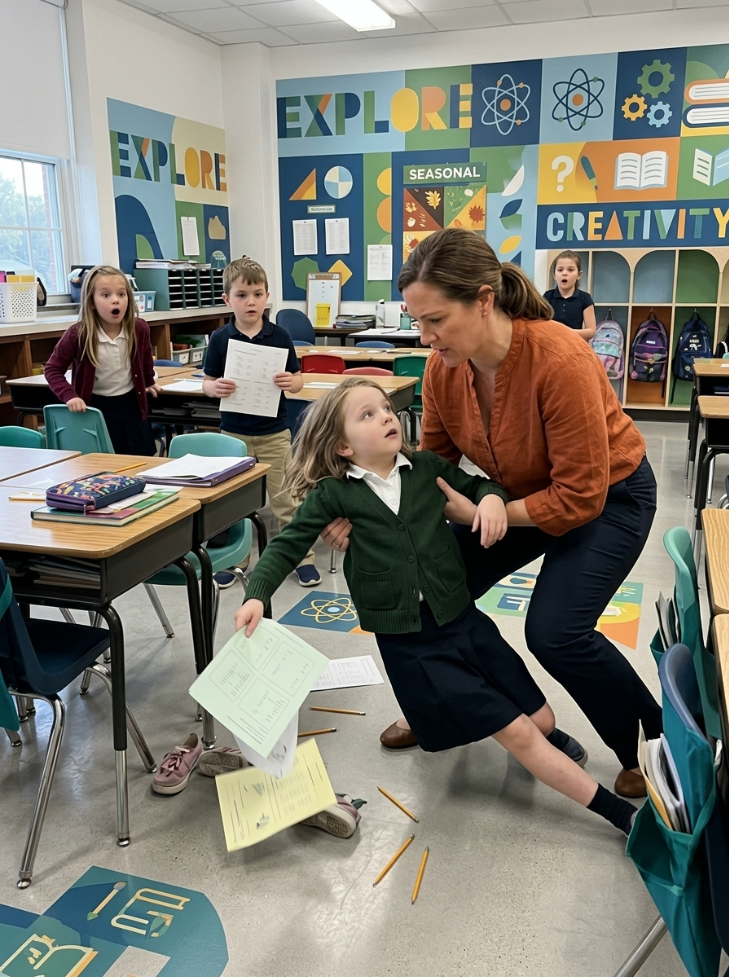
The Thing Lila Was Afraid to Say For a moment, nobody moved.
The nurse’s pen remained suspended above the health log. Valerie could hear the clock on the wall ticking. One second. Two. Three. Then the nurse gently placed the pen down.
“What did your dad say wouldn’t hurt?” she asked. Her voice was soft. Not frightened. Not accusing. Just careful. Lila’s eyes moved toward the door.
The nurse noticed. So did Valerie. It was such a small movement that another adult might have missed it. But Valerie had spent the entire morning watching Lila carefully.
The little girl wasn’t looking at the door because she wanted to leave. She was looking at it because she was afraid someone might come through it.
Valerie leaned slightly closer.
“You’re safe here,” she said.
Lila swallowed.
“Am I?”
The question was barely audible.
Valerie felt something tighten in her chest.
“Yes,” she answered.
She didn’t know if she could promise that.
But she knew what Lila needed to hear.
“Yes. You’re safe here.”
Lila stared at her for several seconds.
Then she whispered,
“He said I had to be brave.”
Valerie glanced at the nurse.
The nurse’s expression had changed.
“Brave about what, sweetheart?”
Lila pulled the blanket higher.
Her chin disappeared beneath it.
“I can’t tell.”
“Why not?”
“Because Dad said if I told, people would take me away.”
The room seemed to become colder.
Valerie sat perfectly still.
She knew enough about children to understand that frightening them with too many questions could make them shut down completely.
So she didn’t ask what they meant.
She didn’t ask whether someone had hurt her.
She didn’t ask whether her father had done something.
Not yet.
Instead, she said,
“Did somebody tell you that you would get in trouble if you talked?”
Lila nodded.
“Dad?”
Another nod.
Valerie’s heart sank.
The nurse quietly reached for the telephone.
Lila noticed.
Her eyes widened.
“Are you calling my dad?”
“No,” the nurse said immediately. “I’m making sure we get you the help you need.”
Lila’s fingers tightened around the blanket.
“Don’t call him.”
“We won’t do anything without making sure you’re safe,” Valerie said.
Lila looked at her.
“You promise?”
Valerie hesitated.
There were promises adults made because they wanted children to trust them.
And there were promises adults could actually keep.
She chose her words carefully.
“I promise I will listen to you.”
That seemed to matter.
Lila slowly relaxed her grip.
Then she said something that made Valerie’s breath catch.
“He told me not to let anybody see.”
“See what?”
Lila looked down at her cardigan.
The incorrectly fastened buttons.
The strange crease.
Her hands moved toward the bottom of the sweater.
She stopped before touching it.
“Underneath.”
Valerie didn’t move.
“What is underneath your cardigan?”
Lila’s lower lip trembled.
“I don’t know what it’s called.”
The nurse looked at Valerie.
“That’s okay,” Valerie said. “You don’t have to know the name.”
Lila’s eyes filled with tears.
“Dad said it was important.”
“What was important?”
“That I didn’t take it off.”
The clock continued ticking.
Valerie felt as if every ordinary sound in the room had become unbearably loud.
The ventilation system hummed.
A cart rolled somewhere in the hallway.
A telephone rang at the far end of the office.
And beneath all of it was the sound of a seven-year-old trying not to cry.
Valerie reached for a tissue and placed it beside Lila.
“You can take your time.”
Lila wiped one cheek.
Then the other.
“My dad said it would make me better.”
Valerie’s eyes narrowed slightly.
“Make you better?”
Lila nodded.
“He said grown-ups don’t understand.”
“Understand what?”
Lila stared at the ceiling.
“My back.”
Valerie remembered the way Lila had walked.
One foot.
Pause.
Then the other.
The way she had held the edge of her desk before standing.
The way she had avoided bending.
The way her cardigan had pulled strangely across her middle.
Suddenly, the details of the morning were arranging themselves into something much more frightening.
The nurse quietly asked,
“Lila, did something happen to your back?”
Lila didn’t answer.
Instead, she whispered,
“Dad said it was because I moved wrong.”
Valerie felt a chill travel down her arms.
“Moved wrong?”
Lila nodded.
“He said I made it worse.”
The nurse stood.
“I’m going to get the school administrator.”
Lila grabbed Valerie’s hand.
“Please don’t.”
Valerie sat back down.
“I’m not leaving.”
“Don’t let them call Dad.”
“I’m staying with you.”
Lila stared at her teacher.
For the first time that morning, Valerie saw something different in the child’s expression.
Not simply fear.
Relief.
Tiny.
Fragile.
But unmistakable.
Then Lila whispered,
“There’s a box.”
Valerie frowned.
“A box?”
“In the garage.”
The nurse stopped near the doorway.
“What kind of box?”
Lila looked toward the window.
“I don’t know.”
“What is inside?”
“I never saw.”
“Then how do you know there’s a box?”
Lila’s face went pale again.
“Because Dad told me.”
Valerie’s voice became even quieter.
“What did he tell you?”
Lila hesitated.
Then she leaned closer.
So close that Valerie had to bend down to hear her.
“He told me if anybody asked about it…”
She stopped.
Valerie waited.
Lila’s eyes filled with tears.
“…I was supposed to say it was just Christmas decorations.”
The nurse looked at Valerie.
Neither woman spoke.
It was October.
Christmas decorations.
A strange thing for a frightened seven-year-old to mention.
But Valerie knew something else.
Children rarely invent elaborate instructions for themselves.
Someone had taught Lila what to say.
Someone had given her an explanation to memorize.
And someone had apparently expected her to be questioned.
The nurse stepped into the hallway.
Valerie heard her speaking quietly to the office administrator.
Lila kept holding Valerie’s hand.
Then, almost as if she had suddenly remembered something, she whispered,
“There was a noise.”
“What kind of noise?”
“Last night.”
“What did you hear?”
Lila looked at the closed door again.
“Metal.”
Valerie waited.
“Like something falling.”
“Where?”
“The garage.”
“Did you see anything?”
Lila shook her head.
“Dad told me to stay upstairs.”
“Did you?”
Another pause.
“No.”
Valerie’s stomach tightened.
“What did you do?”
“I went halfway down the stairs.”
“And?”
Lila’s eyes fixed on the floor.
“I saw Dad carrying something.”
“What was he carrying?”
“I don’t know.”
“Was it heavy?”
Lila nodded.
“Very.”
“What happened then?”
“He saw me.”
Lila’s voice became smaller.
“He got angry.”
Valerie squeezed her hand.
“What did he say?”
Lila looked at her.
“He said, ‘You weren’t supposed to see that.’”
The words hung between them.
Valerie felt a sudden, terrible certainty that whatever had happened was larger than a single injury.
This wasn’t just about a child arriving at school in pain.
There was something at home.
Something hidden.
Something Lila had been ordered not to discuss.
And whatever it was, her father had apparently been preparing her for questions.
The door opened.
The principal, Mr. Daniel Reeves, entered with the school counselor behind him.
Both looked serious.
The nurse quietly explained that Lila had made statements concerning an injury and that there were possible safety concerns at home.
Mr. Reeves nodded.
He approached the cot slowly.
“Lila, my name is Daniel. You know me, right?”
She nodded.
“I’ve seen you in the hallway.”
“That’s right.”
He crouched a few feet away rather than coming too close.
“I want you to know something. You aren’t in trouble.”
Lila looked at him.
“Really?”
“Really.”
“Even if I tell?”
The principal glanced at Valerie.
“Especially if you tell.”
Lila was quiet.
Then she asked,
“Will Dad go to jail?”
Nobody answered immediately.
Valerie knew the question was bigger than anything a second grader should have to carry.
Mr. Reeves finally said,
“I don’t know what will happen next.”
Lila looked frightened again.
“But we’re going to make sure you’re safe.”
The little girl stared at him.
Then she whispered,
“I don’t want him to get hurt.”
Valerie’s heart broke.
Even now.
Even frightened.
Even in pain.
Lila was worried about her father.
Mr. Reeves softened his voice.
“You don’t have to decide what happens to anyone.”
Lila looked at Valerie.
“Can she come with me?”
“Where?” Valerie asked.
“To the place.”
“What place?”
Lila hesitated.
“The doctor.”
The nurse exchanged a glance with the counselor.
Valerie realized then that the child wasn’t afraid of seeing a doctor.
She was afraid of what the doctor might discover.
And perhaps, even more frighteningly, she was afraid of what would happen after the discovery.
The counselor moved closer.
“We’ll all stay with you.”
Lila nodded.
But before they could begin arranging transportation, the office telephone rang.
The nurse answered.
“Room 204 health office.”
Her expression changed almost immediately.
She glanced at Valerie.
Then at the principal.
“Yes,” she said slowly.
“I understand.”
She listened.
Her face became pale.
“What time did you say?”
A pause.
“Okay.”
She hung up.
Mr. Reeves looked at her.
“Who was that?”
The nurse swallowed.
“Lila’s father.”
Valerie felt Lila’s hand suddenly go cold.
“He knows she’s here,” the nurse said.
Lila began shaking.
“What did he say?” Mr. Reeves asked.
The nurse looked at the child.
“He said he was coming to pick her up.”
Silence.
Then Lila whispered something so quietly that Valerie almost didn’t hear it.
“He can’t.”
Valerie leaned closer.
“Why?”
Lila looked toward the window.
And for the first time since Valerie had found her that morning, the little girl seemed to forget her carefully memorized answers.
She forgot to be obedient.
Forgot to be polite.
Forgot to be brave.
She simply looked terrified.
Then she said,
“Because he doesn’t know I found the key.”
Valerie’s blood ran cold.
“The key to what?”
Lila reached slowly into the pocket of her cardigan.
Her fingers trembled.
Then she pulled out a tiny brass key.
It was old.
Scratched.
And tied to it was a small piece of red string.
Valerie stared at it.
Lila closed her fist around it.
“He told me never to touch the door in the garage.”
She looked directly at Valerie.
“But last night…”
Her voice broke.
“I opened it.”
And somewhere outside the nurse’s office, footsteps began approaching down the hallway.
Slow.
Heavy.
Getting closer.
Lila heard them.
Her face went white.
“That’s him,” she whispered.
Valerie stood.
And for the first time that morning, she wasn’t looking at Lila.
She was looking at the hallway door.
Because the footsteps had stopped directly outside.
## Part 2 — The Thing Lila Was Afraid to Say
For a moment, nobody moved.
The nurse’s pen remained suspended above the health log.
Valerie could hear the clock on the wall ticking.
One second.
Two.
Three.
Then the nurse gently placed the pen down.
“What did your dad say wouldn’t hurt?” she asked.
Her voice was soft.
Not frightened.
Not accusing.
Just careful.
Lila’s eyes moved toward the door.
The nurse noticed.
So did Valerie.
It was such a small movement that another adult might have missed it.
But Valerie had spent the entire morning watching Lila carefully.
The little girl wasn’t looking at the door because she wanted to leave.
She was looking at it because she was afraid someone might come through it.
Valerie leaned slightly closer.
“You’re safe here,” she said.
Lila swallowed.
“Am I?”
The question was barely audible.
Valerie felt something tighten in her chest.
“Yes,” she answered.
She didn’t know if she could promise that.
But she knew what Lila needed to hear.
“Yes. You’re safe here.”
Lila stared at her for several seconds.
Then she whispered,
“He said I had to be brave.”
Valerie glanced at the nurse.
The nurse’s expression had changed.
“Brave about what, sweetheart?”
Lila pulled the blanket higher.
Her chin disappeared beneath it.
“I can’t tell.”
“Why not?”
“Because Dad said if I told, people would take me away.”
The room seemed to become colder.
Valerie sat perfectly still.
She knew enough about children to understand that frightening them with too many questions could make them shut down completely.
So she didn’t ask what they meant.
She didn’t ask whether someone had hurt her.
She didn’t ask whether her father had done something.
Not yet.
Instead, she said,
“Did somebody tell you that you would get in trouble if you talked?”
Lila nodded.
“Dad?”
Another nod.
Valerie’s heart sank.
The nurse quietly reached for the telephone.
Lila noticed.
Her eyes widened.
“Are you calling my dad?”
“No,” the nurse said immediately. “I’m making sure we get you the help you need.”
Lila’s fingers tightened around the blanket.
“Don’t call him.”
“We won’t do anything without making sure you’re safe,” Valerie said.
Lila looked at her.
“You promise?”
Valerie hesitated.
There were promises adults made because they wanted children to trust them.
And there were promises adults could actually keep.
She chose her words carefully.
“I promise I will listen to you.”
That seemed to matter.
Lila slowly relaxed her grip.
Then she said something that made Valerie’s breath catch.
“He told me not to let anybody see.”
“See what?”
Lila looked down at her cardigan.
The incorrectly fastened buttons.
The strange crease.
Her hands moved toward the bottom of the sweater.
She stopped before touching it.
“Underneath.”
Valerie didn’t move.
“What is underneath your cardigan?”
Lila’s lower lip trembled.
“I don’t know what it’s called.”
The nurse looked at Valerie.
“That’s okay,” Valerie said. “You don’t have to know the name.”
Lila’s eyes filled with tears.
“Dad said it was important.”
“What was important?”
“That I didn’t take it off.”
The clock continued ticking.
Valerie felt as if every ordinary sound in the room had become unbearably loud.
The ventilation system hummed.
A cart rolled somewhere in the hallway.
A telephone rang at the far end of the office.
And beneath all of it was the sound of a seven-year-old trying not to cry.
Valerie reached for a tissue and placed it beside Lila.
“You can take your time.”
Lila wiped one cheek.
Then the other.
“My dad said it would make me better.”
Valerie’s eyes narrowed slightly.
“Make you better?”
Lila nodded.
“He said grown-ups don’t understand.”
“Understand what?”
Lila stared at the ceiling.
“My back.”
Valerie remembered the way Lila had walked.
One foot.
Pause.
Then the other.
The way she had held the edge of her desk before standing.
The way she had avoided bending.
The way her cardigan had pulled strangely across her middle.
Suddenly, the details of the morning were arranging themselves into something much more frightening.
The nurse quietly asked,
“Lila, did something happen to your back?”
Lila didn’t answer.
Instead, she whispered,
“Dad said it was because I moved wrong.”
Valerie felt a chill travel down her arms.
“Moved wrong?”
Lila nodded.
“He said I made it worse.”
The nurse stood.
“I’m going to get the school administrator.”
Lila grabbed Valerie’s hand.
“Please don’t.”
Valerie sat back down.
“I’m not leaving.”
“Don’t let them call Dad.”
“I’m staying with you.”
Lila stared at her teacher.
For the first time that morning, Valerie saw something different in the child’s expression.
Not simply fear.
Relief.
Tiny.
Fragile.
But unmistakable.
Then Lila whispered,
“There’s a box.”
Valerie frowned.
“A box?”
“In the garage.”
The nurse stopped near the doorway.
“What kind of box?”
Lila looked toward the window.
“I don’t know.”
“What is inside?”
“I never saw.”
“Then how do you know there’s a box?”
Lila’s face went pale again.
“Because Dad told me.”
Valerie’s voice became even quieter.
“What did he tell you?”
Lila hesitated.
Then she leaned closer.
So close that Valerie had to bend down to hear her.
“He told me if anybody asked about it…”
She stopped.
Valerie waited.
Lila’s eyes filled with tears.
“…I was supposed to say it was just Christmas decorations.”
The nurse looked at Valerie.
Neither woman spoke.
It was October.
Christmas decorations.
A strange thing for a frightened seven-year-old to mention.
But Valerie knew something else.
Children rarely invent elaborate instructions for themselves.
Someone had taught Lila what to say.
Someone had given her an explanation to memorize.
And someone had apparently expected her to be questioned.
The nurse stepped into the hallway.
Valerie heard her speaking quietly to the office administrator.
Lila kept holding Valerie’s hand.
Then, almost as if she had suddenly remembered something, she whispered,
“There was a noise.”
“What kind of noise?”
“Last night.”
“What did you hear?”
Lila looked at the closed door again.
“Metal.”
Valerie waited.
“Like something falling.”
“Where?”
“The garage.”
“Did you see anything?”
Lila shook her head.
“Dad told me to stay upstairs.”
“Did you?”
Another pause.
“No.”
Valerie’s stomach tightened.
“What did you do?”
“I went halfway down the stairs.”
“And?”
Lila’s eyes fixed on the floor.
“I saw Dad carrying something.”
“What was he carrying?”
“I don’t know.”
“Was it heavy?”
Lila nodded.
“Very.”
“What happened then?”
“He saw me.”
Lila’s voice became smaller.
“He got angry.”
Valerie squeezed her hand.
“What did he say?”
Lila looked at her.
“He said, ‘You weren’t supposed to see that.’”
The words hung between them.
Valerie felt a sudden, terrible certainty that whatever had happened was larger than a single injury.
This wasn’t just about a child arriving at school in pain.
There was something at home.
Something hidden.
Something Lila had been ordered not to discuss.
And whatever it was, her father had apparently been preparing her for questions.
The door opened.
The principal, Mr. Daniel Reeves, entered with the school counselor behind him.
Both looked serious.
The nurse quietly explained that Lila had made statements concerning an injury and that there were possible safety concerns at home.
Mr. Reeves nodded.
He approached the cot slowly.
“Lila, my name is Daniel. You know me, right?”
She nodded.
“I’ve seen you in the hallway.”
“That’s right.”
He crouched a few feet away rather than coming too close.
“I want you to know something. You aren’t in trouble.”
Lila looked at him.
“Really?”
“Really.”
“Even if I tell?”
The principal glanced at Valerie.
“Especially if you tell.”
Lila was quiet.
Then she asked,
“Will Dad go to jail?”
Nobody answered immediately.
Valerie knew the question was bigger than anything a second grader should have to carry.
Mr. Reeves finally said,
“I don’t know what will happen next.”
Lila looked frightened again.
“But we’re going to make sure you’re safe.”
The little girl stared at him.
Then she whispered,
“I don’t want him to get hurt.”
Valerie’s heart broke.
Even now.
Even frightened.
Even in pain.
Lila was worried about her father.
Mr. Reeves softened his voice.
“You don’t have to decide what happens to anyone.”
Lila looked at Valerie.
“Can she come with me?”
“Where?” Valerie asked.
“To the place.”
“What place?”
Lila hesitated.
“The doctor.”
The nurse exchanged a glance with the counselor.
Valerie realized then that the child wasn’t afraid of seeing a doctor.
She was afraid of what the doctor might discover.
And perhaps, even more frighteningly, she was afraid of what would happen after the discovery.
The counselor moved closer.
“We’ll all stay with you.”
Lila nodded.
But before they could begin arranging transportation, the office telephone rang.
The nurse answered.
“Room 204 health office.”
Her expression changed almost immediately.
She glanced at Valerie.
Then at the principal.
“Yes,” she said slowly.
“I understand.”
She listened.
Her face became pale.
“What time did you say?”
A pause.
“Okay.”
She hung up.
Mr. Reeves looked at her.
“Who was that?”
The nurse swallowed.
“Lila’s father.”
Valerie felt Lila’s hand suddenly go cold.
“He knows she’s here,” the nurse said.
Lila began shaking.
“What did he say?” Mr. Reeves asked.
The nurse looked at the child.
“He said he was coming to pick her up.”
Silence.
Then Lila whispered something so quietly that Valerie almost didn’t hear it.
“He can’t.”
Valerie leaned closer.
“Why?”
Lila looked toward the window.
And for the first time since Valerie had found her that morning, the little girl seemed to forget her carefully memorized answers.
She forgot to be obedient.
Forgot to be polite.
Forgot to be brave.
She simply looked terrified.
Then she said,
“Because he doesn’t know I found the key.”
Valerie’s blood ran cold.
“The key to what?”
Lila reached slowly into the pocket of her cardigan.
Her fingers trembled.
Then she pulled out a tiny brass key.
It was old.
Scratched.
And tied to it was a small piece of red string.
Valerie stared at it.
Lila closed her fist around it.
“He told me never to touch the door in the garage.”
She looked directly at Valerie.
“But last night…”
Her voice broke.
“I opened it.”
And somewhere outside the nurse’s office, footsteps began approaching down the hallway.
Slow.
Heavy.
Getting closer.
Lila heard them.
Her face went white.
“That’s him,” she whispered.
Valerie stood.
And for the first time that morning, she wasn’t looking at Lila.
She was looking at the hallway door.
Because the footsteps had stopped directly outside.
## Part 3 — The Door in the Garage
Nobody spoke.
The footsteps remained outside the nurse’s office.
One second.
Two.
Three.
Then there was a knock.
Lila’s fingers closed around the tiny brass key.
“Don’t let him in,” she whispered.
Valerie moved instinctively between Lila and the door.
Mr. Reeves raised one hand, signaling everyone to stay calm.
The nurse stepped toward the door but didn’t open it.
“Who is it?”
A man’s voice answered from the hallway.
“It’s Lila’s father.”
Lila’s breathing became quick and shallow.
Valerie turned toward her.
“Look at me.”
Lila did.
“You’re not alone.”
The door handle moved.
Mr. Reeves stepped forward.
“Mr. Mercer, please wait outside. We’re still evaluating Lila.”
There was silence.
Then the man’s voice became harder.
“I need to see my daughter.”
“She’s receiving medical attention.”
“She doesn’t need a doctor.”
Lila flinched.
Valerie noticed.
So did the counselor.
Mr. Reeves remained at the door.
“Given what Lila has told us, we need to follow school safety procedures before releasing her.”
The hallway went silent.
Then came a quiet laugh.
Not a warm laugh.
Not an amused one.
A short, humorless sound.
“You’re making a mistake.”
Lila began crying silently.
Valerie crouched beside her.
“What did he do last night?” she whispered.
Lila shook her head.
“Don’t tell.”
“You already told me something important.”
“He’ll know.”
“He won’t know what you said from me.”
Lila looked toward the door.
“He always knows.”
Valerie felt a chill.
“What do you mean?”
Lila’s eyes moved toward the tiny brass key.
“He checks.”
“Checks what?”
“My room.”
“For what?”
“To see if I moved things.”
Valerie’s expression tightened.
“Why?”
Lila whispered,
“Because of the key.”
The counselor sat beside her.
“Lila, sweetheart, when did you find that key?”
“Last night.”
“Where?”
“On Dad’s workbench.”
“Did he see you take it?”
Lila shook her head.
“I put it in my pocket.”
“Why?”
The child looked confused.
“I don’t know.”
Valerie studied her.
Sometimes children couldn’t explain why they did something.
Sometimes they knew exactly why and were too afraid to say.
Lila seemed to be caught somewhere between the two.
“I think…” she began.
Then stopped.
“What?”
“I think Dad dropped it.”
“Did you see what it opened?”
Lila nodded.
“The little door.”
“What little door?”
“In the garage.”
The counselor exchanged another glance with Mr. Reeves.
Lila continued.
“It doesn’t look like a door.”
“What does it look like?”
“A wall.”
Valerie frowned.
“A wall?”
Lila nodded.
“There’s a metal panel behind the shelves.”
“And the key opened it?”
“Yes.”
“What was inside?”
Lila’s face changed.
The fear returned so suddenly that Valerie wished she hadn’t asked.
“I don’t know.”
“But you opened it.”
“I only looked.”
“What did you see?”
Lila swallowed.
“Boxes.”
“How many?”
“Lots.”
“What’s in the boxes?”
“I don’t know.”
“Did you touch anything?”
Lila shook her head.
“Then why are you so scared?”
The little girl looked at Valerie.
“Because I saw my name.”
The room went completely still.
“Your name?” Valerie repeated.
Lila nodded.
“On one of the boxes.”
“What did it say?”
“My whole name.”
“Lila Mercer?”
“Yes.”
“Did it have anything else written on it?”
Lila thought.
“There were numbers.”
“What numbers?”
“I don’t remember.”
“Were they dates?”
“I don’t know.”
“Was your name printed?”
“Yes.”
“How?”
Lila looked toward the door.
“In black marker.”
Valerie felt an uncomfortable pressure building behind her ribs.
The footsteps outside had disappeared.
That somehow made everything worse.
Mr. Reeves quietly stepped into the hallway.
Valerie heard him speaking to someone.
Then a second voice answered.
Lila immediately grabbed her teacher’s sleeve.
“Is Dad still there?”
Valerie nodded.
“Why can’t I hear him?”
“I don’t know.”
Lila lowered her voice.
“He does that.”
“Does what?”
“Gets quiet when he’s angry.”
Valerie looked toward the door.
She understood then that Lila wasn’t simply frightened of her father’s presence.
She was anticipating him.
Anticipating his silence.
His footsteps.
His moods.
His reactions.
It was the kind of knowledge no seven-year-old should have.
A few minutes later, a county child-protection worker arrived with a police officer.
They spoke quietly with Mr. Reeves in the hallway.
Lila watched every movement through the narrow gap in the door.
When she saw the officer, she immediately lowered her head.
“Is he going to take me away?” she asked.
“No,” Valerie said.
“Are you sure?”
“I’ll stay with you.”
The officer eventually entered.
He introduced himself gently and explained that he wanted to make sure Lila was safe.
He didn’t ask her a long list of questions.
Instead, he sat at a distance and let the room settle.
Then he noticed the key.
“Lila, may I ask you about that?”
She looked at Valerie.
Valerie nodded.
Lila slowly opened her palm.
The tiny brass key rested there.
The officer studied it.
“Where did you get this?”
“The garage.”
“What does it open?”
“A door.”
“What kind of door?”
“A secret one.”
The officer’s expression remained neutral.
“Why do you think it’s secret?”
“Because Dad doesn’t tell anybody about it.”
“Does anyone else know?”
Lila shook her head.
“Did you tell anyone before today?”
“No.”
“Why did you tell Ms. Kincaid?”
Lila looked at Valerie.
“Because she noticed.”
The words were simple.
But Valerie felt them deeply.
She had noticed.
Not because she had special training.
Not because she had known exactly what was happening.
She had simply noticed that a little girl was moving as though every movement hurt.
Sometimes, Valerie thought, the most important thing an adult could do was notice.
The officer asked one more question.
“Lila, what happened when you opened the door?”
The child stared at the key.
“I heard something.”
“What?”
“A buzzing sound.”
“Like a machine?”
Lila nodded.
“Was anything turned on?”
“I don’t know.”
“Did you see anyone?”
“No.”
“Did you see anything that scared you?”
Lila hesitated.
Then nodded.
“What?”
“A picture.”
“Of what?”
Lila’s lips trembled.
“Me.”
Valerie felt the room tilt.
“A picture of you?”
“Yes.”
“Was it recent?”
“I don’t know.”
“What were you doing in the picture?”
Lila looked down.
“Sleeping.”
Nobody spoke.
The officer’s expression changed.
“Where was the picture?”
“On the wall.”
“Anything else?”
Lila shook her head.
Then suddenly she remembered something.
“There was a red light.”
“A red light?”
“On a little machine.”
“What kind of machine?”
“I don’t know.”
“Did you touch it?”
“No.”
“Why did you leave?”
Lila’s eyes filled with tears.
“Because I heard Dad behind me.”
The officer leaned forward.
“What happened?”
“I closed the door.”
“Did he see you?”
Lila nodded.
“What did he say?”
She whispered,
“‘You weren’t supposed to know about that yet.’”
Valerie felt every hair on her arms rise.
Yet.
That word.
Not you weren’t supposed to see that.
Not you shouldn’t have opened it.
Yet.
It implied something planned.
Something that had not happened.
Something Lila’s father had expected to happen later.
The officer noticed the same thing.
“What did he mean by ‘yet’?”
Lila shook her head.
“I don’t know.”
“Did he tell you what would happen?”
“No.”
“What happened afterward?”
“He made me take the medicine.”
Valerie looked at the nurse.
“What medicine?”
Lila’s face tightened.
“The little white one.”
“Do you know its name?”
“No.”
“Where was it?”
“On the kitchen counter.”
“Did your father give it to you?”
“Yes.”
“Did he tell you what it was?”
“He said it would make my back stop hurting.”
The nurse looked concerned.
“Did it?”
Lila shook her head.
“It made me sleepy.”
Valerie’s stomach dropped.
“Then what happened?”
“I woke up later.”
“When?”
“It was dark.”
“Where was your father?”
“Downstairs.”
“Did you hear anything?”
Lila nodded.
“Dad was talking to somebody.”
“Who?”
“I don’t know.”
“Was another person in the house?”
“I couldn’t see.”
“What did they say?”
Lila squeezed her eyes shut, trying to remember.
Then she whispered,
“They were talking about me.”
The officer became very still.
“What did they say?”
“I heard my name.”
“What else?”
Lila’s voice broke.
“Dad said…”
She stopped.
Valerie waited.
Lila looked directly at her.
“He said they had to do it before my birthday.”
The officer and the child-protection worker exchanged a look.
“When is your birthday?” the officer asked.
Lila answered.
“October twenty-first.”
Valerie glanced at the calendar on the wall.
October seventeenth.
Four days.
Four days until Lila’s eighth birthday.
The room suddenly felt much smaller.
The officer stood.
“Mr. Reeves, I need to speak with the responding officers.”
Lila reached for Valerie’s hand again.
“Ms. Kincaid?”
“Yes?”
“Can I tell you one more thing?”
“Of course.”
Lila leaned closer.
Her voice became almost inaudible.
“The picture wasn’t the worst part.”
Valerie’s heart pounded.
“What was?”
Lila looked toward the door.
“The other pictures.”
“How many?”
“I don’t know.”
“What were they pictures of?”
Lila’s eyes filled with tears.
“They were pictures of children.”
Valerie froze.
Lila continued.
“And every box had a name.”
Outside the office, someone suddenly shouted.
A chair scraped against the floor.
The officer rushed toward the hallway.
Then Valerie heard Mr. Reeves yell,
“Stop!”
Lila’s hand clamped around Valerie’s.
A moment later, hurried footsteps passed the office.
Then silence.
The child-protection worker looked through the doorway.
Her face had gone pale.
“Mr. Mercer is gone.”
Valerie stared at her.
“Gone where?”
“He left through the side entrance.”
The officer returned a few seconds later.
“He left something behind.”
“What?”
The officer held up a small envelope.
It had apparently been dropped near the hallway door.
Written across the front in black marker were four words:
FOR LILA — WHEN READY
Lila saw the envelope.
She stopped breathing.
“No.”
Valerie crouched beside her.
“What is it?”
Lila shook her head violently.
“I’ve seen that writing before.”
“Where?”
“On the boxes.”
The officer carefully opened the envelope.
Inside was a single photograph.
He looked at it.
His expression changed.
Then he handed it to the child-protection worker.
She stared at the photograph for several seconds.
Finally, she looked at Valerie.
“There’s something you need to see.”
Valerie took the photograph.
It showed a little girl standing beside a birthday cake.
Lila.
But Valerie recognized the room immediately.
It was Lila’s classroom.
Room 204.
The photograph had been taken that very morning.
And behind Lila, reflected faintly in the classroom window, was a man standing outside.
Watching.
The photograph had been taken from across the street.
On the back, written in the same black marker, were six words:
SHE WAS NEVER SUPPOSED TO NOTICE.
Valerie looked up.
For the first time, she understood something terrifying.
Lila’s father hadn’t just known where his daughter was.
Someone had been watching the school.
Watching Lila.
And perhaps watching Valerie too.
## Part 3 — The Door in the Garage
Nobody spoke.
The footsteps remained outside the nurse’s office.
One second.
Two.
Three.
Then there was a knock.
Lila’s fingers closed around the tiny brass key.
“Don’t let him in,” she whispered.
Valerie moved instinctively between Lila and the door.
Mr. Reeves raised one hand, signaling everyone to stay calm.
The nurse stepped toward the door but didn’t open it.
“Who is it?”
A man’s voice answered from the hallway.
“It’s Lila’s father.”
Lila’s breathing became quick and shallow.
Valerie turned toward her.
“Look at me.”
Lila did.
“You’re not alone.”
The door handle moved.
Mr. Reeves stepped forward.
“Mr. Mercer, please wait outside. We’re still evaluating Lila.”
There was silence.
Then the man’s voice became harder.
“I need to see my daughter.”
“She’s receiving medical attention.”
“She doesn’t need a doctor.”
Lila flinched.
Valerie noticed.
So did the counselor.
Mr. Reeves remained at the door.
“Given what Lila has told us, we need to follow school safety procedures before releasing her.”
The hallway went silent.
Then came a quiet laugh.
Not a warm laugh.
Not an amused one.
A short, humorless sound.
“You’re making a mistake.”
Lila began crying silently.
Valerie crouched beside her.
“What did he do last night?” she whispered.
Lila shook her head.
“Don’t tell.”
“You already told me something important.”
“He’ll know.”
“He won’t know what you said from me.”
Lila looked toward the door.
“He always knows.”
Valerie felt a chill.
“What do you mean?”
Lila’s eyes moved toward the tiny brass key.
“He checks.”
“Checks what?”
“My room.”
“For what?”
“To see if I moved things.”
Valerie’s expression tightened.
“Why?”
Lila whispered,
“Because of the key.”
The counselor sat beside her.
“Lila, sweetheart, when did you find that key?”
“Last night.”
“Where?”
“On Dad’s workbench.”
“Did he see you take it?”
Lila shook her head.
“I put it in my pocket.”
“Why?”
The child looked confused.
“I don’t know.”
Valerie studied her.
Sometimes children couldn’t explain why they did something.
Sometimes they knew exactly why and were too afraid to say.
Lila seemed to be caught somewhere between the two.
“I think…” she began.
Then stopped.
“What?”
“I think Dad dropped it.”
“Did you see what it opened?”
Lila nodded.
“The little door.”
“What little door?”
“In the garage.”
The counselor exchanged another glance with Mr. Reeves.
Lila continued.
“It doesn’t look like a door.”
“What does it look like?”
“A wall.”
Valerie frowned.
“A wall?”
Lila nodded.
“There’s a metal panel behind the shelves.”
“And the key opened it?”
“Yes.”
“What was inside?”
Lila’s face changed.
The fear returned so suddenly that Valerie wished she hadn’t asked.
“I don’t know.”
“But you opened it.”
“I only looked.”
“What did you see?”
Lila swallowed.
“Boxes.”
“How many?”
“Lots.”
“What’s in the boxes?”
“I don’t know.”
“Did you touch anything?”
Lila shook her head.
“Then why are you so scared?”
The little girl looked at Valerie.
“Because I saw my name.”
The room went completely still.
“Your name?” Valerie repeated.
Lila nodded.
“On one of the boxes.”
“What did it say?”
“My whole name.”
“Lila Mercer?”
“Yes.”
“Did it have anything else written on it?”
Lila thought.
“There were numbers.”
“What numbers?”
“I don’t remember.”
“Were they dates?”
“I don’t know.”
“Was your name printed?”
“Yes.”
“How?”
Lila looked toward the door.
“In black marker.”
Valerie felt an uncomfortable pressure building behind her ribs.
The footsteps outside had disappeared.
That somehow made everything worse.
Mr. Reeves quietly stepped into the hallway.
Valerie heard him speaking to someone.
Then a second voice answered.
Lila immediately grabbed her teacher’s sleeve.
“Is Dad still there?”
Valerie nodded.
“Why can’t I hear him?”
“I don’t know.”
Lila lowered her voice.
“He does that.”
“Does what?”
“Gets quiet when he’s angry.”
Valerie looked toward the door.
She understood then that Lila wasn’t simply frightened of her father’s presence.
She was anticipating him.
Anticipating his silence.
His footsteps.
His moods.
His reactions.
It was the kind of knowledge no seven-year-old should have.
A few minutes later, a county child-protection worker arrived with a police officer.
They spoke quietly with Mr. Reeves in the hallway.
Lila watched every movement through the narrow gap in the door.
When she saw the officer, she immediately lowered her head.
“Is he going to take me away?” she asked.
“No,” Valerie said.
“Are you sure?”
“I’ll stay with you.”
The officer eventually entered.
He introduced himself gently and explained that he wanted to make sure Lila was safe.
He didn’t ask her a long list of questions.
Instead, he sat at a distance and let the room settle.
Then he noticed the key.
“Lila, may I ask you about that?”
She looked at Valerie.
Valerie nodded.
Lila slowly opened her palm.
The tiny brass key rested there.
The officer studied it.
“Where did you get this?”
“The garage.”
“What does it open?”
“A door.”
“What kind of door?”
“A secret one.”
The officer’s expression remained neutral.
“Why do you think it’s secret?”
“Because Dad doesn’t tell anybody about it.”
“Does anyone else know?”
Lila shook her head.
“Did you tell anyone before today?”
“No.”
“Why did you tell Ms. Kincaid?”
Lila looked at Valerie.
“Because she noticed.”
The words were simple.
But Valerie felt them deeply.
She had noticed.
Not because she had special training.
Not because she had known exactly what was happening.
She had simply noticed that a little girl was moving as though every movement hurt.
Sometimes, Valerie thought, the most important thing an adult could do was notice.
The officer asked one more question.
“Lila, what happened when you opened the door?”
The child stared at the key.
“I heard something.”
“What?”
“A buzzing sound.”
“Like a machine?”
Lila nodded.
“Was anything turned on?”
“I don’t know.”
“Did you see anyone?”
“No.”
“Did you see anything that scared you?”
Lila hesitated.
Then nodded.
“What?”
“A picture.”
“Of what?”
Lila’s lips trembled.
“Me.”
Valerie felt the room tilt.
“A picture of you?”
“Yes.”
“Was it recent?”
“I don’t know.”
“What were you doing in the picture?”
Lila looked down.
“Sleeping.”
Nobody spoke.
The officer’s expression changed.
“Where was the picture?”
“On the wall.”
“Anything else?”
Lila shook her head.
Then suddenly she remembered something.
“There was a red light.”
“A red light?”
“On a little machine.”
“What kind of machine?”
“I don’t know.”
“Did you touch it?”
“No.”
“Why did you leave?”
Lila’s eyes filled with tears.
“Because I heard Dad behind me.”
The officer leaned forward.
“What happened?”
“I closed the door.”
“Did he see you?”
Lila nodded.
“What did he say?”
She whispered,
“‘You weren’t supposed to know about that yet.’”
Valerie felt every hair on her arms rise.
Yet.
That word.
Not you weren’t supposed to see that.
Not you shouldn’t have opened it.
Yet.
It implied something planned.
Something that had not happened.
Something Lila’s father had expected to happen later.
The officer noticed the same thing.
“What did he mean by ‘yet’?”
Lila shook her head.
“I don’t know.”
“Did he tell you what would happen?”
“No.”
“What happened afterward?”
“He made me take the medicine.”
Valerie looked at the nurse.
“What medicine?”
Lila’s face tightened.
“The little white one.”
“Do you know its name?”
“No.”
“Where was it?”
“On the kitchen counter.”
“Did your father give it to you?”
“Yes.”
“Did he tell you what it was?”
“He said it would make my back stop hurting.”
The nurse looked concerned.
“Did it?”
Lila shook her head.
“It made me sleepy.”
Valerie’s stomach dropped.
“Then what happened?”
“I woke up later.”
“When?”
“It was dark.”
“Where was your father?”
“Downstairs.”
“Did you hear anything?”
Lila nodded.
“Dad was talking to somebody.”
“Who?”
“I don’t know.”
“Was another person in the house?”
“I couldn’t see.”
“What did they say?”
Lila squeezed her eyes shut, trying to remember.
Then she whispered,
“They were talking about me.”
The officer became very still.
“What did they say?”
“I heard my name.”
“What else?”
Lila’s voice broke.
“Dad said…”
She stopped.
Valerie waited.
Lila looked directly at her.
“He said they had to do it before my birthday.”
The officer and the child-protection worker exchanged a look.
“When is your birthday?” the officer asked.
Lila answered.
“October twenty-first.”
Valerie glanced at the calendar on the wall.
October seventeenth.
Four days.
Four days until Lila’s eighth birthday.
The room suddenly felt much smaller.
The officer stood.
“Mr. Reeves, I need to speak with the responding officers.”
Lila reached for Valerie’s hand again.
“Ms. Kincaid?”
“Yes?”
“Can I tell you one more thing?”
“Of course.”
Lila leaned closer.
Her voice became almost inaudible.
“The picture wasn’t the worst part.”
Valerie’s heart pounded.
“What was?”
Lila looked toward the door.
“The other pictures.”
“How many?”
“I don’t know.”
“What were they pictures of?”
Lila’s eyes filled with tears.
“They were pictures of children.”
Valerie froze.
Lila continued.
“And every box had a name.”
Outside the office, someone suddenly shouted.
A chair scraped against the floor.
The officer rushed toward the hallway.
Then Valerie heard Mr. Reeves yell,
“Stop!”
Lila’s hand clamped around Valerie’s.
A moment later, hurried footsteps passed the office.
Then silence.
The child-protection worker looked through the doorway.
Her face had gone pale.
“Mr. Mercer is gone.”
Valerie stared at her.
“Gone where?”
“He left through the side entrance.”
The officer returned a few seconds later.
“He left something behind.”
“What?”
The officer held up a small envelope.
It had apparently been dropped near the hallway door.
Written across the front in black marker were four words:
FOR LILA — WHEN READY
Lila saw the envelope.
She stopped breathing.
“No.”
Valerie crouched beside her.
“What is it?”
Lila shook her head violently.
“I’ve seen that writing before.”
“Where?”
“On the boxes.”
The officer carefully opened the envelope.
Inside was a single photograph.
He looked at it.
His expression changed.
Then he handed it to the child-protection worker.
She stared at the photograph for several seconds.
Finally, she looked at Valerie.
“There’s something you need to see.”
Valerie took the photograph.
It showed a little girl standing beside a birthday cake.
Lila.
But Valerie recognized the room immediately.
It was Lila’s classroom.
Room 204.
The photograph had been taken that very morning.
And behind Lila, reflected faintly in the classroom window, was a man standing outside.
Watching.
The photograph had been taken from across the street.
On the back, written in the same black marker, were six words:
SHE WAS NEVER SUPPOSED TO NOTICE.
Valerie looked up.
For the first time, she understood something terrifying.
Lila’s father hadn’t just known where his daughter was.
Someone had been watching the school.
Watching Lila.
And perhaps watching Valerie too.
## Final Part — The Door Opens
Valerie stared at the photograph.
For several seconds, she couldn’t speak.
The classroom window in the picture reflected the gray October sky, the bare branches outside, and the faint silhouette of a man standing across the street.
Watching.
Waiting.
But then the officer noticed something Valerie hadn’t.
“Look at the corner.”
He pointed to the bottom of the photograph.
There, barely visible, was the edge of a sign.
MERCER FAMILY DENTAL — GRAND OPENING
The officer immediately frowned.
“That changes things.”
“What does it mean?” Valerie asked.
He turned the photograph over again.
“There may be another explanation for this.”
Lila looked up anxiously.
“Is Dad going to hurt me?”
“No,” the officer said. “We’re going to find out exactly what’s happening.”
Within minutes, investigators were speaking with school officials, reviewing security footage, and contacting the appropriate child-protection authorities.
The footage revealed something unexpected.
The man across the street wasn’t Lila’s father.
He was a private investigator.
And he hadn’t been watching Lila.
He had been watching someone else.
The mystery became stranger before it became clearer.
The photograph had been taken as part of an investigation into a former employee of Lila’s father’s medical practice—a man suspected of secretly recording patients and falsifying medical records.
The boxes in the garage were connected to that investigation.
But one question remained.
Why was Lila’s name on a box?
And why had she been given medicine?
The answer came that afternoon.
Lila’s father, Thomas Mercer, was finally located at the police station.
He was frightened, exhausted, and furious—not at Lila, but at himself.
When he learned what his daughter had told the school, he broke down.
He explained everything.
The strange metal door in the garage belonged to an old storage room left over from the previous owners.
Months earlier, Thomas had discovered boxes containing old files, photographs, and equipment connected to the former employee.
He had been working with investigators to determine what belonged to whom.
Lila’s name appeared on one of the boxes because it contained medical records from when she had been a toddler.
Thomas had been terrified that someone was trying to obtain those records.
That was why he had told Lila not to go near the room.
But he had made a terrible mistake.
Instead of explaining the danger in a way a child could understand, he had frightened her.
He had told her to keep quiet.
He had told her not to touch anything.
And when she injured her back during gymnastics practice several days earlier, he had panicked.
The medicine he gave her was prescribed for muscle spasms, but he had failed to explain what it was.
Worse, he had allowed his fear to turn into secrecy.
The investigation eventually confirmed that Thomas had not hurt Lila intentionally.
But the authorities agreed that his decisions had frightened her and put her at risk.
He needed help understanding how his secrecy had affected his daughter.
And Lila needed adults she could trust.
So she stayed with her aunt for a while.
She went to doctors.
She spoke with a counselor.
And every day, someone reminded her of the same thing:
She had done nothing wrong.
Two weeks later, Valerie was sitting at her desk in Room 204 when the classroom door opened.
Lila stood there.
Her pale blue cardigan was gone.
Instead, she wore a bright yellow sweater covered in tiny embroidered stars.
She smiled.
A real smile this time.
Not the careful little smile Valerie had seen on that October morning.
The kind that reached her eyes.
“Ms. Kincaid?”
Valerie stood.
“Lila.”
The little girl ran across the room and wrapped her arms around her teacher.
Valerie hugged her back.
“How’s your back?”
“Better.”
“Completely?”
Lila nodded.
“And I’m going to physical therapy.”
“That sounds very grown-up.”
“I know.”
Valerie laughed.
Lila stepped back.
Then she reached into her pocket.
She pulled out something small.
The brass key.
Valerie’s expression softened.
“What are you going to do with that?”
Lila smiled.
“Nothing.”
“Nothing?”
“I gave it to the police.”
“Good choice.”
“They locked the door.”
Valerie nodded.
“And the boxes?”
“Gone.”
“What happened to the secret room?”
Lila shrugged.
“It’s not secret anymore.”
That was the thing Valerie liked most about the story.
The door had been opened.
The truth had come out.
And the darkness that had frightened a little girl was no longer something she had to carry alone.
Later that afternoon, Lila’s father came to the school.
He waited outside the classroom until Valerie agreed to speak with him.
He looked different.
Not dangerous.
Just tired.
“I owe you an apology,” he said.
Valerie nodded.
“Yes, you do.”
He looked through the classroom window at his daughter.
“She saved me too.”
Valerie raised an eyebrow.
“How?”
“Because she told the truth.”
His eyes became wet.
“I thought keeping things from her was protecting her.”
He paused.
“I was wrong.”
Valerie looked at him for a moment.
“Then don’t make the same mistake twice.”
He nodded.
“I won’t.”
When Lila saw her father, she didn’t run toward him immediately.
She looked at Valerie first.
Valerie gave her a small nod.
Then Lila walked across the hallway.
Her father knelt.
For a second, neither of them spoke.
Then Lila wrapped her arms around him.
Thomas closed his eyes.
“I’m sorry,” he whispered.
Lila pulled back.
“You should have told me the truth.”
“I know.”
“Even if it’s scary?”
“Especially if it’s scary.”
She thought about that.
Then she nodded.
“Okay.”
And that was enough.
Not because everything was magically fixed.
Not because fear disappeared in one afternoon.
But because the truth had finally replaced the secrets.
### Four Months Later
Winter arrived in Pennsylvania.
Snow covered the school playground, and Room 204 smelled faintly of crayons, paper, and hot chocolate.
Valerie was helping the children decorate paper snowflakes when Lila raised her hand.
“Yes, Lila?”
“Can I tell everyone something?”
The class became quiet.
Lila stood beside her desk.
She took a breath.
“Sometimes when you’re scared, you think you have to keep it inside.”
The other children listened.
“But you don’t.”
Valerie watched her carefully.
Lila continued.
“You can tell a teacher. Or your mom. Or your dad. Or somebody you trust.”
A boy raised his hand.
“What if you’re scared they won’t believe you?”
Lila thought for a moment.
“Tell another person.”
The room became silent.
Then Valerie smiled.
“That’s very good advice.”
Lila smiled back.
After school, Valerie walked her to the front entrance.
Snowflakes drifted through the evening air.
Lila stopped at the steps.
“Ms. Kincaid?”
“Yes?”
“Do you know what I think?”
“What?”
“I think you noticed because you were looking.”
Valerie smiled.
“I think you were worth noticing.”
Lila hugged her.
Then she ran toward her aunt waiting by the car.
Valerie watched until the car disappeared beyond the snowy street.
She stood there for another moment, thinking about that gray Thursday morning.
The folded cardigan.
The careful steps.
The worksheets falling to the floor.
And five words that had changed everything:
Dad said it wouldn’t hurt.
The pain had been real.
The fear had been real.
The mystery had been real.
But so had something else.
Someone had noticed.
Someone had listened.
Someone had believed a frightened little girl when she finally found the courage to speak.
And sometimes, Valerie would later tell new teachers, that is where a child’s story begins to change.
Not when someone finds all the answers.
Not when every mystery is solved.
But when a child finally realizes:
I don’t have to be afraid alone anymore.
And Lila wasn’t.
Not anymore.
## Final Part — The Door Opens
Valerie stared at the photograph.
For several seconds, she couldn’t speak.
The classroom window in the picture reflected the gray October sky, the bare branches outside, and the faint silhouette of a man standing across the street.
Watching.
Waiting.
But then the officer noticed something Valerie hadn’t.
“Look at the corner.”
He pointed to the bottom of the photograph.
There, barely visible, was the edge of a sign.
MERCER FAMILY DENTAL — GRAND OPENING
The officer immediately frowned.
“That changes things.”
“What does it mean?” Valerie asked.
He turned the photograph over again.
“There may be another explanation for this.”
Lila looked up anxiously.
“Is Dad going to hurt me?”
“No,” the officer said. “We’re going to find out exactly what’s happening.”
Within minutes, investigators were speaking with school officials, reviewing security footage, and contacting the appropriate child-protection authorities.
The footage revealed something unexpected.
The man across the street wasn’t Lila’s father.
He was a private investigator.
And he hadn’t been watching Lila.
He had been watching someone else.
The mystery became stranger before it became clearer.
The photograph had been taken as part of an investigation into a former employee of Lila’s father’s medical practice—a man suspected of secretly recording patients and falsifying medical records.
The boxes in the garage were connected to that investigation.
But one question remained.
Why was Lila’s name on a box?
And why had she been given medicine?
The answer came that afternoon.
Lila’s father, Thomas Mercer, was finally located at the police station.
He was frightened, exhausted, and furious—not at Lila, but at himself.
When he learned what his daughter had told the school, he broke down.
He explained everything.
The strange metal door in the garage belonged to an old storage room left over from the previous owners.
Months earlier, Thomas had discovered boxes containing old files, photographs, and equipment connected to the former employee.
He had been working with investigators to determine what belonged to whom.
Lila’s name appeared on one of the boxes because it contained medical records from when she had been a toddler.
Thomas had been terrified that someone was trying to obtain those records.
That was why he had told Lila not to go near the room.
But he had made a terrible mistake.
Instead of explaining the danger in a way a child could understand, he had frightened her.
He had told her to keep quiet.
He had told her not to touch anything.
And when she injured her back during gymnastics practice several days earlier, he had panicked.
The medicine he gave her was prescribed for muscle spasms, but he had failed to explain what it was.
Worse, he had allowed his fear to turn into secrecy.
The investigation eventually confirmed that Thomas had not hurt Lila intentionally.
But the authorities agreed that his decisions had frightened her and put her at risk.
He needed help understanding how his secrecy had affected his daughter.
And Lila needed adults she could trust.
So she stayed with her aunt for a while.
She went to doctors.
She spoke with a counselor.
And every day, someone reminded her of the same thing:
She had done nothing wrong.
Two weeks later, Valerie was sitting at her desk in Room 204 when the classroom door opened.
Lila stood there.
Her pale blue cardigan was gone.
Instead, she wore a bright yellow sweater covered in tiny embroidered stars.
She smiled.
A real smile this time.
Not the careful little smile Valerie had seen on that October morning.
The kind that reached her eyes.
“Ms. Kincaid?”
Valerie stood.
“Lila.”
The little girl ran across the room and wrapped her arms around her teacher.
Valerie hugged her back.
“How’s your back?”
“Better.”
“Completely?”
Lila nodded.
“And I’m going to physical therapy.”
“That sounds very grown-up.”
“I know.”
Valerie laughed.
Lila stepped back.
Then she reached into her pocket.
She pulled out something small.
The brass key.
Valerie’s expression softened.
“What are you going to do with that?”
Lila smiled.
“Nothing.”
“Nothing?”
“I gave it to the police.”
“Good choice.”
“They locked the door.”
Valerie nodded.
“And the boxes?”
“Gone.”
“What happened to the secret room?”
Lila shrugged.
“It’s not secret anymore.”
That was the thing Valerie liked most about the story.
The door had been opened.
The truth had come out.
And the darkness that had frightened a little girl was no longer something she had to carry alone.
Later that afternoon, Lila’s father came to the school.
He waited outside the classroom until Valerie agreed to speak with him.
He looked different.
Not dangerous.
Just tired.
“I owe you an apology,” he said.
Valerie nodded.
“Yes, you do.”
He looked through the classroom window at his daughter.
“She saved me too.”
Valerie raised an eyebrow.
“How?”
“Because she told the truth.”
His eyes became wet.
“I thought keeping things from her was protecting her.”
He paused.
“I was wrong.”
Valerie looked at him for a moment.
“Then don’t make the same mistake twice.”
He nodded.
“I won’t.”
When Lila saw her father, she didn’t run toward him immediately.
She looked at Valerie first.
Valerie gave her a small nod.
Then Lila walked across the hallway.
Her father knelt.
For a second, neither of them spoke.
Then Lila wrapped her arms around him.
Thomas closed his eyes.
“I’m sorry,” he whispered.
Lila pulled back.
“You should have told me the truth.”
“I know.”
“Even if it’s scary?”
“Especially if it’s scary.”
She thought about that.
Then she nodded.
“Okay.”
And that was enough.
Not because everything was magically fixed.
Not because fear disappeared in one afternoon.
But because the truth had finally replaced the secrets.
### Four Months Later
Winter arrived in Pennsylvania.
Snow covered the school playground, and Room 204 smelled faintly of crayons, paper, and hot chocolate.
Valerie was helping the children decorate paper snowflakes when Lila raised her hand.
“Yes, Lila?”
“Can I tell everyone something?”
The class became quiet.
Lila stood beside her desk.
She took a breath.
“Sometimes when you’re scared, you think you have to keep it inside.”
The other children listened.
“But you don’t.”
Valerie watched her carefully.
Lila continued.
“You can tell a teacher. Or your mom. Or your dad. Or somebody you trust.”
A boy raised his hand.
“What if you’re scared they won’t believe you?”
Lila thought for a moment.
“Tell another person.”
The room became silent.
Then Valerie smiled.
“That’s very good advice.”
Lila smiled back.
After school, Valerie walked her to the front entrance.
Snowflakes drifted through the evening air.
Lila stopped at the steps.
“Ms. Kincaid?”
“Yes?”
“Do you know what I think?”
“What?”
“I think you noticed because you were looking.”
Valerie smiled.
“I think you were worth noticing.”
Lila hugged her.
Then she ran toward her aunt waiting by the car.
Valerie watched until the car disappeared beyond the snowy street.
She stood there for another moment, thinking about that gray Thursday morning.
The folded cardigan.
The careful steps.
The worksheets falling to the floor.
And five words that had changed everything:
Dad said it wouldn’t hurt.
The pain had been real.
The fear had been real.
The mystery had been real.
But so had something else.
Someone had noticed.
Someone had listened.
Someone had believed a frightened little girl when she finally found the courage to speak.
And sometimes, Valerie would later tell new teachers, that is where a child’s story begins to change.
Not when someone finds all the answers.
Not when every mystery is solved.
But when a child finally realizes:
I don’t have to be afraid alone anymore.
And Lila wasn’t.
Not anymore.