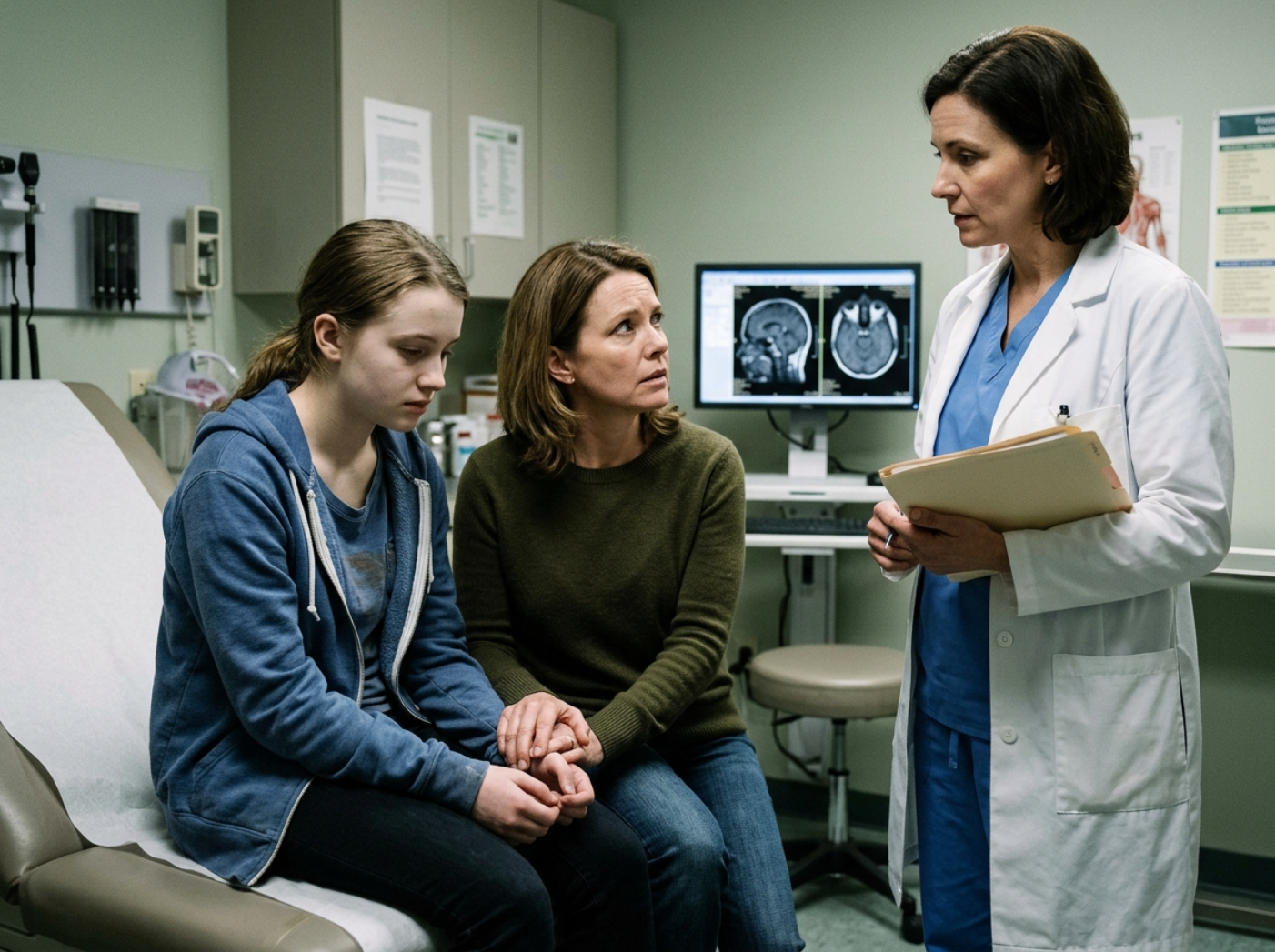
PART 3: So I reached for her hand. “You can tell me,” I whispered. “Whatever it is, you won’t get in trouble.”
Her fingers were cold. “He said you had enough to worry about.”
I swallowed. “And?” “He said if I told you, you’d think he was a bad father.”
I stared at the floor.
There it was.
Not the pain.
Not the missed appointment.
The fear.
My daughter hadn’t been protecting her father.
She had been protecting me from the consequences of telling the truth.
“Did he say anything else?”
She hesitated.
“He said…” Her voice cracked. “He said you always make things bigger than they are.”
Something inside my chest seemed to collapse.
Because that sentence was not new.
I’d heard variations of it for years.
When our son broke his arm playing football and I insisted on taking him to urgent care, my husband had called me dramatic.
When our youngest daughter had struggled with anxiety before starting high school, he had told me I was teaching her to be afraid.
When our refrigerator stopped working and I suggested replacing it before it spoiled all our food, he’d laughed and said I was always looking for something to worry about.
And every time, I had told myself the same thing.
That’s just how he is.
I looked at my daughter.
Suddenly, I wondered how many times she had heard those words when I wasn’t around.
The doctor cleared his throat gently.
“I want to explain something before we continue,” he said. “What we’re seeing does not give us a complete diagnosis yet. We need additional testing. I don’t want either of you jumping to conclusions.”
I nodded.
“Okay.”
“But,” he continued, “the fact that she was already seen five weeks ago and the recommended follow-up didn’t happen is important.”
I looked at him.
“How important?”
He paused.
“Important enough that I’d like to understand exactly what happened between that visit and today.”
My daughter stared at her shoes.
I squeezed her hand.
“You don’t have to answer if you’re uncomfortable.”
The doctor gave me a grateful look.
“We’ll take this one step at a time.”
He explained the next steps carefully. Blood work. Additional imaging. A specialist consultation. More questions about the pain, her appetite, fatigue, and the changes we’d noticed at home.
I listened.
I wrote everything down.
Every word.
Every number.
Every instruction.
My daughter watched me.
At one point, she whispered, “Mom?”
“Yes?”
“Are you mad?”
I stopped writing.
I turned toward her.
“No.”
“Not even at Dad?”
I took a breath.
“I am angry about some things.”
Her eyes dropped.
“But I’m not angry at you.”
She nodded.
“And I’m not going to make you choose between us.”
That seemed to surprise her.
She looked at me for a long moment.
Then she said something that hurt more than anything else she’d told me.
“I thought if I told you, you’d leave him.”
I felt my eyes burn.
“What made you think that?”
She shrugged.
“Because sometimes you look sad.”
I didn’t know what to say.
So I pulled her carefully into my arms.
She cried against my shoulder.
And I let her.
For the first time in months, maybe years, she wasn’t pretending she was fine.
We stayed at the hospital for several more hours.
The tests took longer than expected.
By the time we were finished, it was after seven.
My phone had been vibrating repeatedly inside my purse.
I didn’t need to look to know who it was.
My husband.
I finally checked.
Daniel: Where are you?
Another message appeared.
Daniel: Why did you sign Emma out of school?
Then:
Daniel: Emma isn’t answering me.
Then:
Daniel: Call me now.
I stared at the screen.
My daughter was sitting beside me, exhausted, her head against the wall.
“Does he know?” she asked.
“No.”
She looked frightened.
“Don’t tell him yet.”
I turned toward her.
“Why?”
She didn’t answer.
“Emma?”
Her eyes filled again.
“He’s going to be angry.”
I felt something harden inside me.
“Why are you so sure?”
She whispered, “Because he always is when doctors disagree with him.”
I froze.
“What do you mean?”
She looked at the floor.
“Mom… he doesn’t like when people tell him something is wrong.”
That sentence stayed with me all the way home.
Daniel was standing in the kitchen when we walked through the door.
He didn’t ask whether Emma was okay.
He didn’t ask what the doctors had said.
He looked at me.
Then at her.
Then back at me.
“What happened?”
I took off my coat.
“We went to the hospital.”
His face changed.
“What?”
“She was having pain.”
“I know she was having pain.”
I looked at him.
“You knew?”
He stared at me for half a second too long.
Then he recovered.
“Of course I knew. She told me.”
“How long?”
He frowned.
“What kind of question is that?”
“How long has she been telling you?”
He sighed.
“I don’t know. A few weeks.”
“A few weeks?”
“Yes.”
“Did you take her to the doctor?”
His expression tightened.
“Yes.”
“When?”
“I don’t remember.”
“Five weeks ago?”
He went silent.
My daughter’s shoulders stiffened beside me.
I noticed.
Daniel noticed me noticing.
“She told you about that?”
I felt a chill.
“You took her five weeks ago.”
“Yes.”
“What did the doctor say?”
“Nothing serious.”
“That’s not what the chart says.”
His eyes narrowed.
“What chart?”
“The one from the hospital.”
He stepped closer.
“You went through her records?”
“She is fifteen, Daniel.”
“And?”
“And I’m her mother.”
He laughed once.
Not because anything was funny.
Because he was angry.
“You’re making this into something it isn’t.”
I stared at him.
That sentence again.
You’re making this into something it isn’t.
I heard my daughter’s breathing behind me.
I turned.
“Emma, go upstairs.”
She looked at me.
“Mom—”
“Go.”
She went.
I waited until I heard her bedroom door close.
Then I faced my husband.
“What did the doctor recommend five weeks ago?”
Daniel rubbed his forehead.
“I don’t remember.”
“You were the parent who brought her.”
“Yes.”
“So you signed the paperwork.”
“Yes.”
“You received the instructions.”
“Yes.”
“Then why didn’t she get the follow-up?”
He looked irritated.
“Because she got better.”
“She got better?”
“Yes.”
“She has been in pain for weeks.”
“She exaggerates.”
I stared at him.
He seemed to realize what he’d said.
But instead of correcting himself, he doubled down.
“She does. You know she does.”
I thought of my daughter saying, I stopped telling Dad when it hurts.
I thought of the heating pad.
The untouched dinners.
The mornings when she walked slowly down the stairs.
The way she’d stopped asking for help.
And suddenly, all the little things I’d dismissed began fitting together.
“What did the doctor say at the first appointment?”
Daniel crossed his arms.
“Something about another scan.”
“What kind?”
“I don’t know.”
“You don’t know?”
“No.”
“Did you schedule it?”
“No.”
“Why?”
“Because I didn’t think it was necessary.”
I felt my hands trembling.
“You decided that yourself?”
“I am her father.”
“That doesn’t answer my question.”
“I know my daughter.”
“No,” I said quietly. “I don’t think you do.”
His face went blank.
“What is that supposed to mean?”
“It means she was afraid to tell me because she thought you’d be angry.”
He scoffed.
“That’s ridiculous.”
“Is it?”
“Yes.”
“She said you told her I would think you were a bad father.”
He didn’t respond.
“She said you told her she was making everything worse.”
Still nothing.
Then he said something I would remember for the rest of my life.
“She shouldn’t have told you.”
I stared at him.
Not because I hadn’t heard him.
Because I had.
Every word.
He knew.
He knew she was afraid.
And instead of asking why, his first reaction was anger that she had broken his confidence.
“You’re sleeping somewhere else tonight,” I said.
He blinked.
“What?”
“You heard me.”
“Don’t be ridiculous.”
“I am not being ridiculous.”
“This is my house too.”
“Yes.”
“And you’re throwing me out because our daughter has stomach pain?”
“No.”
I looked directly into his eyes.
“I’m asking you to leave because our daughter was afraid to tell me she was sick.”
His jaw tightened.
“This is insane.”
“Maybe.”
I pointed toward the door.
“But you’re still leaving.”
He stood there for several seconds.
Then he grabbed his keys.
At the doorway, he stopped.
“You’re going to regret this.”
I didn’t answer.
He left.
The front door slammed.
And the house became completely silent.
I went upstairs.
Emma was sitting on her bed with her knees pulled to her chest.
She looked at me.
“Is Dad gone?”
“Yes.”
“Is he mad?”
“Yes.”
She nodded.
“I knew he would be.”
I sat beside her.
“Emma, I need you to understand something.”
She looked at me.
“You never have to hide pain from me to protect me.”
Her eyes filled.
“I didn’t want you to fight.”
“I know.”
“He said you already had too much going on.”
“I know.”
“He said doctors always want more tests because they make money.”
I closed my eyes for a second.
“And you believed him?”
She shrugged.
“I didn’t know what to believe.”
I pulled her close.
“You don’t have to know. That’s why adults are supposed to help.”
She cried quietly.
After a while, she whispered:
“Mom?”
“Yes?”
“There was another thing.”
I pulled back.
“What?”
She looked toward the closed bedroom door.
“Dad told me not to tell you about a phone call.”
“What phone call?”
She hesitated.
“From the doctor’s office.”
My heart began pounding.
“What did they call about?”
“I don’t know.”
“Emma.”
“He answered.”
“What did he say?”
“He told them you weren’t available.”
I stared at her.
“When was this?”
“About two weeks ago.”
I felt the room tilt.
“Are you sure?”
She nodded.
“I was in the kitchen.”
“What did you hear?”
“He said they didn’t need to call again.”
I stood up.
“Did he tell you what the call was about?”
She shook her head.
“No.”
I walked toward the window.
My hands were cold.
Two weeks ago.
A phone call.
A follow-up that had never happened.
And a husband who had apparently decided what medical information I was allowed to receive about my own child.
I looked at my reflection in the dark glass.
For the first time, I wasn’t wondering whether Daniel had made a mistake.
I was wondering what else he had hidden.
The next morning, I called the hospital.
I asked for the records from the first visit.
The receptionist transferred me to medical records.
I confirmed my identity.
Then I asked a question that made my voice shake.
“Can you tell me whether there were any notes added after the original visit?”
There was a pause.
“Yes.”
“How many?”
“Several.”
“Can I get copies?”
“Yes, but some may require authorization.”
“I am her mother.”
“I understand.”
“Please send me everything I’m legally entitled to receive.”
Another pause.
“There’s also a note indicating that the office attempted to contact the family.”
“When?”
“Two weeks ago.”
I closed my eyes.
“Can you tell me why?”
“I can’t discuss clinical details over the phone.”
“I understand.”
Then the receptionist said something unexpected.
“There is a notation that the patient’s father requested that future communications be directed to him.”
I sat completely still.
“He requested that?”
“Yes.”
“Did I authorize that?”
“I don’t see an authorization from you.”
My stomach dropped.
“Thank you,” I said.
I hung up.
Then I called the doctor’s office directly.
The nurse confirmed it.
Daniel had requested that all communication go through him because, according to his explanation, I was “overwhelmed with work and family responsibilities.”
I laughed.
Not because it was funny.
Because I suddenly didn’t know what else to do.
He hadn’t merely forgotten the follow-up.
He had put himself between me and the information.
I opened my laptop.
I began writing everything down.
Dates.
Names.
Appointments.
Symptoms.
Phone calls.
Statements.
Everything.
Because something had changed inside me.
I wasn’t trying to prove my husband was a terrible person.
I was trying to understand what had happened to my daughter.
And I wasn’t going to let anyone tell me I was imagining it.
That afternoon, the specialist called.
The appointment was scheduled for the following morning.
The specialist warned me that they still didn’t know exactly what was happening.
There were several possibilities.
Some were relatively manageable.
Others required more urgent attention.
“Bring someone with you if possible,” she advised.
“Why?”
“We may need to discuss several treatment options.”
I looked across the kitchen.
Emma was doing homework at the table.
“Okay.”
I hung up.
She looked at me.
“Is it bad?”
“I don’t know.”
She waited.
“But we’re going to find out.”
She nodded.
Then she asked:
“Can I tell you something without you getting mad?”
“Always.”
“I don’t want Dad there tomorrow.”
I sat down.
“Okay.”
“You promise?”
“I promise.”
She looked relieved.
Then she whispered:
“There’s one more thing I never told you.”
My heart sank.
“What?”
She reached into her backpack.
She pulled out a folded piece of paper.
It was old and creased.
“What is that?”
“I found it in Dad’s car.”
I unfolded it.
It was a printed medical report.
The date was five weeks earlier.
I read the first few lines.
Then the next.
My hands began shaking.
Because there was something written in the margin.
Not by the doctor.
Not by a nurse.
By someone who had apparently written a private reminder for himself.
Three words.
“Don’t scare her.”
I looked at my daughter.
“Where did you find this?”
“In the glove compartment.”
“When?”
“Last week.”
“Why didn’t you tell me?”
She looked ashamed.
“Because I was scared.”
I put the paper down.
“Emma…”
She whispered:
“Mom, I don’t think Dad was telling us everything.”
Neither did I.
And the next morning, I was going to find out exactly how much he had kept from us.
PART 4
I didn’t sleep that night.
Neither did Emma.
I could hear her moving around upstairs long after midnight, and every time the floor creaked, I found myself staring at the ceiling.
The paper lay on the kitchen table.
Three words.
Don’t scare her.
I had read them so many times that the ink seemed burned into my mind.
At first, I had thought the words were proof that Daniel knew something serious.
Then another thought occurred to me.
Maybe they weren’t.
Maybe they were simply proof that he had been afraid.
Afraid of what the doctors would say.
Afraid of what I would do.
Afraid of admitting that he had made a mistake.
But none of those explanations made what happened acceptable.
At six in the morning, I made coffee I didn’t drink.
At six fifteen, my phone rang.
Daniel.
I watched his name glow on the screen.
I didn’t answer.
He called again.
Then again.
Finally, a message appeared.
We need to talk before you take Emma anywhere today.
I stared at it.
A second message followed.
You are making this much worse than it needs to be.
I almost laughed.
Then another message arrived.
Please don’t make decisions while you’re emotional.
I put the phone face down.
A few minutes later, Emma came downstairs.
She was pale.
“You okay?”
She nodded.
“I’m scared.”
“So am I.”
She looked surprised.
“You’re scared?”
“Yes.”
She sat at the kitchen table.
“But we’re going anyway?”
“We’re going.”
She nodded.
“And Dad isn’t coming?”
“No.”
She looked at me for a long time.
Then she reached across the table and took my hand.
“Thank you.”
Those two words nearly broke me.
Because a child shouldn’t have to thank her mother for taking her to the doctor.
That should have been ordinary.
The specialist’s office was on the fourth floor of a large medical building.
The waiting room was quiet.
Emma sat beside me, her backpack between her feet.
I had brought every document I could find.
The original hospital report.
The follow-up recommendation.
The phone records.
The notes from her school.
The list I’d made of every symptom she’d experienced during the previous several months.
The specialist entered the room carrying a tablet.
She introduced herself and sat across from us.
“I’ve reviewed the imaging from yesterday,” she said.
Emma looked at me.
I squeezed her hand.
The doctor continued.
“There is an abnormal area that we need to investigate further.”
Emma swallowed.
“What does that mean?”
“It means we need more information before we can tell you exactly what it is.”
“Is it cancer?”
The doctor paused.
“No one can answer that from this scan alone.”
Emma looked at me.
I could see the fear in her eyes.
The doctor leaned forward.
“There are several possible explanations, and many of them are treatable. But because of the location and because your symptoms have been persistent, we don’t want to wait.”
She explained the next procedure.
More imaging.
Blood work.
A biopsy if the specialists determined it was necessary.
The word biopsy made Emma go still.
I wrapped my arm around her.
“Whatever happens,” I said, “we’re doing it together.”
The doctor nodded.
Then she looked at the report from the first appointment.
“There’s something I’d like to clarify.”
I looked up.
“What?”
“This recommendation wasn’t simply for routine monitoring.”
My stomach tightened.
“What was it?”
“The radiologist had recommended additional imaging within a specific timeframe.”
“How specific?”
“Within two weeks.”
I stared at her.
Two weeks.
Daniel had waited five.
The doctor continued.
“And there was a second recommendation for a specialist consultation.”
“Was that urgent?”
“Not emergency-level urgent.”
She paused.
“But it was important.”
I nodded slowly.
“Could waiting five weeks have made a difference?”
She chose her words carefully.
“We don’t know yet.”
That answer somehow frightened me more than a definite one.
“We may never know,” she added.
I looked down.
Emma was staring at her hands.
The doctor noticed.
“Emma?”
“Yes?”
“I want you to understand something.”
Emma looked up.
“You didn’t cause this by telling anyone. You didn’t cause this by asking for help. And you did nothing wrong.”
My daughter’s eyes filled.
The doctor looked at me.
“And neither did you.”
I nodded.
But deep inside, I couldn’t stop thinking:
I should have known.
The next week became a blur of appointments.
Blood tests.
Scans.
Waiting rooms.
Phone calls.
Forms.
Questions.
More questions.
Emma handled it better than I did.
She joked with the nurses.
Complained about hospital food.
Sent pictures of her terrible gowns to her best friend.
One afternoon, while we waited for another test, she looked at me and said:
“I think you’re more scared than I am.”
I smiled.
“Probably.”
“Stop looking at me like I’m going to disappear.”
I froze.
“Do I do that?”
“All the time.”
I looked away.
She leaned against my shoulder.
“Mom.”
“Yes?”
“I’m still here.”
I closed my eyes.
“I know.”
“And I’m not planning to go anywhere.”
I hugged her.
“I know.”
But I held her a little tighter.
Meanwhile, Daniel became increasingly desperate to regain control of the situation.
He called constantly.
He sent messages.
He appeared outside the hospital once.
I refused to let him into the appointment.
He became furious.
“You can’t keep me away from my daughter.”
“I am not keeping you away.”
“You won’t even tell me what’s happening.”
“You’ve had access to her medical information for weeks.”
His face changed.
“What are you talking about?”
“You requested that the doctor’s office communicate only with you.”
“I was trying to help.”
“You also failed to tell me about the follow-up.”
“I told you, I didn’t think it was serious.”
“You weren’t qualified to decide that.”
He stepped closer.
“You’re acting like I wanted this to happen.”
“No.”
I looked at him.
“I think you wanted it not to be happening.”
He stared at me.
“And when reality didn’t match what you wanted, you ignored it.”
He said nothing.
Then he asked quietly:
“Is she very sick?”
That was the first time I saw genuine fear in his eyes.
I wanted to hate him.
But for one second, I saw the man I’d married twenty years earlier.
The man who had held our daughter the night she was born.
The man who had taught her to ride a bicycle.
The man who used to sit on the floor and build castles with her.
And I realized something painful.
People didn’t always become strangers overnight.
Sometimes they became strangers one decision at a time.
“No one knows yet,” I said.
He nodded.
“Can I see her?”
I thought about it.
“Not until she wants to see you.”
He looked down.
Then he nodded.
“Okay.”
It was the first time he didn’t argue.
Three days later, we got the preliminary results.
The specialist asked us to come into her office.
I knew immediately that something was different.
Doctors didn’t usually ask patients into private offices for good news.
Emma sat beside me.
The doctor folded her hands.
“The abnormality is not what we feared.”
I stopped breathing.
Emma looked at her.
“So… I’m okay?”
The doctor smiled gently.
“The findings are consistent with a condition that is serious, but treatable.”
I felt tears run down my face before I even realized I was crying.
Emma started crying too.
“What happens now?” she asked.
“We treat it.”
The doctor explained the treatment plan.
It wouldn’t be easy.
There would be several months of medication and monitoring.
There could be difficult days.
There would be restrictions.
There would be follow-up appointments.
But the prognosis was good.
Very good.
I reached for Emma’s hand.
She squeezed mine.
“Mom?”
“Yes?”
“Are you crying?”
“Yes.”
“Why?”
“Because I’m allowed to.”
She laughed through her tears.
And for the first time in weeks, I laughed too.
That evening, we went home.
The house felt different.
Not because anything had changed physically.
Because we knew the truth now.
There would be treatment.
There would be challenges.
But there was a path forward.
Emma went upstairs to rest.
I stayed in the kitchen.
Daniel came home shortly after eight.
He looked exhausted.
He stood in the doorway.
“What did they say?”
I looked at him.
“They know what it is.”
His face tightened.
“And?”
“She can be treated.”
He closed his eyes.
For several seconds, he simply stood there.
Then he sat down.
“Is she going to be okay?”
“Yes.”
His shoulders dropped.
I watched him.
“I want to see her.”
“I’ll ask her.”
He nodded.
After a moment, he said:
“I was scared.”
I didn’t answer.
“I thought if I told you, you’d panic.”
I looked at him.
“You didn’t tell me because you were scared.”
“Yes.”
“You also didn’t tell me because you didn’t want to admit you had ignored the doctor’s recommendation.”
His eyes filled.
“Yes.”
That admission hurt.
But at least it was the truth.
“I thought if I waited, she’d get better.”
“You gambled with her health.”
“I know.”
“No, Daniel.”
My voice shook.
“I don’t think you do.”
He looked at me.
“You didn’t just make a mistake. You taught our daughter that her pain was an inconvenience.”
He lowered his head.
“I know.”
“And you taught her that protecting you was more important than telling me she was hurting.”
He whispered:
“I know.”
I sat across from him.
“I don’t know what happens to us after this.”
He looked up.
“Are you leaving me?”
“I don’t know.”
That answer frightened him.
But I didn’t take it back.
The following morning, Emma agreed to see him.
Daniel knocked on her door.
“Can I come in?”
“Okay.”
I stayed downstairs.
I didn’t listen.
I didn’t want to.
For almost forty minutes, they talked.
When Daniel came downstairs, his eyes were red.
He walked past me.
Then stopped.
“She asked me why I didn’t tell you.”
I said nothing.
“She asked if I was ashamed.”
My chest tightened.
“What did you say?”
“I told her I was.”
He sat down.
“She asked if I thought she was pretending.”
He covered his face with his hands.
“I told her I was wrong.”
I watched him.
“What else?”
He looked at me.
“I apologized.”
“Did she accept?”
“I don’t know.”
That answer was honest.
And for the first time in a long time, honesty was enough for that moment.
But the story didn’t end with an apology.
It couldn’t.
Trust wasn’t rebuilt by saying sorry.
It was rebuilt by what happened afterward.
Daniel began attending every medical appointment.
He asked questions.
He took notes.
He learned the names of her medications.
He stopped telling her to “toughen up.”
He started asking:
“How does it feel?”
“Do you need anything?”
“Do you want me to stay?”
Sometimes she said yes.
Sometimes she said no.
He respected both answers.
That mattered.
One night, about two months into treatment, I found him sitting outside her bedroom.
He wasn’t going in.
He was simply sitting there.
“Why are you out here?”
He looked at me.
“She told me she wanted to be alone.”
“So you’re waiting?”
He nodded.
“I thought maybe she’d want company later.”
I sat beside him.
For several minutes, neither of us spoke.
Then he said:
“I didn’t know I could become someone my own daughter was afraid of.”
I looked at him.
“Neither did I.”
He swallowed.
“I don’t expect you to forgive me.”
“Good.”
He gave a small, sad smile.
“I deserve that.”
“No,” I said. “You deserve to understand why I can’t forget it.”
He nodded.
“I do.”
Months passed.
Emma got stronger.
Her hair didn’t fall out.
She didn’t lose herself.
She returned to school part-time.
Her friends visited.
Her teachers adjusted assignments.
One afternoon, she came home carrying a large envelope.
“What is that?”
She smiled.
“My school project.”
I opened it.
It was a presentation about advocating for yourself when you’re sick.
The title was:
“If It Hurts, Say Something.”
I looked at her.
“You made this?”
“Yes.”
“Why?”
She shrugged.
“Because I wish I had.”
I hugged her.
“You’re going to help a lot of people.”
She smiled.
“I hope so.”
The school eventually learned what had happened.
Not every detail.
We kept much of it private.
But the counselor asked Emma whether she wanted to speak to other students about recognizing when something isn’t right.
She agreed.
She stood in front of a room filled with teenagers and said:
“Sometimes people tell you you’re exaggerating.”
The room became quiet.
“Sometimes they tell you you’re being dramatic.”
She took a breath.
“Sometimes you even start believing them.”
She looked toward the back of the room.
I was standing there.
Daniel was beside me.
Emma continued.
“But your pain belongs to you. If something feels wrong, tell someone you trust.”
She paused.
“And if the first person doesn’t listen, tell someone else.”
There wasn’t a dry eye in the room.
A year after the first appointment, we returned to the hospital for what the doctor called her final major follow-up.
The results were excellent.
Emma was doing well.
The condition was under control.
The doctor smiled.
“I think we’re finally moving from treatment into monitoring.”
Emma smiled.
“So fewer blood tests?”
The doctor laughed.
“Fewer blood tests.”
Emma looked at me.
“I’ll take it.”
We walked out of the hospital together.
The sun was bright.
For a moment, none of us spoke.
Then Emma stopped.
“Mom?”
“Yes?”
“Can we get pancakes?”
I laughed.
“Pancakes?”
“Yes.”
“After everything we’ve been through, that’s what you want?”
She smiled.
“Absolutely.”
Daniel laughed.
“I’m paying.”
Emma looked at him.
“You’re paying for two stacks.”
“Deal.”
We walked toward the parking lot.
And for the first time in a year, I wasn’t counting appointments.
I wasn’t reading medical reports.
I wasn’t waiting for the next phone call.
I was simply walking beside my daughter.
Our marriage did not magically become what it had been before.
For several months, Daniel and I lived separately.
We went to counseling.
Not because I owed him reconciliation.
Because we had a family that needed healthier communication than what we’d had before.
He had to learn to listen.
I had to learn that silence wasn’t always peace.
And Emma had to learn that she was not responsible for keeping adults happy.
Eventually, Daniel moved back home.
But there were boundaries.
Clear ones.
Medical decisions about our children required both parents to communicate.
No parent could hide medical information from the other.
No child was expected to carry adult secrets.
And most importantly:
If one of our children said they were hurting, we listened.
Every time.
Five years later, Emma was nineteen.
She was studying nursing.
One evening, she came home and found me making coffee.
She dropped her bag on the chair.
“Mom?”
“Yes?”
“I got accepted.”
I turned.
“Accepted where?”
She smiled.
“The nursing program.”
I screamed.
She laughed.
Then she hugged me.
“You’re going to be a nurse?”
“Maybe.”
“You’re going to be amazing.”
She pulled back.
“Actually, I want to work with teenagers.”
I smiled.
“Why?”
“Because I know what it’s like when nobody listens.”
I looked at her.
She wasn’t the frightened fifteen-year-old girl who had once pulled her sleeves over her hands and whispered that she had stopped telling her father when it hurt.
She was standing in front of me as a confident young woman.
And I realized something.
The hardest chapter of her life had not destroyed her.
It had taught her to speak.
A few weeks later, I found an old envelope while cleaning the house.
Inside was the copy of that first medical report.
The one with Daniel’s handwritten note.
Don’t scare her.
I held it for a long time.
Then I threw it away.
Not because I wanted to forget.
Because I no longer needed it to remember.
I remembered everything.
The hospital.
The fear.
The unanswered phone calls.
The nights sitting beside Emma’s bed.
The first laugh after the diagnosis.
The pancakes.
The therapy.
The arguments.
The apologies.
The healing.
I remembered my daughter’s voice.
I’m still here.
And she was.
She was still here.
Stronger than before.
Years later, when Emma became a nurse, she kept one sentence written on a card inside her work badge holder.
I saw it one day when she was visiting.
“What does that say?”
She handed me the card.
It read:
Listen when someone says it hurts.
I smiled.
“Why keep that?”
She looked at me.
“Because you listened.”
I shook my head.
“You taught me too.”
She laughed.
“No. You were the one who finally listened.”
I pulled her into a hug.
For years, I had believed being a mother meant protecting my children from everything painful.
I was wrong.
Sometimes protecting them meant hearing the uncomfortable truth.
Sometimes it meant believing them when everyone else said they were exaggerating.
Sometimes it meant asking questions nobody wanted asked.
And sometimes it meant having the courage to walk into a hospital, sit beside your child, and refuse to leave until someone listened.
My daughter had once whispered:
“I stopped telling Dad when it hurts.”
Years later, she would tell me something completely different.
“Mom, I know now that when something hurts, I don’t have to hide it.”
And that became the sentence I carried with me.
Because the greatest lesson wasn’t about illness.
It wasn’t about marriage.
It wasn’t even about forgiveness.
It was about listening.
We can repair broken trust.
We can survive terrible mistakes.
We can rebuild families in ways we never imagined.
But only if we are willing to hear the truth before it becomes too late.
And sometimes the most important words a child will ever say are only three:
“It hurts, Mom.”
When those words come, listen.
Stop everything.
Look at them.
Believe them.
Because they may not be asking you to fix the whole world.
They may simply be asking you not to make them face it alone.
And I will always be grateful that, even though I was late, I finally heard my daughter.