The park on Sundays had a rhythm to it — a slow, forgiving kind of rhythm that Daniel had come to depend on over the years.
Dog walkers traced the same oval path around the pond.
Old men sat on the same benches with their same newspapers, the pages lifting in the same gentle breeze. Children screamed and laughed near the same jungle gym, a bright red structure that had faded to rust-pink sometime in the last decade but remained, stubbornly, standing.
Daniel came here because the constancy soothed him. He had learned, after everything, that constancy was not something to take for granted.
He was sitting on the second bench from the fountain — always the second bench; the first collected pigeon droppings — eating a sandwich he’d made himself, when he saw her.
He recognized the back of her head before he saw her face. The silver hair, cut short and practical.
The slight forward tilt of her shoulders. Eleanor Park had always walked as though she were leaning into a wind that no one else could feel, bracing for something.
He went still. Seven years of practiced composure — seven years of therapy, of slow breathing, of telling himself that grief was not a wound but a landscape you learned to navigate — and still, the sight of that silver head stopped him cold.
He could have looked away. He could have gathered his things and found another bench, another park, another Sunday. That is what the old Daniel would have done. The Daniel of years two and three, who had flinched from anything that carried the shape of that loss.
But he stood up instead and called her name.
“Mrs. Park.”
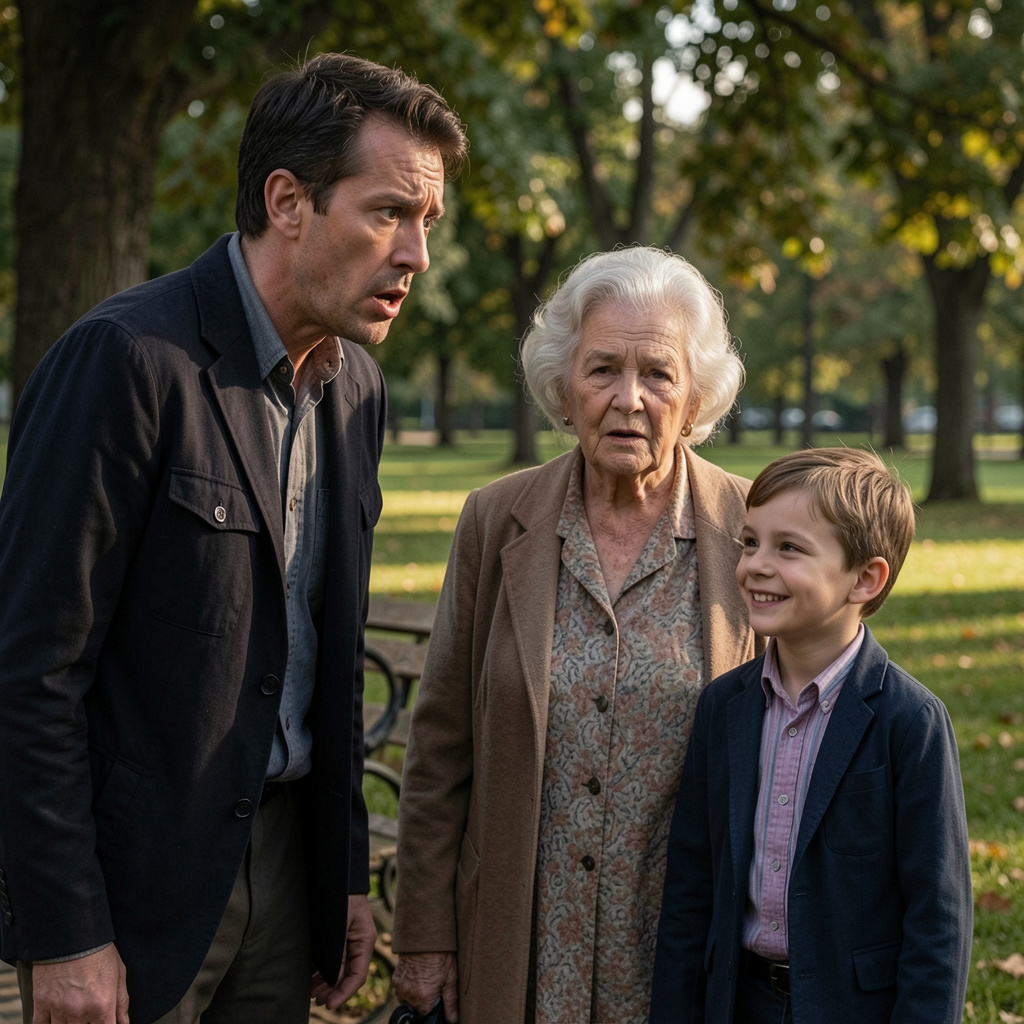
She turned, and he watched the sequence of recognitions cross her face: confusion first, then clarity, then something that clenched and shuttered like a window slamming closed. Eleanor Park had always had an expressive face. It was where Soo-Yeon had gotten hers.
“Daniel,” she said. Just his name. No warmth, no hostility — something held very carefully in between.
“It’s good to see you,” he said, and meant it, even though every muscle in his body was urging retreat. “You look well.”
“I am well,” she said, the words careful as stepping stones. “And you?”
“I’m okay. I really am.” He smiled at her, and she looked at him the way people sometimes looked at recovered addicts — searching for the lie, wanting to believe it and not quite trusting the wanting.
They stood there in the peculiar purgatory of people who have loved the same person and blamed each other for losing her. Daniel had gone over this conversation in his head many times over the years — imagined apologies given and received, imagined accusations finally spoken aloud, imagined silences that somehow communicated everything. None of those rehearsals had included what happened next.
A boy came flying around the bend of the path at full tilt, arms pinwheeling, sneakers slapping the pavement. He couldn’t have been more than six years old. He had a yellow kite tangled around one arm and joy written across every feature of his face, the uncomplicated, total joy that only belongs to small children and the occasionally enlightened.
“Granny!” he shouted. “Granny, it went so high! Did you see? Did you see how high?”
He crashed into Eleanor’s legs and wrapped his arms around them, and Eleanor’s entire body changed. The shuttered window opened. Her hands came down on the boy’s shoulders with a tenderness so fierce it looked almost painful, and she looked down at him the way people look at the only thing left of something precious.
Daniel looked at the boy’s face.
He felt the ground shift.
The boy had Soo-Yeon’s mouth. Not similar to — not reminiscent of — identical to. That same particular curve at the corners, that same slight asymmetry where the left side lifted a half-second before the right. Daniel had spent eight years cataloguing that smile. He had fallen in love with that smile on a Tuesday afternoon in a coffee shop when Soo-Yeon had looked up from her book and caught him staring and smiled at him instead of looking away, and he had thought: there is my whole life.
He felt the blood leave his face.
Eleanor looked up from the boy and found Daniel staring. And in her expression he saw something he had not expected: not triumph, not guilt, not defiance. He saw grief, and beneath it, a terrible, exhausted love.
“We—” she began, and then stopped, and swallowed. “We need to talk. I’ve owed you this for a long time. Will you sit?”
His name was Minjun. He was six years old, and he was currently twenty feet away attempting to re-launch the kite with the intense, unswerving focus of someone who had not yet learned that some things, once tangled, stay tangled.
Eleanor sat beside Daniel on the second bench from the fountain, her hands folded in her lap, and told him the truth.
“Soo-Yeon had a twin,” she said. “You knew this. You knew about her brother, James.”
“I knew he died,” Daniel said. “When he was two. She told me.”
“What she didn’t tell you — what none of us ever spoke of outside the family — was that the twin pregnancy had been because of IVF. Her father and I had struggled for years to conceive. When we finally did, it was two.” Eleanor paused. “Two embryos. Soo-Yeon and James.”
Daniel waited. He did not understand yet, but he could feel the shape of understanding approaching.
“There was a third embryo,” Eleanor said. “We had frozen it. After James died, I couldn’t — I couldn’t bring myself to release it. Her father thought I was being morbid. We disagreed about it for years. Eventually he passed, and the embryo was just — there. On record. My responsibility.”
The kite caught the air for a moment and the boy shrieked with delight.
“When Soo-Yeon died—” Eleanor’s voice broke cleanly on her daughter’s name. She stopped. Rebuilt. Continued. “When she died, I was destroyed. You know this. The things I said to you in that hospital — I have lived with the shame of them every day since. I blamed you because I could not survive blaming no one, and I cannot ask you to forgive me for that. I can only tell you I know what I did.”
“Eleanor—” he started.
“Let me finish,” she said. “Please. I’ve been carrying this.”
He let her.
“About a year after Soo-Yeon passed, I began to think about the embryo constantly. I know how it sounds. I know it is strange. But it felt like — I cannot explain it — it felt like the last piece of her. The last piece of all three of them. James. Her father. Her.” Eleanor pressed her lips together. “I spoke to doctors. I found a surrogate. A young woman I’d known for years through church — married, stable, healthy. She was willing. Selflessly willing.”
Daniel found that he could not speak. He was doing arithmetic that kept resolving to impossible answers.
“He was born fourteen months after Soo-Yeon died,” Eleanor said. “He is her biological sibling. Half-sibling — same mother, same IVF father, but my husband had been gone for years by then. He is not your child, Daniel. I want to be absolutely clear. There is no biological connection to you. He is Soo-Yeon’s brother.”
“Her brother,” Daniel repeated. The words felt strange and enormous, like trying to hold a house in his hands.
“I named him Minjun. It means— ”
“Strong and talented,” Daniel said, surprising himself. He had once asked Soo-Yeon what her name meant, and she’d spent an entire evening teaching him Korean names and their meanings, the two of them lying on the living room carpet with takeout containers and a half-drunk bottle of wine. He remembered the weight of her head on his shoulder. He remembered thinking he was the luckiest man alive.
Eleanor looked at him with an expression that was equal parts sorrow and wonder. “She taught you.”
“She taught me a lot of things.”
Across the grass, Minjun had abandoned the kite entirely and was now spinning in circles with his arms out, watching the sky. He spun until he fell over, and then he lay in the grass laughing at the clouds.
“He does that,” Eleanor said softly. “He spins until he falls. He’s been doing it since he could walk. I don’t know where he gets it.”
Daniel knew. He had a photograph, buried somewhere in a box he hadn’t opened in years, of Soo-Yeon at her cousin’s wedding — twenty-three years old, barefoot on a lawn, arms wide, head thrown back, spinning. Her cousin had captured it mid-rotation and sent it to Daniel months after the funeral, one of those small cruelties of grief, when kindness and agony become indistinguishable.
He watched Minjun stand up, brush the grass from his shorts with great seriousness, and turn to look for his grandmother. When the boy found them both watching him, he waved. And there it was again — that smile, tilting left before it tilted right — and Daniel felt something crack open in his chest that he didn’t have a word for. Not pain, exactly. Something older and stranger than pain.
He raised his hand and waved back.
They talked for nearly two hours. Eleanor was not the woman he remembered from the hospital corridor — the woman who had clutched his arm and told him, in a voice scraped raw by screaming, that he had taken her daughter from her. That woman had been detonated by loss. This woman had rebuilt herself around a child and around guilt and had arrived somewhere quieter and more sober.
She told him about the years of secrecy, how she had feared judgment, how she had feared what Daniel specifically would think — whether he would feel she had stolen something from him, or replaced something, or made a decision about Soo-Yeon’s family without him when he was, perhaps, still part of it.
She told him about the surrogate, who had moved to Canada now and sent a card at Christmas. She told him about the preschool years, about Minjun’s early terror of dogs and his current intense worship of them. She told him about the way the boy asked questions — relentlessly, specifically, with a precision that wore out his teachers and delighted her. She told him, almost accidentally, all the ways the child echoed the daughter she had lost, and Daniel listened to all of it, and did not look away.
“I was wrong to cut you off,” Eleanor said finally. It seemed to cost her something physical to say it. “You had lost her too. You had lost the baby too. And I vanished from your life and took everyone who knew her with me. I’ve thought about that for a long time.”
“I understood it,” Daniel said. “Eventually.”
“Understanding something doesn’t make it right.”
“No,” he agreed. “It doesn’t.”
Minjun had grown bored of the open field and had migrated back, as children always do, to wherever the adults were. He stood a few feet from the bench and studied Daniel with the frank, undefended assessment that is unique to small children and philosophers.
“Who are you?” he asked.
Daniel glanced at Eleanor. He wasn’t sure what the boy knew — what a six-year-old could know, should know, was able to hold.
“My name is Daniel,” he said. “I was a friend of your grandmother’s family.”
Minjun processed this with a small nod. “Do you like kites?”
“I’ve never really flown one.”
The boy’s expression suggested this was among the saddest things he had ever heard. “You should,” he said, with the gravity of someone delivering medical advice. “It’s very good.”
“I’ll keep that in mind.”
“We have an extra. Granny bought two because I broke one.” He shot Eleanor a look of impressive complexity — not quite guilty, not quite proud — and Eleanor shook her head with the helpless affection of someone who has been completely, entirely conquered by another person.
Daniel felt a laugh move through him. Gentle, unexpected — the kind that surfaces from somewhere below decision-making. He hadn’t known he still had that kind of laugh.
He drove home slowly that afternoon through the Sunday streets of a city that looked the same as it always had and felt profoundly rearranged.
He sat in his apartment for a long time without turning on the lights.
He had moved on. That was the true, complicated, unglamorous thing he had done — not the dramatic movie kind of moving on, which happened in montages and left you aesthetically wistful. The real kind, which had been two years of barely functioning, a year of therapy that broke him open before it put him back together, and then the long, quiet work of constructing something worth living in. He had good work now. He had friends. He had mornings that began with coffee rather than dread. He had not remarried, but he had loved someone, briefly and genuinely, and the ending had been its own ordinary sadness, uncolored by catastrophe.
He had thought Soo-Yeon was gone. Every piece of her, gone. That was what he had learned to carry: the total absence.
And now.
He found the box that night. It took some searching — he had moved twice since then, and each time the box had been shuffled further toward the back of things, toward the region of the apartment where the past was allowed to quietly exist without being consulted. He sat cross-legged on the floor and opened it with both hands.
Her handwriting on a birthday card. A photograph at a beach he couldn’t now name. The string of small paper cranes she’d folded one afternoon when they were both home sick, an army of cranes on the kitchen table, something to do with her hands while they watched old movies and ate soup. Her mother’s recipe, Soo-Yeon had noted on an index card in the box — Haemul Sundubu, Mom’s — do NOT add gochugaru before tasting first.
He held the index card for a while.
And then, for the first time in years, he allowed himself to cry for her properly — not the managed grief of a man who had learned to metabolize loss efficiently, but the raw, lurching kind. For her. For the baby they had lost. For the years the two of them had planned and would never have.
When it was finished, he felt hollow and cleaned-out and very, very tired.
He also, somehow, felt less alone than he had in a long time. He could not have explained this logic. But somewhere in this city, a six-year-old boy with his wife’s exact smile was asleep in a bed, probably with several of his grandmother’s protest objections to stuffed animals surrounding him. Soo-Yeon had always slept surrounded by things. Books, mostly. She said the spines were comforting.
He wondered if the boy liked books.
Eleanor called him on Thursday. He had given her his number before they parted, and she had given him hers, and they had stood by the park gate with the specific awkwardness of people who are not enemies and not yet sure what else they are.
“I wanted to ask you something,” she said. “And you can absolutely say no. I want you to know that.”
“Ask,” he said.
“Minjun’s class is doing a project on families. He needs to talk to someone who knew his — who knew Soo-Yeon. I don’t want to be the only voice he has. He hears everything from me, and I am his grandmother; I am too close. I was wondering if you might be willing to tell him something about her someday. When you’re ready. If you’re ever—”
“Yes,” Daniel said. He did not hesitate. He had thought about this for three days without knowing he was thinking about it. “Yes. I’d like that.”
There was a pause on the line, the kind that holds something being felt rather than said.
“She would be glad,” Eleanor said quietly, “that you turned out to be who you are.”
He thought about that for a long time after he put down the phone.
He met them at the same park three weeks later, the first Sunday of the following month. He brought a kite — he had asked the man at the shop which one flew best for beginners and had come away with a blue-and-white delta kite that the man had promised was forgiving.
Minjun inspected it with the seriousness of a quality-control officer.
“The tail is good,” the boy said.
“I was told it’s good for learning.”
“I’ll teach you,” Minjun said. “I’m very good.”
“He’s reasonably good,” Eleanor said, from the bench.
Minjun, magnificent in his six-year-old dignity, pretended not to hear this.
They spent an hour on the grass, the boy running ahead with the string, calling corrections back over his shoulder — let it out, more, no, not that much — and Daniel following, making the small adjustments, watching the blue shape climb against a pale sky. Eleanor watched from the bench, and when he glanced back at her, she was doing what people rarely let themselves do: she was simply watching, without trying to make meaning of it or manage it, simply taking it in.
The kite went high. Genuinely high, higher than Daniel had expected, tugging at the string with a live and purposeful tension, as though it had somewhere to be.
“Did you see?” Minjun demanded, appearing at his elbow. “Did you see how high?”
“I saw,” Daniel said.
The boy looked up at the kite with his grandmother’s straight-backed satisfaction and his mother’s tilting, asymmetric smile.
“I told you,” Minjun said. “It’s very good.”
Daniel looked up at the kite, a blue-and-white shape pulling toward the open sky, and thought: yes. It is.
He held the string. It pulled. He let it run a little further, feeling the give and resistance of something alive at the other end of the line.
It did not bring anyone back. Nothing would bring anyone back. But the kite was up there, and the boy was here, and the sky above the park was the particular shade of blue that Soo-Yeon had once pointed out — on a Sunday not unlike this one — and said simply: perfect. No elaboration. Just: perfect.
He thought that was close enough.
He thought that was, in its way, exactly enough.