Denise met me at the door holding Alan’s handwriting in both hands. For a second, I couldn’t move. The blue envelope was not large. It looked almost ridiculous for something that had driven me across town with both hands locked around the steering wheel.
There was no name on the front except mine. Mara Harlan. Alan’s handwriting. The same block letters he used on grocery lists. The same slight downward slant on the H.
The same habit of pressing so hard with a pen that the paper sometimes tore. I reached for it. Denise didn’t let go. “Before you open it,” she said, “you need to understand something.
“Your husband didn’t want you to know about me.” The words landed harder than they should have. “That much I’ve figured out.”
“No.” Denise shook her head. “I mean he didn’t want you to know because he was afraid you’d misunderstand.” I almost laughed.
After a year of grief, there are certain words that become offensive. Misunderstand. As if a dead man’s secret could be misunderstood. As if there were a version of this where I opened an envelope and discovered everything was simple.
I took it from her.
The paper was warm from her hands. “Who are you?” I asked. She stepped aside. “My name is Denise Mercer. I was the social worker at the VA clinic.”
“I know.”
“No, Mrs. Harlan. You know where I worked.” She looked down the hallway behind me. “Come inside.”
I didn’t want to. I did anyway.
Her house smelled like coffee and old books. There were framed photographs along the walls, most of them showing the same dark-haired boy at different ages. On a shelf near the kitchen sat a folded American flag inside a triangular glass case.
I noticed it. Denise noticed me noticing it. “My husband,” she said. I looked back at her. “He served with Alan?” She nodded. “Vietnam?” “Yes.”
My fingers tightened around the envelope. Alan had almost never talked about Vietnam. I knew only fragments.
A place in Kentucky where he had trained. A base somewhere overseas. A man named Eddie who had died. A promise Alan said he had made “a long time ago.”
Whenever I asked what promise, he’d kiss my forehead and say, “The kind you keep by not talking about it.” I used to think that was Alan being Alan.
Now I wasn’t so sure. Denise poured coffee. I didn’t drink it. She sat across from me.
“Alan came to the clinic every Thursday morning,” she said. “He always arrived early. Always wore the same brown jacket.”
“He had a brown jacket.”
“I know.”
The way she said it made my stomach turn.
“You knew him well?”
“I knew him enough.”
“How?”
Denise looked toward the blue envelope.
“He came because of someone named Thomas Mercer.”
Her husband’s name.
I stared at her.
“Your husband?”
“Yes.”
“What did Alan have to do with him?”
She was silent for several seconds.
Then she said, “Thomas was the person Alan believed he had failed.”
The room seemed to shrink.
“Failed how?”
Denise shook her head.
“That’s in the letter.”
I looked at the envelope.
“Then why did he write to me instead of telling me himself?”
“Because he knew he wouldn’t have the courage.”
I looked up sharply.
“Alan wasn’t afraid of anything.”
Denise smiled sadly.
“He was afraid of hurting you.”
That was the first thing she said that sounded like my husband.
I slid my thumb beneath the envelope flap.
Inside was a single folded sheet of paper.
And a photograph.
I pulled out the photograph first.
It was old.
The edges were curled and yellow.
Three young men stood outside a military barracks.
One was Alan.
I knew him immediately, even though he was barely twenty years old.
His hair was thick and dark. His face was thinner than I’d ever seen it. He was smiling.
Standing beside him was another soldier.
And beside that soldier was a third man.
Thomas Mercer.
I turned the photograph over.
Alan had written something on the back.
June 14, 1971. Camp Holloway. Before everything changed.
My hands began to shake.
“What happened?” I whispered.
Denise didn’t answer.
I unfolded the letter.
There were only six paragraphs.
The first began:
My darling Mara,
I had to stop reading.
Nobody had called me darling in Alan’s handwriting before.
I had heard the word from him thousands of times.
But seeing it there, in ink written by a man who knew he was dying, made my chest hurt.
I continued.
If you’re reading this, then I didn’t get the chance to explain it myself.
I closed my eyes.
Of course.
Even dead, Alan was apologizing for not doing something properly.
For forty-nine years I have carried something I should have told you about.
I read that sentence twice.
Forty-nine years.
I looked at Denise.
She was crying.
Not loudly.
Just tears slipping down her face.
I went back to the letter.
When Thomas was killed, I made a promise to him. I promised that I would find his little sister.
I stopped.
Denise whispered, “That’s me.”
I looked at her.
“You?”
She nodded.
“I was eleven.”
My eyes dropped back to the page.
I didn’t know if she was alive. I didn’t know where her family had gone. I only knew Thomas told me her name was Denise and that if he didn’t come home, somebody had to tell her he had not forgotten her.
My throat tightened.
Alan had spent forty-nine years searching for this woman.
And I had never known.
But then I saw the next line.
I found her twenty-seven years ago.
I looked up.
“Twenty-seven?”
Denise nodded.
“He found me through the clinic.”
“Then why didn’t he tell me?”
She looked at me with an expression I couldn’t understand.
“Because finding me wasn’t the end of the promise.”
I read on.
Thomas left something behind. Something he wanted Denise to have. I finally found it last year.
Last year.
The same year Alan died.
My heartbeat became loud enough that I could hear it.
I thought I had more time.
That sentence was underlined.
Twice.
I was wrong.
There was a second photograph inside the envelope.
I pulled it out.
This one was newer.
Much newer.
Alan stood beside Denise.
He looked older than I remembered him looking.
Thinner.
Tired.
But he was smiling.
On the back, he had written:
She finally knows.
I stared at those three words.
Then I noticed something else.
A date.
March 2.
The day before he died.
I looked at Denise.
“You saw him the day before he died?”
She nodded.
“He came here.”
“What happened?”
“He gave me this.”
She pointed at the envelope.
“He said it was for you.”
“Did he say anything else?”
Denise hesitated.
“He told me you were the strongest person he had ever known.”
I swallowed.
“And?”
“He told me you would be angry.”
Despite everything, I almost smiled.
“That sounds like him.”
“He also said something strange.”
“What?”
Denise leaned forward.
“He said, ‘If Mara asks about the promise, don’t tell her until she finds the second key.’”
The smile disappeared from my face.
“What second key?”
“I don’t know.”
“You’re sure?”
“Yes.”
“Did he explain?”
“No.”
I looked down at the letter again.
There was something written beneath the signature.
A final sentence I hadn’t noticed.
The first key is where we kept our wedding things.
My mouth went dry.
Our wedding things.
I knew exactly where that was.
The cedar chest in our bedroom.
The one I hadn’t opened since the funeral.
I stood so quickly the chair scraped backward.
Denise rose too.
“Mrs. Harlan—”
“Mara.”
She nodded.
“Mara.”
I folded the letter carefully.
“Did Alan tell you what the key opens?”
“No.”
“Did he tell you why he was afraid I’d find it?”
Denise’s expression changed.
“No.”
“What?”
She looked toward the photograph of her husband.
“Because he said if you found the second key, you’d finally understand why he never told you what happened to Thomas.”
I couldn’t breathe for a moment.
Then my phone rang.
It was Beth.
I almost didn’t answer.
“Mom?”
Her voice was tense.
“Where are you?”
“At Denise’s.”
Silence.
Then:
“Who’s Denise?”
I looked at the woman across the room.
Before I could answer, Beth said something that made the blood drain from my face.
“Mom, I think you need to come home.”
“Why?”
“I was looking through Dad’s things.”
My hand tightened around the phone.
“What did you find?”
“A box.”
“What kind of box?”
“I don’t know.”
She paused.
“But there’s a name on it.”
My heart began pounding.
“What name?”
Beth whispered:
“Thomas Mercer.”
And then the call went dead.
Tell Her I Kept My Promise — Part 3: The Ending
By the time I reached home, Beth was standing on the porch.
She was holding the box.
It was smaller than a shoebox, wrapped in brown paper that had gone soft with age. A piece of twine circled it twice.
My name was written across the top.
Not Beth’s.
Mine.
I looked at her.
“Where did you find it?”
“In Dad’s closet.”
“Where?”
“Behind the winter coats. There was a loose board in the back.”
I took the box from her.
It was heavier than it looked.
For one strange second, I thought about putting it back.
Some secrets should stay buried.
But then I remembered Alan’s letter.
The first key is where we kept our wedding things.
I went upstairs.
The cedar chest sat beneath the window.
Dust covered the lid.
I hadn’t touched it in a year.
Inside were our wedding album, my veil, Alan’s old tie, dried flowers, and the little silver cake knife we’d used on our twenty-fifth anniversary.
At the very bottom was a velvet pouch.
My hands shook as I opened it.
Inside was a key.
Small.
Brass.
Taped to it was a note.
For the second lock.
Beth stood behind me.
“Mom?”
I didn’t answer.
We searched the house for almost an hour.
Every drawer.
Every cabinet.
Every old toolbox.
Nothing.
Then Beth noticed the keyhole.
It was inside the wooden box.
I inserted the key.
The lock clicked.
Inside were three things.
A military medal.
A cassette tape.
And a letter addressed to me.
The medal belonged to Thomas Mercer.
The cassette had one word written on it:
Listen.
We found an old tape player in the garage.
It took three tries to make it work.
Then Alan’s voice filled the room.
Older than in the memories I carried.
Tired.
But unmistakably his.
“Mara, if you’re hearing this, I’m gone.”
I closed my eyes.
“I know you probably hate me right now.”
I whispered, “I don’t.”
“You should.”
Beth began crying beside me.
Alan continued.
“I promised Thomas I’d find his sister. But that wasn’t the only promise.”
The tape crackled.
“There was another man with us that night.”
My eyes opened.
“His name was Daniel Harlan.”
I stopped breathing.
My father.
Alan’s voice continued.
“Your father.”
Beth covered her mouth.
I couldn’t move.
My father had died twenty years before Alan.
I had never known he had served with them.
“We were ordered to leave Thomas behind,” Alan said. “Your father refused. He went back.”
A long silence followed.
“Thomas was alive.”
I gripped the edge of the table.
“Your father found him. He carried him almost a mile before he was shot.”
The tape crackled again.
“Thomas didn’t make it.”
I felt tears on my face.
“But your father did.”
My whole life, I’d believed my father had been discharged because of an injury he received overseas.
Alan knew the truth.
“He came home carrying Thomas’s last letter.”
My eyes went to the box.
“That letter was never delivered.”
Alan took a breath.
“I found it forty-nine years later.”
The room was completely silent.
“Thomas had written to Denise. He wanted her to know he loved her. He wanted her to know he was coming home.”
Alan’s voice broke.
“He never got the chance.”
The tape clicked.
For several seconds, there was only static.
Then Alan said:
“So I made him a promise.”
His voice became softer.
“I found Denise. I gave her the letter. And she finally knew her brother hadn’t forgotten her.”
I looked at Beth.
“But there was one thing I couldn’t tell you, Mara.”
The tape hissed.
“Your father saved Thomas because he thought he could save him.”
A pause.
“He couldn’t.”
Alan’s next words were barely audible.
“But he saved me.”
I cried then.
Not the quiet crying I’d learned over the past year.
It came out of me like something breaking.
Alan continued.
“Your father died believing he’d failed.”
My hands covered my face.
“He didn’t.”
The tape clicked.
“Neither did I.”
There was another long silence.
Then Alan said the words I’d been waiting a year to hear.
“I kept my promise.”
The tape ended.
Beth and I sat there without speaking.
Finally, she picked up the letter.
“Mom.”
I looked at her.
“There’s something else.”
She unfolded it.
It wasn’t from Alan.
It was from Thomas.
Dated June 14, 1971.
The last line read:
If Alan ever finds this, tell him I was never afraid. I knew someone would remember me.
I held the paper against my chest.
For a year, I had believed the last thing Alan left behind was an unsent text.
I had thought those six words were a mystery.
They weren’t.
They were a message meant for me.
Not because Alan had failed to tell me something.
Because he had spent his final year making sure two families finally heard the truth.
The next morning, I called Denise.
She answered on the first ring.
“I found it,” I said.
She knew immediately.
“Thomas’s letter?”
“Yes.”
She began to cry.
So did I.
For the first time since Alan died, I didn’t feel like I was standing at the edge of his life, trying to understand where I’d been left behind.
I understood.
He hadn’t been leaving me.
He had been finishing something.
Something he had started when he was twenty years old.
Something he had carried quietly for forty-nine years.
That afternoon, Beth helped me put the photographs into an album.
We placed Thomas’s medal beside Alan’s wedding ring.
My father’s photograph went between them.
Three men who had carried the same secret.
Three lives connected by one promise.
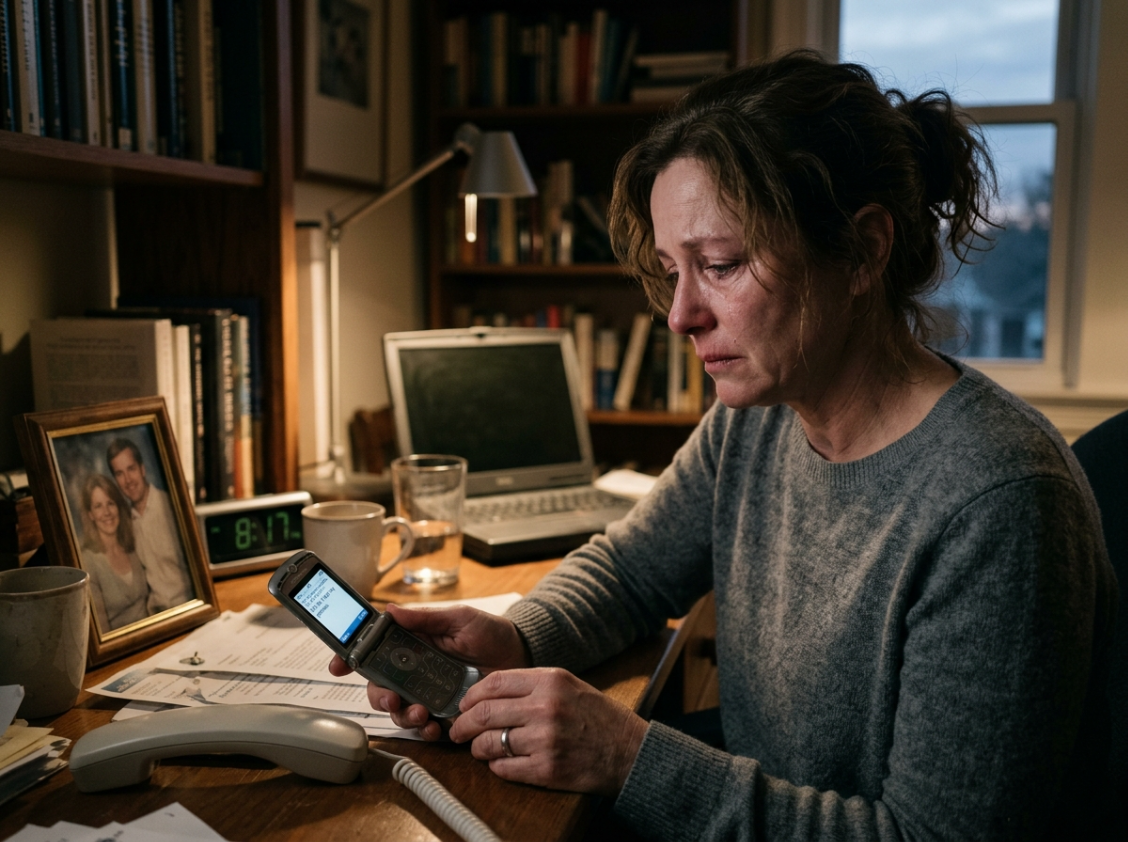
Before we closed the album, I looked once more at Alan’s old flip phone.
The draft was still there.
Tell her I kept my promise.
I finally understood why he had never sent it.
He knew I would find it eventually.
He knew I would call the number.
He knew Denise would answer.
And he knew that once I heard the truth, I would stop asking myself the question that had haunted me since the morning he died:
Why didn’t he wake me?
The answer was simple.
He had spent his last morning trying to finish the promise he had made to another man.
And when he couldn’t finish it himself, he trusted me to find the rest.
That night, I placed the phone back in the shoebox.
But I didn’t close the lid.
For the first time in a year, I wasn’t afraid of his things.
I touched the little silver flip phone and whispered,
“You kept it, Alan.”
Then I smiled through my tears.
“And so did I.”
Outside, the porch light came on automatically as evening settled over the house.
The same light Alan had installed because he hated coming home to a dark porch.
I stood there for a long time.
And for the first time since his funeral, the house didn’t feel empty.
It felt finished.