At JFK, I Found My Widowed Daughter-in-Law Being Sent Away With Her Children—So I Brought Her Back, and When My Sister Saw Who I Was Bringing Home, Her Shock Revealed a Family Secret No One Expected.
I had just returned from London when an unexpected sight stopped me in the middle of JFK Airport. The flight had landed early, a small mercy of favorable winds over the Atlantic, and I remember feeling almost lighthearted as I walked through the terminal, already thinking about the quiet evening ahead,
a glass of scotch, maybe an early night after two exhausting days of board negotiations overseas. That lightness lasted exactly as long as it took me to round the corner near the baggage claim.
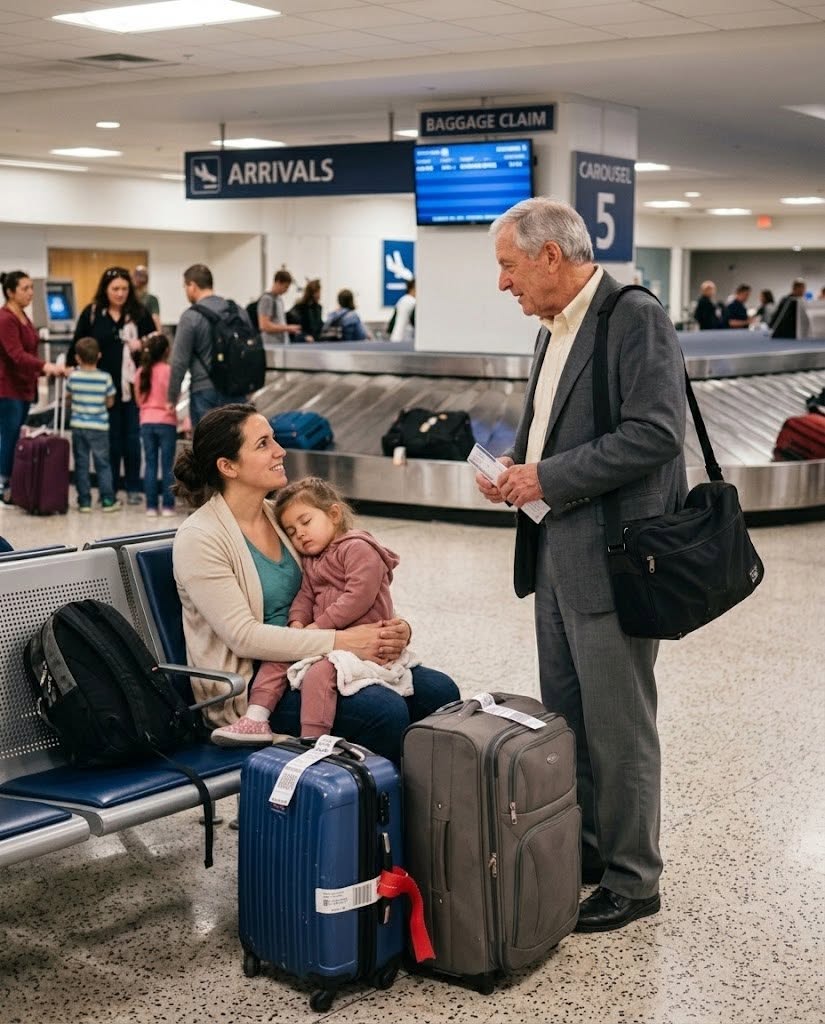
Beneath the harsh fluorescent lights sat my widowed daughter-in-law, Elena, holding my sleeping four-year-old grandson in her arms while three battered suitcases rested at her feet. Tears streaked her face, and she clutched a crumpled envelope so tightly that her knuckles had turned white.
When I called her name, she flinched as though she had spent the entire day expecting another threat instead of someone willing to help.
I dropped my briefcase without a second thought, the leather corner striking the tile with a sound loud enough that a passing traveler glanced over, and knelt beside her. I gently touched Leo’s small hand.
He was warm but clearly exhausted from crying himself to sleep, his cheeks still faintly blotchy, and seeing him in that condition filled me with a mixture of confusion and dread that I hadn’t felt in the year since my son died.
“Elena, what happened? Why are you here?”
She looked at me in disbelief before answering, as though some part of her mind was still trying to work out whether I was actually real, standing there in the middle of the terminal, or another cruel trick of the day.
“You weren’t supposed to return until tomorrow.”
“My meetings ended early. Tell me what happened.”
Without another word, she handed me the envelope she had been clutching, her fingers trembling as they finally released it. Inside was a one-way airline ticket to Dayton, Ohio, accompanied by a formal letter printed on stationery bearing my family’s crest — the same crest that had sat at the top of every
important document I’d ever signed, now used, apparently, to remove my own grandson’s mother from the only home he’d ever known. The message had been signed by my younger sister, Beatrice, and declared that Elena’s continued presence at Whitmore House had become damaging to the family’s
reputation. According to the letter, she and Leo were to leave immediately, security had already been instructed to assist with their departure, and neither of them was permitted to return unless written authorization was granted.
Elena’s voice trembled as she explained how everything had unfolded earlier that morning, the words coming out slowly, haltingly, like she was still trying to process the sequence of events herself even as she narrated them.
“She arrived before breakfast with two security guards. Leo was still wearing his pajamas. The staff packed our things while she told me the decision had already been made.”
“By whom?”
“That’s what I asked. She said that now Liam is gone, I have no place in your family. She said I was tolerated only because he loved me.”
Hearing Liam’s name reopened a wound that had never truly healed. My son had died only a year earlier — an aneurysm, sudden and merciless, taking him from us on an otherwise unremarkable Tuesday morning — leaving behind a grieving wife and a little boy who still asked, some nights, when
his father was coming home. Elena had never cared about the Whitmore fortune, the family foundation, or the privileges attached to our name. She’d met Liam at a small nonprofit before he ever told her who his family was, and by the time she found out, she’d already fallen in love with a man who cooked
terrible pasta and read to her from paperback mysteries in bed, not with a name on a brass plaque. All she wanted, in the year since his death, was to continue raising Leo in the guest house where she and Liam had built their quiet life together, surrounded by the objects and rituals that still made him feel
present.
Beatrice, however, saw things very differently. To her, Leo represented the future of the Whitmore family, a vessel for a legacy she considered herself the natural steward of, and she had convinced herself that Elena’s ordinary background made her unworthy of raising the child who would carry our
name into the next generation.
Elena lowered her eyes before continuing.
“She told me Leo should grow up around people who understand his name. She said that if I truly loved him, I wouldn’t resist what was best for him.”
I searched her face carefully before asking the question that mattered most, the one I was almost afraid to ask.
“Did anyone hurt you?”
“One of the guards took my phone when I tried to call you. Beatrice said I was becoming hysterical.”
Everything became painfully clear, the pieces sliding into place with a coldness that settled somewhere behind my ribs. Beatrice had taken advantage of my business trip to remove Elena from the estate before I could interfere. Sending her back to her hometown wasn’t the true objective. It was only the first
move in a much larger plan. Once Elena was isolated and vulnerable, hundreds of miles away with no phone and no support, Beatrice intended to argue that Leo should remain with the Whitmore family under the respectable language of duty, stability, and concern for his future — language that would
sound, to anyone not paying close attention, like genuine care rather than the calculated theft of a mother’s child.
I stood up without another moment of hesitation.
“Pick up your things. You and Leo are coming home.”
Elena looked uncertain, glancing down at Leo’s sleeping face as though afraid to hope. “But Beatrice said—”
“I know exactly what she said. She has forgotten who owns the house and who has authority over the family trust.”
During the drive back to Long Island, I wasted no time preparing for what I knew would become a confrontation. I called my attorney, Victor Lane, and instructed him to bring every relevant trust document, foundation bylaw, and security contract to Whitmore House immediately, my voice sharper
than I usually allowed it to be with him. Then I contacted our estate manager, Marjorie, a woman who had run that household with quiet competence for nearly fifteen years, ordering her to secure Elena’s residence, preserve every room exactly as it had been left, and document the names of everyone who
had participated in removing her belongings.
I ended the call with one additional instruction, the words coming out of me with more finality than I’d spoken anything in months.
“When Elena returns, she enters through the front door. Not the servants’ entrance or the side portico. The front door.”
“Yes, Mr. Whitmore.”
The car grew quiet after that. Elena watched me from the back seat while Leo slept peacefully against her shoulder, still unaware that his entire future had nearly been decided without his mother’s consent, still unaware of how close he’d come, that morning, to a life built entirely around an aunt’s ambition
rather than his mother’s love.
Finally, she spoke, her voice barely above a whisper. “I don’t want to begin a family war.”
I met her eyes in the rearview mirror before answering.
“You didn’t begin it. You and Leo are already trapped in the middle of one. The difference is that someone has finally arrived on your side.”
When we reached Whitmore House, I discovered Beatrice had already gathered a family council in the west drawing room, apparently confident enough in the success of her morning’s work that she’d wasted no time convening the next phase of her plan. Her husband, several relatives I recognized from
holiday gatherings, two members of the family foundation’s board, and the head of security were all waiting as though the outcome had already been decided, as though my early return was simply an inconvenience to be smoothed over rather than a fundamental disruption to everything Beatrice had
arranged.
I asked Marjorie to take Elena and Leo to the library while I entered the meeting alone.
Beatrice stood near the fireplace wearing silk and pearls, speaking confidently about difficult decisions and necessary adjustments after Liam’s death. She smiled when she saw me,
clearly surprised that I had returned sooner than expected, though the surprise passed quickly, replaced by the same practiced composure she’d worn my entire life whenever she felt certain she held the winning hand.
“Raymond. You returned early.”
“Yes.”
“We were discussing certain adjustments following a difficult year.”
I ignored the performance and asked the only question that mattered.
“Who authorized Elena and Leo’s removal from the estate?”
She smiled even wider, a smile I recognized from childhood, the one she’d worn right before telling our parents some carefully edited version of an argument that always managed to leave her blameless. “Removal is an unnecessarily dramatic word.”
“Who authorized it?”
“I did.”
“Under whose authority?”
Beatrice never hesitated. She insisted she had acted only to protect Leo’s future, arguing that Elena didn’t understand Whitmore traditions, avoided important social functions, and lacked the upbringing necessary to raise the future heir of our family — a litany of complaints she delivered with the smooth
confidence of someone who had rehearsed the speech more than once, perhaps in front of a mirror, perhaps to the members of the board sitting silently around that room.
“Liam is gone. Leo represents the future of this family. We cannot allow him to be shaped entirely by a woman who never belonged here.”
I stared at my sister in disbelief before answering.