For several seconds, neither of us moved. The box lay overturned on the porch between us. I could hear the faint hum of the refrigerator through the open kitchen window behind me. Somewhere down the street, a dog barked twice and fell silent. Everything around us seemed painfully ordinary.
But nothing about that box was ordinary. I stared at what had spilled from it. Then I looked at Dylan. His face had gone pale. Not the pale expression of a man who had brought a terrible surprise. It was the face of someone who had spent twenty years carrying something too heavy to put down. “What is this?” I whispered. Dylan swallowed. “I was hoping you wouldn’t recognize it.” My eyes returned to the contents scattered across the porch.
There were photographs. Dozens of them.
Old photographs, some torn along the edges, some yellowed with age. There were envelopes, handwritten notes, a small child’s drawing, and several documents folded into quarters.
But those were not what had made me stumble backward.
In the center of the box was a photograph of my husband. A photograph I had never seen before. He was standing beside a car.
And beside him was Dylan’s father.
My stomach tightened. “What am I looking at?” Dylan didn’t answer. I crouched slowly and picked up one of the envelopes.
My hands began trembling before I even opened it. The handwriting on the front was unmistakable. It was my husband’s.
I had seen that handwriting thousands of times over the years—on grocery lists, bills, birthday cards, notes left on the kitchen counter.
But this envelope was addressed to Dylan.
And beneath his name were four words that made the blood drain from my face. You know what happened. I looked up.
“Dylan.”
He closed his eyes.
“I know.”
“What happened?”
He didn’t speak.
“Tell me.”
Still nothing.
My voice became sharper.
“You came to my house after twenty years carrying a box full of things that look like evidence, and you’re standing there telling me nothing?”
“I didn’t come here to hurt you.”
“Then why did you come?”
His eyes finally met mine.
“Because you deserve to know.”
A cold feeling spread through my chest.
“Know what?”
He took a slow breath.
“The jewelry wasn’t stolen by me.”
I stopped breathing.
For twenty years, I had imagined that night.
I had imagined Dylan sneaking into our bedroom while I slept.
I had imagined him opening my jewelry box.
I had imagined his young hands taking my grandmother’s earrings, my mother’s ring, the necklaces I had inherited.
I had imagined him selling everything.
I had imagined that our entire relationship had been nothing more than an act.
And now he was telling me none of it had been true.
“Then who took it?”
Dylan looked toward the street.
“My father.”
The words barely registered.
“What?”
“My father took your jewelry.”
I shook my head.
“No.”
“He did.”
“No. You were the one who disappeared.”
“I disappeared because he told me to.”
My knees weakened.
I reached for the porch railing.
“Why?”
Dylan looked at me with an expression I had never seen on his face before.
Fear.
Real fear.
“Because I saw something I wasn’t supposed to see.”
The world seemed to narrow around those words.
“What did you see?”
He hesitated.
Then he picked up the photograph of my husband and his father.
“This.”
I stared at it again.
My husband was younger—much younger.
Maybe thirty years old.
His hair was darker. His face thinner.
Dylan’s father stood beside him, one hand resting on the hood of the car.
Behind them was a building.
I recognized it immediately.
It was an old warehouse on the edge of town.
The same warehouse that had burned down years ago.
I had always assumed the fire had been an accident.
Dylan reached into the box and pulled out another photograph.
This one showed the warehouse at night.
A dark car was parked outside.
Its headlights were on.
My husband’s car.
I looked at Dylan.
“Why would my husband be there?”
“I don’t know.”
“You do know.”
“I know what I saw.”
“Then tell me.”
His jaw tightened.
“I was eleven.”
He looked down at the photograph.
“I woke up one night because I heard voices outside. My father wasn’t home. Neither was my mother. I went to the window.”
He paused.
“There was your husband.”
My heart hammered against my ribs.
“He was talking to my father.”
“About what?”
“I couldn’t hear everything.”
“Everything you could hear.”
Dylan’s voice dropped.
“They were arguing.”
“About what?”
“Money.”
My fingers tightened around the photograph.
“How much?”
“Your husband kept saying he wanted his share.”
I stared at him.
“My husband had no business dealings with your father.”
“I know.”
“No. Dylan, you’re mistaken.”
“I wish I were.”
He reached into the box again.
This time he pulled out a small cassette tape.
I stared at it.
“What’s that?”
“My father recorded everything.”
“Why?”
“Because he trusted nobody.”
Dylan gave a bitter laugh.
“He especially didn’t trust your husband.”
I felt suddenly dizzy.
“Where did you get this?”
“From my father’s house.”
“After he died?”
Dylan nodded.
“He died three years ago.”
I looked at the box.
“Then why didn’t you come sooner?”
His eyes became wet.
“Because I was afraid.”
“Of my husband?”
Dylan didn’t answer.
That was answer enough.
I turned toward the house.
My husband was sitting in the living room.
He was eighty now.
Older.
Slower.
But suddenly, for the first time in my life, I wondered whether I had ever truly known the man I married.
I turned back to Dylan.
“What does the tape say?”
“You should listen to it.”
“Here?”
“No.”
He shook his head.
“Not here.”
“Why?”
He looked toward the windows of my house.
“Because I don’t know whether he knows I’ve come back.”
A chill ran down my spine.
“You think my husband is dangerous?”
Dylan looked at me for a long moment.
Then he said quietly:
“I think you should ask him where he was twenty years ago.”
I felt my heart sink.
“He was here.”
“No.”
“He was asleep.”
“No, Mrs. Holland.”
Dylan’s voice trembled.
“He wasn’t.”
I stared at him.
“What are you saying?”
“I saw him.”
“Where?”
“The night before I left for college.”
My mouth went dry.
“You saw my husband?”
“Yes.”
“Where?”
Dylan looked toward the street.
“Outside my house.”
I couldn’t speak.
He continued.
“He was arguing with my father.”
“About what?”
“The jewelry.”
I felt something inside me crack.
“The jewelry had already been taken?”
“No.”
He looked at me.
“Not yet.”
For a moment I couldn’t understand.
Then the meaning struck me.
“You’re saying my husband knew the jewelry would disappear?”
Dylan nodded.
“And he knew I would be blamed.”
“Why?”
“I don’t know.”
“Then why did you stay silent for twenty years?”
His expression broke.
“Because my father threatened to kill you.”
I stopped.
“What?”
“He told me that if I ever told you what I saw, you’d die.”
I stared at the young boy I remembered.
The skinny child sitting in the cold.
The child who had asked me for cookies.
The boy who had helped me carry groceries.
The boy who had called me when he was frightened.
Suddenly, all those memories felt different.
“You could have told someone.”
“I was a kid.”
“You could have written to me.”
“I tried.”
My heart stopped.
“What?”
“I wrote you letters.”
“How many?”
“Twenty-three.”
I shook my head.
“I never received a single one.”
“I know.”
“Then where did they go?”
Dylan looked down at the box.
“They’re in there.”
My hands began shaking again.
He picked up a thick bundle of envelopes tied together with faded blue string.
“Every letter I wrote you.”
I stared at them.
Twenty-three envelopes.
My name was written across every one.
Some were dated during his first year of college.
Some from his twenties.
Some from his thirties.
One was dated only six months ago.
I reached for the bundle.
“Why didn’t you send this one?”
“Because I wanted to bring it myself.”
“Why now?”
Dylan’s eyes filled with tears.
“Because I finally found the person who can prove everything.”
I looked at him.
“Who?”
He didn’t answer immediately.
Instead, he reached into the box one final time.
He pulled out a photograph.
A woman stood in front of an old hospital.
She was young.
Maybe twenty-five.
I didn’t recognize her.
But Dylan did.
“This is your husband’s first wife.”
I stared at the photograph.
“My husband was never married before me.”
Dylan looked at me sadly.
“He told you that?”
“Yes.”
“He lied.”
The photograph slipped from my fingers.
Dylan bent down and picked it up.
“She disappeared six months before he met you.”
I felt the porch sway beneath my feet.
“Disappeared?”
“Yes.”
“Where did she go?”
Dylan’s eyes lifted to mine.
“That is what I’ve spent the last twenty years trying to find out.”
He placed the photograph back inside the box.
“And I finally found her.”
My breath caught.
“She’s alive?”
Dylan nodded.
Then he looked toward my front door.
“She’s inside your house.”
I turned.
The front door was still open.
And in the darkness beyond it, I saw a woman’s silhouette standing in my hallway.
She was holding my husband’s old photograph.
And she was staring directly at me.
Then she spoke.
“Mrs. Holland…”
Her voice was barely more than a whisper.
“You need to leave this house.”
Behind her, something crashed.
The woman turned sharply.
Dylan grabbed my arm.
“Don’t go inside.”
But I was already staring past her.
Because the sound had come from my husband’s room.
And then I heard his voice.
Calm.
Cold.
Almost unfamiliar.
“Dylan.”
The woman in the hallway went completely still.
My husband called again.
“It’s been twenty years.”
A pause.
Then:
“I wondered when you’d finally come back.”
The Box on the Porch — Part 3: The TruthPart 3 — The Truth
For several seconds, nobody moved.
Dylan stood beside me on the porch, his hand still gripping my arm.
The woman in the hallway stared toward the bedroom.
And my husband stood somewhere in the darkness beyond the doorway.
Then he spoke again.
“Come inside, Dylan.”
Dylan’s grip tightened.
“No.”
My husband laughed softly.
It was not the laugh I knew.
It was colder.
Older.
A laugh that seemed to belong to someone I had never met.
“You’ve been running for twenty years,” he said. “Surely you’re tired.”
The woman stepped onto the porch.
“Don’t listen to him.”
I looked at her.
“Who are you?”
She hesitated.
Then she said the name that made my entire body go numb.
“Margaret.”
My husband’s first wife.
The woman he had told me was dead.
The woman whose photograph Dylan had brought to my door.
I stared at her face.
“You’re alive.”
“Yes.”
“Why didn’t you ever come forward?”
She looked toward my husband.
“Because he made sure I couldn’t.”
Dylan stepped between us.
“Tell her everything.”
Margaret nodded.
Then she began.
Twenty-one years earlier, she had discovered that my husband and Dylan’s father were involved in an illegal financial scheme. They had been moving stolen money through businesses and fake accounts.
Margaret had threatened to expose them.
My husband responded by threatening her.
When that didn’t work, he staged her disappearance.
“She escaped,” Dylan said quietly. “My father helped her.”
I looked at him.
“Your father helped her?”
“He had begun regretting what he’d done. He knew the situation was getting out of control.”
Margaret continued.
“I went into hiding. I couldn’t contact anyone. Every person I trusted was watched.”
“Then why me?” I whispered. “Why was I dragged into this?”
Margaret’s eyes filled with tears.
“Because your husband needed someone to blame.”
Everything suddenly fell into place.
The jewelry.
Dylan.
The twenty years of silence.
My husband had known that Dylan would be leaving for college.
He had stolen my jewelry and arranged things so that Dylan would be blamed.
But why?
Dylan answered before I could ask.
“Because my father had the evidence.”
He pointed toward the box.
“The documents in there prove what they did. My father kept copies of everything.”
My hands trembled.
“And my husband wanted those documents.”
Dylan nodded.
“He believed my father had hidden them somewhere.”
“So he used me?”
“Yes.”
“And you?”
“I found the documents years later.”
“Why didn’t you bring them to the police?”
Dylan looked at Margaret.
“Because by then my father was dead, and I didn’t know who I could trust.”
Margaret reached into her coat and pulled out a small recording device.
“I kept one thing from them.”
She pressed a button.
My husband’s voice came through the speaker.
Clear.
Unmistakable.
I heard him discussing the stolen jewelry.
I heard him discussing Dylan.
And then I heard the sentence that shattered whatever remained of my trust in the man I had married.
“Once they blame the boy, nobody will ever believe him.”
My eyes filled with tears.
For twenty years, I had believed Dylan had betrayed me.
But he had been protecting me.
I turned toward the doorway.
My husband was standing there now.
He looked smaller than I had ever seen him.
Not because he had aged.
Because I finally saw him clearly.
“You knew,” I whispered.
He said nothing.
“You knew I would blame Dylan.”
Still nothing.
“You destroyed twenty years of my life.”
His expression hardened.
“I was protecting us.”
“No.”
My voice shook.
“You were protecting yourself.”
He looked at Dylan.
“You should have stayed away.”
Dylan stepped forward.
“I did.”
Then he pointed toward the box.
“For twenty years.”
Sirens sounded in the distance.
My husband froze.
Margaret looked at me.
“I called them before we came.”
My husband slowly turned toward the street.
Two police cars stopped outside the house.
For the first time, I saw fear in his eyes.
Real fear.
Officers approached.
One of them took the box.
Another took the recording.
My husband did not resist.
As they led him away, he looked back at me.
“You’ll regret this.”
I stared at him.
“No.”
I wiped the tears from my face.
“The only thing I regret is believing you instead of a hungry little boy who trusted me.”
Dylan lowered his head.
For a moment neither of us spoke.
Then I stepped toward him.
“Why did you come back?”
He looked at me.
“Because I never forgot you.”
I touched his face the way I had when he was a child.
“You should have come home.”
His eyes filled with tears.
“I was ashamed.”
“You had nothing to be ashamed of.”
“I left without saying goodbye.”
“You were a child.”
“I let you think I stole from you.”
“You were protecting yourself.”
He shook his head.
“I wanted to tell you every year.”
“Then why didn’t you?”
He smiled sadly.
“Because every time I picked up the phone, I remembered your face the morning I left.”
I knew exactly what he meant.
The little boy I had loved had left my house believing he would never see me again.
And for twenty years, he had carried that pain.
I pulled him into my arms.
For a few seconds, he resisted.
Then he broke down against my shoulder.
Just as he had when he was eleven.
Just as he had when he was frightened.
Only this time, I was the one holding him.
“You’re home now,” I whispered.
He nodded.
“I know.”
Weeks later, the investigation uncovered everything.
My husband’s financial crimes were exposed.
Dylan’s father had left behind enough evidence to prove the scheme.
The stolen jewelry was eventually recovered from a storage unit.
My grandmother’s earrings were scratched.
My mother’s ring was damaged.
But they were still mine.
When the detective returned them, I cried.
Not because of their value.
Because for twenty years, I had believed that losing those things was the price I had paid for trusting Dylan.
Now I understood.
The jewelry had never been the real loss.
The real loss had been twenty years spent believing that a child I loved had betrayed me.
One evening, months after everything ended, Dylan came to my house again.
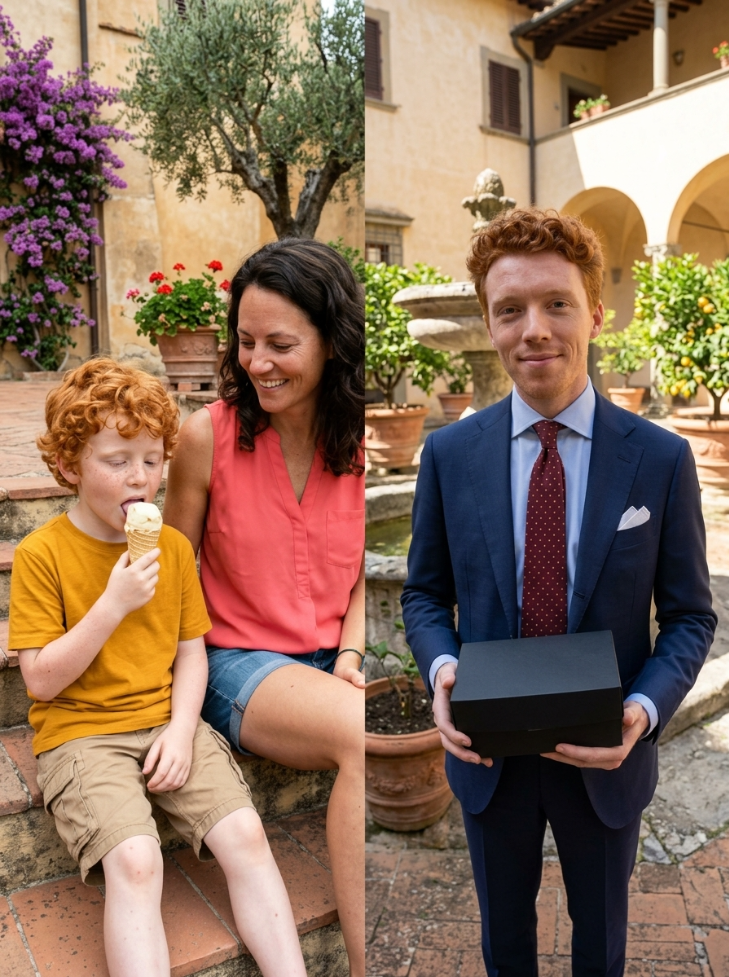
This time he wasn’t wearing a dark suit.
He carried no mysterious box.
He simply stood on my porch holding a paper bag.
I opened the door.
He smiled.
“I brought pizza.”
I laughed through my tears.
“After all these years?”
He shrugged.
“Some things shouldn’t change.”
We sat in the kitchen that night, eating pizza and talking until midnight.
And for the first time in twenty years, my house felt like a home again.
I had never had a child of my own.
But sitting across from me was the little boy I had once invited inside from the cold.
He had grown into a man.
And somehow, after everything we had lost, we had found our way back to each other.
Sometimes love does not disappear when people leave.
Sometimes it simply waits.
And sometimes, after twenty years of silence, it comes back to your porch carrying a box—and gives you back the truth you thought you had lost forever.