The Badge The dispatcher went silent for half a second. Not because she doubted me. Because she understood what I had just told her. “Ma’am,” she said, her voice suddenly careful, “are you saying you are a retired federal prosecutor?” “Yes.” “Do you have reason to believe the injuries were inflicted by someone known to the victim?” “I have reason to believe my daughter was assaulted inside her home, that evidence may have been deliberately destroyed, and that she was abandoned outside in freezing weather.” Another pause. “Officers are being dispatched.” “Good.” “And ma’am?” “Yes?” “Do not move her unless there is an immediate danger.
“I never told my arrogant son-in-law that I was a retired…
“I won’t.”
I closed the lockbox.
For twenty-seven years, that badge had represented cases I no longer discussed at dinner tables.
Fraud.
Public corruption.
Witness intimidation.
Conspiracy.
People who believed money could erase evidence and influence could erase consequences.
I had learned something early in my career:
The most dangerous people weren’t always the ones shouting.
Sometimes they were the ones smiling while everyone else was frightened.
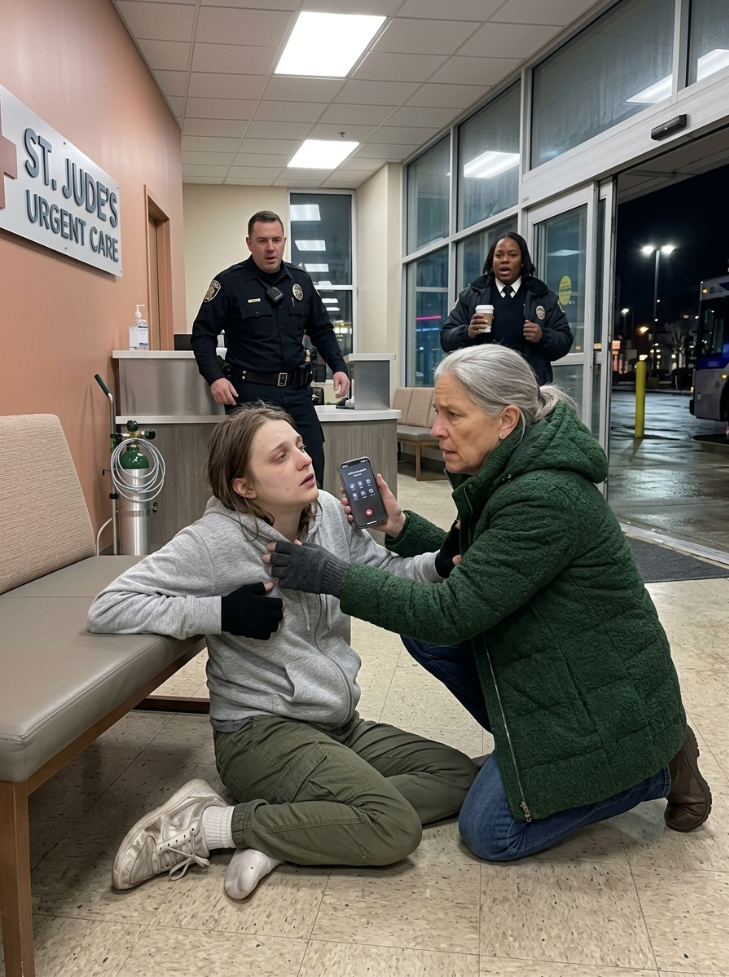
I looked down at Chloe.
Her lips were pale.
One shoe.
No coat.
A thin blouse beneath a sweater that had been torn near the shoulder.
There was a dark mark along her wrist.
And beneath her hair, just above her ear, I saw something that made my stomach tighten.
A small smear of dried blood.
I took out my phone and photographed it.
Then another picture of her torn sleeve.
Then her bare foot.
Then the bench.
Then the exact position in which I had found her.
I wasn’t collecting memories.
I was preserving evidence.
The security guard finally came outside.
“Ma’am,” he said, “ambulance is coming.”
“Did you see her arrive?”
He nodded slowly.
“A man dropped her off.”
“Can you describe him?”
He looked toward the parking lot.
“Tall. Dark jacket. Gray SUV.”
“Did he speak to her?”
“No.”
“Did he touch her?”
The guard hesitated.
“Not that I saw.”
That answer bothered me.
“Did you see the vehicle leave?”
“Yes.”
“Did you see the license plate?”
His face changed.
“I… might have.”
“Might have isn’t good enough.”
He swallowed.
“I wrote it down.”
I stared at him.
“Where?”
He reached into the security booth and pulled out a folded piece of paper.
There it was.
A license plate.
I photographed it.
Then I looked at him.
“Why did you write it down?”
The guard looked embarrassed.
“Because the man seemed angry.”
“What did he say?”
“Nothing.”
“Then why did he seem angry?”
The guard glanced toward Chloe.
“Because before he left, he looked back at her.”
He lowered his voice.
“Like he wanted to make sure she stayed there.”
My jaw tightened.
Before I could ask another question, sirens approached.
Two police cruisers turned into the terminal entrance.
Behind them came the ambulance.
Everything changed at once.
Paramedics rushed toward Chloe.
I stepped back and let them work.
“Female, approximately twenty-eight,” I said. “Found unconscious. Prolonged cold exposure. Possible assault. Unknown duration.”
One paramedic looked at me.
“Relationship?”
“Mother.”
“Any known medical conditions?”
“None that I know of.”
“Medications?”
“None.”
“What happened?”
I looked at Chloe.
Then at the police officers.
“I’ll explain everything.”
The older officer approached.
“Ma’am, I’m Detective Harris.”
He showed me his badge.
I nodded.
“Eleanor.”
“Eleanor what?”
I gave him my full name.
His expression remained neutral.
Then his eyes dropped to the badge clipped inside my coat.
He looked back at me.
“You’re federal?”
“Retired.”
“How long?”
“Twenty-four years.”
He studied my face.
“You’re the prosecutor?”
“I was.”
His partner whispered something into his ear.
Detective Harris looked toward Chloe.
Then toward me.
“Did you touch anything besides your daughter?”
“Yes.”
“What?”
“I opened the lockbox in my home.”
He blinked.
“No, I mean here.”
“I photographed the scene before anyone moved anything.”
His eyebrows lifted.
“I didn’t touch the blood.”
“Good.”
He glanced at his partner.
“Secure the terminal cameras.”
The younger officer immediately walked toward the security booth.
I heard Harris say something quietly into his radio.
Then he turned back to me.
“Ma’am, I need to ask you something.”
“Go ahead.”
“Why did your son-in-law send her here?”
I stared at him.
“That’s what we’re going to find out.”
At 6:31 AM, Chloe was taken away in the ambulance.
I followed in my SUV.
But before I left, Detective Harris stopped me.
“We’re going to need your daughter’s phone.”
I looked at him.
“It wasn’t with her.”
His expression hardened.
“Where is it?”
“At Marcus’s house.”
“Are you sure?”
“Yes.”
“How do you know?”
“Because Chloe never leaves home without it.”
Harris nodded slowly.
“Then someone may have it.”
I didn’t answer.
Because I was thinking the same thing.
And I was thinking about something else.
Marcus had called me at 5:02.
He hadn’t said:
“Your daughter is sick.”
He hadn’t said:
“She’s hurt.”
He hadn’t said:
“There’s been an accident.”
He had said:
“Come pick up your garbage.”
That wasn’t panic.
That was confidence.
He had believed he was getting rid of a problem.
And he had believed I was too insignificant to become one.
He was about to discover how badly he had miscalculated.
At the hospital, a nurse led me into a small waiting room.
The fluorescent lights hummed overhead.
A television mounted in the corner displayed a Thanksgiving parade.
Children waved at enormous balloons.
Families laughed.
People held cups of coffee and smiled at one another.
I couldn’t watch it.
I sat alone.
My hands were still shaking.
Not from fear.
From the realization that I had almost arrived too late.
A doctor came through the door.
“Mrs. Eleanor?”
I stood.
“Yes.”
“Your daughter is alive.”
My knees nearly gave way.
“But she is in serious condition.”
“Tell me.”
“She has moderate hypothermia. Multiple bruises. A possible concussion. We also found injuries that need further evaluation.”
I closed my eyes.
“Is she conscious?”
“Not yet.”
“Will she recover?”
“We’re hopeful.”
Hopeful.
A word doctors used when they couldn’t promise anything.
The doctor hesitated.
“There is something else.”
“What?”
“She appears to have been restrained.”
The room became very quiet.
“Restrained how?”
“We found bruising around both wrists.”
I looked down at my hands.
For twenty-four years, I had watched witnesses sit across from me and describe what powerful people had done to them.
I had always believed I understood fear.
But hearing the word restrained attached to my daughter’s name was different.
It wasn’t professional anymore.
It was blood.
It was family.
It was my child.
I whispered, “Can I see her?”
“In a few minutes.”
The doctor left.
I sat down.
And for the first time that morning, I allowed myself to cry.
Only for thirty seconds.
Then I stopped.
Because my phone rang.
Marcus.
I stared at the screen.
He was calling again.
I answered.
“Eleanor,” he said, sounding irritated, “where are you?”
I said nothing.
“I told you not to bring Chloe back.”
Still nothing.
“She’s making accusations now, isn’t she?”
My fingers tightened around the phone.
“How do you know?”
Silence.
A long silence.
Then Marcus said:
“Because I know my wife.”
I looked toward the hospital doors.
“No,” I said quietly.
“You know what you did.”
His breathing changed.
“What are you talking about?”
“You abandoned her.”
“She left voluntarily.”
“She was unconscious.”
“She was pretending.”
I closed my eyes.
There it was.
The lie.
Not an accident.
Not confusion.
A story.
Already prepared.
“Marcus,” I said, “where is Chloe’s phone?”
He didn’t answer.
I waited.
“Why are you asking me that?”
“Because it wasn’t with her.”
His voice became colder.
“You’re crossing a line.”
“No.”
I stood.
“You crossed it.”
He laughed.
A small, nervous laugh.
“You really think you can threaten me?”
“I haven’t threatened you.”
“You’re acting like some kind of investigator.”
“No.”
I looked at the badge inside my coat.
“I’m acting like her mother.”
Another silence.
Then Marcus whispered:
“You should have stayed retired.”
The call ended.
I stared at the phone.
That sentence stayed with me.
Not because he knew I had been a prosecutor.
But because I suddenly wondered how he knew.
I had never told him.
Never told Sylvia.
Never told Chloe’s friends.
Never told anyone in that family.
Only Chloe knew.
And Chloe was unconscious.
My phone rang again.
This time, it wasn’t Marcus.
It was Detective Harris.
“Eleanor?”
“Yes.”
“We have a problem.”
“What kind?”
“We pulled the terminal security footage.”
“And?”
“The SUV that dropped your daughter off wasn’t registered to Marcus.”
My heart stopped.
“What?”
“We traced the plate your security guard gave us.”
“Who owns it?”
Harris paused.
“A woman.”
“Name?”
“That’s the problem.”
He lowered his voice.
“The registration was transferred three days ago.”
“To whom?”
“Someone named Vivian Cole.”
I felt a chill move through me.
“Who is she?”
“We don’t know yet.”
Then he said something that made every hair on my arms rise.
“But we found her photograph.”
“Where?”
“In Marcus’s house.”
I gripped the phone.
“What photograph?”
“A framed picture.”
“Of Marcus?”
“No.”
Harris took a breath.
“Of Chloe.”
My stomach dropped.
“Detective…”
“Yes?”
“Are you saying this woman has been watching my daughter?”
“I think you should sit down.”
“I am standing.”
“Then sit.”
I didn’t.
Because suddenly the Thanksgiving dinner didn’t matter.
The mistress didn’t matter.
The rug didn’t matter.
Even Marcus didn’t matter.
There was another woman.
A woman who had Chloe’s photograph.
A woman whose vehicle had been used to abandon my daughter.
And somehow, three days earlier, her name had appeared on a vehicle connected to my son-in-law.
I looked through the hospital window toward Chloe’s room.
She was still unconscious.
Then my phone buzzed.
A text message.
Unknown number.
Only seven words:
You should have asked Chloe about the basement.
I read it twice.
Then a third time.
My hands went cold.
Because Chloe’s house did not have a basement.
Or at least…
That was what Marcus had always told me.
I immediately called Detective Harris.
He answered.
“I got a message,” I said.
“What does it say?”
I read it aloud.
There was silence.
Then Harris said:
“Eleanor, don’t go anywhere.”
“Why?”
“Because I’m sending officers to your daughter’s house.”
I looked at the clock.
7:14 AM.
Thanksgiving morning.
While Marcus prepared to carve a turkey for his guests, police officers were driving toward the house where my daughter had nearly died.
And for the first time that morning, I understood something terrifying.
Chloe hadn’t been thrown out because there was a mistress.
She had been thrown out because she had discovered something.
Something hidden.
Something in that house.
Something somebody was willing to hurt her to protect.
I looked at the hospital room.
And whispered:
“Baby, what did you find?”
Then, from inside the room, Chloe’s heart monitor suddenly began to alarm.
The nurse ran toward her bed.
And through the glass, I saw my daughter open her eyes.
She looked directly at me.
Her lips moved.
I couldn’t hear her.
So I stepped closer.
She mouthed one word.
Basement.
Then the machines began screaming.
The Thanksgiving Call — Part 3: The Truth at the TablePart 3 — The Truth at the Table
The machines screamed.
A nurse rushed into Chloe’s room, followed by two more.
I stood behind the glass, frozen.
Chloe’s eyes were open, but they weren’t focused.
Her lips moved again.
“Basement.”
I pressed my palm against the glass.
“I heard you.”
A nurse pulled the curtain.
I stepped back.
Detective Harris arrived less than two minutes later.
“What happened?”
“She woke up.”
“What did she say?”
I looked at him.
“Basement.”
His expression changed.
“That’s all?”
I nodded.
“She said it twice.”
Harris immediately pulled out his phone.
“I’m sending officers to the house now.”
“Go with them.”
He looked at me.
“You?”
“Yes.”
“Your daughter needs you here.”
“She needs someone at that house who knows what to look for.”
He stared at me for several seconds.
Then he sighed.
“Fine. But you stay behind the officers.”
“I know how searches work.”
“I figured you did.”
We left the hospital at 7:31 AM.
Outside, Thanksgiving morning had become strangely bright.
The ice had begun melting from the road.
People were carrying grocery bags.
Cars were heading toward family gatherings.
Somewhere, ovens were warming turkeys.
And inside one house, my son-in-law was probably preparing to pretend everything was normal.
I drove behind Detective Harris.
Neither of us spoke much.
Then my phone rang.
Marcus.
I let it ring.
Again.
I ignored it.
A third time.
I finally answered.
“Eleanor.”
His voice sounded different.
Less confident.
“Where are you?”
“Why?”
“I heard the police are coming here.”
I smiled without humor.
“You heard quickly.”
“I don’t understand what’s happening.”
“You will.”
“Listen to me,” he snapped. “Whatever Chloe told you, she’s confused. She’s been under enormous stress.”
“Then you won’t mind the police looking around.”
Silence.
Then:
“You can’t do this.”
“I already did.”
He hung up.
Detective Harris glanced at me through his rearview mirror.
“You got something?”
“Yes.”
“What?”
“Fear.”
We arrived at Marcus’s house at 7:46 AM.
The driveway was full.
Caterers.
Decorators.
Two expensive SUVs.
A florist’s van.
The front door opened before we reached it.
Sylvia stood there wearing a silk robe and pearls.
Even at eight in the morning, she looked prepared for photographs.
“What is the meaning of this?”
Harris held up his badge.
“Police investigation.”
Her eyes moved to me.
Then narrowed.
“You.”
I said nothing.
“You brought the police to my home?”
“No.”
I looked directly at her.
“You brought them.”
Her face hardened.
“You have always been jealous of this family.”
I almost laughed.
“Where is Marcus?”
“Inside.”
“Where is Chloe’s phone?”
Sylvia’s face went pale.
Only for a moment.
But I saw it.
So did Harris.
“Why are you asking about her phone?” she demanded.
“Because she doesn’t have it.”
“She probably lost it.”
“Where?”
“I don’t know.”
“Interesting.”
Harris stepped forward.
“Ma’am, we’d like to enter.”
“You need a warrant.”
He calmly produced a document.
Her mouth closed.
We walked inside.
The house smelled like roasted turkey, rosemary, expensive candles, and fresh flowers.
Thanksgiving decorations covered the dining room.
Sixteen place settings.
Crystal glasses.
Silverware arranged perfectly.
And at the head of the table sat a name card.
CHLOE.
I stared at it.
They had thrown my daughter into the freezing morning…
Then kept her place at the table.
Why?
I walked closer.
Someone had placed a second name card directly over hers.
VIVIAN.
I felt my stomach turn.
“Detective.”
Harris looked over.
He photographed it.
Then he photographed the table.
Sylvia stepped forward.
“That’s ridiculous. Vivian is a friend.”
“Where is she?” Harris asked.
Sylvia didn’t answer.
Marcus came down the staircase.
He was dressed in a white shirt and dark trousers.
His hair was perfect.
His face wasn’t.
He looked frightened.
When he saw me, his expression collapsed.
“You.”
I stared at him.
“You told me Chloe was garbage.”
“I was angry.”
“You told me not to bring her home.”
“She needed space.”
“You left her without a coat.”
He looked toward Harris.
“I didn’t hurt her.”
I stepped closer.
“You left her to die.”
His jaw tightened.
“I didn’t know she’d pass out.”
“You knew she was injured.”
“No.”
“Then why did you clean the house?”
He froze.
Harris turned toward him.
“What did you clean?”
Marcus said nothing.
Sylvia stepped in.
“There was a broken glass.”
“Broken glass doesn’t explain blood,” I said.
Her eyes flashed.
“Stay out of this.”
I smiled.
“You should have said that before you hurt my daughter.”
Harris walked toward the hallway.
“Where’s the basement?”
Marcus immediately said:
“We don’t have one.”
I looked at him.
Then at the staircase.
Then at the hallway.
“That’s strange.”
“What?”
“Your house was built with a basement.”
Marcus went completely still.
Harris looked at me.
“You know this house?”
“No.”
I pointed toward the kitchen.
“I’m reading the architecture.”
Harris frowned.
I continued.
“The foundation is raised on that side. There is no exterior access. The staircase footprint is too large for the floor plan.”
Marcus swallowed.
I looked directly at him.
“There is a basement.”
He said nothing.
Harris ordered the officers to search.
Five minutes later, one of them shouted from the pantry.
“Detective!”
We rushed over.
A shelving unit had been moved.
Behind it was a narrow door.
Locked.
Harris looked at Marcus.
“Key.”
Marcus didn’t move.
“Key,” Harris repeated.
“I don’t have one.”
Sylvia whispered:
“Marcus.”
He looked at her.
And in that moment, I knew.
The key existed.
An officer searched his pockets.
Nothing.
Another searched the kitchen.
Nothing.
Then I noticed something on Sylvia’s necklace.
A tiny brass key.
I pointed.
“That’s it.”
Sylvia grabbed it.
“No.”
Harris removed it from her hand.
He unlocked the door.
Cold air rushed upward.
Not normal basement air.
It smelled like bleach.
And something metallic.
We went downstairs.
The room was bigger than I expected.
There was a chair.
A table.
A camera.
A box of medical supplies.
And on the wall—
photographs.
Dozens of them.
All of Chloe.
At work.
At restaurants.
Leaving the gym.
Getting into her car.
Standing outside our house.
Sleeping.
My breath caught.
“She was being watched.”
Harris stared at the photographs.
Then he found something on the table.
A folder.
He opened it.
Inside were bank statements.
Copies of Chloe’s emails.
Medical records.
And photographs of bruises.
Not just recent ones.
Old ones.
Some dated months earlier.
I looked at Marcus.
“Why?”
He couldn’t answer.
Harris opened another folder.
This one contained financial transfers.
Thousands of dollars.
Then tens of thousands.
All going to a company registered under a name I recognized.
Cole Strategic Consulting.
“Vivian Cole,” I whispered.
Marcus closed his eyes.
Harris looked at him.
“Where is she?”
Marcus said nothing.
Sylvia began crying.
Not because she was sorry.
Because the secret was over.
Then an officer found a small recording device.
Harris pressed play.
Marcus’s voice filled the basement.
“She doesn’t know about the account.”
Another voice answered.
Vivian.
“She’ll find it eventually.”
Marcus said:
“Then make sure she doesn’t.”
I felt something inside me break.
Not from surprise.
From confirmation.
My daughter hadn’t been imagining things.
She had discovered a hidden financial operation.
Marcus had been stealing money through shell companies.
And Chloe had found the records.
The mistress wasn’t replacing Chloe because Marcus loved another woman.
Vivian was his partner.
The Thanksgiving dinner had been a cover.
They planned to announce something.
A separation.
A transfer of assets.
And Chloe’s disappearance would make everything easier.
Then Harris found one final document.
A handwritten note.
Thanksgiving. 6:00 PM. Chloe must be gone.
Underneath it were three words.
Permanent solution approved.
The room went silent.
Harris looked at me.
“Eleanor.”
I already knew.
This wasn’t domestic violence alone.
It was planned.
At 9:12 AM, Marcus was arrested.
Sylvia was arrested shortly afterward.
Vivian was found two hours later at a hotel across town.
She tried to leave through the service entrance.
She didn’t get far.
The evidence from the basement became the center of a massive federal investigation.
Bank accounts were frozen.
Companies were seized.
Records were subpoenaed.
People who had once laughed when I walked into Marcus’s house began calling lawyers.
But I didn’t care about any of that.
I cared about Chloe.
Three days later, she finally sat upright in her hospital bed.
Her voice was weak.
“Mom?”
I held her hand.
“I’m here.”
“Did you find it?”
“Yes.”
Her eyes filled with tears.
“I thought nobody would believe me.”
I squeezed her fingers.
“I believed you.”
“I was scared.”
“I know.”
She looked down.
“They said you were just an old woman.”
I smiled through my tears.
“They were right about one thing.”
She looked at me.
“I am old.”
She laughed.
It was the first real laugh I had heard from her in days.
Then I reached into my purse.
I pulled out the old badge.
Chloe stared at it.
“You kept that?”
“All these years.”
“Why didn’t you tell them?”
“Because I wanted them to judge me by who I was, not what I used to be.”
She touched the badge gently.
“And now?”
I looked through the hospital window.
Snow had begun falling again.
“Now they know.”
Six months later, Marcus accepted a plea agreement.
Sylvia was convicted for obstruction and evidence tampering.
Vivian faced federal charges related to the financial scheme.
The basement became evidence.
The house was sold.
The Thanksgiving table was gone.
But Chloe kept one thing.
The name card.
The one that said CHLOE.
She framed it.
She put it in her office.
When I asked why, she said:
“Because they tried to erase me.”
Then she smiled.
“They failed.”
I never told Marcus I had been a prosecutor because I wanted to frighten him.
I never showed him my badge because I wanted revenge.
I showed it because sometimes people become so comfortable believing you’re powerless that they forget one simple truth:
Quiet does not mean weak.
Kindness does not mean blind.
And retirement does not erase what you know.
That Thanksgiving morning, Marcus thought he was sending his unwanted wife away.
Instead, he sent her to the one person who knew exactly how to follow a trail of evidence.
He thought he was getting rid of a problem.
He never realized he had just called the person who could uncover everything.
And when the police finally entered that dining room, the turkey was still warm.
The candles were still burning.
The guests were still waiting.
But nobody carved the turkey that Thanksgiving.
Because before the first plate was served, the truth had already taken its seat at the table.