He looked away.
My daughter kept her eyes on the floor.
I could see the edge of the blanket slipping from her head. A small patch of her scalp showed beneath it.
She immediately pulled the blanket back into place.
Something inside me broke again.
I had spent years watching her take pride in her hair.
Every morning, she’d stand on the little stool in front of the bathroom mirror while I worked through the tangles. She liked braids. She liked colorful clips. She liked putting her hair into ridiculous ponytails that somehow stuck straight up from the top of her head.
She had once told me that when she grew up, she wanted hair “all the way down to my knees.”
And now she was afraid to let anyone see her.
The pediatrician slid the reporting forms into a folder.
“I need to explain something,” she said.
My husband immediately became defensive.
“Are you reporting my mother?”
The pediatrician didn’t answer right away.
“I am documenting what your daughter has told me and what I’ve observed. I also have obligations when I have reasonable concern about a child’s safety.”
“You’re making an accusation.”
“No,” she said. “I’m doing my job.”
He laughed once, but there was no humor in it.
“This is unbelievable.”
My daughter flinched.
The pediatrician noticed.
So did I.
My husband noticed too.
For the first time that morning, his expression changed.
Not guilt.
Fear.
He glanced at the folder again.
Then at his daughter.
Then at me.
“What exactly did she tell you?”
I felt my stomach tighten.
The pediatrician answered carefully.
“That she was threatened with having her hair cut. That she understood your response to the threat as approval. That she did not feel she had a choice when the haircut happened. And that she is frightened enough now that she’s avoiding mirrors and covering her head.”
My husband rubbed his forehead.
“She is eight.”
“Yes.”
“She doesn’t understand everything.”
“No,” the pediatrician said. “Which is why the adults around her have to be especially careful.”
He looked at me.
“You’re really going through with this?”
I didn’t know what he meant.
“The report?”
I swallowed.
“I didn’t make that decision.”
“You brought her here.”
“Yes.”
“You knew this would happen.”
“No.”
His eyes narrowed.
“You knew.”
I shook my head.
“I knew she was scared.”
“That doesn’t mean my mother abused her.”
The word hung in the room.
Abused.
My daughter went completely still.
I wished he hadn’t said it.
Not because the word was wrong.
Because she was hearing it.
The pediatrician noticed too.
She crouched slightly so she was closer to my daughter’s eye level.
“You don’t have to decide what anything is called,” she said. “You just have to tell the truth about what happened.”
My daughter nodded.
Then, almost inaudibly, she said, “Can I go to school?”
My husband blinked.
“School?”
She nodded.
I looked at her.
“You want to go?”
Another nod.
The pediatrician asked, “Why?”
My daughter hesitated.
Then she whispered, “Because nobody there makes me take the blanket off.”
My heart sank.
I hadn’t realized she had already figured out how to hide.
The pediatrician asked me to step into the hallway with her for a moment.
My husband stayed in the room with our daughter.
I immediately turned around.
“I don’t want them alone.”
The pediatrician understood.
“Then we’ll have someone stay with him.”
A nurse entered the room.
Only then did I follow the doctor into the hallway.
She closed the door behind us.
For a moment, neither of us spoke.
Then she said, “There are things I’m concerned about beyond the haircut.”
My throat went dry.
“What things?”
“Her reaction to your husband’s presence. Her reaction to his mother’s name. The fact that she is describing an earlier threat. And the fact that she seems to believe she isn’t allowed to say certain things.”
I stared at her.
“What do you mean?”
“She watches adults before answering.”
I thought about it.
The squeezing of my fingers.
The way she’d looked at her father before saying anything.
The way she’d stopped speaking whenever someone raised their voice.
“She may be trying to figure out which answer is safe,” the pediatrician said.
I felt cold despite the warm hallway.
“Do you think my husband hurt her?”
“I don’t know.”
The honesty of that answer scared me more than certainty would have.
“But I think,” she continued, “that you should take what she is telling you seriously.”
I nodded.
Then she added something that made me stop breathing.
“And I would not leave your daughter alone with either adult until this has been evaluated.”
“Either?”
She gave me a careful look.
“Your daughter specifically named both of them in connection with the incident.”
My mind raced.
My husband had said one word.
Good.
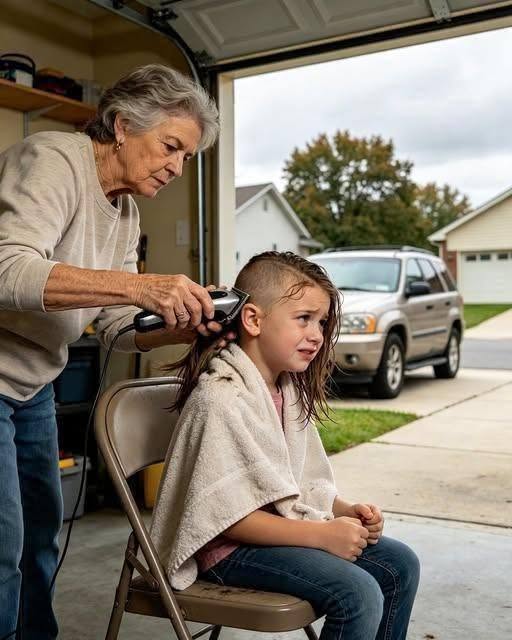
His mother had used the clippers.
But the pediatrician wasn’t only talking about the haircut.
“What else could there be?”
“I don’t want to speculate.”
“Please.”
She lowered her voice.
“When I asked your daughter whether Grandma had ever frightened her before, she said yes.”
I stared at her.
“When?”
“She wouldn’t answer.”
My hands began to shake.
“Then she asked me whether I would tell her dad.”
I closed my eyes.
“Did she say why?”
The pediatrician nodded.
“She said, ‘Because he’ll tell Grandma.’”
I opened my eyes.
For several seconds, I couldn’t speak.
My husband had always told me his mother was simply “old-fashioned.”
She was strict.
She had raised three children.
She didn’t tolerate disrespect.
She believed children needed discipline.
Whenever I’d complained about something she’d said to our daughter, he’d smiled and told me, “That’s just Grandma.”
But my daughter hadn’t said “Dad will be mad.”
She hadn’t said “Dad won’t believe me.”
She had said:
He’ll tell Grandma.
As if Grandma was the person who couldn’t be allowed to know.
The door opened.
My husband stepped into the hallway.
“What are you two whispering about?”
The pediatrician looked at him.
“We’re discussing your daughter’s care.”
He stared at me.
“Can I talk to you alone?”
“No.”
His face hardened.
“Seriously?”
“Our daughter doesn’t want to be separated from me.”
“She needs to hear that her father isn’t some kind of monster.”
I looked past him.
My daughter was sitting on the exam table, still wrapped in the blanket.
She was watching us.
I could see only her eyes.
And something about those eyes made my decision for me.
“Not here,” I said.
He scoffed.
“Then where?”
“I don’t know yet.”
His expression changed.
“What does that mean?”
“It means I’m taking her home.”
“Good.”
“And you’re not coming with us.”
He stared at me.
The hallway seemed to become completely silent.
“What?”
“You heard me.”
“You’re not serious.”
“I am.”
“You can’t just keep my daughter from me.”
I looked at the pediatrician.
She didn’t tell me what to do.
She simply said, “If you’re concerned about immediate safety, you can ask the appropriate authorities for guidance before leaving.”
My husband laughed bitterly.
“Authorities?”
I didn’t answer.
He stepped toward me.
The nurse moved slightly between us.
That was when I noticed something on the floor.
His hand.
He was holding our daughter’s backpack.
No.
He had been holding it when he entered.
But when my daughter took it from him, I remembered seeing him hesitate.
As though he didn’t want to give it to her.
I looked at the backpack.
There was a small zipper pocket on the front.
It was partially open.
A corner of pink paper was sticking out.
My daughter’s drawing paper.
I reached for it.
My husband immediately said, “Don’t.”
I froze.
He froze too.
The pediatrician looked at him.
“Why not?”
“It’s her private stuff.”
My husband said it too quickly.
I looked at my daughter.
“Is it okay if I check your backpack?”
She nodded.
My husband shook his head.
“You’re really going to search through her things now?”
I pulled the pink paper from the pocket.
It was folded several times.
I opened it.
At first, I didn’t understand what I was looking at.
It was a drawing.
My daughter had drawn our family.
There was me.
There was her.
There was Grandma.
There was Dad.
But the figures weren’t standing together.
I stared at the picture.
Grandma had been drawn huge.
Her arms stretched almost to the edges of the paper.
My daughter was tiny.
She was standing behind a door.
I looked closer.
There was something written above the door.
I recognized my daughter’s handwriting.
I read it twice.
Then a third time.
DON’T LET GRANDMA KNOW I TOLD.
My husband went pale.
“That’s nothing.”
I looked at him.
“Why would she draw that?”
“She’s eight.”
“You keep saying that.”
“Because she is!”
My daughter suddenly spoke.
“Mom?”
I turned toward her.
She was looking at the drawing.
Her face had gone white.
“Where did you get that?” she whispered.
I walked over.
“I found it in your backpack.”
She looked at her father.
Then back at me.
“I didn’t draw it yesterday.”
My stomach dropped.
“What do you mean?”
She pulled the blanket tighter.
“I drew it last week.”
My husband said, “Enough.”
The pediatrician raised her hand.
“Let her finish.”
My daughter swallowed.
“I was going to give it to Mom.”
“Why didn’t you?”
She looked at Dad.
“He found it.”
My husband didn’t move.
“He found it,” she repeated.
I could barely breathe.
“What did Dad do with it?”
My daughter looked down.
“He said I shouldn’t make Mom worried.”
My husband finally spoke.
“That isn’t what happened.”
My daughter flinched.
The pediatrician stepped closer to her.
“You don’t have to answer anything else right now.”
But my daughter shook her head.
“No.”
She looked at me.
“I want to tell.”
My husband stared at her.
I took her hand.
“Okay.”
She took a shaky breath.
“Dad put the picture in my backpack.”
“Why?”
“Because Grandma was coming.”
My skin prickled.
“What was Grandma coming for?”
My daughter hesitated.
Then she whispered:
“To talk to me.”
The room went silent.
I looked at my husband.
He looked at the floor.
And suddenly, I remembered something I’d dismissed three months earlier.
A Saturday morning.
My daughter had asked me whether grown-ups could make you keep secrets.
I’d laughed and told her that good secrets were okay, like birthday surprises, but scary secrets should always be told.
She’d nodded.
Then she’d asked:
“What if Dad says it’s a scary secret but Grandma says it’s normal?”
I’d thought she was talking about something she’d seen on television.
I’d forgotten about it.
Until now.
My daughter squeezed my hand.
“Mom?”
“Yes?”
“Can I tell you the other thing?”
My heart began pounding.
“What other thing?”
She looked at the pediatrician.
Then at me.
Then, finally, at her father.
“He told me not to tell you.”
My husband closed his eyes.
And for the first time that morning, I realized the haircut might not have been the beginning of this story.
It might have been the first thing he had done that I could actually see.
Absolutely. Here is Part 3, bringing the story to a tense, emotional conclusion while resolving the mystery without losing the slow-burn feeling.
Writing
Part 3 — The Thing She Was Told Not to Tell
My husband closed his eyes.
For a moment, he looked less angry than tired.
That frightened me more.
I had expected denial.
I had expected shouting.
I had expected him to say our daughter was confused, that I was twisting her words, that his mother had done nothing wrong.
Instead, he stood there silently.
The pediatrician looked at him.
“What did you tell her not to tell her mother?”
He opened his eyes.
“Nothing.”
My daughter immediately shook her head.
“You did.”
His face tightened.
“Sweetheart—”
“Don’t call me that.”
The words came out so quietly that they almost disappeared.
But everyone heard them.
My husband took a step backward.
My daughter stared at him from beneath the blanket.
“You said Mom would get mad.”
“I said she would worry.”
“You said Grandma would be angry.”
He didn’t answer.
The pediatrician pulled a chair closer to my daughter.
“Would you like to tell us what happened?”
My daughter nodded.
Then she looked at me.
“Last week, Grandma took me into the laundry room.”
My stomach tightened.
“Why?”
“She said she needed to ask me something.”
“What did she ask?”
My daughter picked at the corner of the blanket.
“She asked if I loved Dad.”
I felt something cold move through me.
My husband immediately said, “That wasn’t—”
The pediatrician held up a hand.
“Let her finish.”
My daughter continued.
“Then she asked if I loved Mom.”
I swallowed.
“She said families don’t work if people take sides.”
My husband stared at the floor.
“She told me Dad was having a hard time because Mom was always upset with Grandma.”
I looked at my husband.
He didn’t look at me.
“She said I was old enough to understand things.”
My daughter’s voice trembled.
“She said sometimes children have to help their parents.”
I felt tears burning behind my eyes.
“How?”
“She said I should tell Dad that Mom doesn’t like Grandma.”
I stared at my husband.
My daughter continued.
“She said if I did, Dad would know I was on his side.”
The room seemed to tilt.
My husband finally spoke.
“I didn’t know she was saying that.”
My daughter looked at him.
“You were there.”
His face changed.
“I was outside.”
“You were at the door.”
He went silent.
I remembered that day.
My daughter had come downstairs afterward unusually quiet.
I’d asked what was wrong.
She’d said, “Nothing.”
I’d believed her.
Or maybe I’d simply wanted to.
The pediatrician asked, “What happened after Grandma talked to you?”
My daughter looked down.
“Dad came in.”
“What did he say?”
“He asked what Grandma told me.”
My husband closed his eyes again.
“And what did you say?”
“I told him I didn’t want to talk about it.”
My daughter wiped her cheek.
“Then Dad said, ‘Good. Keep it that way.’”
I felt something inside me collapse.
Not because of one sentence.
Because suddenly dozens of small moments were rearranging themselves in my mind.
The unexplained silences.
The way my daughter sometimes stopped talking when my husband entered a room.
The drawings she hid.
The questions she asked and then pretended weren’t important.
The way she had started asking whether I would be angry if she told me something.
I had thought she was going through a phase.
She hadn’t been.
She had been testing whether it was safe to speak.
The pediatrician asked my husband, “Did you tell your daughter to keep secrets from her mother?”
He rubbed both hands over his face.
“I was trying to protect her.”
“From what?”
He looked at me.
“From you.”
I almost laughed.
Not because it was funny.
Because it was unbelievable.
“From me?”
“You were constantly fighting with my mother.”
“I disagreed with her.”
“You made everything difficult.”
My daughter covered her ears.
The pediatrician immediately said, “Stop.”
My husband looked at her.
“She doesn’t need to hear this.”
“Then don’t say it in front of her.”
He fell silent.
The pediatrician turned to me.
“I recommend that you and your daughter leave together today. I’ll document everything we’ve discussed and make the appropriate report.”
My husband stared at her.
“You’re actually doing this.”
“Yes.”
He looked at me.
“If you walk out with her, don’t expect me to just forgive this.”
I picked up my daughter’s backpack.
“I don’t need forgiveness for protecting my child.”
His expression hardened.
“You’re destroying our family.”
I looked at my daughter.
She was watching me.
Waiting.
I crouched beside her.
“We’re going.”
She nodded.
As we walked toward the door, my husband said something behind us.
“Wait.”
I stopped.
Not because I wanted to.
Because I knew that whatever came next might matter.
He spoke quietly.
“I didn’t know she was going to cut her hair.”
I turned.
He looked genuinely frightened now.
“I swear.”
The pediatrician watched him carefully.
“What did you think your mother meant when she said she would take care of the hair problem?”
He hesitated.
Then whispered, “I thought she’d scare her.”
My stomach turned.
“You knew she was threatening our daughter.”
“I didn’t think she’d actually do it.”
There it was.
Not innocence.
Not ignorance.
A choice.
He had heard the threat.
He had approved of it.
And then he had trusted his mother not to cross a line.
Except he had never bothered to find out where the line was for our daughter.
My daughter reached for my hand.
We left.
Three Days Later
The report moved faster than I expected.
There were interviews.
Questions.
More questions.
People asked me what I knew.
What I had seen.
What my daughter had told me.
I kept reminding myself not to answer for her.
Her story belonged to her.
My husband was temporarily staying elsewhere while everything was being evaluated.
His mother was not allowed to contact our daughter.
For the first two nights, my daughter slept in my room.
She kept the blanket over her head.
On the third morning, I woke up and found her standing in front of the bathroom mirror.
She wasn’t wearing the blanket.
She was wearing one of my old hoodies.
Her newly shaved head was completely visible.
She stared at herself.
I didn’t say anything.
She noticed me in the doorway.
“Mom?”
“Yeah?”
“Do you think I’ll look like me again?”
My throat tightened.
“You already do.”
She touched her head.
“I don’t feel like me.”
I walked over and stood beside her.
“You don’t have to feel like yourself today.”
She looked at our reflections.
“Can I grow it long again?”
“As long as you want.”
She smiled faintly.
“Even if it takes forever?”
“Even if it takes forever.”
She was quiet for a moment.
Then she said, “Can I brush it?”
I smiled.
“Of course.”
She picked up the brush.
There wasn’t much hair to brush.
But she ran it gently over her scalp anyway.
Slowly.
Carefully.
Like she was taking something back.
Then she looked at me.
“Mom?”
“Yes?”
“Next time Grandma tells me to keep a secret…”
She stopped.
I waited.
“…I can tell you?”
I put my arms around her.
“Every time.”
She hugged me tightly.
And that was the first morning since the haircut that she didn’t pull the blanket over her head.
Two Weeks Later
The investigation eventually confirmed what my daughter had told us.
There had been more than one conversation.
More than one secret.
Nothing my daughter had done had caused any of it.
She hadn’t been difficult.
She hadn’t been dramatic.
She hadn’t misunderstood.
She had been eight years old and had been placed in the middle of adult problems she never should have been asked to carry.
My husband admitted that he had known his mother was pressuring our daughter to take sides.
He said he thought it would stop.
He said he didn’t believe it was serious.
He said he was sorry.
Maybe he was.
But being sorry didn’t erase what happened.
It didn’t erase the fear in our daughter’s face when Grandma’s name was mentioned.
It didn’t erase the drawing.
It didn’t erase the word “Good.”
And it certainly didn’t make me forget the moment my daughter walked across that exam room, took her backpack from her father, and placed it in my hands.
That was the moment I understood something.
Children don’t always know how to say, “I don’t feel safe.”
Sometimes they say it with silence.
Sometimes they say it by hiding.
Sometimes they say it by refusing to look in a mirror.
And sometimes they say it by reaching for the one person they still believe will listen.
My daughter couldn’t control what happened to her hair that morning.
But she could decide what happened next.
And this time, someone finally listened.
A month later, her hair had begun to grow back.
One afternoon, she stood in front of the mirror and ran her fingers over the soft fuzz covering her head.
Then she smiled.
“Mom?”
“Yeah?”
“I think I’m ready.”
“For what?”
She picked up the brush.
“To start over.”
I smiled through my tears.
“Okay.”
She handed me the brush.
And for the first time in weeks, I brushed my daughter’s hair.
There wasn’t much of it.
But she sat still.
She didn’t flinch.
She didn’t cover her head.
And when she looked into the mirror, she didn’t look away.