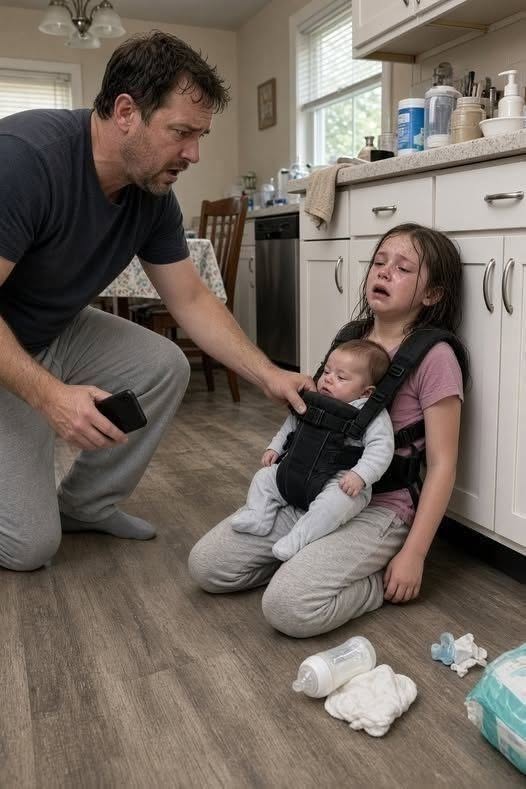
I swallowed hard.
“Tessa.”
She looked up.
“Did Mom take another phone with her?”
“I don’t know.”
“Did you see her leave?”
A small nod.
“What time?”
“She said it was almost lunchtime.”
“Was Miles asleep?”
“Yes.”
“And you were already home?”
Another nod.
I forced myself to keep my voice calm.
“Did she tell you to stay inside?”
“She said I could watch TV.”
“And when did she say she’d be back?”
“Seventeen minutes.”
I looked at the phone again.
Seventeen minutes.
That number suddenly felt important.
Not because it was precise.
Because it was ridiculous.
Nobody leaves a nine-year-old alone with an eight-month-old baby for “seventeen minutes” unless they’re trying to make something dangerous sound harmless.
I crouched down until I was eye level with Tessa.
“Did Mom look scared when she left?”
Tessa thought about it.
“Not scared.”
“Angry?”
“No.”
“Sad?”
She hesitated.
“A little.”
“What did she say?”
Tessa’s eyes moved toward the hallway.
“She said she had to fix something before Dad found out.”
My chest tightened.
“Before I found out about what?”
“I don’t know.”
“Did she say my name?”
“She said Grant.”
I closed my eyes for a second.
My name sounded different when my daughter said it.
Not like a husband hearing his wife had kept something from him.
Like a father realizing his child had been dragged into an adult secret she never should have known existed.
I stood.
“Okay.”
Tessa looked nervous.
“What?”
“I’m going to find out what happened.”
She nodded.
Then, very quietly, she asked:
“Are you mad at Mom?”
I looked at her.
There were a thousand answers I could have given.
But none of them belonged in front of a nine-year-old.
“I’m scared,” I said.
That seemed to surprise her.
“You’re not mad?”
“I’m mad about what happened to you.”
Her lower lip trembled.
“But I’m scared because I don’t understand why.”
I put a hand on her shoulder.
“And I’m going to make sure you don’t have to carry this by yourself.”
Her eyes filled with tears.
Then the phone buzzed.
We both jumped.
A new message appeared.
This one wasn’t from R.
It was from an unknown number.
UNKNOWN: Don’t open the drawer again.
I stared at it.
Tessa saw it too.
Her face went pale.
“Dad…”
I locked the phone.
“Go to the living room.”
“But—”
“Now.”
She didn’t argue.
That frightened me more than anything.
Tessa was usually the kind of kid who asked twenty questions before doing anything.
But this time, she simply turned and walked away.
I waited until I heard her footsteps reach the living room.
Then I looked back at the phone.
My first instinct was to call my wife.
I did.
Straight to voicemail.
I tried again.
Same result.
I opened the hidden phone.
There was no passcode.
That should have been my first warning.
The phone had been deliberately hidden, yet it hadn’t been protected.
I opened the messages.
There were dozens.
Most had been deleted.
But not all of them.
The conversation with R went back almost six weeks.
At first, the messages seemed harmless.
R: Are you sure?
Her: I don’t know.
R: You can’t keep pretending everything is fine.
Then:
Her: Grant doesn’t know.
R: He’ll know eventually.
Then:
Her: That’s why I need time.
I scrolled.
My hands became colder with every message.
There were references to money.
A storage unit.
A meeting.
And something called “the file.”
I stopped.
R: Did you get the file?
Her: Not yet.
R: Then don’t tell Grant anything.
Another message.
Her: I can’t keep lying to him.
R: You already started.
I stared at that sentence for a long time.
Then I saw something that made my stomach drop.
A message from three days earlier.
R: He still thinks the baby is his.
I stopped breathing.
For several seconds, I couldn’t move.
Miles.
My son.
My eight-month-old boy.
I looked toward the living room where I could hear him making small, tired noises.
My mind rejected the thought before it even finished forming.
No.
I wasn’t going there.
Not without facts.
Not because of a single anonymous message.
I scrolled faster.
There was another message.
Her: Don’t bring him into this.
R: You brought him into it the day you lied.
Then nothing for two days.
Until today.
1:02 p.m.
Her: I’m coming.
1:08 p.m.
R: Bring the envelope.
1:17 p.m.
R: You said Grant wouldn’t find out. Leave the kids with Tessa and come now.
I stared at the screen.
Then I noticed something.
There was a location attached to the last message.
I tapped it.
A map opened.
My heart began pounding.
The location wasn’t downtown.
It wasn’t a restaurant.
It wasn’t a hospital.
It was a small roadside property outside Edmond.
A place I knew.
An old storage facility.
I had driven past it hundreds of times.
I zoomed in.
There were several units.
One of them was highlighted.
Unit 38.
I looked at the clock.
4:51 p.m.
If my wife had gone there after leaving the house, she could still be there.
Unless she’d gone somewhere else.
Unless someone had taken her.
Unless—
I stopped myself.
I had spent fifteen years training dogs to read behavior under pressure.
When a dog panicked, you didn’t panic with it.
You looked for the trigger.
You isolated the variables.
You followed the evidence.
So I did the only thing I could think to do.
I took screenshots of every message.
Then I photographed the phone itself.
Then I placed it carefully inside a plastic bag from the kitchen.
I didn’t know yet whether I’d need the evidence.
But something told me I would.
I walked back into the living room.
Tessa was sitting on the couch with Miles beside her.
She looked up.
“Are you going somewhere?”
I sat beside her.
“Maybe.”
“To find Mom?”
“Yes.”
Her eyes dropped.
“Is she in trouble?”
I didn’t answer immediately.
“I don’t know.”
Tessa hugged her knees.
Then she whispered:
“She told me not to tell you something.”
My entire body went still.
“What?”
Tessa looked toward the front door.
“She said if you ever asked about today, I should tell you she went to the store.”
I felt a chill run down my back.
“The store?”
Tessa nodded.
“But she didn’t go to the store.”
“How do you know?”
“Because I saw what she took.”
“What did she take?”
Tessa pointed toward the hallway.
“The blue envelope.”
I stood.
“Which blue envelope?”
“The one from your office.”
I couldn’t speak.
There was only one blue envelope in my office.
It contained documents I had never shown my wife.
Documents I had kept locked away for years.
I ran down the hallway.
My office door was closed.
I unlocked it.
The cabinet was still locked.
I opened it.
The envelope was gone.
I stood there staring at the empty space.
Then I remembered something.
Something my wife had said two months earlier.
I’d asked her why she’d been looking through my old files.
She’d smiled and told me she was searching for a warranty document.
I’d believed her.
Now I wasn’t sure I’d ever known the truth.
I turned around.
Tessa was standing in the doorway.
“Dad?”
I looked at her.
“What’s in the envelope?”
She shook her head.
“I don’t know.”
“Did you see Mom take it?”
“Yes.”
“When?”
“Before she left.”
I walked back toward her.
“Why didn’t you tell me this before?”
Her eyes filled with tears.
“Because she told me you’d be angry.”
I knelt in front of her.
“Listen to me carefully.”
She looked at me.
“Whatever your mother told you, you are not responsible for protecting grown-ups from consequences.”
A tear rolled down her cheek.
“I was scared.”
“I know.”
“I tried to take care of Miles.”
“I know.”
“I thought she’d come back.”
“I know.”
“I didn’t know what else to do.”
I pulled her into my arms.
“You did everything right.”
She cried against my shoulder.
And for a few seconds, I allowed myself to simply be her father.
Not a husband.
Not a detective.
Not a man trying to understand a secret.
Just her dad.
Then Miles began crying.
I lifted him carefully.
He rested his head against my chest.
I looked down at him.
Eight months old.
Completely unaware that the adults around him had just torn open a door none of us could easily close.
I kissed the top of his head.
“I’m not letting anything happen to you,” I whispered.
Then my phone rang.
It was my wife’s number.
I answered immediately.
“Where are you?”
Silence.
“Hello?”
Nothing.
Then I heard breathing.
Slow.
Shaky.
And a faint scraping sound in the background.
“Who is this?”
A woman’s voice finally whispered:
“Grant?”
My heart stopped.
It wasn’t my wife.
It was someone else.
“Who are you?”
The woman started crying.
“I don’t have much time.”
“Where’s my wife?”
Another pause.
Then:
“She’s not the person you think she is.”
My grip tightened around the phone.
“Where is she?”
The woman breathed in sharply.
“Don’t go to Unit 38.”
I froze.
“How do you know about Unit 38?”
She didn’t answer.
Instead, she whispered:
“Because that’s where they expect you to go.”
The call ended.
I stared at the screen.
Tessa watched my face.
“Dad?”
I didn’t answer.
The phone buzzed again.
A text message.
This time from my wife.
Her: Please don’t trust R.
I read it twice.
Then another message arrived.
Her: And whatever you do, don’t let them take Miles.
I looked at my son.
Then at Tessa.
And suddenly the hidden phone wasn’t the most frightening thing in the house.
The most frightening thing was the realization that whatever had started months ago…
had somehow ended up involving my children.
And someone had been waiting for me to discover it.
Here’s Part 3, written as the longer concluding chapter, resolving the mystery while keeping the emotional tension through the ending.
WritingPart 3 — What She Had Been Hiding
For several seconds, I couldn’t move.
I kept staring at the message on my phone.
Don’t let them take Miles.
Those six words changed everything.
Until that moment, I had been trying to understand why my wife had left our children alone.
Now I understood that leaving them hadn’t been the real mystery.
Someone was after my son.
I looked at Tessa.
“Miles stays with me.”
She nodded.
“Are we going somewhere?”
“Yes.”
“Where?”
“Somewhere safe.”
I didn’t tell her about Unit 38.
I didn’t tell her about the unknown woman.
And I certainly didn’t tell her what the hidden phone had suggested about Miles.
She was nine years old.
She had already been forced to carry more responsibility that afternoon than any child should ever have to carry.
I wasn’t going to put the rest of the weight on her shoulders.
I called a friend I trusted and asked him to come to the house.
Then I contacted the police.
I told them everything.
The hidden phone.
The messages.
The blue envelope.
The strange call.
The warning about Unit 38.
And my wife’s disappearance.
An officer asked me one question.
“Do you know who R is?”
“No.”
“Any idea why someone would say the baby isn’t yours?”
I looked at Miles.
“I don’t know.”
It was the truth.
But there was another truth I hadn’t admitted out loud.
I was terrified to find out.
About forty minutes later, the police located the storage facility.
They didn’t send me inside.
They didn’t have to.
Unit 38 was empty.
The lock had been cut.
Inside was an old wooden chair, a folding table, several cardboard boxes—and the blue envelope.
My wife’s envelope.
The one she’d taken from my office.
An officer called me from the scene.
“Grant, you need to come down here.”
“What did you find?”
“A lot.”
I looked at Tessa.
“I’ll be there.”
When I arrived, the blue envelope was sitting on the table inside the unit.
It contained photographs.
Documents.
Bank records.
And one hospital record.
My name was on it.
I picked it up.
My hands began shaking.
It was a DNA test.
I read the first page.
Then the second.
Then the result.
Probability of paternity: 99.98%.
I stared at it.
Miles was my son.
My knees nearly gave out.
For the first time that day, I breathed normally.
But then I saw the date.
The test had been performed two months earlier.
Two months.
Without telling me.
I turned the page.
There was another document.
This one was older.
Much older.
It concerned my wife.
And another man.
The name was familiar.
R.
I recognized it immediately.
Ryan Mercer.
My wife’s former boyfriend.
A man she’d told me hadn’t been part of her life for years.
Except apparently he had.
The police found his name in the financial records too.
Money transfers.
Payments.
Threats.
And one document that made everything suddenly make sense.
Ryan had been blackmailing her.
Years earlier, before I met my wife, she’d witnessed something involving him.
He’d been involved in an insurance fraud scheme.
She had kept evidence.
She’d been afraid to report him because he’d threatened her family.
Eventually, she met me.
We married.
We had Tessa.
Then Miles.
But Ryan never completely disappeared.
He came back months before.
And this time, he wasn’t asking for money.
He wanted the evidence.
The blue envelope contained copies of the original documents that could put him in prison.
My wife had secretly been collecting proof.
She’d hidden the phone because she was afraid Ryan was monitoring her regular phone.
She’d told me nothing because she believed she could handle it alone.
And then she’d made the worst decision of her life.
She trusted him enough to meet him.
She thought she could give him copies of the documents and make him leave us alone.
Instead, he threatened her.
And when she refused to hand over the originals, he sent the message that had started everything.
Leave the kids with Tessa and come now.
He had known I was away.
He had known the children were home.
He had known exactly how vulnerable my family was.
But there was one thing he hadn’t known.
Tessa had called me.
And she had saved us.
I stood in the storage unit holding the DNA test.
“Where is my wife?”
The officer looked at me.
“We’re working on it.”
Then his radio crackled.
A location had been found.
My wife’s car had been spotted near an abandoned farmhouse outside Edmond.
We drove there with police.
The sun was beginning to disappear when we arrived.
The farmhouse looked abandoned.
No lights.
No cars.
No movement.
Then we heard a sound from inside.
Three knocks.
Pause.
Three knocks again.
I knew that rhythm.
My wife used to knock on our bedroom door that way when she wanted me to know it was her.
I stepped forward.
The police moved past me.
The door opened.
She was standing there.
Her hair was messy.
There was a bruise near her cheek.
But she was alive.
“Grant.”
I couldn’t speak.
I simply walked toward her.
She broke down before I reached her.
“I’m sorry.”
I pulled her into my arms.
For a moment, neither of us said anything.
Then she whispered:
“I thought I was protecting you.”
I closed my eyes.
“You almost destroyed us trying to protect us.”
“I know.”
“You left Tessa alone.”
“I know.”
“She thought she’d done something wrong.”
My wife’s face crumpled.
“I know.”
I stepped back.
“Do you understand what she went through?”
She nodded.
“I’ll never forgive myself.”
Behind her, officers arrested Ryan.
He had been hiding in the farmhouse.
The same man who had threatened my wife.
The same man who had manipulated her.
The same man who had sent those messages.
But there was one final piece I didn’t understand.
The woman who had called me.
The one who warned me about Unit 38.
The police found her number in the hidden phone.
Her name was Melissa.
She was Ryan’s sister.
And she had been helping my wife gather evidence.
She had called me because she realized Ryan planned to use the children as leverage.
She knew Unit 38 was a trap.
She knew my wife was in danger.
And she had risked everything to warn me.
Weeks later, the house was quiet again.
Not the strange, frightening quiet from that afternoon.
A different kind.
The kind that comes after a storm.
My wife sat at the kitchen table.
Tessa was doing homework.
Miles was asleep upstairs.
I stood in the doorway and watched them.
Everything looked normal.
But I knew better now.
Normal could disappear in a single phone call.
I walked over to Tessa.
She looked up.
“Dad?”
“Yeah?”
“Are you still mad at Mom?”
I thought for a moment.
“I’m hurt.”
She nodded.
“But are we okay?”
I looked at my wife.
Then at my daughter.
Then toward the stairs where my son was sleeping.
“We’re going to be.”
Tessa smiled faintly.
Then she reached for my hand.
I held it.
A few months later, she stopped apologizing every time something went wrong.
She stopped checking the clock whenever I left the house.
She stopped asking whether she was supposed to take care of Miles.
She was nine again.
She played outside.
She laughed.
She complained about vegetables.
She left toys in the hallway.
She became a kid again.
And I learned something I should have understood much earlier.
Sometimes children don’t need adults to make everything okay.
They need adults to make sure they never have to pretend they’re okay when they’re not.
My wife and I had a lot to repair.
Trust doesn’t come back because someone says “I’m sorry.”
It comes back slowly.
Through honesty.
Through showing up.
Through keeping promises.
Through answering the phone.
Especially when your child whispers your name and says she can’t hold the baby anymore.
Months after that afternoon, I found the hidden phone in a box of evidence the police had returned.
The screen was cracked.
The battery was dead.
I almost threw it away.
Instead, I kept it.
Not because of what it had revealed.
But because of what it had taught me.
I put it in the back of a locked cabinet.
Then I went upstairs.
Tessa was reading beside Miles’ crib.
She looked up.
“He’s asleep.”
“I see that.”
She smiled.
“I didn’t have to hold him.”
I smiled back.
“No.”
She closed her book.
“Good.”
I kissed her forehead.
Then I looked at my son.
Sleeping peacefully.
Safe.
Home.
For the first time since that phone call, I felt something other than fear.
Relief.
I turned off the light.
And as I closed the bedroom door, I realized the mystery had never really been about the second phone.
It had been about everything people were willing to hide in the name of protecting the people they loved.
My wife had hidden the truth to protect us.
Ryan had hidden the truth to control us.
And my nine-year-old daughter had been the only one brave enough to tell me what was really happening.
That day, Tessa hadn’t failed us.
She had saved us.
And I would spend the rest of my life making sure she never again believed she had to carry the weight of an adult world on her little shoulders.