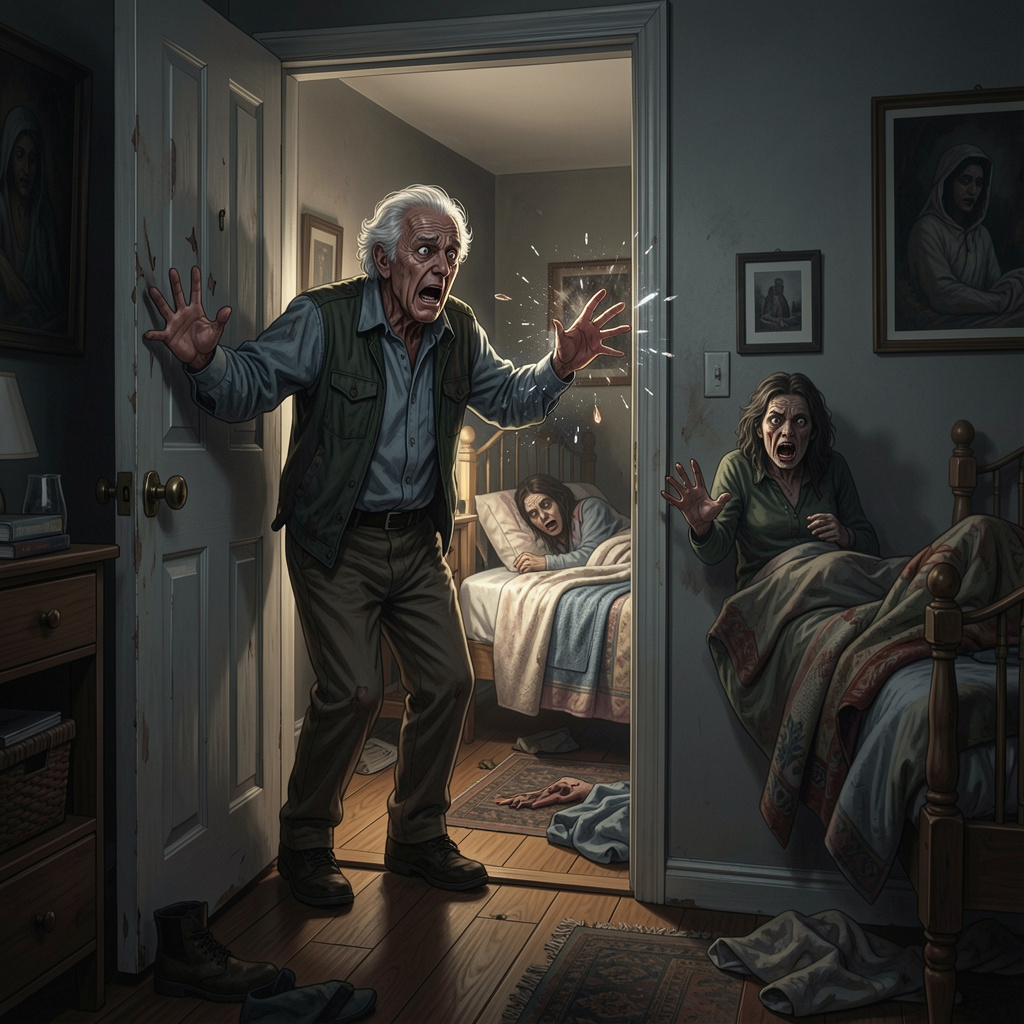
The call came at 11:47 on a Tuesday night.
I know because I had just turned off my bedside lamp, and my phone glowed on the nightstand with Caleb’s name. Eleven-year-old boys don’t call their grandmothers at midnight for no reason. My hand was on the phone before the second ring finished.
“Grandma Ruth.” His voice was barely a thread of sound, pulled so tight it might snap. He was whispering so hard I could hear his breath shaking — the kind of shallow, careful breathing a child does when he is trying very hard not to be heard.
“Caleb. Baby, I’m here. What’s wrong?”
A pause. Then: “Something’s happening to Destiny.”
My granddaughter. His stepsister. Sixteen years old, a girl who kept her bedroom door closed and her feelings closer, who had learned to be quiet in a house that rewarded silence. A girl I had been worried about for longer than I wanted to admit.
“Where is she?”
“In Marcus’s room.” Another pause. The way he said the name — Marcus, his stepfather — had a flatness to it, like a stone thrown into still water with no intention of watching it sink. “She went in there an hour ago and she was yelling and now I can’t hear her anymore and Grandma, she was screaming.”
I was already out of bed.
“Caleb, listen to me. Are you safe right now? Are you in your room?”
“Yes, ma’am. I locked my door.”
“Good boy. You stay there. You keep that door locked. I’m coming right now and I will call you back when I’m pulling up, okay? Do you understand me?”
“Yes, ma’am.”
“I love you.”
“I love you, Grandma. Please hurry.”
I drove the fourteen minutes to their house in nine. I don’t remember most of the drive. I remember my hands on the steering wheel and the streetlights blurring and a single thought, repeating like a struck bell: Not Destiny. Not that child.
Marcus Webb had come into my daughter Lorraine’s life three years ago, following her divorce from Caleb’s father. He was handsome in the way that men who know they are handsome tend to be — measured, deliberate about it, as if charm were a cologne he applied each morning. He owned a landscaping company. He coached youth soccer on Saturdays. He remembered birthdays and brought wine to dinners and called me “Miss Ruth” with a smile that showed all his teeth.
I had never trusted a smile that worked that hard.
Lorraine was in love with him the way a woman who has been through one difficult marriage falls in love — gratefully, a little desperately, with enormous hope. I understood that. I did not hold it against her. But I watched. Grandmothers who love their grandchildren do nothing but watch.
What I had seen in the past year concerned me. Small things. The way Destiny had stopped wearing her hair down. The way she flinched sometimes at loud sounds, though she was not a girl who had flinched before. The way she had stopped bringing her friends to the house. The way Caleb, once loud and silly, had become careful.
Children become careful when their environment teaches them that carefulness is how you survive.
I had said something to Lorraine once, gently, testing the water. She had looked at me with patient, exhausted eyes and said, “Mama, you never liked him.” And she was right that I didn’t. But that wasn’t why I was worried.
Lorraine was traveling for work that week. A conference in Atlanta. She’d asked me if I could check on the kids while she was gone. I had said yes, of course. I hadn’t imagined it would be like this.
The neighborhood was dark and quiet when I turned onto their street, lined with identical brick houses and oak trees whose roots were lifting the sidewalks. Every light in the house was off except for the thin orange glow in an upstairs window — Marcus’s room, facing the street.
I called Caleb as I pulled up.
“I’m outside,” I said. “Come open the front door for me, baby. Quietly.”
The porch light clicked on and the front door opened before I had finished climbing the front steps. Caleb stood in the doorway in his pajamas, his face pale, his eyes enormous. I pulled him into me for just a moment — one hand on the back of his head, one around his thin shoulders — and felt him trembling.
“She went quiet,” he whispered into my shoulder. “About twenty minutes ago. She just went quiet.”
“Which room?”
“Top of the stairs, last door on the left.”
I held his face in both my hands and looked at him. He had his father’s eyes, wide-set and dark, and right now they were the eyes of a child who had seen or heard something he could not process, something that had cracked the ordinary surface of his world and left him looking down into unfamiliar depth.
“Go to your room,” I told him. “Lock the door. If you hear anything frightening, you call 911. Don’t call me — call them. You understand?”
He nodded.
“Good. Go.”
He went.
I climbed those stairs alone. My hand was on the banister, the carpet soft beneath my feet, and the house around me was the peculiar kind of quiet that is not peaceful — the quiet of held breath, of things unsaid, of a situation that has gone underground.
At the top of the stairs I stopped and listened.
From behind the last door on the left came a voice. Marcus’s voice, low and controlled, the way a voice gets when a person is choosing each word carefully. I could not make out what he was saying. But I could hear the cadence of it, the pressure of it, and beneath it — barely — a sound that stopped my heart.
Destiny. Crying. The small, suppressed crying of someone who has been told, or who has learned, that making noise is dangerous.
I didn’t knock.
I tried the handle first — locked. Then I stepped back and I put my shoulder into that door with every pound of my sixty-three-year-old body and every year of love I had stored up for that girl, and the cheap interior lock gave way on the second attempt with a crack like a starter pistol.
The door swung open.
And everyone froze.
What I saw was not what I had most feared, and what I had most feared was the worst thing a grandmother can imagine. Let me say that clearly, because it matters: Destiny was clothed. She was sitting on the far edge of the bed, hunched over her own knees, her face buried in her arms. She was shaking.
Marcus was standing near the door, and the expression on his face when I entered — that one, unguarded moment before his composure reassembled itself — told me everything. It was not the face of a man caught in an act. It was the face of a man caught in a system. Caught mid-process. And that, I would come to understand, was in some ways worse.
On the desk behind him, lit by a single lamp, was a laptop. The screen showed a document — a spreadsheet, I thought at first, until my eyes adjusted and I understood what I was seeing. It was a ledger. Two columns. Names on the left. Amounts on the right.
And Destiny’s name was near the top.
She lifted her face when the door broke open. Her cheeks were wet. Her left eye was swollen — not dramatically, not the violence of a fist, but the particular puffiness that comes from crying for a very long time, and perhaps from a hand applied more carefully than a fist would have been.
“Grandma Ruth,” she said, and her voice broke on the last syllable of my name.
Marcus took a step toward me. “Ruth, I understand how this looks—”
“Don’t.” I said it quietly. The quieter I am, the more I mean what I say. My children and grandchildren know this. He was learning it now. “Don’t say a single word to me.”
I crossed the room to Destiny and sat beside her on the bed and put my arm around her, and she leaned into me with her whole weight, the way small children fall asleep against you in the car, completely trusting, all resistance gone.
“I’m here,” I told her. “I’ve got you.”
And she held onto my arm with both of hers and didn’t let go.
I called the police from that room, with Marcus still in it. I didn’t leave and I didn’t allow him to leave. He tried once, with some story about needing water, needing air, and I told him without raising my voice that if he walked through that door before the police arrived, I would make a great deal of noise about why, and that it was his choice.
He stayed.
He sat in the desk chair and looked at his hands and said nothing, and that silence told me he understood what the laptop screen contained and what it meant.
The officers arrived in eleven minutes. Two of them, a man and a woman, and I was grateful for the woman — Officer Denia Marsh, young and capable-looking, with short locs and the particular steadiness of someone trained to enter charged rooms and make them smaller. She took Destiny out into the hallway first, just the two of them, while her partner stayed with me and Marcus.
I heard Destiny’s voice from the hallway, slow at first and then faster, like water finding its channel. She talked for a long time.
The story that emerged — that night, and in the weeks that followed — was not simple, because these things are never simple, and anyone who tells you otherwise is selling you comfort instead of truth.
Marcus had not touched Destiny. Not the way I had feared driving over there, white-knuckling the steering wheel in the dark. But what he had done was its own category of violation, its own careful architecture of harm.
He had been taking her money. Hers, and Caleb’s, and in a more complicated way, Lorraine’s.
Destiny had a part-time job at a bakery two afternoons a week — she’d been working there since she was fifteen, saving, the way disciplined teenagers save, toward something: a car, college, escape from whatever weight she carried quietly on her shoulders. She had saved almost four thousand dollars over fourteen months.
Over the past seven months, Marcus had borrowed it. That was the word he used: borrowed. The first time, he said it was an emergency. The second time, he promised to pay it back with interest. By the third and fourth times, he had moved past promises and into pressure — subtle at first, then less so. The ledger on his laptop was not his accounting of a debt. It was his record of what he considered he was owed by the people in his household, reframed through a logic only he fully inhabited.
Caleb’s money — birthday gifts from relatives, twenty dollars here, fifty dollars there, kept in an envelope in his desk — had gone missing twice. He hadn’t said anything because he was eleven and because the atmosphere of the house had taught him that saying things had consequences.
Lorraine’s bank account showed irregularities she had noticed but not yet investigated, attributing them to her own distraction, her own busyness, the general financial blur of running a household.
That night, Destiny had confronted him. She had found the ledger — not by snooping, but by accident, looking for a phone charger on his desk while he was in the shower — and she had read her name at the top of it, and the number beside it, and something in her had finally, after seven months, ignited.
She screamed at him the way sixteen-year-olds scream when they have been holding something enormous for too long. She was loud and she was right and she was furious, and then he had closed the door and turned the lock and sat her down and begun the slow, controlled work of making her feel that the noise she’d made was the problem.
That was when she went quiet. Not because he had frightened her into silence with violence. Because he was good at a different kind of frightening. The kind that makes you wonder if you’ve misunderstood. The kind that turns your anger back on itself. The kind that leaves no marks.
Caleb had heard the screaming stop and known, with the animal instinct of a child who has learned to read a household’s weather, that the silence was worse than the screaming. And he had called me.
I called Lorraine from the police cruiser’s parking spot outside the house while Officer Marsh finished with Destiny inside. It was past one in the morning in Atlanta.
She answered on the second ring because mothers always do.
I told her as plainly as I could. I didn’t dress it up and I didn’t dull the edges. She deserved the truth, full-strength.
There was a silence after I finished. Then she said: “I should have listened to you.”
“That’s not what matters right now.”
“Mama—”
“What matters right now is that Destiny is safe and Caleb is safe and you need to get in your car or find a flight and come home. Everything else we deal with when you’re here.”
Another silence. Then: “Is she okay?”
I looked through the window at Destiny sitting on the front steps with Officer Marsh beside her, a blanket around her shoulders that someone had found, her face still wet but her posture different now — something released in it, some long-held rigidity beginning to unknot.
“She will be,” I said. “She’s strong. You raised a strong girl.”
Lorraine cried then, and I let her, and I stayed on the phone until she was done.
Marcus was not arrested that night. The law is particular about what it will and won’t move on quickly, and financial manipulation within a household, especially when the records are ambiguous and the victim is a minor who cannot file charges independently, requires time and documentation and the machinery of investigation grinding forward at its own pace.
What happened that night was: he was asked to leave the home voluntarily, and he did — with his laptop, which Officer Marsh had the presence of mind to ask him to leave behind. He argued about that. He lost.
A detective was assigned. A social worker came the next day. There were interviews and forms and the particular exhaustion of having your private disaster processed by systems designed to handle private disasters.
Lorraine drove through the night and arrived at seven in the morning. She came through the door and went straight to Destiny, and the two of them stood in the hallway holding each other without speaking, and I took Caleb to the kitchen and made him toast and chocolate milk and sat with him while he told me, in fragments, everything he had noticed and not said for the past several months.
He was a perceptive child. He had seen more than I would have wished.
“You did the right thing calling me,” I told him, when he was finished.
He looked at his toast. “I should have called sooner.”
“Caleb.” I waited until he looked up. “You are eleven years old. You called when you knew you needed to. That is exactly right. Do you understand me?”
He thought about it. Then: “Yes, ma’am.”
“The adults in your life are supposed to handle the hard things. That is our job. Your job is to be eleven. Okay?”
He nodded. He ate his toast.
In the weeks that followed, several things happened.
Marcus was formally charged — not immediately, but eventually — with financial exploitation and fraud, charges built carefully from the laptop’s ledger, from bank records, from Destiny’s account statements, from testimony. His lawyer called it a misunderstanding. Lawyers often do.
Destiny began seeing a counselor — a woman she chose herself from a list, which mattered, the choosing. She was someone who specialized in adolescents and in the specific damage done by manipulation rather than force, the kind of harm that leaves people questioning their own perceptions, wondering if what happened to them counts.
It counts. It always counts.
Lorraine filed for divorce. She did it without anger, or rather, she did it with anger but the anger was clean, purposeful, a tool rather than a wound. I was proud of her.
Caleb, slowly, became loud again. He left his bedroom door open. He left his shoes in the middle of the hallway. He and Destiny argued about the television remote and who had used the last of the milk. These were the sounds of a house returning to itself, imperfect and alive.
I am not a dramatic woman. I don’t tell this story at dinner parties or use it to make myself interesting. But I’ve turned it over in my mind in the quiet hours — the drive over, the stairs, the door giving way — and there is one thing I keep returning to.
It is the phone call. Not mine to Lorraine, not the police, not any of the calls that happened after. The first one. Caleb’s.
He was eleven years old and frightened and alone in a locked room in a house where something was wrong, and he did the only thing a child can do in that situation: he reached for someone older, someone he trusted, someone he believed would come.
He called me.
I think about that call as one of the most important phone calls of my life. Not because of what I did afterward — broke a door, stood in a room, called the police — but because I was someone worth calling. Because somewhere in the years of Sunday dinners and school pickups and sitting beside him while he cried over things that seemed small but were not small, I had made myself into a person he believed in.
We talk a great deal, those of us who love children, about protecting them. Supervision, rules, the right schools, the right neighborhoods. These things matter. But there is another kind of protection that doesn’t get discussed as much, and it is this: being the person a child thinks to call.
Being so reliably, undramatically present that when the worst moment comes, your name is the first one in their mouth.
That is the work of grandmothers and grandfathers, of aunts and uncles, of neighbors and coaches and every person who shows up consistently in the small ordinary moments that children are always, always watching.
Be worth calling.
Be someone who picks up.
Be someone who says I’m coming and means it.
The rest, you figure out when you get there.
Destiny graduated high school the following spring, on a bright May morning that smelled of cut grass and someone’s drugstore perfume. She walked across the stage in a gold cap and gown and found us in the crowd afterward with her diploma held against her chest like something she had fought for — which, of course, she had.
She hugged me for a long time.
“Thank you for breaking down that door,” she said into my shoulder.
I held her at arm’s length and looked at her face — older now, steadier, still carrying things but carrying them differently.
“You would have broken it down yourself eventually,” I told her.
She smiled. It was a real one, the kind that reaches the eyes.
“Maybe,” she said. “But I’m glad I didn’t have to.”