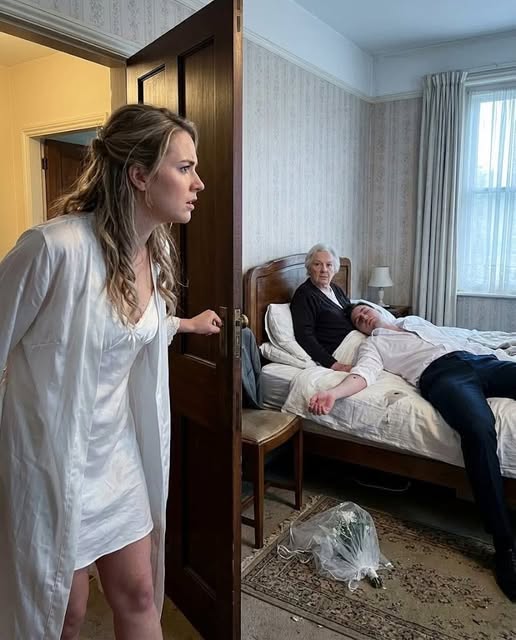
The Vial The responder took the vial from my hand without saying a word. For one second, nobody moved. The room seemed to shrink around us. My husband lay strapped loosely to the stretcher, his eyes following the vial as the responder held it up to the light.
There was barely anything inside—just a thin residue clinging to the bottom of the glass. His grandmother stared at it. Not with confusion. With recognition. It lasted less than a second, but I saw it. Her face changed before she could hide it. Then the mask returned. “That could belong to anyone,” she said.
The responder looked at her. “Which is why we’re going to preserve it.
She opened her mouth. Closed it. For the first time since I’d entered that house, she had nothing to say. I looked at my husband.
“I’m coming with you.”
He swallowed. “Please.” That single word broke something inside me. Not because he was asking me to stay. Because he sounded like a frightened child. The ambulance doors closed behind us, cutting off the house and everyone inside it. As the siren began to rise, I sat beside him and watched the monitor. His heart rate was too fast. His skin was cold.
“What happened?” I asked.
He stared at the ceiling. “I don’t know.” “You said you told her you weren’t drinking something.” His eyes moved toward me. “I remember her bringing me a glass.” “What was in it?” “I don’t know.” “Did you drink it?”
“No.”
His voice cracked. “I swear I didn’t.” I reached for his hand. He held mine immediately. Hard. Almost desperately. Then he whispered, “But I remember waking up.” “Where?”
“In her room.”
My stomach tightened. He closed his eyes. “I couldn’t move.” The ambulance rocked as we turned. “She was standing over me.” “What did she do?” “I don’t know.” “You have to try.” “I heard her talking.”
“To whom?”
He opened his eyes. “To my grandfather.” I stared at him. “Your grandfather is dead.” “I know.” The words came out barely louder than a breath.
“She was talking to his photograph.”
A cold silence settled between us. Then he said something that made my blood run cold. “She told him the family had finally found another one.” “Another what?” He shook his head.
“I don’t know.”
The medic glanced at us from the other side of the compartment. My husband looked at me. “And then she said something else.”
“What?”
His fingers tightened around mine. “She said, ‘He’ll remember what he’s supposed to remember.’” I felt my throat go dry. Before I could ask anything else, the medic interrupted. “We’re almost there. Let us work.” The hospital swallowed him within minutes.
Doors.
White lights. Questions. Forms. Doctors moving quickly. I stood in the corridor alone, still wearing the dress I’d been married in less than twenty-four hours earlier. There was dried makeup beneath my eyes.
My wedding ring felt strangely heavy. A nurse eventually approached me. “Are you his wife?”
“Yes.”
“He’s stable.”
I nearly collapsed from relief. “But we’re running several tests.” “Will he be okay?” “We don’t know yet.” She hesitated. “There are some unusual findings.”
“What kind?”
“His blood pressure was extremely low when he arrived. He’s also showing signs consistent with exposure to a sedating substance.”
My stomach dropped.
“Drugs?”
“We don’t know yet.”
She lowered her voice.
“There’s also the puncture wound.”
“I saw it.”
“Did you see anyone inject him?”
“No.”
“Did he have any history of injections, medication, diabetes, anything like that?”
“No.”
The nurse nodded.
“Then please tell the doctor everything you saw.”
“I will.”
She walked away.
I stood there for several seconds.
Then I called my husband’s mother.
She answered on the third ring.
“Hello?”
“Your son is in the hospital.”
Silence.
Then:
“What happened?”
“He was unconscious in your mother’s bedroom.”
Another silence.
Longer this time.
“Is he alive?”
The question made me stop breathing.
Not is he okay?
Not what happened?
Is he alive?
“Yes.”
Her voice changed.
“What did you find?”
“A vial.”
I heard something fall on her end of the line.
“What kind of vial?”
“I don’t know.”
She didn’t answer.
“Do you know what it was?”
“No.”
She was lying.
I knew it immediately.
“You knew something like this could happen.”
“No.”
“Then why did you ask about the vial?”
She breathed out slowly.
“I need you to listen to me.”
“I am.”
“Do not go back to that house.”
My heart began pounding.
“Why?”
“Because if my mother knows you found that vial, she will know you know.”
“Know what?”
“I don’t have time to explain.”
“Then make time.”
She whispered:
“The tradition isn’t what they told you.”
I looked down the hospital corridor.
“What tradition?”
“The one about the groom sleeping beside the matriarch.”
I waited.
Her voice trembled.
“It isn’t a blessing.”
My grip tightened around the phone.
“Then what is it?”
“I don’t know everything.”
“Tell me what you know.”
“My father did it.”
She paused.
“My brother did it.”
Another pause.
“My husband did it.”
“And?”
Her voice became almost inaudible.
“They all changed afterward.”
I felt a chill crawl up my arms.
“What do you mean, changed?”
“I mean they stopped being themselves.”
The call suddenly ended.
I stared at my phone.
I called back.
No answer.
Again.
Nothing.
Then a doctor came through the doors.
“Mrs.?”
I turned.
“Yes?”
“Your husband is awake.”
I hurried toward the room.
He looked smaller somehow.
The confident man I’d married seemed buried beneath the hospital blankets.
His eyes found me.
“You came.”
I sat beside him.
“Of course I came.”
He looked toward the door.
“Is she here?”
“No.”
He exhaled.
For the first time, his shoulders relaxed.
Then he looked at me.
“I need to tell you something before I forget.”
My heart stopped.
“Forget what?”
He stared at me.
“I don’t remember last night.”
“You remember the glass.”
“Yes.”
“You remember your grandmother.”
“Yes.”
“You remember waking up in her room.”
“Yes.”
He swallowed.
“But there’s a part missing.”
“What part?”
“The part between refusing the drink and waking up.”
I reached for his hand.
“That’s okay. The doctors can figure it out.”
“No.”
He shook his head.
“They won’t.”
“Why?”
“Because this has happened before.”
I froze.
“What?”
He looked ashamed.
“I’ve been waking up places I don’t remember for years.”
The room suddenly felt colder.
“Why didn’t you tell me?”
“Because I thought I was losing my mind.”
He looked at our wedding ring.
“Every few months, I’d have these gaps. An hour. Sometimes a whole night.”
“Did your family know?”
He didn’t answer.
That was answer enough.
“You knew they knew.”
“My grandmother always told me it was stress.”
“And you believed her?”
“I wanted to.”
He looked away.
“Because when you’re raised in a family where everyone tells you the same lie, eventually the lie becomes the thing that makes the most sense.”
I couldn’t speak.
Then he whispered:
“There was one time when I was seventeen.”
I waited.
“I woke up in the basement.”
“Why?”
“I don’t know.”
“What happened?”
“I had a mark on my arm.”
My eyes went immediately to the puncture.
“The same kind?”
He nodded.
“I asked my grandmother.”
“What did she say?”
“She said I’d been sick.”
He laughed bitterly.
“She said I’d imagined it.”
“And your parents?”
“My father told me never to ask again.”
The room went silent.
I remembered his mother’s words.
They all changed afterward.
I leaned closer.
“What happened to your father?”
My husband stared at the ceiling.
“He died six months after his last ritual.”
“How?”
“Heart failure.”
“Was he sick?”
“No.”
The answer came too quickly.
I looked at him.
He finally turned toward me.
“That’s what the doctor said.”
A terrible thought formed in my mind.
“Do you have any medical records?”
“Why?”
“Because I don’t think this started with you.”
He stared at me.
Neither of us spoke.
Then the door opened.
A police officer stood outside.
Beside him was the responder who had taken the vial.
“We need to ask you both some questions.”
My husband sat up slightly.
The officer looked at me.
“Your husband’s grandmother has been making several calls.”
“To whom?”
“We’re not sure yet.”
The responder held up a small evidence bag.
“The laboratory is processing the vial.”
My husband stared at it.
“Did you find anything?”
“Not yet.”
Then the officer said:
“But we found something else.”
He removed a folded photograph from a file.
He placed it on the table.
It showed a group of men standing outside the same house.
Young men.
Older men.
Different generations.
But all of them were wearing the same expression.
Blank.
Unhappy.
Afraid.
My husband leaned forward.
“That was my grandfather.”
The officer pointed to another man.
“Your father?”
“Yes.”
Then he pointed to the youngest man in the photograph.
My husband went completely still.
“That can’t be me.”
I looked at the photograph.
The boy couldn’t have been more than seventeen.
But the face was unmistakable.
It was my husband.
Standing outside the house.
Wearing a white shirt.
With a tiny puncture mark visible on his left arm.
My husband whispered:
“I’ve never seen this picture.”
The officer looked at me.
“We found it hidden behind a loose panel in your grandmother’s bedroom.”
My husband began shaking.
“There was one more thing.”
The officer hesitated.
“What?”
He placed another photograph on the table.
This one was older.
Much older.
A woman stood in the center.
An elderly woman.
The matriarch.
My husband’s grandmother stood beside her as a young girl.
And behind them were three generations of men.
All wearing white.
All looking directly at the camera.
All with the same tiny mark on their arms.
But that wasn’t what made my blood run cold.
At the bottom of the photograph, someone had written a date.
And beneath it, six words:
THE FIRST ONE WAS NEVER A GROOM.
My husband looked at me.
“What does that mean?”
I didn’t answer.
Because suddenly I remembered something his grandmother had said during the wedding ceremony.
Something I’d dismissed as an old family saying.
She had leaned close to me and whispered:
“Every family has one person who carries the memory.”
At the time, I’d thought she meant tradition.
Now I wasn’t so sure.
The officer gathered the photographs.
“We’re going back to the house.”
My husband caught his wrist.
“Don’t.”
The officer looked at him.
“Why?”
My husband stared toward the hospital window.
His face had gone pale again.
“Because if you go into her room…”
He stopped.
“What?”
He swallowed.
“She’ll know we remembered.”
The officer frowned.
“Remembered what?”
My husband looked at me.
And this time, there was no confusion in his eyes.
Only terror.
“I just remembered where I’ve seen that vial before.”
“Where?”
He whispered the answer.
“In the photograph.”
I looked at the old picture again.
Near the bottom corner, almost hidden behind a chair, was a tiny glass bottle.
The same shape.
The same dark residue.
And beside it stood a man I had never seen before.
A man whose face had been scratched away with something sharp.
Underneath the damaged photograph, barely visible beneath layers of dust, were three handwritten words:
HE COMES BACK.
And somewhere far across town, inside the house we had left behind, a phone began ringing in an empty room.
Once.
Twice.
Three times.
Then someone answered it.
And the voice on the other end belonged to my husband’s grandmother.
“Did he remember?”
A pause.
Then a man’s voice replied:
“Not yet.”
Another pause.
“He will.”
The grandmother smiled.
Because this time, they had made one mistake.
They had forgotten that the bride was listening.