For six years my nephew paid my bills. “You shouldn’t worry about numbers at your age,” he’d and I let him. I get $1,900 a month and never saw where it went. Then the mail carrier left an envelope at my door meant for him. A credit card statement. My name on the $31,000. Charges for a boat slip, a steakhouse, a jeweler in Tulsa. I sat at the kitchen table and read it three times. My grocery money had bought another woman’s ring. I didn’t call him. I didn’t cry. Monday morning I walked into the bank with the statement and asked manager to manager to pull every account with my name. She turned the screen toward me and said …
Part 1: For six years, my nephew paid my bills. “You shouldn’t worry about numbers at your age,” he’d say. And I let him. At first, I was grateful.
My husband, Walter, had handled most of the finances before he passed. I knew how to write a check, balance a grocery list, and keep enough cash in my purse for emergencies, but Walter had taken care of the rest. The insurance paperwork. The automatic payments. The bank statements with their tiny columns of numbers.
When Walter died, everything suddenly had my name on it.
Everything. The electric bill. The property taxes. The insurance. The checking account.
And every envelope that arrived seemed to contain another decision I didn’t understand.
My nephew, Daniel, stepped in.
He was my sister’s boy. Forty-two years old, friendly, well-spoken, always dressed neatly. He worked in “financial services,” though I never completely understood what that meant.
“Let me help you, Aunt Margaret,” he told me after Walter’s funeral. “You don’t need this stress.”
I remember sitting at my kitchen table, exhausted from the funeral and all the people who had come through my house with casseroles and sad faces.
Daniel took my hand. “You’ve taken care of everyone your whole life,” he said. “Let somebody take care of you now.” It sounded kind. Maybe that was why I never questioned it. For six years, Daniel handled everything.
My Social Security check was $1,900 a month. It came in on the third Wednesday.
Daniel arranged automatic payments. He set up online banking. He told me paper statements were dangerous because “people steal information from mailboxes.”
So eventually, I stopped receiving them. If I needed groceries, he gave me cash. Usually two hundred dollars. Sometimes less. “Prices are going up,” he’d say apologetically. If I needed something unexpected—a new pair of shoes, medicine, repairs around the house—I called him. He would sigh sometimes.
Not angrily.
Just enough to make me feel guilty. “Aunt Margaret, you have to watch your spending.” So I watched it. I stopped buying new clothes. I canceled my newspaper subscription.
I planted tomatoes behind the house because vegetables were getting expensive.
One winter, when the furnace began making a strange knocking sound, I wore extra sweaters for almost two weeks before calling Daniel.
“Repairs are expensive,” he reminded me.
I knew that. I didn’t want to be a burden. So I became careful. Very careful. Meanwhile, Daniel visited every Sunday. He’d bring doughnuts. Sometimes he’d mow my lawn.
Sometimes he’d sit at the kitchen table with his laptop and say things like, “Everything’s handled.”
And I believed him.
Why wouldn’t I?
He was family.
Then, last Thursday, the mail carrier left an envelope at my door.
It was addressed to Daniel.
That was unusual.
Daniel didn’t live with me.
Hadn’t for years.
I almost called him immediately.
But then I noticed something else.
My address was printed beneath his name.
And below that was the name of a credit card company.
I stood in the doorway for several minutes.
I knew I shouldn’t open someone else’s mail.
My mother had raised me better than that.
So I set it on the kitchen table.
Then I made coffee.
Then I looked at it again.
There was something about the envelope that bothered me.
Maybe it was because Daniel had been receiving so much of my financial mail.
Maybe it was because I had recently realized I couldn’t remember the last time I’d seen my own bank statement.
Or maybe, after six years, some small part of me had finally begun asking questions.
The envelope was already partially torn along one side.
Not enough to expose everything.
Just enough that I could see paper inside.
I told myself I was only going to check whether it had been delivered to the wrong address.
That was all.
I opened it.
The statement was for a credit card.
Daniel’s name appeared at the top.
Then I saw mine.
Margaret Louise Bennett.
My full legal name.
My hands began shaking.
I put on my reading glasses.
Then I read it again.
The account balance was $31,482.16.
I stared at the number.
Thirty-one thousand dollars.
At first, I thought there had to be some mistake.
Perhaps I was listed as an emergency contact.
Perhaps Daniel had accidentally used my address.
Then I looked closer.
The account holder section listed my name.
Daniel’s name was underneath it.
Authorized user.
I didn’t understand.
I read every line.
Then I read it again.
And again.
The charges were spread across several pages.
A boat slip.
I had never owned a boat.
A steakhouse in Oklahoma City.
I had not been to Oklahoma City in twenty-three years.
A jeweler in Tulsa.
Three thousand eight hundred dollars.
My heart began beating so hard I could hear it.
I kept reading.
Hotels.
Restaurants.
Gas stations.
Clothing stores.
A furniture company.
There was even a charge from a resort in Florida.
I sat down slowly.
My kitchen was quiet except for the ticking clock above the stove.
Tick.
Tick.
Tick.
I thought about the last six years.
The times Daniel told me money was tight.
The times he gave me fifty dollars and said it had to last until the end of the week.
The furnace.
The newspaper.
The shoes I had glued because I didn’t want to ask for money.
Then I looked again at the jeweler.
I remembered Christmas two years earlier.
Daniel had brought his girlfriend, Rebecca, to dinner.
She had shown everyone a beautiful diamond ring.
“Oh, Daniel,” I had said. “It’s lovely.”
He’d smiled proudly.
“Had to save for a long time.”
Rebecca laughed.
“Worth every penny.”
I remembered sitting there, smiling.
I remembered bringing out the pumpkin pie.
My grocery money had bought another woman’s ring.
That realization should have made me cry.
It didn’t.
Instead, something inside me became very still.
I didn’t call Daniel.
I didn’t call my sister.
I didn’t call anyone.
I folded the statement carefully and placed it inside my purse.
Then I went to bed.
I barely slept.
Every hour, I woke up and looked toward the window.
At three in the morning, I got up and made tea.
At five, I sat at the kitchen table again.
The statement was still there.
$31,482.16.
By sunrise, I had made a decision.
I would find out everything.
Not what Daniel told me.
Not what I assumed.
Everything.
Monday morning, I dressed carefully.
Blue blouse.
Gray skirt.
The shoes with the worn soles.
I brushed my hair and put on the small pearl earrings Walter had given me on our twentieth anniversary.
Then I drove myself to the bank.
That may not sound important.
But Daniel had discouraged me from driving very far.
“Too much traffic,” he would say.
“The roads aren’t safe.”
“The bank has everything online anyway.”
That morning, I drove thirty-two minutes.
And I felt perfectly capable.
The bank manager was a woman named Angela Morris.
I’d seen her before, though we had never spoken much.
She was probably in her fifties. Calm face. Silver glasses.
When I walked into her office, I placed the credit card statement on her desk.
“I need some help,” I said.
She looked at the envelope.
“Of course, Mrs. Bennett.”
I sat down.
Then I said something I hadn’t said to anyone in six years.
“I want to see every account connected to my name.”
Angela looked at me.
“Every account?”
“Yes.”
“Checking, savings, loans, credit cards?”
“Everything.”
Her expression changed slightly.
Not dramatically.
But enough that I noticed.
“Is there a particular concern?”
I pushed the statement toward her.
“My nephew has been helping me with my finances.”
Angela glanced down.
“Is he an authorized user?”
“I don’t know.”
She looked back at me.
“Mrs. Bennett, before we continue, I’d like to verify your identity.”
“Of course.”
I handed her my driver’s license.
She typed for several minutes.
I watched her face.
At first, nothing happened.
Then her eyebrows pulled together.
She clicked something.
Then something else.
“Mrs. Bennett,” she said slowly, “how often do you review your accounts?”
“I don’t.”
Her fingers stopped moving.
“My nephew does.”
She looked at me.
“Does he have power of attorney?”
“I don’t know.”
That was the first time I felt embarrassed.
Imagine being seventy-four years old and not knowing who legally controlled your own money.
Angela didn’t make me feel foolish.
She simply nodded.
“Let’s take this one step at a time.”
For nearly twenty minutes, she searched.
She asked me questions.
Did I recognize certain account numbers?
No.
Did I remember opening a savings account three years ago?
No.
Had I signed documents allowing Daniel to manage my finances?
I remembered signing papers.
But Daniel had told me they were “routine.”
Angela leaned closer to her screen.
Then she went quiet.
That was when I became afraid.
“What is it?” I asked.
She didn’t answer immediately.
Instead, she stood.
“Would you mind waiting here for just a moment?”
I looked at her.
“Is something wrong?”
“I’d like to bring in our senior account specialist.”
My mouth went dry.
“Yes,” I said.
“Please.”
She left the office.
I sat alone.
Outside the glass wall, people stood in line.
Someone was depositing a check.
Someone was arguing softly about a mortgage.
A little boy was spinning in circles while his mother filled out paperwork.
The world continued normally.
Meanwhile, I sat in that small office wondering what had been happening to my life while I trusted someone else to explain it to me.
Angela returned with another woman.
Her name was Patricia.
She introduced herself and sat beside Angela.
“Mrs. Bennett,” Patricia said gently, “we’re going to show you some information. But first, I need to ask you something.”
“All right.”
“Has your nephew ever asked you to sign documents without reading them?”
I thought about it.
There had been several occasions.
Daniel would come over on Sunday.
He’d place papers in front of me.
“Just routine paperwork.”
“Just sign here.”
“Nothing important.”
Sometimes he seemed impatient.
Sometimes he was already halfway through explaining something before I had finished reading the first sentence.
“Yes,” I said.
Patricia nodded.
“Do you remember signing anything related to a line of credit?”
“No.”
“A personal loan?”
“No.”
“A second checking account?”
“No.”
She looked at Angela.
Angela turned her monitor toward me.
And said—
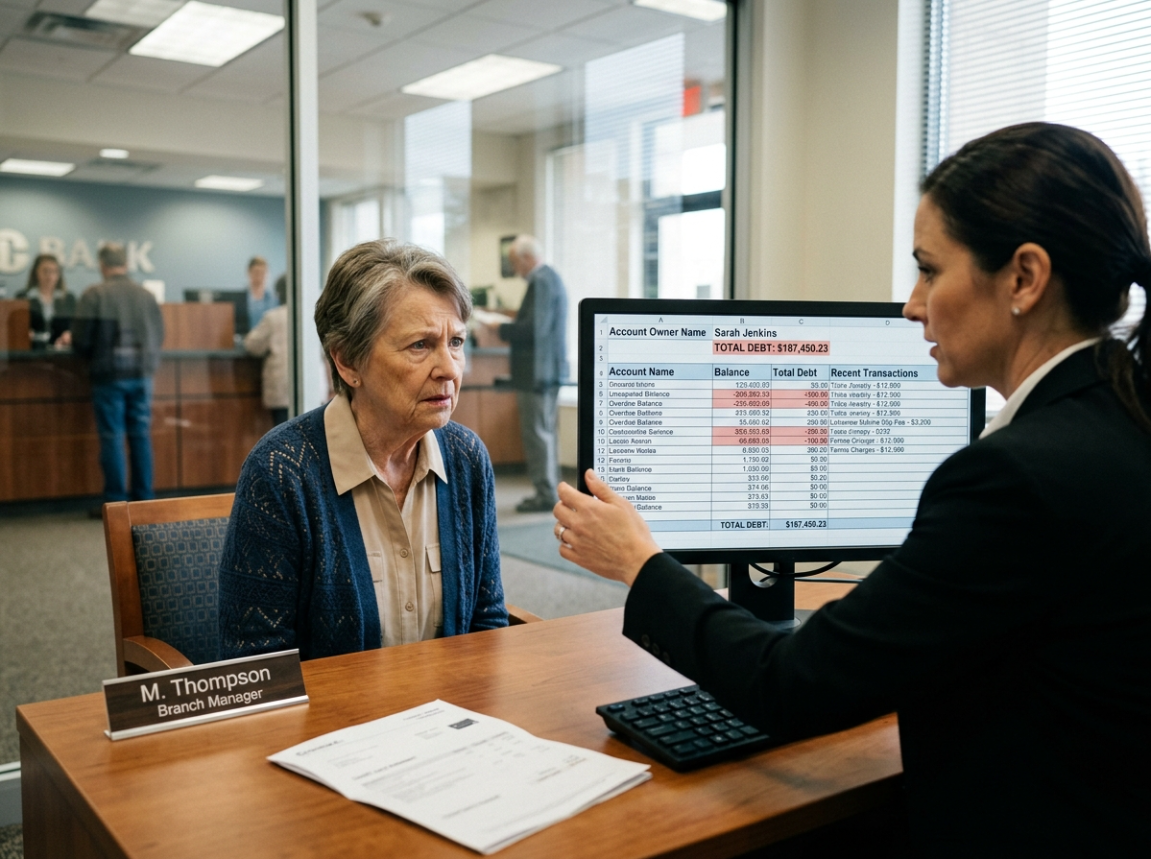
**“Mrs. Bennett, there are seven active financial accounts connected to your Social Security number.”**
I stared at the screen.
Seven.
I had known about one.
My checking account.
The account where my $1,900 arrived every month.
But there were six others.
A savings account.
Two credit cards.
A personal line of credit.
A money market account.
And something called a secured loan.
I looked at the numbers.
Then I looked at Angela.
“I don’t understand.”
“I know,” she said quietly.
Patricia clicked the mouse.
“Let’s start with this one.”
A checking account opened four years earlier.
My name.
My Social Security number.
My signature.
But I had never seen it before.
There was a balance of $217.
That wasn’t what caught my attention.
It was the history.
Thousands of dollars had moved through the account.
Deposits.
Transfers.
Cash withdrawals.
Payments to Daniel.
I leaned closer.
“Why is his name there?”
Patricia looked uncomfortable.
“He is listed as an authorized signer.”
My stomach tightened.
“Can he take money out?”
“Yes.”
“Can he transfer money?”
“Yes.”
“Can he open things in my name?”
There was a pause.
“Not legally without your authorization,” Patricia said.
I looked at the screen.
Then at my hands.
I remembered every time Daniel told me not to worry.
Every time he said I was “too old for all this.”
Every time I had apologized for needing money.
I felt something rise inside me.
Not sadness.
Not yet.
Anger.
Slow.
Cold.
Clear.
“Show me the next account,” I said.
The savings account contained $43.
It had once contained nearly $18,000.
“Where did it go?” I asked.
Patricia opened the transaction history.
Transfers.
Monthly.
Sometimes weekly.
Most went to the checking account Daniel controlled.
Then disappeared.
The first credit card was the statement I’d found.
$31,482.16.
The second credit card had a balance of $14,906.
I closed my eyes.
When I opened them, Patricia was watching me.
“Mrs. Bennett,” she said, “are you all right?”
“No,” I answered.
And for the first time that morning, I told the truth.
“No. I don’t think I am.”
Angela reached for a box of tissues.
I didn’t take one.
I wasn’t crying.
Not yet.
Then Patricia opened the secured loan.
And that’s when everything changed.
The loan was for $85,000.
I stared at the number.
“What is that?”
Patricia didn’t answer immediately.
She looked at the paperwork.
Then she turned the screen slightly away from me.
“Mrs. Bennett, this loan appears to be secured by your property.”
“My house?”
“Yes.”
I felt the room disappear.
Not literally.
But for a moment, I couldn’t hear anything.
Walter’s house.
Our house.
The place we’d bought in 1979.
The kitchen where we’d raised two children.
The hallway where their height marks were still scratched into the doorframe.
The bedroom where Walter had died.
I had lived there for forty-seven years.
“Who borrowed eighty-five thousand dollars?”
Patricia looked directly at me.
“The loan documents list you as the borrower.”
My voice came out barely above a whisper.
“I never borrowed eighty-five thousand dollars.”
Angela and Patricia exchanged a look.
Then Angela reached for a folder.
“Mrs. Bennett,” she said, “there is something else you need to see.”
She opened it.
Inside were copies of documents.
Loan applications.
Account forms.
Authorization papers.
And several signatures.
Mine.
Or something that looked like mine.
I picked up one page.
Margaret L. Bennett.
The handwriting was close.
Very close.
But not right.
I knew my own signature.
Walter used to joke that my M looked like a mountain.
This one didn’t.
I looked at another document.
Then another.
My name was everywhere.
But I hadn’t written it.
My hands began trembling again.
“That’s not my signature.”
Patricia nodded.
“Are you certain?”
“Yes.”
She placed another document in front of me.
“Did you sign this?”
I looked.
Power of attorney.
My nephew, Daniel Bennett, was listed as the agent.
The document gave him broad authority over my finances.
Banking.
Property.
Financial transactions.
I read every word.
Then I looked at the signature at the bottom.
My name.
Again.
Wrong.
I looked at Patricia.
“I never signed this.”
The room became completely silent.
Angela closed the office door.
Patricia spoke carefully.
“Mrs. Bennett, I need you to understand something. We cannot determine everything right now. But based on what you’re telling us, there may have been unauthorized activity involving your accounts.”
“May have been?”
She nodded.
“We need to investigate.”
I leaned back in my chair.
Six years.
Six years of being told not to worry.
Six years of asking permission to spend my own money.
Six years of thinking I was becoming confused.
I suddenly remembered something Daniel had said last Christmas.
“You’re lucky I’m here, Aunt Margaret.”
At the time, I’d smiled.
Now I understood.
I looked at Angela.
“What happens next?”
She opened another folder.
“We can immediately place additional security on your accounts.”
“Yes.”
“We can remove unauthorized access where appropriate.”
“Yes.”
“We can begin a fraud investigation.”
“Yes.”
“And because there may be issues involving your property and a possible forged power of attorney, you should speak with an attorney.”
I nodded.
“Today.”
Patricia’s expression softened.
“Do you have someone who can come sit with you?”
I thought of my sister.
Daniel’s mother.
Then I thought of calling her and hearing her say, *There must be some misunderstanding.*
I thought of Daniel.
His doughnuts.
His Sunday visits.
His concerned voice.
I shook my head.
“No.”
“Mrs. Bennett—”
“I have myself.”
That sounded stronger than I felt.
But it was true.
For the first time in six years, I was going to take care of my own business.
Angela printed copies of everything.
The account histories.
The loan information.
The power of attorney.
The signatures.
Before I left, she handed me a thick envelope.
I put it inside my purse.
Then I stood.
My knees felt weak.
But I stood.
At the office door, I turned around.
“One question.”
Angela looked up.
“Yes?”
“Can Daniel see that I came here?”
She and Patricia exchanged another glance.
“Not immediately,” Angela said. “But once we begin restricting access and investigating the accounts, he may become aware that something has changed.”
I nodded.
“Good.”
Angela blinked.
I looked down at my purse.
“Let him wonder.”
I walked out of the bank.
The September sun was bright.
I sat in my car for several minutes without starting the engine.
Then my phone rang.
Daniel.
His name appeared on the screen.
For six years, I had answered every time.
That morning, I watched it ring.
Once.
Twice.
Three times.
Then it stopped.
A moment later, a message appeared.
**Hey Aunt Margaret. Everything okay?**
I looked at those words.
Everything okay?
I almost laughed.
Instead, I placed the phone facedown on the passenger seat.
Then I started the car.
I had an attorney to find.
And Daniel had no idea that by the end of the week, I would know exactly what he had done.
But first, I needed to discover one thing.
**Where had the eighty-five thousand dollars gone?**
And when I found out, I would learn that the credit cards were only the beginning.
**Part 2 will continue with Margaret’s investigation, the missing $85,000, and the first time Daniel realizes she knows the truth.**
## Part 2
She turned the screen toward me and said, “Mrs. Harlan… before we go any further, I need you to understand that there are more accounts connected to your name than the checking account you came in to ask about.”
For a moment, I thought I had misunderstood her.
The bank manager was a woman in her fifties with silver hair and glasses hanging from a chain around her neck. Her nameplate said **MARGARET LEWIS**. She had been patient with me from the moment I sat down, even when I struggled to explain why I had brought in an envelope addressed to my nephew.
I looked at the computer screen.
There were columns of numbers.
Checking.
Savings.
Credit.
Loan.
A second checking account.
And another savings account.
I stared at them until the words blurred.
“How many?” I asked.
Margaret folded her hands.
“Five active accounts and two closed accounts within the last three years.”
My mouth went dry.
“I have one checking account.”
She looked at me carefully.
“You have one checking account that you appear to actively use.”
That sentence frightened me more than anything else she’d said.
“What does that mean?”
“It means,” she said gently, “that the other accounts have your name and Social Security number associated with them, but the activity patterns suggest someone else may have been managing them.”
Someone else.
I already knew who.
I didn’t want to say his name.
Not yet.
Margaret clicked the first account.
“Do you recognize this savings account?”
I leaned closer.
No.
The address was mine.
The account holder was me.
But I had never seen it before.
“What’s in it?” I asked.
Margaret’s expression changed slightly.
“Nothing now.”
My stomach tightened.
“What do you mean, now?”
She clicked another screen.
“This account had a balance of eighty-seven thousand four hundred dollars approximately fourteen months ago.”
I stopped breathing.
Eighty-seven thousand.
I had spent the last six years thinking I was barely getting by.
I bought generic cereal.
I stopped getting my hair done at the salon because I thought twenty-five dollars was too much.
When my refrigerator broke, I spent three months using a borrowed cooler because I was afraid to ask my nephew whether I could afford a new one.
And there had been eighty-seven thousand dollars in an account with my name on it.
“Where did it go?” I whispered.
Margaret didn’t answer immediately.
She looked toward the glass walls of her office, then back at me.
“Most of it was transferred out.”
“To where?”
She clicked again.
“To an external account.”
“Whose?”
She hesitated.
“I can show you the transfer history. But because this is beginning to look like possible financial exploitation, I would strongly recommend that we bring in our fraud department.”
The word hit me like a slap.
**Exploitation.**
I was seventy-four years old.
For six years, my nephew had come to my house every other Friday.
He brought groceries.
He checked my mail.
He paid my electric bill.
Sometimes he sat at my kitchen table with his laptop open and said things like, “Aunt Evelyn, you really don’t need to worry about this stuff anymore.”
And I believed him.
Because my sister had raised him.
Because when my husband died, my nephew was the one who drove me home from the hospital.
Because family is supposed to be the last place you look for danger.
I looked at Margaret.
“Please show me.”
She turned the screen.
The transfers were listed one beneath another.
Five thousand.
Seven thousand.
Twelve thousand.
Three thousand.
Nine thousand.
The destination account number was partially hidden.
But the name wasn’t.
I read it once.
Then twice.
**DANIEL HARLAN.**
My nephew.
I put my hand over my mouth.
Margaret said something, but I didn’t hear it.
All I could see was Daniel’s face.
Thirty-eight years old.
Blue eyes like my sister’s.
The same crooked smile he’d had since he was a boy.
The boy who used to spend summers in my backyard.
The man who had stood beside me at my husband’s funeral and said, “Don’t worry, Aunt Evelyn. I’ll take care of you.”
And he had.
Just not in the way I’d believed.
“How much?” I asked.
Margaret leaned closer.
“Transferred directly to accounts under his name?”
I nodded.
She typed for several seconds.
“From this particular savings account, approximately seventy-two thousand dollars.”
The room tilted.
I grabbed the edge of the desk.
Margaret stood immediately.
“Mrs. Harlan?”
“I’m fine.”
But I wasn’t.
Not even close.
Because suddenly six years made sense.
Every time I asked why my balance seemed low.
Every time Daniel said there were unexpected expenses.
Every time he told me inflation was getting worse.
Every time he said my insurance had gone up.
I had believed him.
He had made me feel foolish for asking.
“You don’t understand these things anymore,” he’d say.
Not cruelly.
That was the worst part.
Kindly.
Patiently.
As if he were protecting me from information too complicated for my old mind.
I looked back at the screen.
“What about the credit card?”
Margaret opened another file.
“The card you brought in?”
“Yes.”
“You are the primary account holder.”
“I never applied for it.”
“I understand.”
“Can you see when it was opened?”
“Four years ago.”
I closed my eyes.
Four years.
The charges appeared on the screen.
The boat slip.
The steakhouse.
The jeweler in Tulsa.
But there was more.
Hotels.
Airline tickets.
Furniture stores.
An electronics store.
Restaurants I had never visited.
A resort in Florida.
I opened my eyes.
“Can I print that?”
Margaret nodded.
“I’ve already asked my assistant to prepare copies.”
She had known.
She had understood where this was going before I did.
A few minutes later, another woman entered the office and introduced herself as someone from the bank’s fraud team. They asked me questions.
Had Daniel ever had access to my mail?
Yes.
Had he ever helped me open accounts?
Possibly.
Did he know my Social Security number?
Yes.
Did he have access to my debit card?
Sometimes.
Did I ever knowingly authorize transfers to him?
I stopped.
Because suddenly I remembered.
Two years earlier, Daniel had brought me some papers.
He said they were bank documents.
“Just routine stuff,” he’d told me.
I remembered signing them.
Not reading them.
“Maybe,” I said.
The fraud specialist nodded.
“Do you remember what the documents were?”
“No.”
“Do you still have copies?”
“I don’t know.”
And then I remembered the filing cabinet in my spare bedroom.
Daniel had reorganized it last year.
He’d thrown away what he called “old junk.”
I felt cold.
The fraud specialist took notes.
Then she said, “Mrs. Harlan, I want to be very clear. You do not need to decide everything today. But based on what you’re telling us, I recommend we immediately freeze any accounts that could be accessed by someone else.”
I nodded.
“Yes.”
“Even if that person is family?”
My throat tightened.
“Yes.”
They began closing doors.
Not literal doors.
Financial ones.
They froze the accounts.
Canceled my debit card.
Flagged the credit line.
Changed passwords and contact information.
For the first time in six years, my phone number—not Daniel’s—was listed as the primary contact.
That hurt more than I expected.
My own bank had been calling him about my money.
I sat there for nearly three hours.
By the time I left, I had a thick envelope full of statements.
Margaret walked me to the front doors.
“Do you have someone who can stay with you today?”
I almost laughed.
The only person who would normally come was Daniel.
“No,” I said.
She touched my arm.
“Then please don’t answer any calls if you don’t feel ready. And if he comes to your house, you don’t have to open the door.”
I looked at her.
“Do you think he knows?”
She didn’t answer directly.
“He may notice the accounts have been frozen.”
Of course he would.
By the time I got home, there were three missed calls on my phone.
All from Daniel.
I stood in my kitchen and stared at his name.
**DANIEL CALLING.**
For six years, that name had meant safety.
Now it made my hands shake.
The phone rang again.
I didn’t answer.
A voicemail appeared.
I pressed play.
“Aunt Evelyn, hey, it’s me. The bank called me about some weird issue with one of your accounts. Give me a call, okay? Don’t worry about anything. I’ll handle it.”
I listened to it twice.
Then I deleted it.
Not because I wanted to forget.
Because I didn’t want to hear him say **I’ll handle it** ever again.
That afternoon, I took every piece of mail I could find from the last two years and spread it across my dining room table.
Bank letters.
Tax documents.
Insurance notices.
Statements.
There were things Daniel had never shown me.
Letters addressed to me that had been opened.
Statements that had been redirected electronically.
One envelope caught my attention.
It was from an insurance company.
Inside was a notice about a life insurance policy.
I had no life insurance policy.
At least, not one I knew about.
My hands trembled as I read it.
The policy was worth two hundred thousand dollars.
I was the insured person.
And the beneficiary was Daniel.
I sat back slowly.
For a long time, I couldn’t move.
Then I picked up the phone and called the number on the letter.
The woman who answered confirmed it.
The policy had been opened three years earlier.
Premiums were being paid automatically from one of my accounts.
I asked one question.
“Who signed the application?”
She paused.
“Mrs. Harlan, I would need to transfer you to our fraud department for that information.”
Of course.
Another department.
Another investigation.
Another door I hadn’t known existed.
By evening, I understood something I had spent my whole life refusing to believe.
You can love someone and still be in danger from them.
You can share holidays with someone.
Bake them birthday cakes.
Hold them as babies.
Watch them grow up.
And still not know who they are when money is involved.
At seven-thirty that night, there was a knock at my front door.
I froze.
Another knock.
Then Daniel’s voice.
“Aunt Evelyn? I know you’re home.”
I didn’t move.
He knocked again.
“Aunt Evelyn, please open the door.”
I walked quietly to the living room window.
His truck was in my driveway.
The same truck I had helped him pay for three years earlier.
I had forgotten that.
He’d told me he was short on money.
I had written him a check for six thousand dollars.
I thought I was helping my nephew.
Now I wondered how much of my own money had already been flowing into his pockets.
“Aunt Evelyn,” he called again.
His voice sounded worried.
Almost convincing.
Then my phone rang.
Daniel.
I watched it vibrate on the table.
I didn’t answer.
The knocking stopped.
For a moment, I thought he’d left.
Then I heard his voice through the door.
“You’re making a mistake.”
Everything inside me went still.
Not, **I’m sorry.**
Not, **Let me explain.**
You’re making a mistake.
I stepped closer to the door but didn’t unlock it.
“What mistake?”
Silence.
Then he said, “Talking to the bank without me.”
I looked at the deadbolt.
My heart was beating so hard I could feel it in my neck.
“This is my money, Daniel.”
Another silence.
Longer this time.
Then his voice changed.
Only slightly.
But enough.
“You don’t understand what’s going on.”
For six years, I had heard that sentence in one form or another.
You don’t understand the bills.
You don’t understand investments.
You don’t understand banking.
You don’t understand how expensive things are now.
But standing behind my locked front door, with the bank statements spread across my dining room table, I finally understood perfectly.
“I understand enough,” I said.
Daniel exhaled.
“Aunt Evelyn, please. Open the door.”
“No.”
His voice hardened.
“Someone is filling your head with things.”
“No one filled my head.”
“Aunt Evelyn—”
“I saw the transfers.”
Silence.
I continued.
“I saw the credit card.”
Still nothing.
“I saw the jewelry charge.”
His truck door slammed.
I jumped.
Then I heard his footsteps moving away from the house.
A few seconds later, his engine started.
I watched through the window as his truck backed out of my driveway.
I expected relief.
Instead, I felt something else.
Fear.
Because Daniel knew.
He knew I had seen enough.
And somewhere between the bank and my front door, my nephew had stopped pretending this was about helping me.
My phone rang again at 9:14.
This time, it wasn’t Daniel.
It was a number I didn’t recognize.
I answered.
“Hello?”
“Mrs. Harlan?”
“Yes?”
“My name is Detective Ruiz. I’m calling regarding a report that was forwarded to us from your bank.”
I sat down slowly.
“Yes.”
“I understand you’ve discovered some accounts and transactions that you may not have authorized.”
I looked across the room.
At the statements.
At six years of paper.
At numbers that had once meant nothing because someone I loved had convinced me I didn’t need to understand them.
“Yes,” I said.
The detective paused.
“Mrs. Harlan, is your nephew Daniel Harlan?”
My fingers tightened around the phone.
“Yes.”
“Please don’t discuss the accounts with him any further until we have an opportunity to speak with you in person.”
I stared at the dark window.
Daniel was gone.
For now.
“Why?” I asked.
The detective’s answer made my blood turn cold.
“Because, Mrs. Harlan, you’re not the first person connected to Daniel whose finances we’re looking into.”
I didn’t sleep that night.
And by morning, I knew one thing for certain.
I had spent six years letting my nephew tell me not to worry about numbers.
Now the numbers were about to tell me everything.