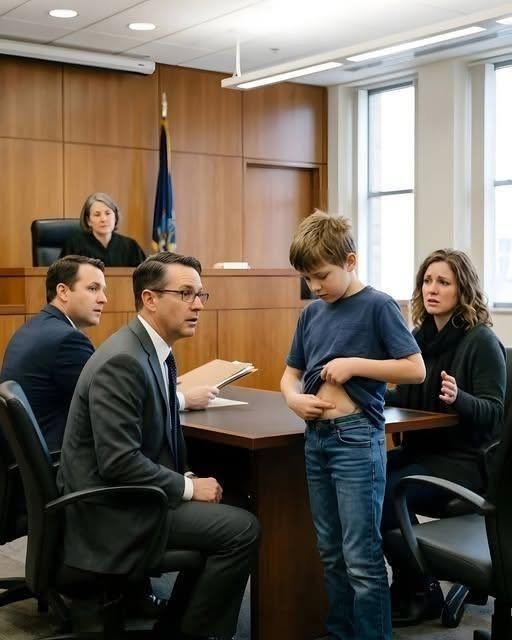
What Was Hidden Beneath the Shirt Nolan pulled the shirt higher. At first, I didn’t understand what I was looking at. Neither did the judge.
The courtroom went strangely quiet. Beneath the faded navy fabric, taped carefully against Nolan’s small stomach, was a clear plastic envelope. Inside it were several folded pieces of paper. And something else. A tiny silver flash drive. My breath caught. “Nolan…”
I whispered. He looked at me for half a second. There was fear in his eyes. But there was something stronger there, too. Determination. Judge Whitmore leaned forward. “Son,” she said gently, “what is that?” Nolan lowered his shirt but kept one hand pressed over the envelope. “It’s proof.” Carroway immediately stood. “Your Honor, I object. This is highly irregular.
The child has clearly been coached.” Nolan’s face changed. For the first time since he had entered the courtroom, he looked angry. “My mom didn’t tell me to do this.” Carroway opened his mouth.
Nolan continued.
“She told me not to tell anyone.”
The room seemed to freeze. I felt every pair of eyes turn toward me. The judge looked at me. “Mrs. Parker?” “I…” My voice failed. I honestly didn’t know what to say.
Because Nolan was telling the truth. Three nights earlier, I had discovered something strange. Something I had never told my attorney. Something I had barely admitted to myself.
It had started with a noise outside our apartment. A car. Same engine. Same low rumble.
Same headlights that seemed to pause beneath our window every night. I had initially dismissed it as coincidence. Then Nolan told me he had seen the same black SUV outside his school. That frightened me.
Not because Grant owned a black SUV. He didn’t.
But because the man sitting inside it had been watching Nolan. I had called the police. They found nothing. The next night, the SUV returned. And the following morning, I discovered an envelope pushed beneath our apartment door.
No name. No return address.
Just three words written across the front.
LOOK AT THE PHOTOS.
Inside were pictures. Dozens of them. Pictures of Grant. Pictures of Grant meeting people I had never seen before. Pictures of him entering an office downtown.
Pictures of him handing an envelope to a man in a gray coat.
And one photograph that made my stomach twist.
Grant was standing outside the courthouse.
Talking to Carroway.
That photograph had been taken two weeks before our custody hearing.
I hadn’t known what it meant.
I still didn’t.
So I had hidden everything.
Not because I trusted the mysterious sender.
I didn’t.
I hid it because I was terrified.
And because I had one person left in this world I needed to protect.
Nolan.
But somehow, my eight-year-old son had found the envelope.
I looked at him now.
“Where did you get that?”
He swallowed.
“From the box.”
“What box?”
“The one Dad told me never to open.”
Grant moved.
It was the first time I’d seen him lose control.
“That’s enough.”
His voice cracked across the courtroom.
“Nolan, come here.”
My son stepped backward.
“No.”
Grant stared at him.
“Nolan.”
“No!”
The word came out louder.
The judge immediately raised her hand.
“Mr. Parker, sit down.”
Grant sat.
But his face had changed.
The confident man in the expensive suit was gone.
For the first time, he looked afraid.
Carroway leaned toward him and whispered something.
Grant shook his head.
Then he looked at me.
Not with anger.
With fear.
And that was when I knew.
Whatever was inside that envelope mattered.
A lot.
Judge Whitmore looked at Nolan.
“Would you like to give me the envelope?”
Nolan hesitated.
He looked at me.
I nodded.
Slowly, he walked toward the judge.
His sneakers squeaked against the polished floor.
He reached the bench and placed the plastic envelope in front of her.
Judge Whitmore opened it.
She removed the first paper.
Then the second.
Then the third.
Her expression changed.
Not dramatically.
Just enough.
Her eyebrows drew together.
She read one page again.
Then another.
Finally, she looked toward Grant.
“Mr. Parker.”
Grant didn’t answer.
“Would you like to explain these?”
He swallowed.
“I don’t know what those are.”
Judge Whitmore held up one document.
“Your name is on it.”
“That’s not my signature.”
Carroway immediately stepped in.
“Your Honor, these documents have not been authenticated. Their relevance is questionable, and we have no idea where they came from.”
Judge Whitmore looked at him.
“Then I’m sure you won’t object to having them authenticated.”
Carroway went silent.
I watched the judge turn another page.
Then she reached into the envelope and pulled out a photograph.
She stared at it for several seconds.
Her expression hardened.
She handed it to the clerk.
“Make a copy.”
The clerk looked at the picture.
His face went pale.
I couldn’t see it from where I was sitting.
“What is it?” I whispered.
Nolan answered.
“It’s Dad.”
My heart sank.
“What was he doing?”
Nolan looked at his father.
“He was taking money.”
Grant shot to his feet.
“That’s a lie!”
The judge’s gavel struck.
“Mr. Parker!”
Grant froze.
“You will sit down.”
He did.
But his hands were shaking.
I looked at Carroway.
The attorney who had spent the last ten minutes calling me irresponsible suddenly looked like a man who had realized he had walked into the wrong courtroom.
Judge Whitmore continued reading.
Then she stopped.
Her eyes settled on a single line.
She read it again.
This time, she looked directly at me.
“Mrs. Parker, did you know your son was keeping records of these events?”
“No.”
Nolan lowered his head.
“I started writing them down because Mom was always scared.”
My chest tightened.
“Nolan…”
He looked at me.
“You cried in the bathroom.”
I felt tears burn behind my eyes.
“You thought I couldn’t hear you.”
The courtroom became completely silent.
“I heard you.”
He reached into the envelope again.
This time he pulled out a small notebook.
The cover was bent and covered with blue crayon marks.
“I wrote down everything.”
Grant stared at the notebook.
Then something happened that I will never forget.
He looked at the clock.
Not the judge.
Not me.
Not Nolan.
The clock.
As if he were calculating how much time he had left.
Judge Whitmore noticed.
“So,” she said quietly, “you’ve been keeping notes.”
Nolan nodded.
“Yes, ma’am.”
“Why?”
Nolan’s little fingers tightened around the notebook.
“Because Dad said nobody would believe Mom.”
Grant’s face went white.
Judge Whitmore leaned back.
“Mr. Parker, I am ordering a temporary recess.”
Carroway stood.
“Your Honor—”
“Mr. Carroway.”
The judge’s voice was ice.
“Before you say another word, I suggest you review the material that has just been placed before this court.”
Carroway slowly sat.
Judge Whitmore looked at me.
Then at Nolan.
“I also want the child interviewed by a court-appointed professional before this hearing resumes.”
I nodded.
Nolan looked terrified.
I reached for his hand.
“It’s okay.”
But before we could leave, Nolan tugged gently on my sleeve.
“Mom.”
“What?”
He whispered so softly that only I could hear.
“There’s one more thing.”
I stared at him.
“What?”
He looked across the courtroom.
At Grant.
Then at Carroway.
Then back at me.
“The last paper isn’t about Dad.”
My heart stopped.
“What is it about?”
Nolan’s eyes filled with tears.
“It’s about you.”
I felt the room tilt beneath me.
The judge was already gathering her papers.
But Nolan pulled the final folded page from beneath his shirt.
It was different from the others.
Older.
Yellowed.
And across the front, written in handwriting I recognized immediately, were four words:
YOUR GRANDMOTHER KNEW EVERYTHING.
I couldn’t breathe.
My grandmother had been dead for six years.
And suddenly, the antique locket I had pawned four months earlier didn’t feel like a piece of jewelry anymore.
It felt like a clue.
And somewhere inside that courthouse, someone knew exactly what my grandmother had tried to hide.
I stared at the words.
YOUR GRANDMOTHER KNEW EVERYTHING.
For a moment, I couldn’t hear anything else.
Not the murmuring lawyers.
Not the scrape of chairs.
Not even the judge calling for order.
All I could hear was my grandmother’s voice from years ago.
Never trust a person who needs you to believe you are powerless.
I had always thought it was one of her strange sayings.
Now I wasn’t so sure.
“Nolan,” I whispered, “where did you get this?”
He looked toward Grant.
“From Dad’s desk.”
Grant’s chair scraped violently against the floor.
“That’s enough.”
The judge looked at him.
“Mr. Parker, sit down.”
“But that document—”
“Sit.”
He did.
Slowly.
For the first time, I noticed something I had never noticed before.
His expensive watch wasn’t sitting correctly on his wrist.
The strap was loose.
And underneath it was a small red mark.
A mark I had seen before.
On the wrist of the man in the photograph.
The man in the gray coat.
My stomach dropped.
“Your Honor,” I said.
The judge looked at me.
“I think I know who the man in the photographs is.”
Carroway’s face tightened.
Grant looked at him.
That single glance told me everything.
They knew each other.
Maybe not just professionally.
Maybe they had been working together.
Judge Whitmore noticed it too.
“Mrs. Parker, what are you saying?”
I stood.
“My ex-husband has been telling everyone that I destroyed our finances. That I lost my job because I was irresponsible. That I couldn’t keep a home.”
My voice shook.
“But I didn’t.”
I looked at Grant.
“He did.”
Grant shook his head.
“You have no evidence.”
I almost laughed.
It was a strange, broken sound.
“No evidence?”
I pointed toward the table.
“Your son just brought it into this courtroom.”
Nolan looked down.
The judge asked the clerk to bring her the remaining documents.
She studied them carefully.
Then she asked, “Who gave these to your son?”
Nolan hesitated.
“I don’t know.”
“Then how did he get them?”
“Someone left them in Dad’s office.”
Grant’s face went rigid.
The judge looked at him.
“Mr. Parker?”
“I have no idea what the child is talking about.”
Nolan suddenly spoke.
“Yes, you do.”
Everyone turned.
My little boy reached into his pocket and pulled out something tiny.
A key.
“I found this too.”
Grant’s face drained of color.
“What is that?”
Nolan looked at him.
“You told me it was for your special drawer.”
The judge held out her hand.
Nolan gave her the key.
“Where is the drawer?” she asked.
Nolan pointed toward Grant.
“At his office.”
Carroway stood.
“Your Honor, this has gone far beyond the scope of today’s custody hearing.”
The judge’s expression became cold.
“I agree.”
She paused.
“Which is precisely why I am referring these materials for investigation.”
Grant stood again.
“You can’t do this.”
“I can.”
“But this is a custody hearing!”
“It was.”
The judge closed the folder.
“Now I believe we may be looking at something considerably more serious.”
Grant stared at her.
Then at Carroway.
Carroway wouldn’t meet his eyes.
And that was the moment Grant understood.
His lawyer wasn’t going to save him.
Neither was his money.
Neither was his expensive suit.
Neither was his $10,000 watch.
The courtroom doors opened.
Two investigators entered.
Grant’s expression changed completely.
One of them approached him.
“Mr. Parker, we’d like to speak with you.”
Grant looked at me.
For once, I didn’t look away.
He had spent two years making me feel small.
He had convinced me that I was poor because I was worthless.
That I had lost my job because I wasn’t good enough.
That my son would be better off without me.
But now he was the one sitting beneath the fluorescent courtroom lights, surrounded by people who no longer believed his story.
Then one of the investigators placed a photograph on the table.
It showed Grant entering a bank.
Behind him was the same man from the photographs.
The investigator looked at the judge.
“We also obtained security footage.”
Grant stopped breathing.
The investigator continued.
“Mr. Parker appears to have been transferring money through several accounts connected to shell companies.”
My knees nearly gave out.
The investigator turned another page.
“And some of those transfers occurred on the same dates Mrs. Parker reported missing child-support payments.”
I looked at Grant.
He couldn’t look at me anymore.
The truth was finally catching up.
The money hadn’t disappeared.
He had hidden it.
The complaints against my employer hadn’t been random.
They had been manufactured.
The landlord who suddenly refused to renew our lease?
A friend of Grant’s.
The anonymous accusations that had cost me my job?
Traced to an account connected to one of his businesses.
And the money he claimed he didn’t have?
Moving quietly through accounts I had never known existed.
For two years, he had built a story in which I was the failure.
And I had almost believed him.
Then the judge looked at Nolan.
“Young man, you did something very brave today.”
Nolan looked at me.
“I just wanted Mom to stop being scared.”
That broke me.
I pulled him into my arms.
He buried his face against my shoulder.
“I’m sorry,” I whispered.
“For what?”
“For making you carry things a child shouldn’t have to carry.”
He hugged me tighter.
“You didn’t.”
I closed my eyes.
For the first time in years, I let myself cry.
Not because I had lost.
Because I finally understood.
I hadn’t lost.
I had survived.
Weeks later, the investigation uncovered the rest.
Grant had manipulated financial records.
He had hidden income.
He had deliberately interfered with my employment.
And the mysterious documents had come from someone inside his own circle—someone who had finally decided they wanted no part of his scheme.
But there was one mystery I still couldn’t solve.
The message about my grandmother.
So I went back through everything.
The photographs.
The documents.
The notebook.
The key.
Then I remembered the locket.
My grandmother’s antique locket.
The one I had pawned to buy Nolan his birthday shirt.
I went back to the pawnshop.
I expected it to be gone.
It wasn’t.
The owner recognized me.
“I’ve been holding this.”
He placed the little velvet box on the counter.
I opened it.
The locket looked exactly as I remembered.
But when I turned it over, I noticed something.
A tiny seam ran around the edge.
I pressed it.
The back clicked open.
Inside was a folded piece of paper.
My hands began shaking.
There was only one sentence.
If Grant ever tries to take Nolan from you, show them what is inside the blue moon.
I froze.
The blue moon.
Nolan’s shirt.
The same shirt Grant’s lawyer had held up in court.
The shirt they had called dirty.
The shirt they had used to prove I was an unfit mother.
I suddenly understood why Nolan had lifted it.
He hadn’t just been showing the documents.
He had been showing them where he had hidden them.
And beneath the moon embroidered over his pocket was a tiny second layer of fabric.
A pocket I had never noticed.
Inside was the final piece of evidence.
A memory card.
My grandmother had hidden it years ago.
And on it was a recording.
Her voice.
Old.
Soft.
But unmistakably hers.
She explained that she had discovered Grant’s family had been involved in financial fraud long before I married him.
She had tried to warn me.
But Grant had convinced me that she was paranoid.
Then came the final sentence.
“If you’re hearing this, he has probably already tried to convince you that you are the problem.”
I covered my mouth.
My grandmother continued.
“Don’t believe him.”
The recording ended.
I sat there for a long time.
Then Nolan came into the room.
He climbed onto the sofa beside me.
“Mom?”
I wiped my eyes.
“Yeah?”
“Are we okay now?”
I looked at my son.
At the boy who had stood in a courtroom when every adult around him was afraid.
I pulled him close.
“Yes.”
He smiled.
“Really?”
“Really.”
Outside, snow had begun falling.
Softly.
Quietly.
The same kind of snow that had covered Knoxville on the morning we went to court.
But everything felt different now.
The next morning, I put on clean clothes.
So did Nolan.
Then I took the faded blue shirt and washed it one last time.
The stains never completely disappeared.
I didn’t care.
I folded it carefully and placed it in a box.
Because that shirt had once represented everything I thought I had lost.
My money.
My marriage.
My dignity.
My security.
But it had also carried the truth.
And when I looked at the tiny moon embroidered above the pocket, I finally understood something my grandmother had known all along:
Sometimes the thing people use to shame you becomes the very thing that saves you.
Grant wanted the judge to see a dirty shirt.
He wanted everyone to see a broken mother.
Instead, they saw the truth.
And my eight-year-old son made sure they couldn’t look away.