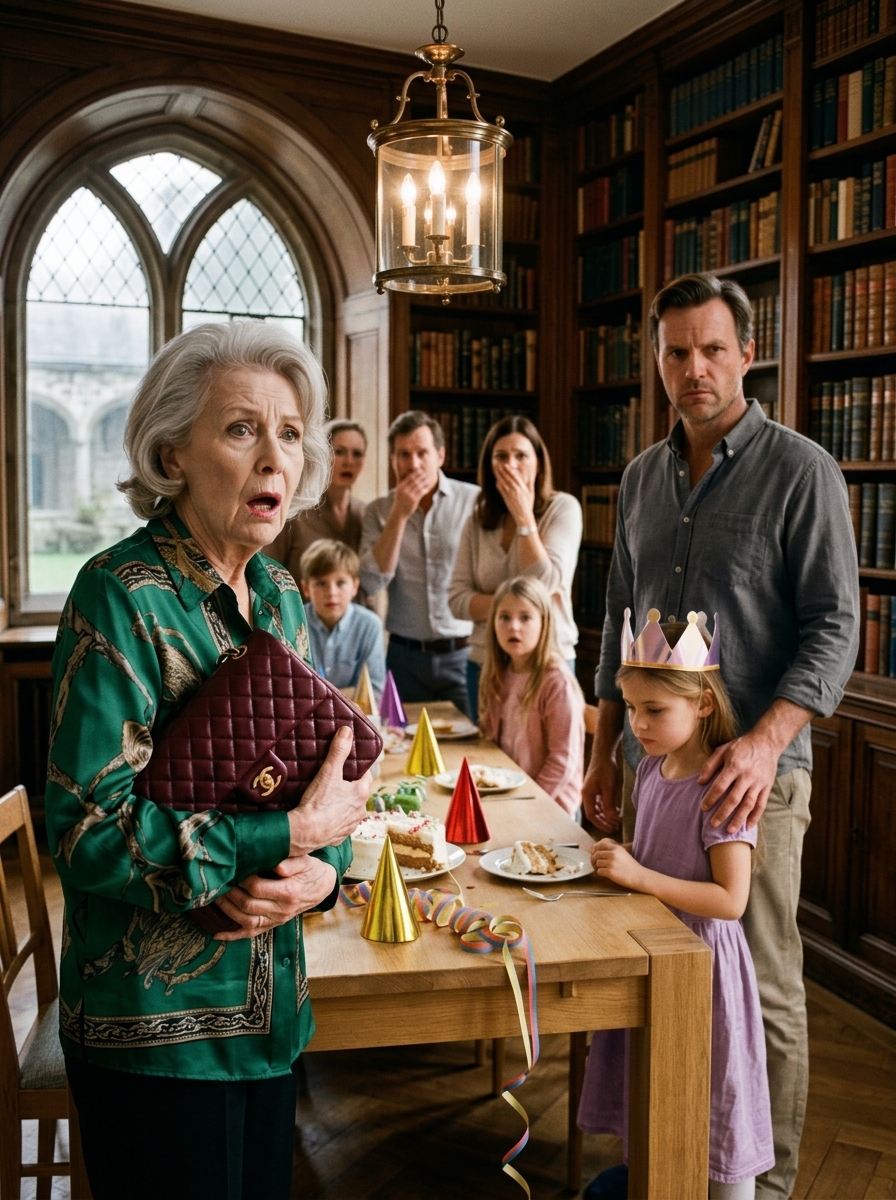
Greg never raised his voice.
That was what made everyone stop moving.
A few minutes earlier, I had noticed June’s empty chair beside the children’s table.
Her paper cup was still there, her slice of pizza untouched, her purple napkin folded neatly beside her fork.
Amber, Greg’s fifteen-year-old daughter, and Mason, his twelve-year-old son from his first marriage, were sitting with their cousins. They were laughing over something on Mason’s phone.
But June was gone.
My seven-year-old daughter had been so excited about Greg’s birthday.
She had spent almost an hour that afternoon carefully coloring a birthday card. She had drawn a crooked picture of Greg holding a cake, with herself standing beside him.
At the bottom, in uneven purple letters, she had written:
**HAPPY BIRTHDAY, DADDY. I LOVE YOU.**
She had asked me four times whether he would like it.
“He’ll love it,” I’d promised.
Now her chair was empty.
I looked around the crowded dining room of Greg’s parents’ house.
His mother, Evelyn, was moving between the kitchen and dining room, collecting plates.
His father, Richard, was standing near the fireplace talking to two of Greg’s uncles.
Several cousins were gathered around the long table.
Music played softly in the background.
Everyone seemed to be having a wonderful time.
Except my daughter.
“Where’s June?” I asked.
Nobody answered.
I looked at Greg.
He was near the birthday cake, talking to his sister, Melissa.
“Greg?”
He turned.
“What?”
“Have you seen June?”
His smile disappeared.
“No. I thought she was with you.”
I felt something cold settle in my stomach.
“I thought she was with you.”
Greg immediately began looking around.
“June?”
No answer.
I checked the living room.
Nothing.
The hallway.
Nothing.
Then I heard a tiny sound coming from the den.
A sniffle.
I opened the door.
June was sitting on the floor behind an armchair, hugging her knees.
Her purple dress was wrinkled.
Her eyes were wet.
And she was holding the birthday card against her chest.
My heart broke.
“Sweetheart?”
She looked up at me.
For a moment she didn’t speak.
Then she whispered, “Mommy, can we go home?”
I crouched beside her.
“Why?”
She shook her head.
“Did somebody hurt you?”
She hesitated.
Then she whispered, “Grandma doesn’t want me here.”
I felt my entire body go still.
“What happened?”
June looked toward the hallway.
“Grandma said I had to leave.”
“Leave where?”
“The birthday room.”
I didn’t understand.
“Why?”
June’s lower lip trembled.
“She said this party was for Dad’s real children.”
Those words hit me harder than a slap.
“Who said that?”
“Grandma.”
I stood slowly.
“What else did she say?”
June wiped her cheeks.
“She said Amber and Mason needed the seats because they’re Dad’s real kids.”
I could barely breathe.
“And then?”
“She pushed me.”
My hands tightened.
“Where?”
June pointed toward her shoulder.
“She pushed me outside the room.”
I looked at my daughter’s shoulder.
There was no serious injury, but the sight of her sitting alone on the floor was enough to make something inside me crack.
I wanted to storm into that dining room.
Instead, I picked her up.
“Come on.”
“Mommy?”
“Yes?”
“Am I not Dad’s real daughter?”
I closed my eyes for half a second.
Then I hugged her tighter.
“You are my real daughter. And you are Greg’s daughter too.”
She whispered, “But Grandma said I’m not.”
I carried her back toward the party.
Greg saw us first.
His expression changed immediately.
He walked toward us.
“June.”
She buried her face in my shoulder.
“What happened?” he asked.
I stared at him.
“Your mother happened.”
Greg’s face went pale.
“What?”
“Ask her.”
His eyes moved toward his mother.
Evelyn was standing near the kitchen doorway.
She suddenly became very interested in arranging plates.
Greg walked toward her.
“Mom.”
She looked up.
“What?”
“Did you tell June to leave the dining room?”
Evelyn sighed.
“I simply asked her to sit somewhere else.”
“Why?”
“Greg, don’t make this dramatic.”
His jaw tightened.
“Why?”
She glanced around.
Then she said, “Because Amber and Mason are your children.”
The room went quiet.
Evelyn continued.
“They are your real children. They deserve to sit at the family table.”
I felt June stiffen against me.
Greg looked at his mother.
Then at June.
Then at me.
His voice remained calm.
“Mom, what did you just call my daughter?”
Evelyn frowned.
“You know exactly what I mean.”
“No.”
Greg’s voice was still quiet.
“I don’t.”
His father stepped forward.
“Greg, this isn’t the time.”
Greg turned toward him.
“Actually, Dad, I think it’s exactly the time.”
Everyone stopped talking.
The music suddenly seemed far too loud.
Greg walked over to June.
He crouched in front of her.
“June.”
She slowly looked at him.
“I’m sorry.”
She said nothing.
“I need you to know something.”
Greg glanced around the room.
Then he stood.
“My daughter does not have to earn a seat at my table.”
Nobody moved.
He continued.
“She doesn’t have to compete with Amber. She doesn’t have to compete with Mason. She doesn’t have to prove she’s family.”
Evelyn’s face hardened.
“Greg—”
He held up one hand.
“No, Mom. You had your turn.”
His voice never rose.
That was what made everyone stop breathing.
“I have three children.”
He looked at Amber.
Then Mason.
Then June.
“Three.”
Amber’s eyes widened.
Mason looked down.
Greg continued.
“Amber is my daughter. Mason is my son. June is my daughter.”
He paused.
“And anyone who calls one of my children less real than the others is not welcome to decide who sits at my table.”
Evelyn stared at him.
“You’d choose her over your own mother?”
Greg shook his head.
“That’s not what I’m doing.”
He looked at June.
“I’m choosing to be her father.”
The room fell silent.
But this wasn’t where the story began.
It had started three years earlier.
When Greg and I met, he already had two children.
Amber was twelve.
Mason was nine.
I had June, who was four.
I knew from the beginning that blending our families wouldn’t be easy.
Children carry histories adults sometimes don’t understand.
Amber had spent years watching her parents’ marriage collapse.
Mason had barely adjusted to having two homes.
And June had never known another father besides the man who had been in her life since she was four.
Greg had always been kind to her.
At least, that’s what I thought.
He helped with homework.
He attended school performances.
He bought her ice cream after soccer practice.
He called her “kiddo.”
He never treated her badly.
But there was one problem.
His parents never accepted the arrangement.
Evelyn believed children belonged in categories.
Her grandchildren were Amber and Mason.
June was “my daughter-in-law’s child.”
The first time she said it, I pretended not to hear.
It was Christmas.
June had been sitting beside me on the sofa, showing everyone a handmade ornament.
Evelyn looked at it and said, “That’s lovely.”
Then she turned to Greg.
“Of course, you should help Amber and Mason make theirs too.”
Greg frowned.
“I did.”
Evelyn smiled.
“Good.”
Then she looked at June.
“Her mother can help her.”
I remembered how June’s smile faded.
I had told myself it was harmless.
It wasn’t.
Over the next two years, the comments became more frequent.
At Easter, Evelyn gave Amber and Mason expensive gift cards.
June received a small coloring book.
At Thanksgiving, she arranged family photographs.
Amber and Mason stood beside Greg.
June was asked to stand beside me.
At a summer barbecue, Evelyn introduced Greg’s children to a neighbor.
“These are my grandchildren.”
June stood three feet away.
The neighbor asked, “And who’s this?”
Evelyn answered, “That’s June.”
Nothing else.
No relationship.
No explanation.
Just June.
I talked to Greg about it.
He always apologized.
“I’ll speak to Mom.”
And he did.
But somehow, the problem never disappeared.
Because Greg thought occasional conversations could fix a lifetime of his mother’s beliefs.
I knew better.
Still, I tried to keep the peace.
Until his birthday.
His fortieth birthday was supposed to be different.
Greg didn’t want a big party.
His family insisted.
So we agreed to celebrate at his parents’ house.
June was thrilled.
She helped me wrap his present.
She chose the purple napkin for his place setting because purple was his favorite color.
She even asked whether she could sit next to him.
“Of course,” I told her.
She smiled.
“I want to tell Daddy happy birthday first.”
That afternoon, she handed him the card.
Greg opened it.
His eyes immediately softened.
“June.”
He pulled her into a hug.
“This is the best birthday card I’ve ever received.”
She grinned.
I thought everything would be okay.
I was wrong.
After dinner, people moved toward the cake.
June went to the children’s table.
Amber and Mason were already there.
For several minutes, everything looked normal.
Then Evelyn approached.
I didn’t see what happened.
I only saw June disappear.
Now, standing in that dining room, Greg was still facing his mother.
Evelyn crossed her arms.
“I didn’t mean anything cruel.”
“You pushed her.”
“I barely touched her.”
June flinched.
Greg noticed.
His expression changed.
“Mom.”
“What?”
“Apologize.”
Evelyn laughed nervously.
“To a child?”
“Yes.”
“Greg, don’t be ridiculous.”
Greg nodded once.
“Then we’re leaving.”
His father stepped forward.
“You’re going to walk out of your own birthday party?”
Greg looked at him.
“My daughter was pushed out of a room in this house because someone decided she wasn’t a real child.”
Richard sighed.
“You’re taking this too seriously.”
“No.”
Greg glanced at me.
Then at June.
“I’m finally taking it seriously enough.”
He walked to the cake.
Everyone watched.
He picked up the birthday card June had been carrying.
He opened it.
His eyes became glassy.
“She made this for me.”
No one spoke.
Greg looked at his mother.
“You told my seven-year-old daughter she wasn’t real.”
Evelyn looked uncomfortable.
“I said she wasn’t one of my—”
“Stop.”
One word.
Quiet.
Final.
Greg turned toward everyone.
“I have spent years trying to make everyone comfortable.”
He looked at Amber and Mason.
“I’ve tried to protect them from feeling like I was replacing their mother.”
Then he looked at June.
“And I tried to make sure June never felt like she was replacing anyone.”
He took a breath.
“But somehow, while I was trying to keep everyone comfortable, my daughter learned that she had to wonder whether she belonged.”
His voice broke slightly.
That was the first time I’d ever seen Greg struggle to keep his emotions contained.
He walked toward June.
“Come here, sweetheart.”
She hesitated.
Then she went to him.
He knelt.
“I’m sorry I didn’t see this sooner.”
June whispered, “It’s okay.”
“No.”
Greg shook his head.
“It isn’t.”
He looked into her eyes.
“You should never have had to hear those words.”
June asked quietly, “Am I your real daughter?”
Greg’s face crumpled.
He pulled her into his arms.
“You’re my daughter.”
She hugged him.
“And nothing anyone says will change that.”
Amber suddenly stood.
“Grandma.”
Everyone turned.
Evelyn looked at her granddaughter.
“What?”
Amber’s voice shook.
“June is my sister.”
Silence.
Evelyn stared at her.
“Amber—”
“No.”
Amber wiped her eyes.
“She’s my sister.”
Mason nodded.
“Mine too.”
That broke something open in the room.
For the first time, Evelyn looked genuinely ashamed.
Richard sat down heavily in his chair.
Greg stood with June in his arms.
Then Amber walked over and took June’s hand.
Mason joined them.
Three children.
One family.
The adults had spent years arguing over definitions.
The children had already decided.
We left that night.
Nobody tried to stop us.
In the car, June sat beside Greg.
She was still holding her birthday card.
After several minutes, she asked, “Daddy?”
“Yes?”
“Did Grandma really mean it?”
Greg looked at her through the rearview mirror.
“I don’t know what she meant.”
Then he smiled sadly.
“But I know she was wrong.”
June nodded.
“Okay.”
I looked out the window.
The anger was still there.
But underneath it was something else.
Relief.
Because Greg had finally seen what I had been trying to explain for years.
Family wasn’t about bloodlines alone.
It was about who showed up.
Who protected you.
Who saved you a seat.
Who made sure you knew you belonged.
The next morning, Greg called his parents.
I didn’t hear the entire conversation.
I didn’t need to.
But I heard enough.
“I love you, Mom.”
Pause.
“But loving you doesn’t mean allowing you to hurt my child.”
Another pause.
“No. This isn’t negotiable.”
He ended the call.
Then he sat at the kitchen table.
“What did she say?” I asked.
“She said she wants to apologize.”
I nodded.
“Will you accept?”
“Maybe.”
He looked at me.
“But forgiveness doesn’t mean access.”
That sentence stayed with me.
A week later, Evelyn came to our house.
She stood on the porch holding a small wrapped package.
Greg opened the door.
She looked older somehow.
“I’m here to see June.”
Greg didn’t move.
“Why?”
“To apologize.”
He studied her face.
Then he stepped aside.
June was coloring at the kitchen table.
Evelyn approached slowly.
“June?”
June looked up.
Evelyn sat in the chair across from her.
“I owe you an apology.”
June didn’t answer.
“I said something cruel.”
June continued coloring.
“I said you weren’t a real child.”
Her pencil stopped.
Evelyn swallowed.
“I was wrong.”
June looked at her.
“Why did you say it?”
Evelyn looked down.
“Because I was afraid.”
“Afraid of what?”
Evelyn’s eyes filled.
“Of losing my son.”
June frowned.
“You didn’t lose him.”
Evelyn smiled sadly.
“No.”
She looked toward Greg.
“I almost lost him because I forgot what being his mother was supposed to mean.”
Then she turned back to June.
“I’m sorry.”
June thought for a moment.
Then she asked, “Do I get a seat at the birthday table next time?”
Evelyn’s face collapsed.
“Yes.”
“Always?”
Evelyn nodded.
“Always.”
June returned to her coloring.
“I forgive you.”
Evelyn cried quietly.
Greg watched from the doorway.
I reached for his hand.
He squeezed mine.
But there was one more thing that needed to happen.
At the next family gathering, Greg arranged the seating himself.
Three chairs were placed beside him.
One for Amber.
One for Mason.
One for June.
Evelyn arrived early.
She looked at the table.
Then at June.
She walked over and pulled out the chair beside Greg.
“This one’s yours.”
June smiled.
“Thank you.”
She climbed into the seat.
Amber sat on her other side.
Mason sat across from them.
Greg looked around the table.
“Ready?”
June nodded.
Then she whispered something to Amber.
Amber laughed.
Mason joined in.
Soon everyone was laughing.
Even Greg.
For the first time, the room didn’t feel divided.
There were no “real” children.
No “step” children.
No children who belonged more than others.
There were simply children.
And there was a father who had finally understood that loving them equally wasn’t enough.
He had to defend that love equally too.
Months later, June kept the birthday card she had made for Greg.
It was framed and hanging in our hallway.
The purple letters were still crooked.
**HAPPY BIRTHDAY, DADDY. I LOVE YOU.**
Underneath it, Greg had added one sentence.
**My daughter. Always.**
Whenever June walked past it, she smiled.
And whenever I looked at it, I remembered that birthday.
Not because of the shouting that never happened.
Not because of the cruel words.
Not even because of the moment Greg’s parents went pale.
I remembered it because that was the night my husband stopped trying to keep the peace between people who refused to respect our family.
He chose his daughter.
Quietly.
Completely.
Without hesitation.
And sometimes, the strongest defense doesn’t come with yelling.
Sometimes, it comes in a calm voice that makes an entire room stop moving.
“She is my daughter.”
And sometimes, that’s enough to change everything.