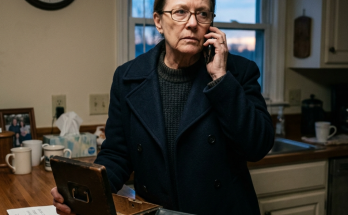
“Before you go inside, you should know something.” “What?” “Clara believes you knew about the pregnancy.” “That’s impossible.” “She says she tried repeatedly to contact you.” “I never received anything.”
The doctor studied me.
“I’m not deciding what happened. I’m only asking you not to turn this into an argument tonight.”
“I won’t.”
Clara looked pale and exhausted when I entered.
The moment she saw me, her expression hardened.
“Why are you here?”
“The hospital called.”
She gave a humorless laugh.
“So now you answer.”
“What does that mean?”
“I called you six times.”
My stomach dropped.
“I never got them.”
“I left three voicemails.”
“I never heard them.”
“I emailed you.”
“Clara—”
“I called your office.”
“I swear to you, I didn’t know.”
She reached for her phone.
Then she showed me her final message.
Liam, I don’t understand why you won’t answer me. I’m pregnant. I’ve called, left messages, emailed, and even contacted your office. You were the one who filed for divorce. I never wanted our marriage to end. If you truly want me gone, I’ll stop trying. But you deserve to know about the baby.
The message had shown as delivered.
But I had never seen it.
“I didn’t get this.”
Her eyes filled.
“I waited for weeks.”
“I thought you wanted the divorce.”
She stared at me.
“What?”
I told her about the email Julian had shown me.
Clara slowly shook her head.
“I never hired a lawyer before you filed.”
My chest tightened.
“Never?”
“No.”
I sat down.
Then another memory surfaced.
Shortly after our separation, my company phone had been replaced.
Our IT department had transferred everything to a new device connected to the company communications platform.
Julian had personally brought the phone to my office.
I stepped into the hallway and called our head of IT, Marcus Thorne.
“I need archived records from my communications account from seven months ago.”
“What kind?”
“Calls from Clara. Voicemail access. Routing changes. Blocked contacts. Corporate email rules.”
“What happened?”
“Do not tell Julian I called you.”
There was a pause.
“Understood.”
Then I went to meet my son.
He weighed three pounds, nine ounces.
He looked impossibly small beneath the wires and monitors.
“What’s his name?” I asked.
“Leo Hayes.”
Clara’s last name.
It hurt for about half a second.
Then I realized she had every reason to use it.
As far as she knew, I had heard she was pregnant and chosen silence.
I reached through the opening in the incubator.
Leo wrapped his tiny hand around my finger.
I cried.
Not quietly.
Not gracefully.
I had spent years walking into rooms where hundreds of millions of dollars were discussed as if they were numbers on a screen.
Nothing had ever made me feel smaller than that tiny hand.
Just after midnight, Marcus called.
“We found the calls.”
My heart started pounding.
“All six?”
“Yes.”
“What happened?”
“Clara’s number had a specific routing rule attached to it inside the corporate phone system. Her calls were diverted before they reached you.”
“To where?”
“An internal extension controlled by Julian.”
I closed my eyes.
“The voicemails?”
“Three were received and later deleted through an administrator account.”
“Whose?”
“You know whose.”
“And the message?”
“Her number had been added to a blocked-contact rule. The system recorded the message as delivered to the service, but it was filtered before appearing normally on your device.”
“What about her email?”
“A mailbox rule moved messages from her address into an archive folder.”
“Created by?”
“Julian’s admin credentials.”
I leaned against the wall.
“Preserve everything.”
“We already are.”
“One more thing. Find the email Julian showed me from Clara’s supposed attorney.”
Marcus found it before sunrise.
The law office did not exist.
The email domain had been registered two days before Julian showed it to me.
The registration and related activity traced back to devices and administrative resources under his control.
The divorce had begun with a fabrication.
But I still didn’t understand why.
Clara did.
When she woke, I told her what Marcus had found.
Her face went pale.
“The Southshore invoices.”
“What about them?”
“I made copies.”
“How much did you find?”
“Almost $11 million in suspicious payments before I stopped looking.”
She explained that multiple companies appeared independent on paper but shared addresses, owners, transfer routes, or billing patterns.
Julian’s approvals appeared throughout the transactions.
“After I left,” she said, “he called demanding the copies.”
“And you refused.”
“Yes.”
Everything finally connected.
Julian needed Clara away from me because she had discovered the fraud.
So he created an email convincing me she wanted a divorce.
I responded exactly as he hoped.
Then Clara discovered she was pregnant.
If she reached me, we might talk.
If we talked, she might tell me why she had really left and what she had found.
So he intercepted the calls, erased the voicemails, filtered the message, buried the email, and used his authority to keep her away from me.
I suspended the Southshore signing immediately and hired an independent forensic team.
This time, I didn’t confront Julian.
I wanted proof first.
Over the following weeks, investigators uncovered a network of shell vendors connected to the project.
Millions had already been siphoned away through inflated consulting and acquisition expenses.
Investigators connected the financial approvals and communications manipulation to accounts, devices, and administrative access controlled by Julian.
Only after the evidence was secured did the board remove him.
He denied everything.
Then the investigators showed him the records.
He stopped talking.
Months later, criminal charges were filed in connection with the financial scheme.
But I refused to tell myself Julian had destroyed a perfect marriage.
He hadn’t.
He exploited a damaged one.
He lied.
He manipulated us.
He deliberately created silence.
But I was the man who had chosen pride over one phone call.
I had dismissed Clara when she tried to warn me.
I had become so consumed by work that believing she had suddenly left me was easier than asking why.
Julian built the trap.
I helped close the door.
Leo remained in the NICU for seven weeks.
I stayed in North Carolina.
At first, Clara thought I was there because I felt guilty.
She wasn’t entirely wrong.
But eventually guilt became something else.
I learned how to change a diaper around wires.
I learned what every alarm meant.
I learned how terrifying ten seconds could become when your child was struggling.
And Clara and I began talking again.
Not about remarriage.
About everything we should have said before the divorce.
“I needed you to choose us sometimes,” she told me.
“I thought working this hard was choosing us.”
“It wasn’t.”
“I know.”
That time, I didn’t defend myself.
When Leo finally went home, Clara took him to Maya’s house temporarily.
I rented a place nearby.
Then I took parental leave.
For years, I had convinced myself my company couldn’t function without me.
It did.
That was one of the most humbling discoveries of my life.
Clara and I started counseling so we could become good co-parents.
That was all we promised each other.
Then months passed.
Coffee after pediatric appointments became dinner.
Dinner became long conversations.
We learned how to argue without disappearing.
I learned to put my phone down.
She learned to tell me when something hurt before resentment had months to grow.
Almost a year later, Leo pulled himself upright against Clara’s couch.
My phone buzzed with a board call.
I looked at the screen.
Then silenced it.
Clara noticed.
“Aren’t you supposed to answer that?”
Leo let go of the couch, stood alone for a second, then fell into my arms laughing.
I smiled.
“They can survive without me for ten minutes.”
Clara looked at me differently.
“You really have changed.”
“I should have changed sooner.”
Nearly two years after Leo was born, Clara and I remarried.
It was small.
Family, a few close friends, and Leo in tiny suspenders trying to escape halfway through the ceremony.
There were no business reporters.
No investors.
No expensive ballroom.
And for once, I wasn’t thinking about what meeting came next.
Sometimes I still think about the morning Dr. Bennett called.
My pen had been inches from an agreement tied to a $940 million project.
I thought I was seconds away from the most important moment of my career.
Then a doctor said:
“Your son was born early this morning.”
I didn’t know I had a son.
I didn’t know Clara had been pregnant.
I didn’t know she had called me six times, left three voicemails, sent a message, emailed me, and contacted my office.
Someone had made sure I never received any of it.
But the hardest truth wasn’t that Julian lied.
It was that his plan worked because Clara and I had already stopped speaking directly when it mattered most.
He created the silence.
Our pride allowed it to grow.
And I learned something I will never forget:
Never let somebody else tell you what a person you love supposedly thinks when you still have the ability to ask them yourself.
Sometimes silence doesn’t mean there is nothing left to say.
Sometimes the message was sent.
You just never received it.