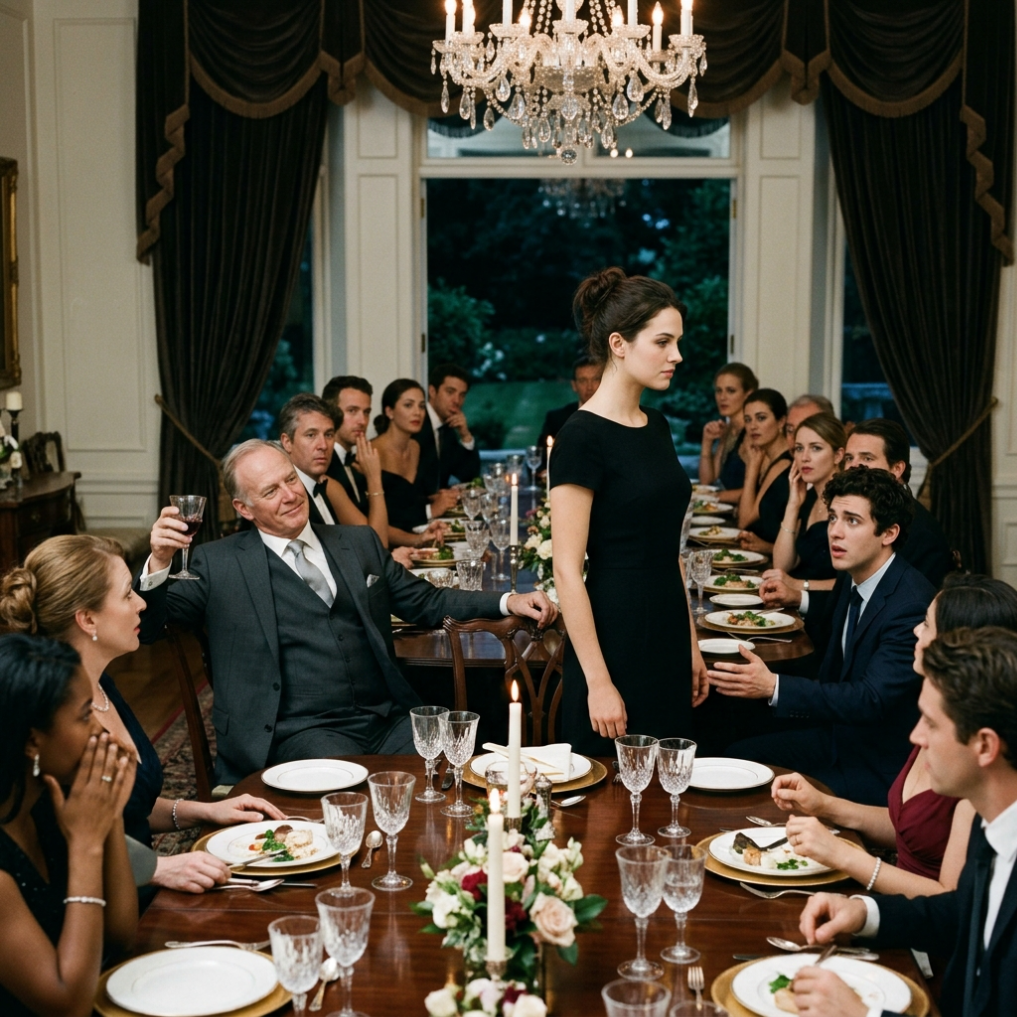
My boyfriend’s billionaire father eyed my dress and let out a cold laugh. “Street trash in a borrowed dress,” he announced in front of twenty-three guests.
My boyfriend pleaded with me to ignore him, while his father sat back, smirking like he had finally put me in my place. I didn’t argue. I just sat there and let him finish his little show.
Then I stood up, thanked him for the meal, and walked right out. He had no clue that a single phone call from me the following morning would dismantle everything he had spent his entire life building.
I kissed him softly.
“Call me tomorrow.”
Then I walked out to my ten-year-old Toyota, started the engine, and drove away.
I hardly slept that night.
Not because Arthur’s insults had wounded my pride.
They hadn’t.
I had endured much worse from older men in suits who genuinely believed a bank balance was a substitute for a personality.
What kept me awake was the massive red folder sitting on my desk downtown.
For five months, a dedicated team had been structuring an acquisition deal involving Sterling Enterprises.
A massive one.
The kind of deal that required law firms in three different time zones, armies of analysts, and due diligence reports thick enough to use as body armor.
Arthur knew the deal inside and out.
What he didn’t know was me.
At 6:45 the next morning, I picked up my phone and made one call.
Maya answered on the second ring.
“You’re up early.”
“Pull the Sterling deal.”
Dead silence on the line.
Then, “Completely?”
“Completely.”
“Chloe, we’re four business days away from signatures.”
“I know.”
“The legal fees alone on this have cost us a fortune.”
“I know.”
Maya’s tone shifted from professional to protective.
“What happened?”
“I finally met Arthur Sterling last night.”
A long pause.
“Oh.”
That single syllable meant she completely understood.
Maya had been the one to warn me about him.
During due diligence, our analysts had uncovered buried complaints about his draconian management style.
Several high-level executives had fled Sterling subsidiaries over the last two years.
There were red flags about nepotism.
Red flags about toxic workplace environments and verbal abuse.
Nothing explicitly illegal.
Nothing catastrophic enough on its own to kill a billion-dollar merger.
But enough to make my gut twist.
Arthur had spent five months charming our proxies, swearing up and down that those rumors were exaggerated by disgruntled ex-employees.
Then I sat at his table and watched him publicly humiliate a guest just because he assumed she had a lower net worth than he did.
It answered every lingering doubt I had.
“Are you absolutely sure this isn’t personal?” Maya asked gently.
“It became personal last night. But that’s not why I’m pulling the plug.”
“Then why?”
“Because he showed me exactly who he is when he thinks the person across from him has no leverage.”
Maya went quiet.
I kept talking.
“If that is how he behaves with a guest in his own dining room, I completely believe every single exit interview we flagged.”
“That’s a fair assessment.”
“Reopen negotiations with the Mercer Group.”
“Our backup?”
“Yes.”
Maya exhaled sharply.
“Alright. I’ll make the calls.”
“One more thing.”
“Yeah?”
“Make sure Julian doesn’t catch wind of this until the formal termination notice is filed.”
“You know this is going to gut Sterling Enterprises.”
“I know.”
“Like, really gut them?”
I stared out my kitchen window as the Seattle fog began to lift.
“Gut them enough.”
By 8:30 AM, Sterling Enterprises received the official notice of termination.
By 9:15 AM, four different Sterling executives had frantically called Maya.
By 10:00 AM, Arthur’s CFO was leaving desperate voicemails for anyone on our side who might pick up.
At 11:00 AM, the financial news networks had broken the story.
A landmark capital injection for Sterling Enterprises had collapsed at the eleventh hour.
The deal had been projected to provide a massive cash lifeline the company desperately needed after a botched logistics expansion the year prior.
Without our money, Sterling was suddenly staring down a debt crisis, imminent layoffs, and a furious board of directors.
I watched the ticker scroll across my office TV.
I still hadn’t spoken to Julian.
My cell phone rang just after noon.
“Did you do this?”
I leaned back in my leather chair.
“What exactly are you asking me?”
“My dad’s lifeline deal evaporated this morning.”
“Yes, it did.”
“And he is currently tearing his office apart.”
“I can imagine.”
There was a heavy silence on the line.
Then Julian said, his voice dropping an octave, “He still hasn’t put it together, has he?”
“No.”
“I was this close to telling him.”
“Why didn’t you?”
“Because you asked me to wait.”
That meant a lot.
“Thank you.”
“He thinks the deal fell apart because some faceless suit at the private equity firm got cold feet.”
“Somebody did.”
Julian let out a dry, humorless laugh.
“Chloe.”
“Yes?”
“I love you.”
“I love you too.”
“And I am so sorry.”
“You didn’t say those things to me last night.”
“I’m the one who dragged you into that house.”
“I walked in on my own two feet.”
“He’s demanding a face-to-face meeting with whoever made the final call.”
I looked through the floor-to-ceiling glass of my office.
Maya was standing in the hallway, holding a thick file and raising her eyebrows at me.
“Good,” I said.
Julian paused.
“Good?”
“Tell him he can have his meeting.”
It was scheduled for 3:00 PM.
Arthur arrived twenty-five minutes early.
Of course he did.
Maya left him to wait in the main executive boardroom.
I watched him from my office as he paced aggressively behind the frosted glass.
He had probably stood in hundreds of boardrooms exactly like this one.
He had probably walked into all of them assuming he was the most important man in the room.
But this time, he didn’t know whose name was on the lease.
At exactly 3:00 PM, I pushed open the heavy double doors of the boardroom.
Arthur spun around.
The color instantly drained from his face.
For a full ten seconds, neither of us said a word.
His eyes darted from my face, to the glass wall behind me, and finally to the brushed steel plaque mounted next to the door.
CHLOE BENNETT FOUNDER & MANAGING PARTNER
He read it twice.
Then he stared at me.
“You?”
I let the door click shut behind me.
“You demanded a meeting with the person who pulled your funding.”
His mouth opened, but no sound came out.
I walked over and took the seat at the head of the table.
Crestwood Capital had started with three analysts in a cramped, windowless office nine years ago.
Today, we managed billions of dollars in assets, specializing in tech, green infrastructure, and logistics acquisitions.
I practically never gave press interviews.
Maya handled the public-facing side of our portfolio.
Our senior partners had run the Sterling negotiations from day one.
Arthur had seen my name on the bottom of a hundred legal documents.
He had simply never bothered to connect the billionaire founder of Crestwood to the girl dating his son.
Why would he?
To him, I was just a nobody with a cheap car and a borrowed dress.
Arthur slowly pulled out a leather chair and sat down.
“You own Crestwood?”
“I built it.”
He stared at me, his eyes wide.
“And you’re the final signature?”
“Yes.”
His jaw locked.
“So this is a petty revenge play.”
“No.”
“You torch a billion-dollar deal twelve hours after a dinner party and expect me to believe it isn’t revenge?”
“I expected to sign those papers on Thursday.”
I slid the thick red folder across the polished wood table.
“Then I met the CEO.”
He didn’t reach for it.
I kept going.
“During due diligence, our analysts flagged systemic complaints about a toxic culture inside Sterling. We brought those concerns to your team. You swept them under the rug.”
“That has absolutely nothing to do with what was said last night.”
“It has everything to do with last night.”
His eyes hardened.
“You insulted me because you calculated that I had no leverage to stop you.”
He looked toward the window.
“You looked at me and saw someone poor. You assumed I was using your son. You assumed that just being allowed inside your mansion meant I should bow my head and take whatever abuse you handed out.”
“It was a private family dinner.”
“With twenty-three corporate guests.”
He flinched.
“I made an error in judgment.”
“No, Arthur. You made the mistake of showing me your true judgment.”
Silence filled the room.
I tapped the folder.
“Those are exit interviews from your former executives. Some of them spent fifteen years building your company.”
He finally looked at the file.
“I employ fourteen thousand people. You can always find someone willing to complain.”
“That’s the exact line you fed our proxies last month.”
“And today?”
“Today, having sat at your table, I believe the employees.”
Arthur leaned forward, planting his hands on the table.
“You are willing to risk thousands of livelihoods because your feelings got hurt?”
“No. Protecting those livelihoods is exactly why I’m not signing.”
His eyes narrowed in confusion.
“I don’t follow.”
“Sterling is already bleeding cash. You need this capital because of reckless decisions you made at the top. If Crestwood injects a billion dollars into your company, we inherit your mess. I am not handing you a lifeline while pretending your leadership isn’t the actual liability.”
His face turned ashen.
“You’ve reopened talks with Mercer.”
I didn’t say a word.
The silence was confirmation enough.
The Mercer Group was Sterling’s most aggressive rival in the region.
Arthur grasped the reality instantly.
“If they get Crestwood’s backing—”
“They will expand.”
“And choke us out of the market.”
“That is how business works.”
His hands balled into tight fists on the table.
“You set me up.”
“Until 8:00 PM last night, I was your silent partner.”
Those words hit him harder than a physical blow.
He just sat there, breathing heavily, staring at me.
Then the boardroom doors opened.
Julian walked in.
Arthur shot up out of his chair.
“You knew.”
Julian calmly closed the doors.
“Yes.”
“You knew who she was this entire time?”
“Yes.”
“And you sat there and let me—”
“I tried to stop you.”
“You let me make a complete fool of myself.”
Julian stared his father down.
“You did that all on your own, Dad.”
Arthur’s face flushed purple.
“I am your father.”
“And she was a guest in our home.”
“I was trying to protect you.”
“From what?”
Arthur pointed a shaking finger at me.
“From a woman I knew absolutely nothing about.”
Julian’s voice dropped, cold and steady.
“You knew nothing about her because you never bothered to ask a real question.”
The words struck the center of the target.
Arthur looked at me.
Then back to his son.
“I asked what she did for a living.”
“No,” Julian said. “You cross-examined her so you could quickly categorize whether or not she was worth your respect.”
He took a step closer to the table.
“You saw the Toyota. The dress. You heard her mom cleaned hotel rooms. You gathered just enough data to place her beneath you.”
Arthur was speechless.
“And you couldn’t have been more wrong.”
For the very first time since I met him, I saw an emotion besides arrogance on Arthur Sterling’s face.
Panic.
Not panic over the collapsing deal.
Panic that his son no longer respected him.
He slowly sank back into his leather chair.
“What do you want?”
I tilted my head.
“Excuse me?”
“What is your price to put the deal back on the table?”
“That isn’t why I took this meeting.”
“Everything has a price, Chloe.”
I let out a soft laugh.
“That worldview is exactly why you aren’t getting the money.”
His shoulders sagged.
I stood up, buttoning my blazer.
“The deal is dead, Arthur.”
“Chloe—”
“I’m not destroying your company. I’m just choosing not to subsidize the arrogance that is.”
He had absolutely no counter for that.
The following week was a bloodbath for Sterling Enterprises.
The board of directors convened an emergency session.
Creditors started calling in debts.
Two institutional investors publicly demanded Arthur’s resignation.
Then, emboldened by the massive deal collapse, several former executives leaked stories to the Seattle business journals.
The floodgates opened.
Vice presidents ousted for pushing back on Arthur’s ideas.
Lucrative contracts handed to golfing buddies.
Staff members humiliated in open meetings for where they went to college.
A culture of fear masked as corporate loyalty.
My dinner didn’t invent those scandals.
It just gave me the clarity to see they were real.
Julian sat in the boardroom and voted with the rest of the directors to strip his father of the chairmanship.
That vote fractured their relationship.
Arthur called it a stab in the back.
Julian called it his fiduciary duty.
When the board pushed Julian to take the CEO slot, he turned it down flat.
“I am not replacing one Sterling with another just because it looks good on a letterhead,” he told them.
They brought in an outside turnaround specialist instead.
Refusing the crown earned Julian more loyalty from the rank-and-file employees than any promotion his father could have handed down.
Three months later, Sterling Enterprises was a shadow of its former self.
They liquidated two massive logistics hubs.
Scrapped a dozen vanity projects.
Overhauled the board.
Implemented blind feedback systems.
The company survived.
But it was no longer the absolute monarchy Arthur had built.
Crestwood Capital fully backed the Mercer Group instead.
Mercer swallowed up two regional markets Sterling had previously monopolized.
Arthur lost his corner office.
His chairman title.
His ability to dominate a room just by walking into it.
But he kept his fortune.
He kept his estates.
He remained wealthier than 99 percent of the planet.
The only thing he was truly bankrupt of was the illusion that the world would always bend the knee to him.
Julian and I stayed together.
Not because the aftermath was a fairy tale.
For weeks, he wrestled with the guilt of dismantling his family’s legacy.
I never once asked him to pick me over his father.
I only asked him to pick the kind of man he wanted to be when he looked in the mirror.
And he did.
Six months after the dinner party, Arthur reached out and asked for a meeting.
Not at his Bellevue estate.
Not at my Crestwood office.
At a quiet, mid-tier Italian restaurant near the condo Julian and I shared.
He showed up alone.
When I slid into the booth opposite him, he looked deeply uncomfortable.
That was a good look for him.
“I owe you an apology.”
I took a sip of water and waited.
He looked me right in the eye.
“What I said to you that night was vicious.”
“Yes, it was.”
“And entirely classless.”
“Agreed.”
A faint, tired smile touched his lips.
“I suppose you aren’t going to make this easy for me.”
“You ran a multi-billion dollar logistics empire, Arthur. I’m confident you can handle a conversation.”
He let out a short, genuine laugh.
Then his eyes turned serious.
“I honestly thought I was shielding my son from a gold digger.”
“You came to that conclusion before you even knew my last name.”
“I did.”
“Would it have been acceptable to speak to me that way if I actually had been a housekeeper’s daughter living paycheck to paycheck?”
His mouth clicked shut.
That was the only apology I actually cared about.
Not whether he felt stupid for insulting a billionaire.
Whether he realized that insulting a waitress would have been just as pathetic.
After a long silence, Arthur slowly shook his head.
“No.”
And I believed he meant it.
“I spent forty years convincing myself that my bank account was a scoreboard that proved my worth,” he said quietly. “I guess I tried to forget how broke I was when I started out.”
I looked at him.
“You didn’t forget it.”
He frowned.
“You became deeply ashamed of it.”
He looked down at his coffee cup.
That observation clearly stung.
But eventually, he nodded.
“You might be right about that.”
We didn’t hug at the end of the meal.
I didn’t tell him all was forgiven and forgotten.
Some bridges take more than one plate of pasta to rebuild.
But when we walked out to the street, I shook his hand.
And this time, it didn’t feel like I was being tested.
A year after the night he called me street trash, Julian and I had dinner with Arthur again.
There were no senators.
No venture capitalists.
No crystal chandeliers.
Just the three of us sitting around a fire pit on Julian’s back patio.
I showed up in faded jeans.
Arthur glanced at them.
I raised my eyebrows.
“Something wrong with the denim?”
He shook his head rapidly.
“Not a single thing.”
Julian had to cover his mouth to hide his laugh.
I just smiled.
My ten-year-old Toyota was still parked out in the driveway.
I had received a massive amount of unsolicited advice from people telling me it was time for an upgrade.
I ignored every word of it.
Though one night, Julian walked into the kitchen and caught me looking at a shiny new SUV online.
He stopped in his tracks, staring at my laptop screen.
“Is the mighty Toyota finally dying?”
“No.”
“Then whatever happened to ‘I’ll replace it when it stops moving’?”
“I have the right to change my mind.”
He grinned.
“So what are you going to get?”
I snapped the laptop shut.
“None of your business.”
He laughed, pulled me out of my chair, and kissed me.
That was exactly the life I wanted.
A life where money was a useful tool, but never the metric by which I measured human value.
Where a borrowed dress was nothing more than a piece of fabric.
Where a hotel maid could raise a daughter who built an empire from scratch.
And where a billionaire could sit at the head of a massive mahogany table and still be the poorest man in the room in the things that actually mattered.
Arthur Sterling thought he had put me in my place that night.
In a funny way, he absolutely did.
He reminded me exactly where my place was in this world.
It wasn’t beneath him.
It wasn’t adjacent to his wealth.
And it certainly wasn’t sitting at his table begging for his validation.
My place was inside the empire I had built with my own two hands.
The only difference was that by the very next morning, Arthur Sterling finally learned exactly what that empire was worth.