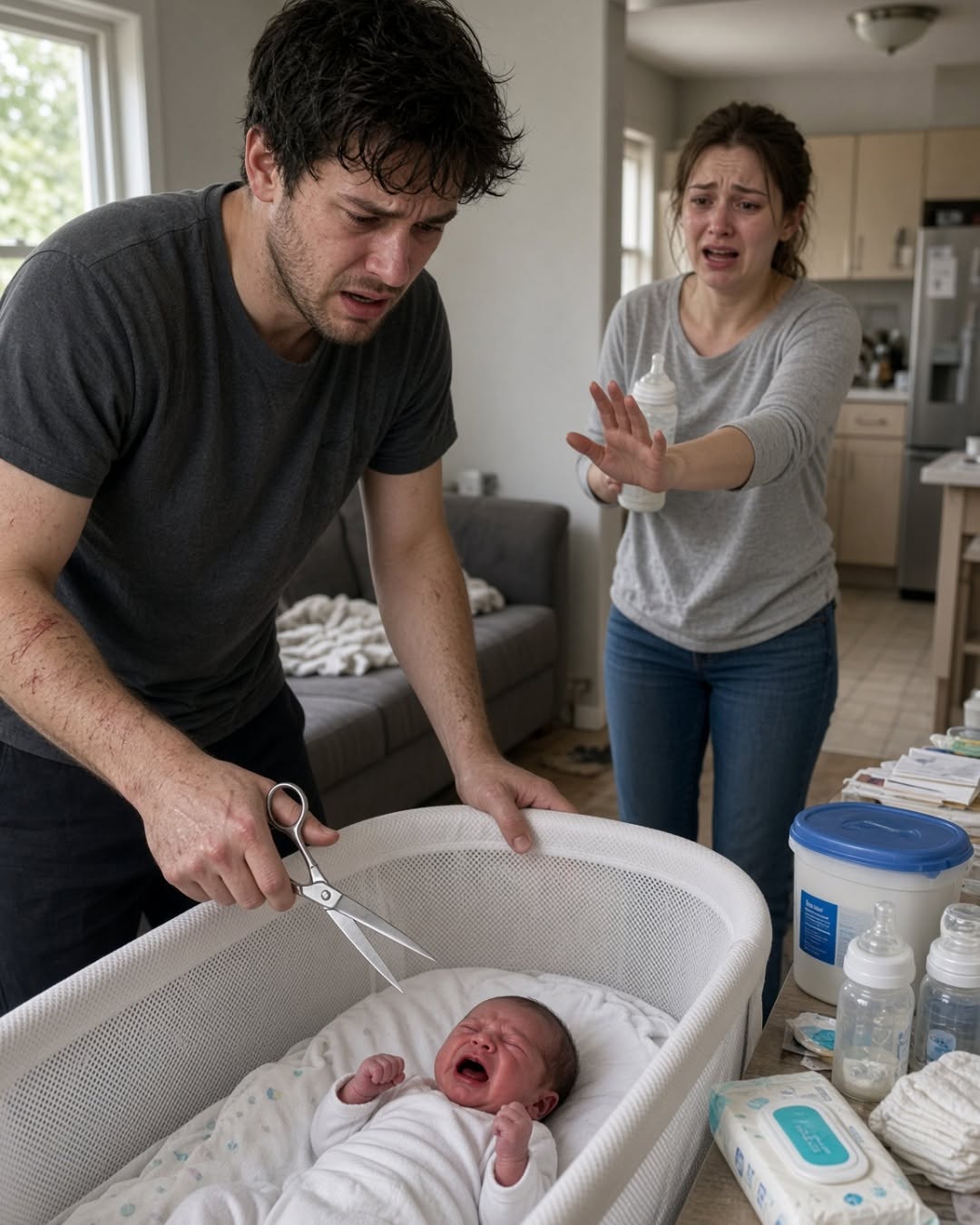
The nurse closed the door after my mother-in-law was placed on the no-visitor list, and for several seconds I could hear nothing but the quiet sounds of the hospital around me.
My baby was asleep beside me.
For the first time since I had brought my child home, I knew exactly where we stood. My husband was not coming into that room. His mother was not coming into that room. And I was no longer waiting for either of them to decide whether my baby deserved to be safe.
A few minutes later, the officer returned.
He sat across from me and placed his notebook on his knee.
“I need to explain what happens next,” he said. “You don’t have to make every decision tonight. But we need to make sure you and the baby are protected.”
I nodded.
He told me that the recording of my mother-in-law’s call had been preserved. Her statements had not been treated as harmless family advice. The way she described my husband’s temper, the way she blamed me for provoking him, and the way she told me to come home and handle things differently had all been documented.
I looked toward my baby’s crib.
“She really thinks this is my fault,” I said.
The officer didn’t answer immediately.
“What matters right now,” he said, “is what happened to your child and what happened to you.”
That was the first time anyone had said it that plainly.
Not what my husband meant.
Not what his mother believed.
Not how much the diapers cost.
What happened.
A social worker came in carrying a folder and sat beside me. She asked whether I had somewhere safe to stay. I told her I didn’t want to go anywhere either of them knew about.
She nodded as if that answer made perfect sense.
Then she asked me whether there was anyone I trusted.
I gave her one name.
She helped me make the call.
While I waited, my phone lit up again.
This time it wasn’t my mother-in-law.
It was my husband.
I stared at his name until the screen went dark.
A minute later, another message appeared.
Then another.
I didn’t open them.
The social worker noticed.
“You don’t have to answer,” she said.
I almost laughed because answering him had always felt like a responsibility. If I didn’t answer, he would become angry. If I answered too slowly, he would become angry. If the baby cried while I was on the phone, somehow that became my fault too.
I turned the phone face down.
“I’m not answering anymore,” I said.
The words sounded strange coming from me.
But they also sounded true.
Later that evening, an officer came back with an update. My husband had been taken into custody while investigators continued documenting what had happened. He said there were additional steps ahead and that the case would not be decided by what my mother-in-law claimed was a family misunderstanding.
I asked whether she could still contact me.
“She can try,” he said. “You don’t have to engage with her. Save the messages and let us know if she threatens you or tries to locate you.”
I nodded.
Then he added something I hadn’t expected.
“The call you made from that bathroom mattered.”
I looked down.
I remembered my hand shaking around the phone. I remembered my husband pulling at the bathroom handle. I remembered being terrified that if he knew what I was doing, he would break through the door before help arrived.
At the time, it hadn’t felt brave.
It had felt like survival.
But now I understood that the moment I locked that door, I had made a decision I had been afraid to make for a long time.
I had chosen my baby over his anger.
The next morning, a doctor came to speak with me about my child’s injuries. She explained what they had documented and what follow-up care would be needed. I listened carefully, asking questions whenever I didn’t understand something.
Then she looked at me.
“None of this should have happened to your baby,” she said.
My throat tightened.
I nodded because I couldn’t speak.
After she left, I held my baby’s tiny hand.
I kept thinking about all the times I had tried to prevent another explosion at home. I had learned how much noise was too much. How quickly I needed to respond when my husband complained. How carefully I had to measure every purchase. How quickly I needed to pick up the baby when the crying started.
I had treated his anger like weather.
Something I couldn’t stop.
Something I could only prepare for.
But his anger had never been the responsibility of a newborn.
And it had never been mine to absorb.
That afternoon, my mother-in-law called again.
I didn’t answer.
Then she left a voicemail.
The social worker listened with me.
Her voice sounded different this time. Less angry. More urgent.
She said my husband needed me. She said I was destroying the family. She said everyone would suffer if I continued with the police.
Then she said something that made me stop the recording.
“You don’t understand what you’re doing to him,” she said. “He has already lost control once. If you keep pushing this, you don’t know what he’ll do when he gets out.”
The social worker looked at me.
Neither of us spoke for a moment.
Then she asked, “Do you want me to save this?”
I nodded.
“Yes. Save everything.”
That was when the fear changed shape.
Before, I had been afraid of what would happen if I told the truth.
Now I was afraid of what could happen if I stopped telling the truth.
I began writing down everything I remembered.
Dates.
Arguments.
The injuries.
The complaints about formula.
The arguments about diapers.
The way my husband reacted when the baby cried.
The things his mother said afterward.
I didn’t try to make it sound dramatic.
I wrote it exactly as I remembered it.
When I finished, I read the last page twice.
At the bottom, I wrote one sentence.
“I was afraid to leave because I believed leaving would make him more dangerous.”
I stared at those words for a long time.
Then I signed my name.
That night, I slept in a room I didn’t recognize with my baby beside me.
It wasn’t home.
But nobody was pacing outside the door.
Nobody was shouting about money.
Nobody was waiting for a crying newborn to become an excuse for violence.
For the first time in months, I fell asleep without listening for footsteps.
The next morning, I woke before my baby did.
I watched the sunlight move across the wall and realized something I hadn’t allowed myself to think about before.
I didn’t have to go back.
Not for my husband.
Not for his mother.
Not because they were family.
Not because she insisted that I had a duty to protect her son from the consequences of his own actions.
My baby stirred.
I reached over and touched the blanket.
“We’re not going back,” I whispered.
A few hours later, the officer called with another update.
He told me that my mother-in-law had contacted investigators herself.
My stomach tightened.
“What did she say?”
There was a pause.
“She repeated that your husband loses his temper when he’s frustrated about money,” he said. “And she said she believes you should have known how to prevent it.”
I closed my eyes.
Even after everything, she was still trying to explain him instead of what he had done.
But then the officer said something else.
“There’s a problem for her.”
I opened my eyes.
“What problem?”
“She doesn’t realize that every time she explains why he becomes violent, she’s also confirming that she knew about his behavior.”
I didn’t answer.
I just sat there holding my baby.
For months, my mother-in-law had used her knowledge of her son’s temper as a reason for me to stay quiet.
Now that same knowledge was becoming part of the record.
And for the first time, her words were no longer protecting him.
They were telling the story she had spent so long trying to hide.
The story of a man who blamed a newborn for the cost of being a father.
The story of a mother who watched her grandchild suffer and told me to endure it.
And the story of the night I finally stopped trying to keep their peace.
I had thought locking that bathroom door was the end of something.
It wasn’t.
It was the first door I had ever locked against their anger.
And this time, I wasn’t going to open it again.