The address Mark finally gave the officer was one I knew by heart.
It was Evelyn’s house.
For a few seconds, nobody in the hospital room moved. I stared at my husband, waiting for him to tell me I had misunderstood. Mark looked at the floor.
“You said they were taking her somewhere else,” I whispered. “You said you didn’t know what your mother was planning.”
“I didn’t know everything,” he said.
The officer’s expression hardened. “Then start with what you do know.”
Mark swallowed. “My mother kept the equipment there.”
My stomach dropped.
“The table?” I asked.
He nodded.
“The restraints?”
Another nod.
“And the notebook?”
Mark looked toward the evidence bag.
“She kept copies.”
That was the first moment I understood how much bigger this was than the room where I had found my daughter.
Evelyn had not improvised an experiment. She had built a system.
And Mark had known enough to help her hide it.
The officer asked him when the next session was scheduled. Mark said three days. He said Evelyn had told him the first treatment was only a preliminary test and that the second location was where the real observation would happen.
“What happens during the transfer?” the officer asked.
Mark hesitated.
“She said the baby would be easier to manage there.”
I felt something inside me go cold.
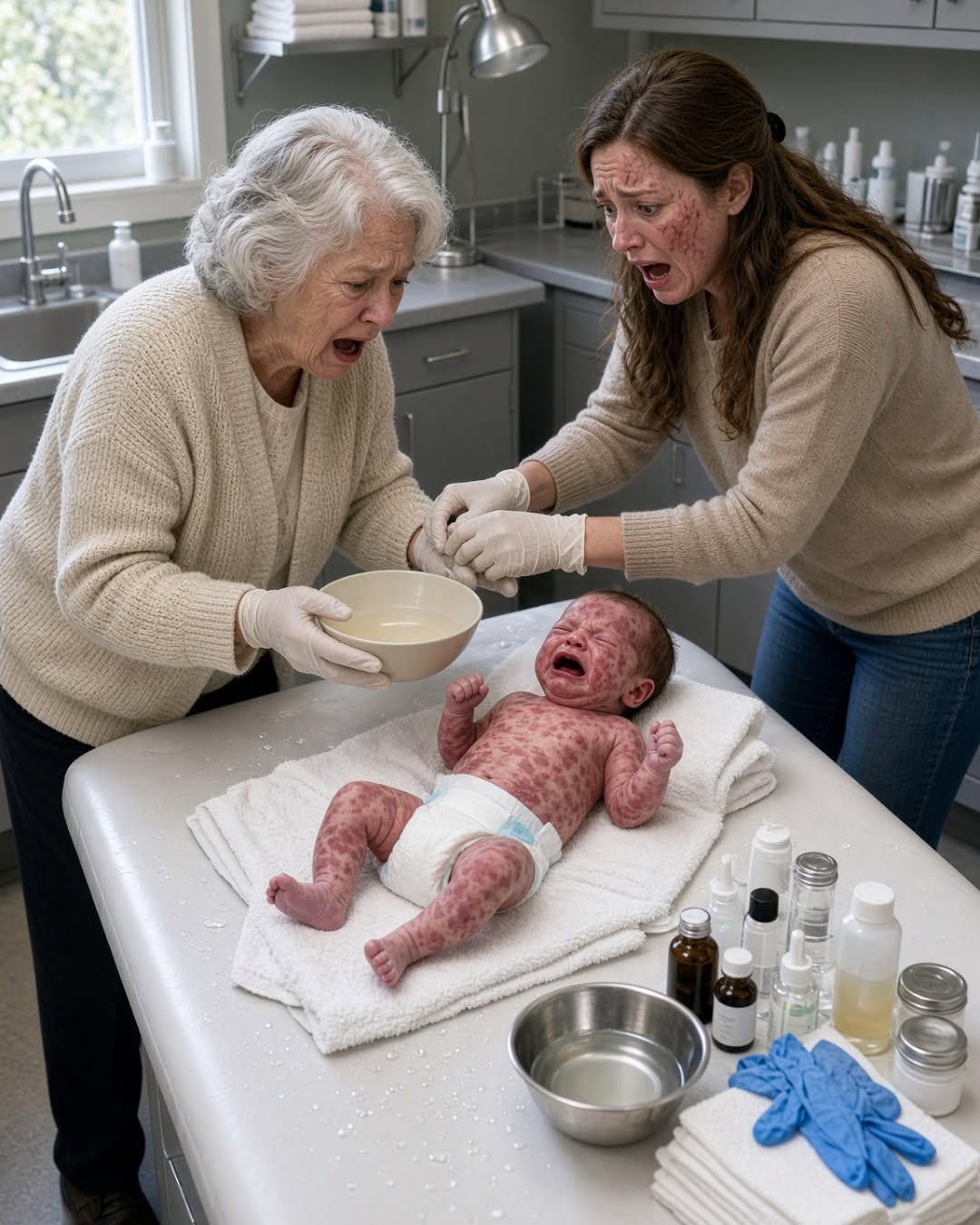
My daughter was lying only a few feet away, being treated for burns caused by the woman who had called herself her grandmother. And my husband had known there was another appointment waiting for her.
I looked at Mark.
“You knew.”
His eyes filled with tears.
“I thought I could stop it before it got that far.”
“You brought her to Evelyn.”
“I trusted my mother.”
“You helped her prepare my baby.”
“I was wrong.”
The officer stepped between us before I could answer.
“Mr. Mark, you are going to explain every part of your involvement.”
Mark finally began talking.
He said Evelyn had spent years telling him she was working on a private medical theory. She never called the babies patients. She called them subjects. She told him the children were selected because their families could be persuaded to cooperate, pressured into silence, or simply never understand what had happened.
The six entries in the notebook were not random.
Each child had been brought into Evelyn’s circle through someone who knew the family.
A relative.
A friend.
A person who believed Evelyn was helping with a harmless treatment.
Some families had refused to continue. Others had been told their children had suffered an unexpected reaction. At least one family had taken its baby away before Evelyn could begin another session.
Mark insisted he had never seen a child seriously injured before our daughter.
The officer asked him whether he had read the notes.
Mark said yes.
That answer was enough.
The officer took his statement while another investigator went to Evelyn’s house.
I stayed beside my daughter.
When the doctor finally came in, she told me the burns were serious but treatable. My daughter would need close monitoring, and the doctors would watch for complications from the substances that had been placed on her skin.
I held her tiny hand through the bandages.
She had no idea what had happened.
She only knew that she hurt.
And I kept thinking about that notebook.
Subject 7.
Not her name.
Not my daughter.
A number.
I wondered how many times Evelyn had looked at that page and thought of my child as an experiment rather than a person.
Then an investigator came back into the room.
They had searched the house.
They found the table.
They found restraints.
They found containers labeled with dates and numbers.
They found photographs.
And they found another notebook.
This one was older.
Inside were notes that connected the six previous subjects to specific adults who had helped Evelyn obtain access to them.
Several names were crossed out.
Some were marked with short comments.
One word appeared again and again.
TRANSFER.
The investigator told me they were still determining exactly what had happened to each child, but the evidence showed that Evelyn had been planning these sessions for much longer than anyone had realized.
Then he showed me something that made my hands go numb.
A page from the second notebook contained a list of future subjects.
My daughter was not the only infant on it.
There were three more entries.
Three families.
Three babies.
And beside each one was information about when the mother would be alone, when the father would be working, and who could be trusted to bring the child to Evelyn.
I recognized one of the names.
A woman from our neighborhood.
She had congratulated me when my daughter was born.
She had even asked about the baby’s feeding schedule.
At the time, I thought she was being friendly.
Now I understood why she had been asking.
The investigation widened that afternoon.
Police contacted the other families connected to the notebooks. Some refused to believe what they were hearing. Others immediately remembered strange appointments Evelyn had arranged.
One mother told investigators her baby had developed unexplained burns months earlier.
Another said Evelyn had offered to monitor her child’s sleep and feeding after a minor illness.
A third family had refused her completely.
That family’s name appeared beside the words FAMILY REFUSED NEXT PHASE.
The phrase had seemed cold when I first saw it.
Now I understood how deliberate it was.
Evelyn had not been documenting medical care.
She had been documenting compliance.
Who agreed.
Who resisted.
Who could be persuaded.
Who needed to be kept calm.
And who might become a problem.
Mark was questioned for hours.
He admitted he had supplied Evelyn with information about our household. He had told her when I would be away. He had answered questions about our daughter’s routine. He had even reassured me on the morning of the incident when Evelyn asked to spend time alone with the baby.
He said he had convinced himself that his mother would never hurt her.
But there was one thing he could not explain.
Why did he write, “Mom gets first session alone. Keep her calm if she asks questions”?
He eventually admitted that the sentence meant exactly what it looked like.
He had been instructed to prevent me from interfering.
I asked him why.
His answer was almost impossible to hear.
“Because she said you would stop us.”
Us.
Not her.
Us.
That single word ended whatever remained of the marriage I thought I had.
I did not scream.
I did not throw anything.
I simply looked at him and realized that while I had been preparing for the birth of our child, he had been preparing for the day his mother would use her.
My daughter eventually woke.
Her tiny fingers curled around mine.
That was when I made my decision.
I would not let anyone tell her story as though she were merely a victim in someone else’s experiment.
She had survived.
She was here.
And I would spend the rest of my life making sure nobody ever treated her like a number again.
The investigation continued for weeks.
Evelyn was charged based on the evidence recovered from the house and the injuries suffered by my daughter and me. The notebooks became central to the case because they showed planning, repeated conduct, and connections to other families.
The people who had helped her were investigated one by one.
Some claimed they had believed Evelyn was conducting legitimate research.
Others admitted they knew she was hiding something but said they never imagined she would hurt a baby.
The evidence did not allow every excuse to survive.
Mark cooperated after his arrest, but cooperation did not erase what he had done.
He had not poured the chemicals onto our daughter.
He had not tied her down.
But he had opened the door.
He had supplied the information.
He had known there would be a session.
And he had expected me to stay calm while his mother carried it out.
Months later, I received copies of several pages from the notebooks as part of the case file.
I almost did not read them.
Then I saw Subject 7 again.
This time, I noticed something I had missed at the hospital.
Beneath the schedule for my daughter’s planned transfer was a handwritten note.
It was in Evelyn’s handwriting.
The sentence was short.
“Final observation after transfer.”
There was no explanation.
No medical language.
No justification.
Just a plan.
My daughter had been scheduled to disappear into a second stage of something I had never consented to and never even known existed.
And Mark had known enough to help make it possible.
That was the truth that stayed with me long after the burns healed.
People often imagine danger as something obvious.
A stranger at the door.
A warning sign.
A person who looks dangerous.
But sometimes danger arrives smiling.
Sometimes it brings gifts for the baby.
Sometimes it tells you that everything is fine.
Sometimes it is sitting across the dinner table while you trust it with your child.
I used to think the worst moment of that day was when Evelyn threw the bowl at me.
It wasn’t.
The worst moment was when I saw Mark’s handwriting in that notebook.
Because the chemicals told me someone was willing to hurt my daughter.
His handwriting told me someone I loved had helped them get close enough to try.
My daughter is older now.
The scars have faded, though some reminders remain.
She will grow up knowing that she was loved fiercely from the moment I pulled her out of that room.
She will never know herself as Subject 7.
She is my daughter.
And when I look back at the little black notebook that exposed everything, I no longer see a list of numbers and experiments.
I see the moment the truth finally became impossible to hide.
Evelyn thought she was documenting subjects.
Mark thought he could control how far things went.
They were both wrong.
Because the moment I saw my daughter’s birth date written there before she was even born, I understood what they had forgotten.
A child is never a specimen.
A family is never a laboratory.
And trust, once used to place a baby in danger, is not something anyone can demand back.