My phone buzzed twice against the conference-room table before I answered it.
That detail still bothers me.
Twice.
My four-year-old son had called twice while I was sitting in a budget meeting trying to follow numbers on a screen.
Nothing in the room felt urgent.
Old coffee.
Dry marker ink.
A slide full of percentages.
Legal pads open in front of people who were already thinking about their next meeting.
My phone vibrated once.
I ignored it.
Then again.
That was when I looked down and saw Noah’s name.
I answered.
“Hey, buddy. You okay?”
Normally, Noah answered immediately.
Four-year-olds rarely waste time deciding how to begin a conversation.
They simply begin.
Dad, guess what.
Dad, look what I did.
Dad, can I have—
This time there was breathing.
Wet.
Uneven.
Small.
My chair moved backward before my mind fully understood why.
“Noah?”
Then his voice.
“Dad… please come home.”
Everything inside me tightened.
“Where’s Mom?”
“She’s not here.”
Lena being gone mattered, but there was no time to ask where she was.
Noah kept speaking.
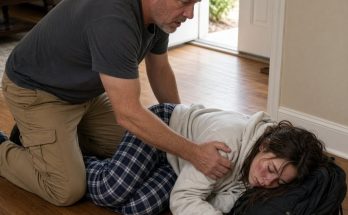
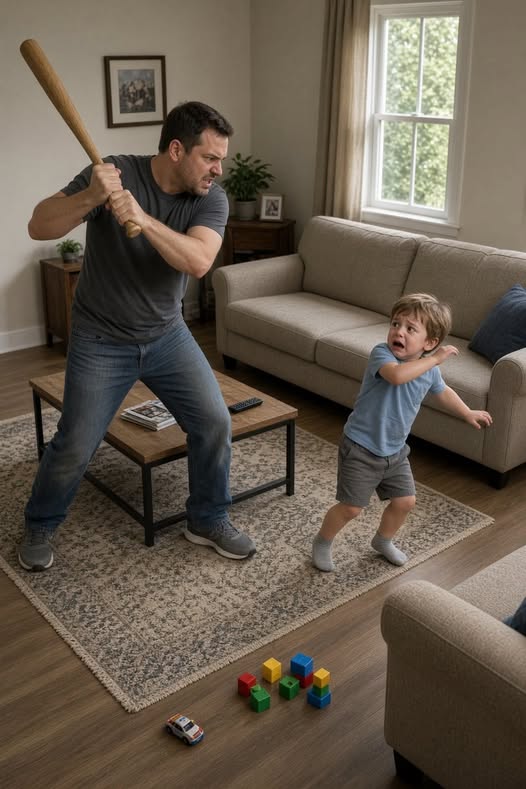
“Mom’s boyfriend… Travis… hit me with a baseball bat.”
I stopped hearing the room.
“My arm hurts really bad.”
My hand closed around the phone.
Then he added:
“He said if I cry, he’ll hit me again.”
I remember every word because fear makes strange things precise.
There are moments you recall only as fragments.
This was not one of them.
Every word stayed.
Every pause.
Every breath.
Then a grown man’s voice exploded behind Noah.
“Who are you talking to? Give me the phone!”
The line went dead.
I stared at the screen.
Conference room.
Budget slide.
People.
Everything returned at once.
Nobody spoke.
A woman from accounting held a paper coffee cup halfway between the table and her mouth.
Someone else still had a pen suspended above a legal pad.
The air conditioner clicked.
They had not heard Noah’s side clearly enough to know every word.
They had heard my voice.
They had heard enough from the man in the background.
Maybe they had heard Noah crying.
I did not explain.
“My son has been attacked.”
My voice did not sound like mine.
“I’m leaving.”
I grabbed my keys.
By the time I reached the hallway, my hands were shaking.
That angered me.
Not because fear was inappropriate.
Because I needed my hands.
Keys.
Phone.
Driving.
Calling for help.
I almost dropped everything once near the elevator.
Then I looked at the time.
2:14 PM.
Tuesday afternoon.
My call log showed Noah’s calls.
There were thirty-one seconds of audio that would later matter as part of the record of what had happened.
But none of that entered my mind as evidence then.
I was not thinking:
Preserve the call.
Document the threat.
Think ahead.
I was thinking about twenty minutes.
That was the drive from my office to home under good conditions.
Downtown traffic on a Tuesday afternoon was not good conditions.
Twenty minutes might become twenty-five.
Maybe more.
Every minute was a unit of fear.
Noah was four.
He was alone inside my house with an adult he said had hit him with a baseball bat.
His arm hurt.
The man had threatened to strike him again if he cried.
And the call had ended because that same man realized Noah was talking to someone.
Distance became the only fact that mattered.
I could not get there fast enough.
That realization nearly broke me.
Fathers are supposed to come when their children call.
That belief is unreasonable in all sorts of practical ways.
Jobs exist.
Traffic exists.
Distance exists.
Still, when your four-year-old says:
Dad, please come home.
Every mile feels like betrayal.
I entered the elevator.
Pressed the parking level.
Then thought of Derek.
My older brother.
There are people you love because they are family.
Then there are people whose reliability becomes part of how you understand safety.
Derek was both.
He had been there the day we brought Noah home.
Blue hospital blanket.
Tiny face.
Derek looked terrified to hold him.
“I’m going to break him.”
“You’re not going to break him.”
“He’s the size of a loaf of bread.”
Eventually, he took Noah.
Held him as though somebody had handed him glass.
Within a year, Derek had developed his own rituals with him.
Fist-bumps.
Ridiculous voices.
A special way of making him laugh when he was overtired and angry about bedtime.
When Noah bent a training wheel on his little bike, Derek fixed it.
Not because I could not.
Because he happened to be there and Noah asked.
When Noah had a fever one night, Derek stayed beside his bed for hours.
No audience.
No dramatic speech.
He simply stayed.
That was Derek.
He showed up.
The elevator doors opened.
I called him while running into the garage.
“Hey, what’s up?”
His voice was casual.
I changed that with one sentence.
“I just got a call from Noah.”
I unlocked the car.
“Lena’s boyfriend hit him with a baseball bat. I’m twenty minutes away. Where are you?”
There was a pause.
Tiny.
Not confusion.
Recalculation.
“I’m about fifteen minutes from your house.”
“Do you want me to go by?”
“Go now.”
I got into the car.
“I’m calling 911.”
“I’m already moving.”
His voice had changed.
Derek had fought in regional mixed martial arts years earlier.
People who knew that part of his history liked to turn it into the explanation for everything.
Derek is dangerous because he can fight.
That was never what frightened me when his voice changed.
It was the opposite.
Control.
His fighting years had ended after a shoulder injury.
But what remained was the discipline.
He knew distance.
Timing.
Escalation.
He knew that anger could make a person fast and stupid at the same time.
Most importantly, he knew Noah.
I did not need a fighter racing to my house.
I needed my brother.
I started the car.
Called emergency services.
The dispatcher answered.
I gave the address first.
Then Noah’s name.
Lena’s name.
Travis’s first name.
I told her what Noah had said.
I told her his arm hurt.
I repeated the threat.
I told her the call ended after an adult male demanded the phone.
“Is your child injured?”
“Yes.”
The word came too quickly.
I knew only what Noah had told me.
His arm hurt badly.
That was enough.
“Is the adult male still inside?”
“I believe so.”
I hated saying believe.
I wanted certainty.
I had none.
The dispatcher told me units were being sent.
Relief did not come.
Police being dispatched is not the same thing as police already standing beside your child.
Then I told her about Derek.
“My brother is closer. He’s heading there now.”
Her tone sharpened slightly.
“Tell him not to engage if he can avoid it.”
That sentence mattered.
It gave structure to the panic.
The goal was Noah.
Not revenge.
Not proving anything.
Not Derek confronting Travis.
Not me getting there and doing what anger wanted.
Get help there.
Protect Noah.
Avoid creating another danger if possible.
I called Derek back.
The car in front of me moved half a length.
Then stopped.
Traffic.
I wanted to drive through it.
Over curbs.
Between lanes.
Anything.
I did not.
Another part of protecting Noah was making sure I actually arrived.
“Police are coming,” I told Derek.
“Dispatcher says don’t engage if you can avoid it.”
“I know.”
His voice remained level.
That steadied mine.
The city outside my windshield became unbearable.
Red lights.
Brake lights.
People changing lanes badly.
A delivery truck blocking part of an intersection.
Every normal traffic delay felt personal.
Nobody else knew.
That was the strange part.
The driver beside me might have been thinking about groceries.
The person behind me might have been late for an appointment.
To everyone else, it was Tuesday.
To me, twenty minutes had become a wall between my son and safety.
I kept replaying Noah’s voice.
Dad… please come home.
Mom’s boyfriend hit me.
My arm hurts really bad.
He said if I cry, he’ll hit me again.
Four years old.
I tried not to imagine what “hit me” looked like.
That way lay panic.
Noah was conscious enough to call.
He knew the phone.
He knew my number or knew how to reach me through whatever setup we had for him.
He was speaking.
Those were facts.
I held onto facts.
Then anger arrived again.
Travis.
I knew him as Lena’s boyfriend.
That was all I needed to think about then.
I did not need to invent a history of red flags.
The source does not provide one.
I did not need to decide whether Lena knew what had happened.
She was not there according to Noah.
That was all.
The supported facts were already enough.
A four-year-old said an adult hit him with a baseball bat.
His arm hurt.
The adult threatened to do it again if he cried.
Then the adult interrupted the call.
That was enough to send every protective instinct I had into overdrive.
My phone rang.
Derek.
I answered immediately.
“I’m two blocks out.”
My hand tightened around the steering wheel.
“Stay on the line.”
“I am.”
I could hear road noise on his end.
Then his voice changed again.
Quieter.
“I see the house.”
I pictured it.
Our driveway.
Front porch.
The little stretch of lawn.
Home is supposed to be the boring safe place in a child’s life.
That day, the word felt different.
Derek’s engine cut.
Then a truck door slammed through the line.
Footsteps.
He was moving.
I wanted to tell him to run.
I wanted to tell him to slow down.
Both urges arrived at once.
“Derek.”
“I’m here.”
“Police are coming.”
“I know.”
“Do not—”
“I know.”
He did.
That was why I had called him.
Not because I wanted him to fight.
Because I trusted him to understand that getting there first did not give him permission to make the situation worse.
There is a difference between intervention and retaliation.
That difference can disappear when somebody hurts a child you love.
I needed it not to disappear.
Derek’s footsteps continued.
Concrete.
Then softer.
Driveway into the area near the house.
He stopped.
“What?”
I asked.
No answer immediately.
Then:
“I’m at the house.”
My traffic moved a few feet.
Stopped.
I checked the mirror.
Signal.
Moved lanes.
The entire time, the phone stayed near my ear.
“Can you see Noah?”
“Not yet.”
That answer hurt more than I expected.
Part of me had imagined Derek arriving and immediately seeing Noah at a window.
Safe enough to wave.
Something.
Instead:
Not yet.
He kept his voice low.
I imagined him scanning the front.
Door.
Windows.
Anything unusual.
The source does not tell me what he saw at that point, so I cannot add it.
No broken window.
No visible bat.
No blood on a porch.
No Travis appearing at the door.
Nothing beyond Derek reaching the property and not yet seeing Noah.
The dispatcher’s instruction stayed with me.
Do not engage if he can avoid it.
Derek knew it.
I knew it.
And yet every second of silence felt like abandonment all over again.
I thought about Noah holding the phone.
How did a four-year-old decide to call Dad in that moment?
Maybe it was instinct.
Maybe he knew I would answer.
Except I did not answer the first buzz.
That thought hit me.
I ignored the first call.
It is irrational to torture yourself with details like that.
I know.
But fear does not respect fairness.
What if I had answered immediately?
Would Travis have noticed sooner?
Would Noah have been able to say more?
Would anything have changed?
There was no answer.
I forced the thought away.
I answered.
I called for help.
Derek was there.
Emergency units were on the way.
Those were the next necessary facts.
Another red light.
I could see the timer counting down.
Forty-three seconds.
Forty-two.
I had never hated a number so much.
Derek remained quiet on the line.
Then I heard movement near his phone.
Not words.
Something faint.
He stopped.
I stopped breathing too.
“What?”
Nothing.
Then he whispered:
“Hold on.”
The line became almost completely silent.
That silence was worse than shouting.
Because shouting gives the mind something to process.
Silence gives it room to create.
I imagined Noah.
Then stopped myself.
No.
Facts.
Derek was there.
Police were coming.
Noah had called.
I was driving.
No more than that.
At the conference table, my biggest problem had been a budget slide.
Less than ten minutes later, I was learning how quickly ordinary life can split.
Before the call.
After the call.
Before, home was a place on the other end of a twenty-minute commute.
After, every minute of that commute became intolerable.
Before, Derek was my brother.
After, he was the only person I knew who could physically reach my son faster than I could.
That did not make him a weapon.
It made him a bridge.
That distinction mattered.
I had called the person I trusted to show up, not the person I wanted to punish somebody.
When I said:
“Go now.”
I meant:
Get close to Noah.
Help if you safely can.
Be there until professionals arrive.
That is less satisfying than revenge.
It is more responsible.
I know what anger would have told me to do if traffic vanished and I reached that house first.
That knowledge scared me.
Not because loving your child makes violence inevitable.
Because fear can disguise itself as certainty.
You tell yourself:
I know exactly what happened.
I know exactly what I need to do.
But at that point, I knew only what Noah had said.
Serious.
Terrifying.
Enough to call emergency services.
Still a situation requiring judgment.
The dispatcher had given me that judgment when mine was under pressure.
Tell him not to engage if he can avoid it.
Those words kept the objective clear.
Noah.
Everything came back to Noah.
Not my anger.
Not Derek’s past.
Not Travis’s ego.
My son.
Four years old.
Arm hurting.
Trying not to cry because an adult threatened him.
I thought about Derek sitting beside Noah’s bed during that fever.
He had not needed to be asked.
I woke sometime after midnight and found him in the chair.
“You can go home.”
“He’s still hot.”
“I’ve got him.”
“I know.”
He stayed anyway.
That was why his proximity mattered now.
Noah trusted him.
If Derek could safely reach him, Noah would not be facing everything alone.
The traffic light changed.
I moved.
Derek still had not spoken.
“Derek?”
A beat.
“I’m here.”
“Talk to me.”
“I’m listening.”
“To what?”
Another pause.
“I don’t know yet.”
That was a good answer.
Not a dramatic one.
Not:
I hear Travis.
Not:
I hear Noah.
Not:
Something terrible is happening.
He did not know.
So he said he did not know.
Control.
Again.
People think control means never being afraid.
It does not.
Control means refusing to turn incomplete information into certainty simply because uncertainty hurts.
Derek had learned that through fighting.
I had to learn it in traffic.
My hands were steadier now.
Not because I felt better.
Because there was something to do.
Drive.
Stay on the phone.
Keep police informed if anything changed.
Do not crash.
Do not turn rage into another emergency.
I saw another intersection ahead.
Cars stacked across it.
I looked at the clock.
Time felt wrong.
Too slow outside me.
Too fast inside.
I remembered Noah’s blue hospital blanket.
Derek trying to fist-bump a baby who could barely close his fingers.
Training wheels.
Fever.
Small ordinary memories.
Parents store those moments without realizing they may later become the evidence their minds use to resist panic.
Noah was not only the voice on the phone.
He was every version of himself that came before it.
And Derek was not only an adult approaching a dangerous situation.
He was the uncle who had already spent four years showing Noah:
If you need me, I come.
I wished I could be there.
That truth did not go away because I had made the right calls.
I still felt guilty.
Twenty minutes.
If I had worked closer.
If the meeting were somewhere else.
If Lena had been home.
If Travis had never been there.
The mind produces impossible alternate worlds when the real one becomes unbearable.
None helped.
I stayed with the one I had.
My phone.
My car.
Derek.
Emergency response en route.
Then I heard another faint sound through Derek’s line.
Again, the source does not tell us what it was.
It would be tempting to make it Noah crying.
A door opening.
Travis shouting.
Sirens.
Any of those would push the story forward.
They are not supported.
So the moment remains exactly where it should.
Derek was at the house.
He had not yet confirmed seeing Noah.
He heard something.
He whispered:
“Hold on.”
Then silence.
That is the cliffhanger.
And from the perspective of the father trapped in traffic, it is enough.
Because sometimes fear is not the terrible thing you see.
It is the gap between what you know and what the person you love may be experiencing.
I had spent my whole adult life assuming that if Noah ever needed me, I would go.
That Tuesday taught me a harder version of that promise.
Sometimes you cannot get there first.
Sometimes protecting your child means admitting distance is stronger than your will for a few minutes and calling the person who can beat you to the door.
There is no pride in that moment.
No competition.
No:
I’m his father, I handle it.
Only:
Who can reach him?
Derek could.
So I called.
He went.
No hesitation.
Then I called 911.
That order mattered.
Family close enough to arrive quickly.
Professionals already being dispatched.
Not one instead of the other.
Both.
I had no idea what Derek would find.
He did not know either.
What I knew was that Noah had managed to make one call from inside that house.
He had told me what happened.
He had asked me to come home.
And although I was still trapped behind traffic lights, his call had already put people in motion.
Me.
Derek.
Emergency responders.
That mattered.
Whatever Travis had intended when he threatened Noah for crying, my son was no longer alone with a secret.
He had spoken.
Someone believed him.
Help was moving toward him.
I wish I could say that thought made the drive easier.
It did not.
I watched the car in front of me.
Brake lights.
Turn signal.
Movement.
Stop.
On the phone, Derek remained almost silent.
Then his footsteps shifted again.
I heard one careful step.
Another.
My pulse climbed.
“Derek?”
No answer.
I wanted to fill the silence.
Give him instructions.
Ask questions.
Demand certainty he did not have.
I stopped myself.
He needed to listen more than I needed reassurance.
So for once, I did the hardest thing available.
I stayed quiet.
In that conference room, silence had meant everybody waiting for me to explain.
On the road, silence meant my brother was close enough to my son that every unnecessary word might matter.
Two different silences.
Both unforgettable.
My son had called me crying.
I was twenty minutes away.
I called the one person who could reach him faster.
Now Derek was at the house.
Police were on their way.
And through the phone, I listened to my brother stop outside the place where my four-year-old was waiting for someone to come.