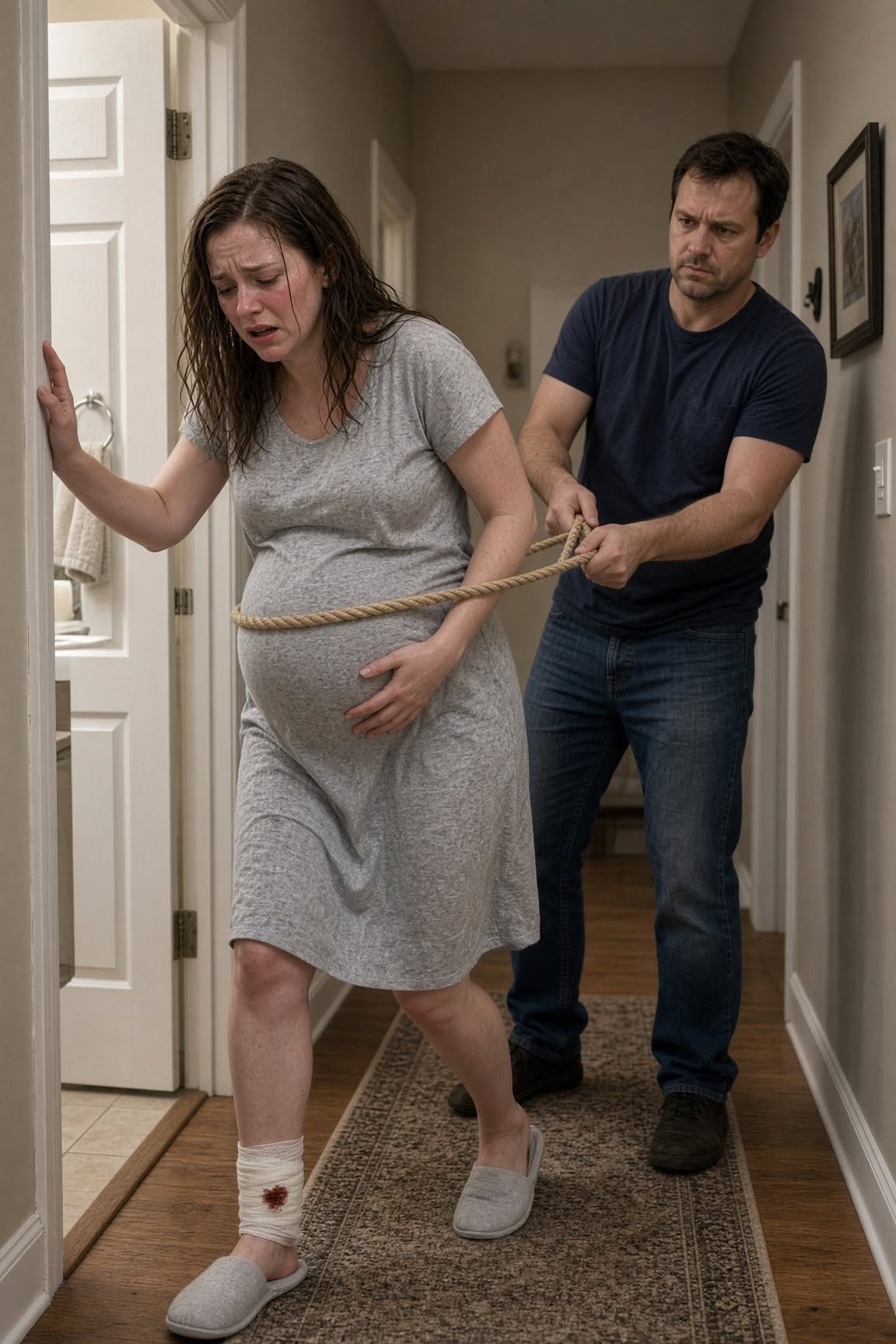
His footsteps rushed away from the bathroom and stopped at the front entry. He had barely reached it when a firm voice from the porch told him to open the door and move away from it.
The woman from the maternity unit was still in my ear. “Help is there. Stay where you are until someone comes to you.”
My husband answered the front door without opening it all the way. I heard him say there had been a misunderstanding, that his wife was upset, that we were handling a private family matter.
Image
Then someone outside asked where I was.
He hesitated.
I didn’t.
“Bathroom!” I shouted.
The word tore out of me just as another contraction tightened across my stomach. I gripped the sink and shouted again, louder this time. “I’m locked in the downstairs bathroom!”
Everything at the front of the house changed at once. Voices sharpened. My husband tried to answer over them, but someone ordered him to step aside.
My mother-in-law hurried into the hallway. “She’s in labor. We were taking her to the hospital.”
I pressed my forehead against the cool edge of the mirror.
“No, you weren’t,” I called through the door. “You said I couldn’t go until I signed.”
The papers were still scattered on the floor outside the bathroom, exactly where I had pushed them back.
My mother-in-law made the mistake that finally broke their story apart.
“We told her we’d take her as soon as she signed the last page,” she said, sounding irritated rather than frightened. “She was making everything difficult.”
There was a short silence in the hallway.
Then a man asked, “You made medical care conditional on her signing these papers?”
My mother-in-law began correcting herself immediately. She said that wasn’t what she meant. She said everyone was emotional. She said the divorce had already been discussed.
My husband cut in and told her to stop talking.
The woman on my phone heard that too.
A few seconds later someone knocked gently on the bathroom door and identified himself as a paramedic. Another voice said my husband had been moved away from the hallway.
I unlocked the door.
I will never forget the paramedic’s expression when he saw me. His eyes went first to my face, then to the rope around my belly, then to the blood beginning to show through the bandage at my ankle.
He asked whether I could walk.
“I tried,” I said. “My ankle gave out.”
My husband called from farther down the hall, “That rope isn’t what it looks like. She put it there.”
I turned toward the sound of his voice.
“He tied it.”
The paramedic didn’t argue with either of us. He crouched beside me, checked how the rope was sitting, and asked permission before touching it. Another responder came in with equipment while an officer remained in the hallway.
The rope came loose slowly because part of it had tightened while I had been pulling at it during contractions. When it finally slid away, I felt how much pressure I had been fighting without realizing it. I could take a full breath again.
My husband tried once more to explain.
He said I had been panicking. He said I had threatened to leave. He said the papers were simply something we had agreed to finish before going to the hospital.
The officer asked me one question from the doorway.
“Did you agree to delay medical care until you signed?”
“No.”
“Did you want to leave the house?”
“Yes.”
“Were you being prevented from leaving?”
“Yes.”
My mother-in-law started to say I could have left at any time.
I looked at the rope lying on the tile, my injured ankle, and the divorce papers outside the door.
The officer looked at the same things.
No one needed a speech.
They put me on a stretcher because my contractions were coming close enough together that the paramedics didn’t want me trying to walk. As they rolled me through the hallway, I saw my belongings stacked in boxes along the wall. Some were taped shut. My maternity clothes were in one. The small bag I had prepared for the hospital was sitting beside another box instead of by the front door where I had left it.
My mother-in-law stood near the kitchen with her arms folded tightly across her chest.
I asked her one question.
“Were you really going to make me leave after I signed?”
She opened her mouth, but my husband answered for her.
“You’re the one destroying this family.”
I had heard versions of that sentence for months. If I disagreed, I was destroying peace. If I asked where money had gone, I was destroying trust. If I wanted him to stop letting his mother make decisions about our home, I was destroying the family.
Now I was being carried through my own front door in labor, and somehow he still wanted me to carry the blame.
For the first time, I didn’t answer him.
The woman from the maternity unit remained connected until the paramedics confirmed I was in their care. Before we disconnected, she told me that she had documented what she personally heard during the call and that the staff receiving me would already know I did not feel safe with my husband.
That mattered almost immediately.
My husband drove to the hospital.
He arrived before I had even been moved completely through intake and told the front desk he was my spouse. He wanted to know which room I was in. He wanted to come back with me. He told them I would calm down once we spoke privately.
A nurse asked me whether I wanted him there.
For years, questions about what I wanted had somehow become negotiations. Where we spent holidays. How much his mother could interfere. Whether I should apologize after he yelled. Whether I was being too sensitive.
This question wasn’t treated like a negotiation.
“No,” I said.
The nurse marked my chart accordingly.
My husband did not come into my room.
That was the first consequence he couldn’t talk his way around.
He called repeatedly. Then he sent messages. The first were angry. The next were softer. He said everyone had lost control. He said the rope had been a stupid mistake. He said his mother had made the packing situation worse. He said I should focus on the baby and we could settle the rest later.
Then another message arrived.
You got what you wanted. Now sign the papers.
I read that one twice.
Even after responders had entered the house, even after I had been transported in labor, even after he knew hospital staff understood that I was afraid of him, his priority had not changed.
He still wanted the signature.
I turned my phone facedown.
Labor kept moving.
There wasn’t a dramatic moment where fear disappeared and I became suddenly fearless. I was exhausted. My ankle hurt. I cried once when a nurse asked whether there was anyone I wanted contacted because I realized I had spent so long managing my husband’s reactions that I had stopped making ordinary plans for myself.
But every time someone asked me a question in that room, they waited for my answer.
Did I consent to an examination?
Did I want medication?
Did I want my husband notified?
Did I want my mother-in-law admitted as a visitor?
No one slid a pen toward me and attached a punishment to the answer.
Hours later, my baby was born safely.
When they placed that tiny body against me, the first thing I noticed was the weight. Not heavy, exactly. Just real. Warm. Breathing. Entirely dependent on what I chose to do next.
I had spent months convincing myself that keeping the marriage intact was the same thing as protecting my child.
Lying there, I finally understood those were not necessarily the same thing.
My husband learned about the birth only after I decided I was ready for him to know. He immediately asked to visit.
I said no.
My mother-in-law asked too.
I said no to her as well.
She sent a long message saying she was sorry things had become so extreme. She insisted she had never wanted me or the baby hurt. Then, halfway through the message, she wrote that she had only been trying to help her son finish a divorce we had supposedly already agreed upon.
That sentence mattered.
I had never agreed to the terms they put in front of me that day. I had never agreed to being packed out of the house while I was in labor. And I certainly had never agreed that access to a hospital could be withheld until I signed.
I saved the message instead of answering it.
For the next day, my husband’s messages changed tone again. He said he loved me. He said he had panicked because he believed I planned to take the baby away from him. He said his mother had pushed the situation too far.
Then his mother sent another message blaming him for telling her I had already agreed to leave.
For a moment, it looked as though they might turn on each other and make my decision easier.
They didn’t.
By that evening, their stories lined up again. Both claimed the rope had been temporary. Both claimed nobody had truly prevented me from leaving. Both insisted that the boxes had been packed only because the marriage was ending anyway.
That was the sideways move I recognized from every argument we had ever had: change the wording without changing the behavior.
I stopped trying to persuade them.
Before I left the hospital, I asked for copies of the paperwork I was entitled to receive about my own treatment. I kept the messages on my phone. I wrote down the sequence of what happened while it was still fresh enough that I could remember which sentence came before which contraction.
I also asked that my husband not be given discharge information.
The day I left, I did not return to the house alone.
Arrangements were made so I could collect what I needed without having to negotiate privately with him. Most of my belongings were still in the boxes his mother had packed. My hospital bag was exactly where I had seen it while being wheeled out.
The divorce papers were gone from the bathroom hallway.
My husband had them.
He stood several feet away while I collected clothes for myself and the baby. He looked calmer than he had on the day of the birth.
“I don’t understand why you’re doing this,” he said.
I nearly laughed, but I was too tired.
“You tied a rope around me while I was in labor.”
He looked toward the floor.
“I said that was a mistake.”
“You stopped me from going to the hospital.”
“I was trying to get you to finish something you’d been avoiding.”
There it was again.
Not denial.
Just justification.
I carried one small bag out myself. Someone else carried the heavier boxes because of my ankle. As I reached the door, my husband asked whether I was really willing to break up our family over one terrible day.
I turned around.
“One terrible day didn’t create this,” I said. “It showed me what all the other days were becoming.”
I left without signing anything.
The hardest part came later.
Once the emergency was over, there were no paramedics standing between us. No locked bathroom. No contractions forcing every decision into the next thirty seconds. There were forms, appointments, messages, sleepless nights with a newborn, and long stretches where my husband sounded completely reasonable.
That almost worked on me.
He apologized for frightening me. He offered counseling. He blamed stress. Then he blamed his mother. Then he blamed me for refusing to discuss the divorce sooner.
Some days, I caught myself wondering whether I had made everything larger than it was because I had been scared and in pain.
That was the collapse I hadn’t expected. Escaping the bathroom had been simpler than trusting my own memory afterward.
Then the records began lining up.
The hospital documentation reflected that I had told staff I was being prevented from seeking medical care. The responder records noted the condition in which I was found. The woman who had stayed on the phone had documented the voices and statements she personally heard. My husband’s messages continued after the birth, including the one telling me to sign after I had already been taken to the hospital.
None of those things depended on whether he sounded calm weeks later.
Neither did my mother-in-law’s message admitting that she believed the divorce had already been decided because that was what her son told her.
When the divorce process finally moved forward, my husband tried to describe the day I gave birth as the day our separation simply became official. His version was neat: the marriage had been ending, my belongings were packed, and I left the house.
But I had not simply left.
I had been carried out by paramedics after calling for help from a locked bathroom.
That distinction changed everything about how I saw the story, even before anyone else evaluated it.
For months I had allowed him to turn outcomes into proof that his version was correct. If I apologized, it meant I had been wrong. If I gave up a plan, it meant his plan had always made more sense. If I stayed after an argument, it meant the argument couldn’t have been that serious.
I had almost let him do the same thing with the day my baby was born.
I didn’t anymore.
His mother eventually asked to speak with me without him present. I agreed once, in a setting where I could leave whenever I wanted.
She apologized for packing my belongings and for telling me to sign before going to the hospital. She also tried to explain herself. She said her son had convinced her the marriage was already finished and that getting my signature would prevent a worse fight later.
I listened until she was done.
Then I asked, “When I told you I needed the hospital, did you know I wanted to go?”
Her eyes dropped.
“Yes.”
“And you still told me to sign first?”
“Yes.”
That was enough.
I didn’t need her to become a different person so I could move forward. An apology did not erase participation.
I told her any future relationship with my child would depend on boundaries that were mine to set and on behavior I could actually trust. She didn’t like hearing that, but she didn’t argue.
My husband reacted differently when he realized I was no longer going to negotiate the basic facts of what happened. His apologies became shorter. The accusations returned. Then, eventually, communication narrowed to what was necessary for the legal process and parenting issues handled through the appropriate channels.
The marriage ended.
There was no single courtroom speech and no magical ruling that repaired everything. What mattered was much less dramatic: I had time to read documents before signing them. I could ask questions. I could disagree. I could make decisions without anyone tying access to medical care, housing, or peace to my obedience.
Months after the birth, I sat down with the final divorce documents in front of me.
I read every page.
When I reached the signature line, I thought about the papers pushed beneath that bathroom door. I remembered the pen rolling across the tile while my mother-in-law told me that signing would make everything over.
She had been wrong about that.
Signing under coercion would not have ended anything. It would only have taught them that enough pressure could still make my choices belong to them.
This time there was no locked door beside me, no rope around my body, no one standing between me and a hospital.
My baby was nearby, sleeping peacefully.
I picked up my own pen.
And I signed because I had chosen to leave.