Before Julian returned from the kitchen, Dad reached inside his coat and tucked a folded bank notice into my hand. The digits printed across the top belonged to an account missing from every stack Julian had shown me. Near the bottom was a recent transfer for $84,000.
Dad kept his voice barely above a breath.
“He said that account wasn’t real.”
Image
I folded the notice once and slid it into my pocket. A few seconds later Julian walked back into the room carrying two glasses of water. “Everything okay?” he asked. Dad lowered his eyes. I smiled. “We’re fine.” Julian looked at us for another second, then handed Dad a glass.
I watched my brother’s face while Dad drank.
There was no panic there yet.
That mattered.
As long as Julian believed I was still the guilty daughter who had appeared after months away, I had room to move.
I went upstairs ten minutes later and photographed both sides of the bank notice. Then I sent the images to Mara, the colleague I’d contacted earlier.
Mara and I had worked together on financial investigations for years. My job wasn’t to kick down doors or make arrests. I traced money, reconstructed transactions, compared documents, and helped attorneys, banks, and investigators understand what records actually showed.
I also knew the difference between suspicion and evidence.
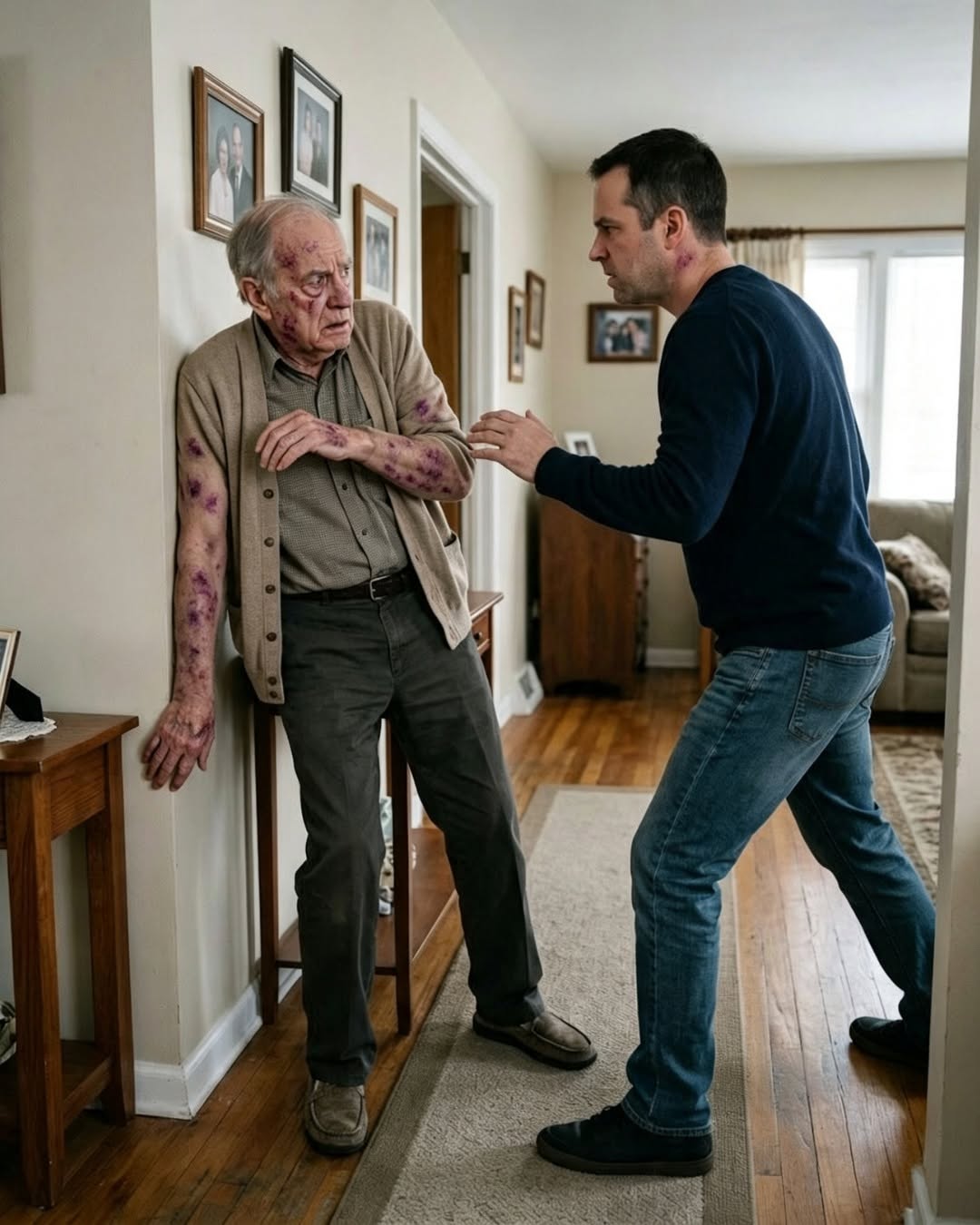
The bruises on Dad told me something terrible had happened.
The bank notice might tell me why.
Mara replied with one sentence.
“Do not alert him until your father is somewhere safe.”
I didn’t need her to tell me twice.
That night I waited until Julian and Chloe had gone to their bedroom. I found Dad awake in the guest room, still wearing the coat over his pajamas.
I sat beside him.
“Dad, I need you to answer one question. Not what you think I want to hear. What do you want?”
He stared at his hands.
“I want to leave this house.”
That was the first decision.
Everything after it had to protect his ability to keep making his own decisions.
The next morning, I came downstairs dressed as though nothing unusual had happened.
“I’m taking Dad out for breakfast,” I announced. “Birthday do-over. Just us.”
Chloe immediately looked at Julian.
He put down his coffee.
“He gets tired quickly.”
“Then I’ll bring him back quickly.”
“Elena, you don’t understand his condition.”
Dad was standing beside me.
His shoulders tightened.
I could feel him starting to shrink into the version of himself they had been describing since I arrived: forgetful, fragile, incapable.
So I didn’t answer for him.
I waited.
Julian looked at Dad. “You want to go out?”
Dad swallowed.
Then he said, “Yes. I am going with my daughter.”
Julian’s expression changed for only a second.
It wasn’t enough for anyone else to notice.
I noticed.
Chloe started to say something about medication, but Dad had already picked up his cane.
I helped him into the passenger seat and drove away without looking back at the house.
We did not go to breakfast.
We went to a medical clinic.
Dad almost changed his mind in the parking lot.
He stared through the windshield and whispered, “If they find out I told someone, Julian will say I fell again.”
I turned toward him.
“You don’t have to prove anything to me. But a doctor needs to see what happened, and you get to decide what you tell them.”
He sat silently for a long time.
Then he opened the car door.
The physician who examined him documented bruising along his shoulders, ribs, and sides, along with the marks around his wrists. When she asked how the injuries happened, Dad looked at me first.
I didn’t speak.
Finally he said, “My son grabbed me. More than once.”
The room went very still.
Because of Dad’s age and the circumstances, the clinic initiated the appropriate adult-protection report. Dad also agreed to speak with an officer, but only after I assured him we weren’t going back to Julian’s house alone.
While the nurse finished his paperwork, I bought a package of crackers from a vending machine and left it unopened on the chair beside me.
Then Dad and I went to his bank.
I expected resistance.
What I didn’t expect was confusion inside the bank itself.
A branch manager named Ms. Patel checked Dad’s profile, looked at her screen, and said, “Your son appears to be a joint owner on the account. If that’s correct, he may have had authority to make transfers.”
Dad went white.
“I never made him an owner.”
Ms. Patel stopped typing.
I asked her to pull the underlying authorization records instead of relying on the account summary.
She disappeared into an office.
When she returned, she immediately corrected what she had told us.
Julian was not a joint owner.
He had been added as an authorized financial agent under a power-of-attorney document processed six weeks earlier.
Dad stared at the date.
“That’s the week Chloe brought me papers about my prescriptions.”
Ms. Patel asked whether he remembered signing a power of attorney.
“No.”
“Did you sign papers that week?”
Dad nodded slowly.
“She kept covering pages and telling me where to put my name.”
That did not automatically prove fraud. Dad had signed something. Julian had a document that looked valid enough for a bank employee to process.
But it gave us a trail.
At Dad’s request, the bank printed statements covering the months before and after Julian gained authority.
The $84,000 transfer from the notice was only the largest transaction.
There had been smaller movements first.
Five thousand.
Nine thousand.
Twelve thousand.
Each one could have passed as household expenses if viewed alone.
Then the amounts increased.
Money moved from Dad’s old savings account into his checking account, then out again within hours or days. Several payments had descriptions Dad didn’t recognize. One went to a business account associated with a company whose public registration listed Julian as an officer.
Dad looked at me as though the page itself had betrayed him.
“He told me my savings were gone because your mother and I spent more than I remembered.”
My mother had been dead for four years.
Dad had believed Julian because grief had already made parts of those years feel blurred.
That was when I understood the cruelty of what my brother had done.
He hadn’t needed Dad to forget everything.
He only needed Dad to doubt himself often enough.
Ms. Patel contacted the bank’s fraud department while Dad signed a written dispute and requested that Julian’s authority be suspended pending review. She warned us that the bank could freeze disputed transactions but could not simply decide a crime had occurred.
That was fine with me.
I didn’t need a dramatic declaration.
I needed time.
By early afternoon, Julian had discovered something was wrong.
My phone started ringing.
I let it ring.
Then Chloe called.
Then Julian again.
Finally a text appeared.
WHERE IS DAD?
I showed it to him.
“Do you want me to answer?”
Dad shook his head.
Another message came thirty seconds later.
YOU HAVE NO IDEA WHAT YOU’RE INTERFERING WITH.
Dad flinched.
I took a screenshot, preserved the message, and put the phone face down.
We spent that night at a small hotel near the clinic because Dad wasn’t ready for a six-hour drive to my home.
For once, nothing happened.
No investigator called with a breakthrough. No new document appeared. Nobody knocked on the door.
I ordered soup. Dad ate half of it. I found a tiny chocolate cake in the hotel convenience shop and stuck one candle in the middle because I had brought no birthday supplies with me.
He laughed when he saw it.
It was the first time I’d heard him laugh since arriving.
Then he looked at the candle and said, “This wasn’t how I thought seventy-eight would look.”
“Me either.”
He reached across the table.
“I’m sorry I didn’t tell you sooner.”
I squeezed his hand.
“You told me when you could.”
The next morning, the fight changed.
Julian hired an attorney.
The letter arrived electronically before breakfast. It accused me of isolating Dad, interfering with his care, and manipulating a vulnerable elderly man into challenging financial decisions he had previously approved.
Attached was something worse.
A video.
Dad was sitting in his living room three weeks earlier. Chloe was behind the camera.
On the recording, Dad said Julian was helping him manage his money because he was having trouble remembering things.
He also said he trusted Julian.
When the video ended, Dad covered his face.
“They made me do that.”
I asked what he meant.
He said Chloe had told him the recording was necessary so Julian could speak to doctors and banks for him. She had repeated lines until Dad said them correctly.
“Why didn’t you stop?” I asked gently.
His answer hurt more than I expected.
“Because by then I wasn’t sure anymore. They kept telling me I forgot things. Sometimes I do forget things. I thought maybe they were right about the rest too.”
That video gave Julian exactly what he needed: a simple story.
A devoted son had stepped in when his aging father began struggling. An absent daughter arrived suddenly, misunderstood the arrangement, and turned Dad against the people providing daily care.
Mara reviewed the financial records that afternoon.
Her conclusion wasn’t comforting.
“The money trail is bad,” she told me, “but bad isn’t the same as provable theft. The transactions were initiated using access connected to your father’s accounts. The power of attorney was on file. And that video will be used to argue consent.”
For the first time since finding the bruises, I felt the ground disappear beneath me.
I had built my entire career around records.
Now the records seemed to be protecting Julian.
Dad saw my face.
“Maybe we should stop.”
“Dad—”
“If I go back and apologize, maybe he’ll leave it alone.”
That was the closest I came to losing him.
Not physically.
To fear.
I wanted to tell him Julian would never touch him again. I wanted to promise we already had enough evidence.
I couldn’t honestly promise either.
So I asked one question instead.
“When the bank called about the big transfer, what happened?”
Dad looked up.
“What bank call?”
I pointed to the fraud-reference number printed beside the $84,000 transaction on the notice.
He stared at it for several seconds.
Then his expression changed.
“There was a woman. She called the house.”
“Do you remember what she asked?”
“She asked if I wanted to send the money.”
My pulse quickened.
“What did you tell her?”
Dad’s eyes filled.
“I told her I wasn’t sure. Julian was standing beside me.”
He paused.
“He kept telling me what to say.”
I called Ms. Patel immediately.
I did not ask her to give me a recording. She couldn’t.
I asked her to preserve it.
That distinction was my world.
Preserve first. Obtain lawfully afterward.
The fraud department confirmed that calls connected to transaction verification could be retained. The officer who had taken Dad’s statement contacted the appropriate investigator, and the bank received a formal request to hold the audio while the case was reviewed.
Julian still didn’t know what I did for a living.
He found out two days later.
His attorney had challenged Dad’s attempt to revoke the financial authority, and a hearing was scheduled to determine who, if anyone, should temporarily control the disputed accounts while the allegations were investigated.
I did not ask the court to hand Dad’s finances to me.
That mattered.
Dad didn’t need one child replacing another.
He wanted Julian removed and his own choices respected.
Until the dispute was resolved, Dad agreed to a neutral professional managing only the frozen funds.
At the hearing, Julian sat across the room in a dark suit. Chloe sat beside him.
He looked calm until my professional background was entered into the record.
For years, Julian had told relatives I worked “in accounting.”
He had never asked what that meant.
When he heard that I specialized in forensic financial investigations involving concealed assets, altered records, and exploitation claims, he finally looked directly at me.
I didn’t smile.
There was nothing satisfying about seeing fear on my brother’s face.
I wanted Dad safe.
That was all.
Julian’s attorney played the video of Dad saying he trusted him.
Then he produced the power of attorney.
Then he pointed to transaction logs showing access from Dad’s home and confirmation through Dad’s telephone number.
On paper, it looked organized.
Responsible, even.
Then the bank recording was played.
The room changed.
A bank employee’s voice asked Dad whether he personally authorized the $84,000 transfer.
Dad hesitated.
In the background, another man’s voice could be heard.
Julian’s voice.
“Tell her yes.”
The employee asked again.
Dad said, “I don’t know why it has to move.”
Julian spoke louder in the background.
“Dad, we already explained this. Tell her you approved it.”
There was a long silence.
Then Dad said yes.
The recording did not prove every allegation by itself.
But it destroyed the clean version of events Julian had presented.
The financial documents were no longer being viewed in isolation. They sat beside medical photographs of Dad’s injuries, the clinic report, Dad’s statement, the escalating transfers, the power-of-attorney paperwork, and Julian’s own voice coaching him during a bank verification call.
Chloe’s role came under scrutiny too. Document timestamps and electronic submission records showed that she had transmitted several forms Dad said she had presented to him as routine medical paperwork.
When Dad was called to speak, Julian’s attorney began by asking about his memory.
Dad admitted he sometimes forgot appointments.
He admitted he misplaced his glasses.
He admitted that after my mother’s death he had relied more heavily on Julian.
Then the attorney asked whether he could really be certain about what had happened months earlier.
Dad looked toward Julian.
For a moment, I saw the same fear I’d seen in the bathroom.
Then he straightened.
“I may forget where I put my glasses,” he said. “I did not forget telling my son not to take my money. And I did not forget him hurting me when I asked where it went.”
Nobody needed me to explain that sentence.
The court removed Julian’s financial authority while the investigation continued and kept the disputed assets under neutral control. Dad remained free to live wherever he chose.
He chose not to return to the house while Julian and Chloe were there.
That decision came from him.
Over the following months, investigators reconstructed the transfers with the bank’s cooperation. Some of the money had remained in accounts that could be frozen. Other funds had been used for Julian’s personal expenses and obligations unrelated to Dad’s care.
The case did not end with one dramatic arrest in a courtroom.
Real consequences moved slower than that.
But they moved.
Julian was eventually prosecuted for financially exploiting Dad and for the physical abuse Dad had reported. He ultimately admitted wrongdoing in a plea agreement that included restitution and barred him from controlling Dad’s finances or acting as his caregiver again.
Chloe also faced consequences for her involvement in obtaining and submitting documents under misleading circumstances. Her case was resolved separately, with restitution obligations and restrictions on acting for Dad.
The bank recovered part of the missing money directly. Additional funds were returned through the legal process.
Dad never recovered every dollar.
That bothered me at first more than I admitted.
I was trained to follow numbers until they balanced.
Families don’t balance that way.
You can recover money without recovering trust.
You can win a case and still lose the version of your family you thought existed.
Dad understood that before I did.
He spent several months living near me while he recovered. He worked with an independent financial adviser he chose himself, added transaction alerts to his accounts, and gave nobody unrestricted control.
Not even me.
Especially not me.
The point had never been for me to become the next person making decisions for him.
It was to make sure he was allowed to make them.
Almost a year after the birthday that started all of it, we drove back to his house together after Julian and Chloe had moved out.
Dad walked through each room slowly.
He stopped in the bathroom where he had first told me the truth.
Neither of us said anything about the bruises.
We didn’t need to.
Later, while I was packing a box of clothes for donation, Dad opened the hall closet.
The heavy wool coat was still hanging there.
For months, that coat had been the thing he used to hide what was happening to him.
He took it off the hanger, ran his hand over the sleeve, and held it out to me.
His face was calm.
“Take the coat with you, Elena. I don’t need it anymore.”