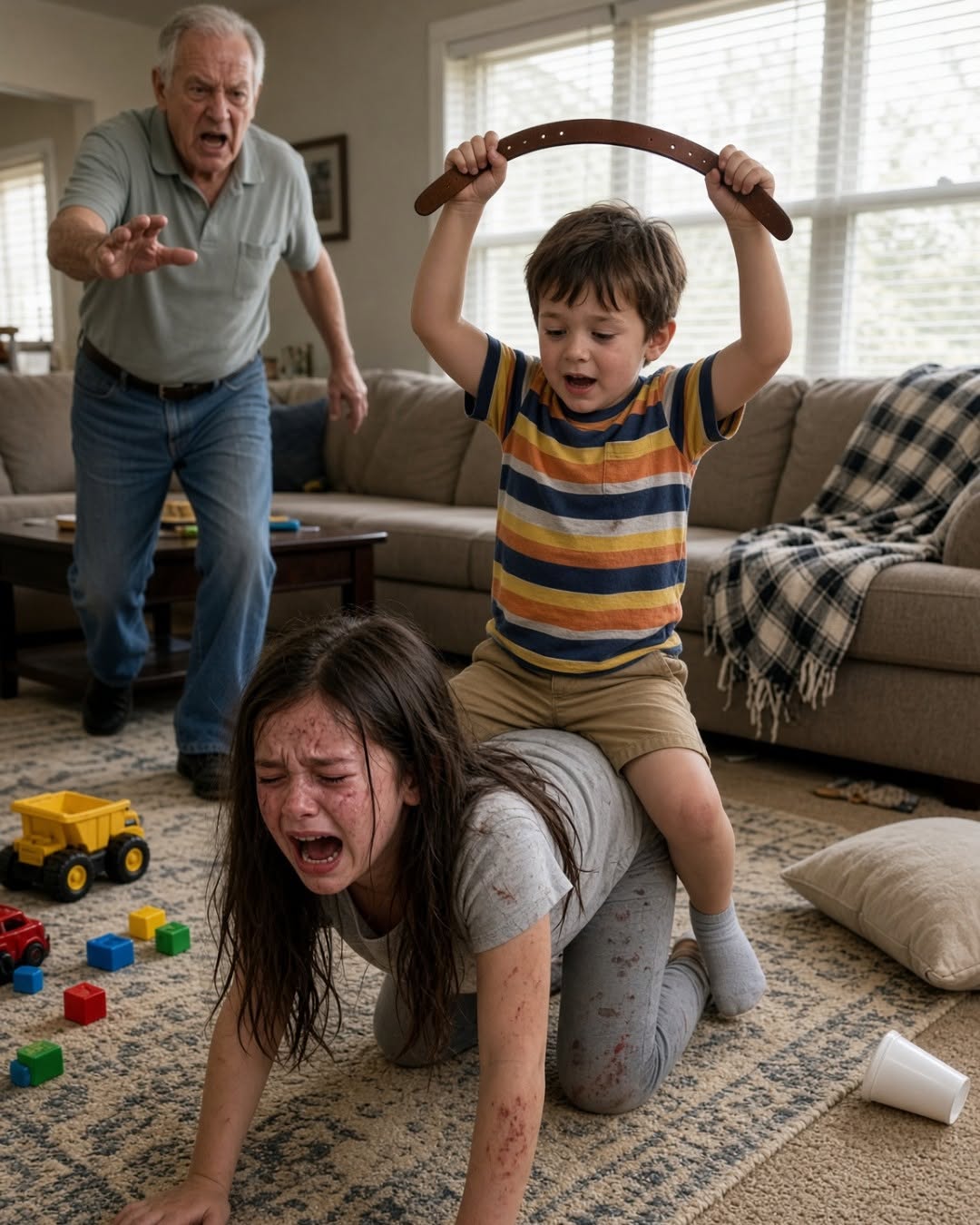
The message from my cousin changed everything. I read it three times. Then I looked at my daughter sleeping in the hospital bed. Her face was turned toward the wall, one hand curled around the sleeve of my shirt even in her sleep. I had spent years believing that my father’s cruelty was something I had to survive quietly.
I had told myself that once my daughter and I got back on our feet, we would leave.
I had told myself that his insults were temporary.
His control was temporary.
His favoritism was temporary.
His anger was something I could manage if I chose my words carefully enough. But I had been wrong about one thing. None of it had ever been temporary. It had simply been waiting for the moment when he could hurt someone smaller than himself. And now I knew something else. He had recorded it.
My hands started shaking.
I opened the family group chat.
There were dozens of unread messages.
At first, I couldn’t make sense of them. Then I saw the videos. My father had sent them himself. There was one from earlier that afternoon.
Another from the previous weekend.
And another from several weeks before.
I didn’t open them.
I didn’t need to.
The messages surrounding them told enough of the story. Some relatives had responded with laughing emojis. One had written: “Your grandson is having the time of his life.” Another said:
“She really lets him boss her around 😂.”
Someone else had written:
“Kids these days are too sensitive.”
I stared at those messages until the words blurred.
My father hadn’t simply lost his temper. He had created an audience. He had turned my daughter’s suffering into family entertainment.
And people had watched.
Some had laughed.
Some had ignored it.
Some had encouraged him.
I took screenshots.
Every message. Every name. Every timestamp. Every video thumbnail. Then I sent everything to the social worker. Within minutes, she came back to my room. She didn’t ask me to explain. She looked at the evidence quietly. When she finished, she said, “Please don’t delete anything.”
“I won’t.”
“And don’t confront your father about it.”
I looked at her.
“Why?”
“Because right now, the safest thing you can do is let the professionals handle the contact. If he knows what evidence you have, he may try to pressure people into deleting things or changing their stories.”
I nodded.
For once, I was going to listen before reacting.
My father called again.
I watched his name appear on my screen.
Dad.
The same name I had saved since I was a teenager.
For years, seeing it had meant home.
Now it meant something else.
I turned the phone facedown.
The social worker noticed.
“Do you want help making a plan for tonight?”
I looked at my daughter.
“Yes.”
That one word felt like the beginning of my life.
—
We didn’t return to my father’s house.
A temporary family shelter had a room available, and a local advocate helped me arrange transportation.
I packed only what I could carry.
Clothes for my daughter.
Her school things.
Medicine.
Important documents.
A few photographs.
The stuffed animal she slept with.
And the little wooden bracelet my mother had given her before she died.
Everything else stayed behind.
My father called twenty-three times that night.
Then came the messages.
First came anger.
“You are embarrassing this family.”
Then guilt.
“After everything I’ve done for you?”
Then threats.
“You will regret turning everyone against me.”
Then denial.
“You know exactly what really happened.”
Then desperation.
“Just bring her home and we can forget this.”
I didn’t answer.
For the first time, silence wasn’t weakness.
It was a boundary.
The next morning, an investigator contacted me.
She asked if I could come in and provide a formal statement.
I said yes.
Before I left, my daughter asked me a question.
“Are we going back to Grandpa?”
“No.”
“Ever?”
I paused.
Then I said, “You don’t have to see anyone who makes you feel unsafe.”
She looked at me carefully.
“Even Grandpa?”
“Even Grandpa.”
She nodded.
Then she climbed into my lap.
“I thought you were going to make me go back.”
That sentence broke something inside me.
Not because she was blaming me.
Because I realized how frightened she had been for how long.
I held her.
“I should have protected you sooner.”
She shook her head.
“You came.”
I closed my eyes.
“I should have come sooner.”
“But you came.”
And somehow, that was the sentence that allowed me to breathe.
—
The investigation moved quickly.
My father’s house was no longer just a place where a family argument had occurred.
It was now an evidence scene.
The neighbor gave her statement.
The responding officers gave theirs.
The hospital provided medical documentation.
The family group chat was preserved.
The videos were collected.
And then came the most unexpected evidence of all.
My father’s grandson.
The little boy who had been inside the doorway.
His mother was my brother’s wife.
She initially refused to speak.
She said she didn’t want to become involved.
Then the investigator showed her one of the messages my father had sent.
Her face changed.
She asked to see another.
Then another.
Finally, she put her phone on the table and whispered:
“I didn’t know.”
The investigator didn’t accuse her.
She simply asked, “Would you like to tell us what you do know?”
The woman began crying.
She explained that my father had always treated his grandson differently.
He bought him expensive gifts.
Let him stay up late.
Called him “my little man.”
And constantly told everyone that the boy was the future of the family.
My daughter, meanwhile, was often expected to serve him.
Fetch things.
Clean up after him.
Give up her seat.
Give him whatever he wanted.
The woman said she had assumed my daughter was simply being bossed around like children sometimes do.
Then she admitted something else.
“My son told me Grandpa said she was supposed to make him happy.”
The room went silent.
The investigator wrote it down.
“Did your son ever tell you anything else?”
She wiped her eyes.
“He said Grandpa told him that girls should learn their place.”
That sentence became part of the record.
So did everything else.
—
A week later, my father was no longer living as though nothing had happened.
There were legal proceedings.
Protective orders.
Interviews.
Restrictions on contact.
The exact consequences would be determined through the legal system.
But the biggest change happened inside my family.
People stopped pretending.
The same relatives who had told me to forgive him began deleting their earlier messages.
Some tried to explain.
“I didn’t understand what was happening.”
“I thought he was joking.”
“I didn’t want to get involved.”
“I was afraid of him too.”
Some apologies were sincere.
Others were clearly attempts to protect themselves.
I stopped trying to determine which was which.
I had more important things to do.
My daughter needed me.
She needed consistency.
She needed sleep.
She needed to know that adults could say no.
She needed to understand that love wasn’t something she had to earn by tolerating pain.
So we began therapy.
At first, she barely spoke.
She drew pictures instead.
Our therapist gave her colored pencils and paper.
One afternoon, she drew three people standing beneath a large yellow sun.
There was a little girl.
A woman.
And a tiny house.
“What is this?” I asked.
“Our new house.”
I smiled.
“Who’s the little girl?”
“Me.”
“And who’s the woman?”
“You.”
“What’s the house?”
She looked at me as though the answer was obvious.
“Home.”
I had to turn away for a moment.
Because for years, I had thought home was an address.
A mortgage.
A childhood bedroom.
A familiar kitchen.
My father’s house.
I had been wrong.
Home was the place where my daughter didn’t have to be afraid.
—
Three months later, the case reached another stage.
The evidence from the family group chat had become critical.
The videos showed something my father could no longer explain away.
He tried anyway.
His attorney argued that the recordings lacked context.
That the family had misunderstood his intentions.
That my daughter had been difficult.
That I had exaggerated what happened because of a long-standing conflict with my father.
But there was one problem.
There were too many witnesses.
Too many messages.
Too many dates.
Too many people who had seen pieces of the same pattern.
And then the prosecutor presented something nobody expected.
A message from my father himself.
It had been sent months earlier to one of my aunts.
He had written:
“She needs to learn that this is my house and my rules.”
My aunt had never responded.
But she had kept the message.
When she learned what had happened, she turned it over.
Then another relative did the same.
Then another.
One by one, the family members who had spent years protecting my father began providing evidence against him.
Not because they suddenly hated him.
Because they were finally afraid of what would happen if they stayed silent.
The family secret had become too heavy to carry.
—
My father eventually asked to speak with me.
I refused.
The investigator asked whether I wanted to submit a written statement instead.
I did.
I wrote exactly what I wanted him to know.
Not an insult.
Not a threat.
Not revenge.
Just the truth.
I wrote:
“You told me that if I left your house, I should never come back asking you for anything.
You were right.
I will never ask you for anything again.
Not money.
Not shelter.
Not forgiveness.
Not permission.
You believed everything you gave me created a debt.
You believed your house gave you ownership over my choices.
You believed being my father gave you authority over my child.
It didn’t.
My daughter is not your possession.
She is not entertainment.
She is not a servant.
And she is not less valuable because she is a girl.
You told me I was a freeloader.
Maybe you thought that word would make me feel small.
Instead, it gave me the courage to leave.
Because I finally understood that anything I received from you came with a price I could no longer afford.
You wanted gratitude.
You wanted obedience.
You wanted silence.
But what my daughter needed was a mother willing to say no.
So I am saying it now.
No more.”
I gave the statement to the investigator.
I never asked whether my father received it.
I didn’t need to know.
—
Six months passed.
Then a year.
Life became ordinary again.
And ordinary felt miraculous.
My daughter returned to school.
At first, she didn’t want to participate in group activities.
She hated loud voices.
She startled whenever someone raised a hand too quickly.
She sometimes woke up crying.
But slowly, things changed.
Her teacher learned what she needed.
Her counselor checked on her privately.
Her classmates didn’t know every detail, and they didn’t need to.
She was allowed to be a child again.
One afternoon, I picked her up from school and found her laughing with two friends.
I stood beside the car and watched.
She ran toward me.
“Mom!”
I opened my arms.
She jumped into them.
“Guess what?”
“What?”
“I got picked to be the narrator in the school play.”
I smiled.
“That sounds important.”
“It is!”
She grabbed my hand.
“You have to come.”
“I wouldn’t miss it.”
She looked at me seriously.
“Promise?”
“Promise.”
That night, while helping her practice, she suddenly stopped.
“Mom?”
“Yeah?”
“Am I still allowed to be loud?”
I stared at her.
“Of course.”
“Even if someone doesn’t like it?”
“Yes.”
“Even if Grandpa says girls should be quiet?”
I sat beside her.
“Especially then.”
She smiled.
Then she continued practicing.
Louder this time.
—
The legal case eventually ended.
The court imposed consequences based on the evidence and the applicable law.
There were orders restricting contact.
There were conditions my father had to follow.
And there were consequences that would remain part of his record.
I didn’t celebrate.
There was nothing to celebrate.
My daughter had been hurt.
No court outcome could erase that.
But accountability mattered.
It told her something important.
That adults were not allowed to hurt children simply because they called it discipline.
That family did not place anyone above the law.
That a person’s age did not make them entitled to another person’s fear.
And perhaps most importantly:
That speaking the truth could change what happened next.
My father tried contacting me through relatives several times.
I refused.
Eventually, even those messages stopped.
The house was sold.
I heard about it from an old neighbor.
My father moved away.
I never asked where.
I didn’t want to know.
That chapter of my life didn’t need a location.
It only needed an ending.
—
Two years after the incident, my daughter and I moved into a small house of our own.
It wasn’t large.
The kitchen was tiny.
The driveway had cracks.
The upstairs bathroom had terrible water pressure.
But the first night we slept there, my daughter walked through every room.
She opened the closets.
Looked under the beds.
Checked behind the curtains.
Then she came back downstairs.
“Mom?”
“Yeah?”
“It’s quiet.”
“It is.”
She smiled.
“I like it.”
I smiled too.
“So do I.”
We ate pizza on the floor because our dining table hadn’t arrived yet.
There were boxes everywhere.
The television was still in its packaging.
We had one lamp plugged into an extension cord.
And somehow, it was the happiest dinner I could remember.
Halfway through eating, my daughter looked at me.
“Mom?”
“What?”
“Do you remember when Grandpa said we’d never have anything without him?”
I swallowed.
“Yes.”
She took another bite.
“We have a house.”
I laughed.
“Yes.”
“And you bought it.”
“I did.”
She nodded thoughtfully.
“Then I guess we did okay.”
I looked at her.
“We did more than okay.”
She smiled.
Then she leaned against my shoulder.
And for the first time in years, I didn’t feel like I was waiting for something terrible to happen.
—
A few months later, I received a letter.
There was no return address I recognized.
Inside was a short note from my father.
He said he regretted what happened.
He said he had been angry.
He said he had made mistakes.
He said he missed us.
He asked whether I could forgive him.
I read the letter once.
Then again.
My daughter was doing homework at the kitchen table.
She looked up.
“Who is it?”
I folded the letter.
“Someone from the past.”
She went back to her homework.
I walked to the trash can.
For a second, I hesitated.
Not because I wanted to keep it.
Because I remembered being a little girl myself.
Remembered wanting my father’s approval.
Remembered how many times I had tried to become whatever he wanted me to be.
Then I understood something.
Forgiveness did not require access.
It did not require reconciliation.
It did not require pretending nothing happened.
And it certainly did not require putting my daughter in danger.
I tore the letter in half.
Then I threw it away.
I returned to the table.
My daughter looked up.
“You okay?”
I smiled.
“Yes.”
She studied my face.
“You sure?”
I nodded.
“For the first time in a long time.”
—
Years later, my daughter would remember that day differently than I did.
I remembered the fear.
The hospital.
The police.
The screenshots.
The family members turning against one another.
The sleepless nights.
The legal meetings.
The uncertainty.
She remembered something else.
She remembered me carrying her outside.
She remembered our neighbor standing beside us.
She remembered the officer asking her if she felt safe.
She remembered me saying we weren’t going back.
And she remembered that I kept my promise.
One evening, when she was old enough to understand more of what had happened, she asked me why I hadn’t fought my father sooner.
I didn’t give her an easy answer.
“I was afraid.”
She looked surprised.
“You were afraid of Grandpa?”
“Yes.”
“Why?”
“Because when you grow up with someone controlling everything, sometimes you start believing you can’t live without them.”
She was quiet.
Then she said, “But you left.”
“Yes.”
“Because of me?”
I shook my head.
“Because of both of us.”
She smiled.
Then she reached across the table and took my hand.
“You saved me.”
I squeezed her fingers.
“You saved me too.”
She laughed.
“How?”
“By giving me something worth fighting for.”
She rolled her eyes.
“That’s cheesy.”
I laughed.
“Probably.”
She leaned her head against my shoulder.
And we sat there together.
No shouting.
No threats.
No one demanding obedience.
Just a mother and daughter in a quiet house.
Safe.
—
I sometimes think about the sentence my father said at the door.
“You leave this house, don’t come back asking me for anything.”
At the time, I thought he was taking everything away from me.
A roof.
Financial support.
Security.
Family.
But he accidentally gave me the one thing I had been too afraid to claim.
Freedom.
The day I walked out with my daughter was the day I stopped negotiating with someone who believed love meant control.
I stopped asking permission to protect my child.
I stopped measuring my worth by what my father was willing to give me.
And I stopped confusing family with entitlement.
The videos he recorded were supposed to humiliate my daughter.
Instead, they became evidence.
The messages he sent were supposed to make relatives laugh.
Instead, they exposed years of cruelty.
The threat that was supposed to frighten me into silence became the sentence that pushed me through the door.
And the house he used as a weapon became the place I never needed again.
My daughter once asked me why Grandpa loved her cousin more than her.
I didn’t know how to answer that without putting a burden on her that didn’t belong to her.
So I told her the truth.
“Sometimes adults make terrible choices about how they treat people. That doesn’t tell us anything about the value of the person being mistreated.”
She thought about it.
“So it wasn’t because I wasn’t good enough?”
“No.”
“Wasn’t because I was a girl?”
“No.”
“Wasn’t because I did something wrong?”
“No.”
She nodded.
“Then it was his problem.”
“Yes.”
She smiled.
“Okay.”
And that was enough.
Because she didn’t need to understand every broken part of my father.
She only needed to understand that none of them were her fault.
—
The last thing I kept from that house was a photograph.
It was old and slightly damaged.
It showed me as a little girl standing beside my father.
I was smiling.
He had one hand on my shoulder.
For years, I had kept that photograph because I thought it proved there had once been love between us.
Now I keep it for another reason.
It reminds me that children often believe adults are larger, stronger, wiser, and safer than they really are.
It reminds me that fear can disguise itself as respect.
And it reminds me why my daughter will never be taught that obedience is more important than safety.
She will know how to say no.
She will know that adults can be wrong.
She will know that family members can hurt you and still call themselves family.
She will know that asking for help is not betrayal.
And she will know that she never has to earn love by suffering.
I put the photograph in a box.
Then I closed the lid.
My daughter called from upstairs.
“Mom! Are you coming?”
“Coming!”
I turned off the light.
I walked upstairs.
And I closed the door behind me.
Not the door of my father’s house.
Not the door of my childhood.
Not the door of a family secret.
A new door.
Our door.
The one I chose.
And behind it was the sound of my daughter laughing.
For the first time, I understood what my father never had.
A home isn’t a place where one person has power over everyone else.
A home is where nobody has to be afraid.
And this time, I had made sure she had one.