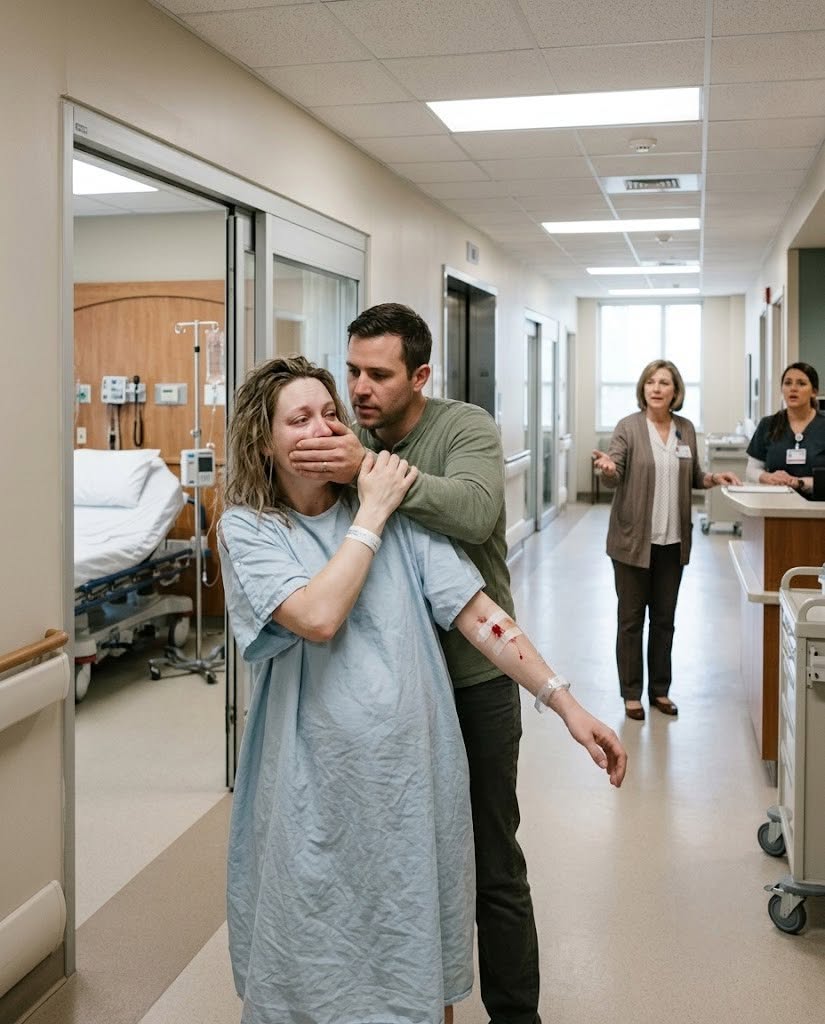
The receptionist’s voice stopped us before the maternity ward doors could close. “There’s another change on the account.”
The security officer took the second page from her hand and read it without speaking. I could see my husband watching his face, waiting for some clue about what had appeared on the paper.
Image
The consultant was still beside my wheelchair. One hand rested on the emergency scan, the other pointing toward the nurse who was preparing to take me back into the ward.
Another tightening rolled through my abdomen.
I closed my eyes until it passed.
“Take her now,” the consultant said.
The nurse pushed me forward. My husband moved with us, but the security officer stepped into his path again. “You can wait here.” “I’m her husband.”
“I know.”
“I need to be with her.”
The officer looked down at the paper in his hand. “That depends.” My husband’s expression hardened. “Depends on what?” The officer didn’t answer him. He turned to the receptionist instead. “Who entered this second change?”
She looked uncomfortable.
“It came through the patient account.”
“From which terminal?”
She pointed toward the administrative desk at the far end of the lobby. My mother-in-law immediately stepped in. “This is ridiculous. My son was handling everything because she was in no condition to deal with paperwork herself.” The consultant stopped walking.
“She was conscious when she was brought down here.”
My mother-in-law opened her mouth.
The consultant continued.
“And she has now clearly told us she did not request discharge.”
Nobody answered. The nurse pushed me through the ward doors. For the first time that morning, I was moving in the direction of care instead of being dragged away from it.
The doors swung shut behind me.
I heard my husband call my name once.
Then the ward swallowed the sound.
The nurse transferred me onto the bed while the consultant reviewed the scan again. She asked about the pain, the tightening, the pulling around my abdominal dressing, and whether I had noticed any change before my husband dragged me out of the room.
I told her everything I could remember.
The answer was simple.
I had been uncomfortable, but I had not been in this kind of pain before.
She nodded.
“We’re going to monitor you closely.”
A nurse checked the reopened IV site and started working on it again. Another adjusted the fetal monitors across my abdomen.
Four separate heartbeats filled the room.
Fast.
Steady.
Alive.
I stared at the ceiling and finally let myself breathe.
Outside the curtain, I could hear people moving quickly. A phone rang. Someone answered it. Footsteps crossed the corridor.
Then the consultant came back to my bedside.
“The babies are being monitored. We need to see how your contractions behave.”
I nodded.
She hesitated before adding, “There’s something else.”
My stomach tightened again.
“What?”
“The scan was ordered because your symptoms changed. The reason we are taking this seriously is that the imaging gives us something we need to watch.”
She didn’t frighten me with words she couldn’t support.
She simply told me that the next few hours mattered.
That was enough.
I asked about the room.
Not because I wanted it back.
Because I needed to understand why my husband had been willing to pull me out of a maternity ward while I was carrying four babies.
The consultant looked at me carefully.
“You can ask him when you’re medically stable.”
“I want to know now.”
She didn’t argue.
But she didn’t leave me alone with him either.
A few minutes later, the security officer appeared at the doorway.
He stayed outside the room.
“Your husband is asking to come in.”
I looked at the consultant.
Then I said, “Not alone.”
The officer nodded.
“He won’t be.”
My husband entered with his mother behind him.
He looked different now.
Not calmer.
More controlled.
He had lost the confidence he carried in the lobby, but he was still trying to keep the conversation in the place he wanted it.
“The room situation got out of hand,” he said.
I stared at him.
“You dragged me out of my hospital room.”
“I was trying to move you somewhere quieter.”
“You reopened my IV.”
“I didn’t mean to.”
“You covered my mouth.”
He looked away.
His mother stepped forward.
“He panicked.”
I looked at her.
“Why?”
She didn’t answer.
My husband did.
“Because everything was happening at once.”
“No,” I said. “You wanted the room.”
His jaw tightened.
“It wasn’t like that.”
“Then tell me what it was like.”
Silence.
The security officer remained by the door.
The consultant stood at the foot of the bed.
My husband knew he couldn’t change the subject anymore.
Finally he said, “Someone needed privacy.”
I almost laughed, but another tightening made me grip the sheet instead.
The nurse checked the monitor.
My husband waited until the wave passed.
Then he said quietly, “She had a procedure scheduled.”
His mother nodded.
I looked between them.
“She?”
Neither spoke.
“You mean your mistress.”
His mother closed her eyes for a second.
My husband finally said, “Yes.”
The word landed differently now that there was no room left for pretending.
The private room wasn’t for a family emergency.
It wasn’t for his mother.
It wasn’t for a relative who had suddenly become ill.
It was for the woman he had been seeing while I carried his four children.
I looked at him for a long moment.
“That’s why you needed me out.”
“She needed privacy.”
“And I didn’t?”
“That isn’t what I said.”
“You didn’t have to.”
The consultant stepped closer when the monitor changed again.
“We need to focus on the patient.”
My husband nodded, but his eyes stayed on me.
Then the security officer’s radio crackled.
He stepped into the hallway.
A minute later, he came back holding the first cancellation record and the second account change.
“There is a discrepancy.”
My husband stiffened.
“What discrepancy?”
The officer looked at the consultant first.
“Both changes were entered before the patient was removed from the ward.”
I frowned.
My husband said, “Yes. Because she wasn’t in a condition to handle them.”
The officer shook his head.
“That doesn’t explain the access log.”
My mother-in-law stepped forward.
“What access log?”
“The account was accessed from a terminal outside the maternity ward.”
My husband’s face changed.
The officer continued.
“And the second change was made from a different terminal.”
Nobody spoke.
The consultant looked toward me.
“Do you recognize either location?”
I shook my head.
I had never used the hospital’s administrative terminals.
The officer held up the paper.
“That’s why we asked whether you requested the discharge. We have to establish who made the request and whether the patient consented.”
My husband rubbed his forehead.
“You’re making this sound criminal.”
The officer’s voice remained even.
“I’m making it factual.”
That sentence changed the room.
There was no accusation in it.
No threat.
Just a record.
A time.
A terminal.
A request.
And a patient who had said she never made it.
My husband turned toward his mother.
She wouldn’t meet his eyes.
I noticed.
So did he.
“Mom?”
She said nothing.
“Did you do it?”
Her silence stretched.
Then she said, “I was trying to help.”
My husband stared at her.
“With what?”
“You were overwhelmed.”
“That isn’t an answer.”
She finally looked at me.
“She was going to make everything difficult.”
My chest tightened.
Not from the contraction this time.
From the realization that she had known exactly what was happening.
“She was going to make what difficult?” I asked.
She hesitated.
“The room.”
I looked at my husband.
Then at her.
“So you decided I should be gone before she arrived.”
Nobody corrected me.
The consultant stepped toward the door.
“We are done with this conversation for now. She needs rest.”
My husband started to object.
The security officer stopped him with one glance.
He and his mother left.
The door closed.
The nurse adjusted my monitors again.
I watched the four lines moving across the screen.
For months, I had imagined the moment when I would finally have to confront my husband’s affair.
I had imagined shouting.
Crying.
A confession.
Maybe even an apology.
I hadn’t imagined lying in a hospital bed while four tiny heartbeats continued to pulse through the room as proof that the consequences of his choices were no longer limited to our marriage.
The consultant checked the readings.
“Your contractions are continuing.”
I swallowed.
“What does that mean?”
“It means we’re staying ahead of this.”
She didn’t promise an outcome.
She didn’t frighten me with one either.
She simply kept working.
Hours passed in pieces.
A nurse checked my IV.
Another adjusted the monitors.
The consultant returned several times.
My husband did not come back into the room.
His mother didn’t either.
Eventually, the security officer appeared once more.
He had a folder in his hand.
“I spoke with administration,” he said.
I waited.
“The cancellation request and the room change were both entered while you were still registered as an inpatient.”
I nodded.
He placed the papers on the side table.
“There is one more thing you should know.”
I looked at him.
“The private room had already been assigned.”
My stomach dropped.
“To her?”
He nodded.
“She was expected to arrive later that day.”
I stared at the papers.
So it had been planned.
Not a sudden favor.
Not a misunderstanding.
Not something my husband had decided in a panic.
They had expected me to be gone.
The room had been arranged for someone else before anyone had asked me whether I agreed to leave.
I thought about the torn hospital gown.
The blood around my reopened IV.
My mother-in-law telling strangers I was mentally unstable.
My husband’s hand covering my mouth.
And the way he had kept repeating that we could discuss the room later.
As if the room were the only thing that mattered.
The consultant came in again.
She saw the papers on the table but didn’t pick them up.
“Your monitoring has stabilized for the moment.”
I closed my eyes.
“For the moment?”
“We’re still watching you.”
I nodded.
Then I asked the question I had been afraid to ask all day.
“Are my babies okay?”
She looked at the monitors.
“They’re being monitored closely. Right now, that’s what we’re concentrating on.”
Four heartbeats continued.
One after another.
I reached for the edge of the sheet.
For the first time since my husband dragged me from that room, I felt something return that I hadn’t realized I’d lost.
Choice.
Not control over everything.
Not certainty about what the next hours would bring.
But the right to say what happened to me.
The right to be heard.
The right to remain where my doctors believed I needed to be.
And the right to decide what happened next.
That evening, my husband finally returned.
He stood at the doorway without entering.
“I need to talk to you.”
I looked at the consultant.
She nodded once.
I looked back at him.
“You can talk.”
He swallowed.
“There was something I didn’t tell you.”
My heart sank.
He looked down at the floor.
“The room wasn’t the only reason.”
I waited.
He took a breath.
“The woman wasn’t just having cosmetic recovery.”
I felt the room become very still.
“What else?”
He didn’t answer immediately.
Then the security officer appeared behind him.
In his hand was another document.
The officer looked at me.
“We need to show you this before anyone makes another change to your account.”
My husband closed his eyes.
And for the first time all day, I understood that the private room had never been the real story.
It was only the reason they thought they could move me out of the way.