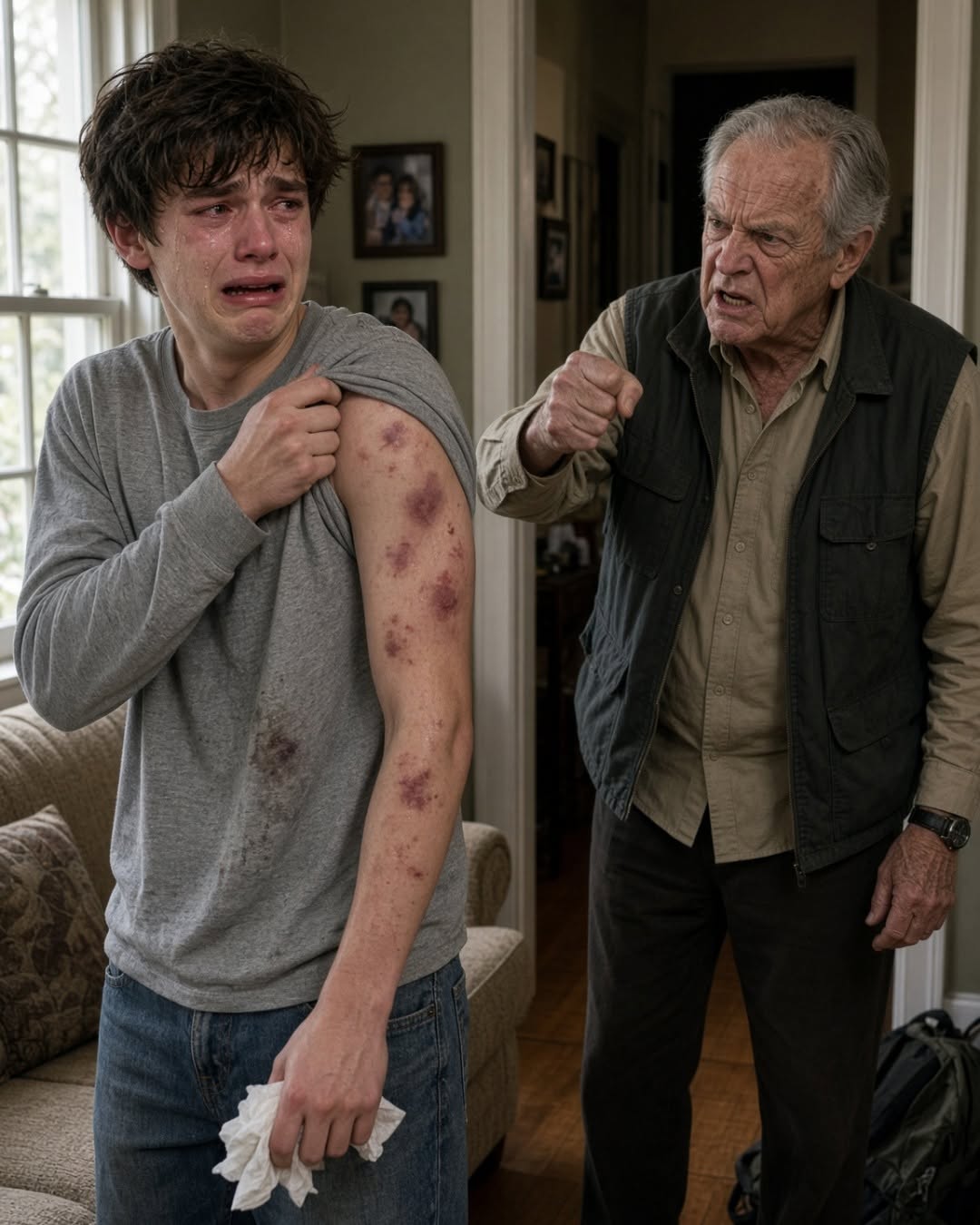
Miranda stopped when the officer raised his hand. “Ma’am, stay there.” Her expression changed for half a second. Then the worried stepmother returned. “I’m only trying to bring her home.” The second officer looked at me. “Can we speak with you separately?”
My stomach dropped. Miranda answered before I could. “She’s confused. She’s been upset lately.” Grandpa turned his head.
“Officer.”
His voice stayed calm.
“She can answer for herself.”
That mattered.
Nobody had said that to me in months.
The officer nodded toward the living room.
I sat on the edge of Grandpa’s couch, the cedar-smelling quilt still folded beside me.
He asked my name.
My age.
Whether I felt safe going back with Miranda.
“No.”
The word barely came out.
He waited.
So I said it again.
“No.”
Then he asked about the bruises.
I told him what I had told Grandpa.
Not everything.
Not all at once.
Just enough.
When I looked toward the doorway, Miranda was no longer smiling.
Grandpa stood several feet behind her with his arms at his sides.
No threats.
No yelling.
Just waiting.
The officer glanced toward his partner.
Then back at me.
“Has a doctor seen these injuries?”
“Not yet.”
Grandpa spoke from the doorway.
“That was where we were going this morning.”
The officer nodded slowly.
Then Miranda said the one thing she probably thought would end the conversation.
“I’m a nurse. I know what accidental bruising looks like.”
The officer looked at her.
“So do doctors.”
For the first time since she arrived, Miranda had nothing ready to say.
That silence frightened me more than her yelling usually did.
Miranda was never quiet when she believed she had control.
She corrected.
Explained.
Reframed.
Made herself sound reasonable and everyone else emotional.
Now she stood on Grandpa’s porch with two officers between us, and nobody was letting her finish my sentences.
The officer sitting across from me kept his voice even.
“Do you want your grandfather to stay in the room?”
I looked at Grandpa.
He did not nod.
Did not answer for me.
He waited.
“Yes.”
“Okay.”
Grandpa came inside and sat in the chair farthest from me.
That surprised me.
I thought he would sit beside me.
Instead, he gave me space.
The officer asked another question.
“Did the injuries happen at the same time?”
I looked at my arms.
Some were fading.
Others were darker.
“No.”
“How many times?”
My throat tightened.
“I don’t know.”
That was the truth.
There had been too many moments I had tried to forget as soon as they happened.
A hard grab.
Being shoved into the hallway wall.
Fingers closing around my arm when I talked back.
A hand at my shoulder.
None of it had seemed large enough, on its own, to become the thing that finally made me tell someone.
That was how Miranda worked.
Nothing dramatic when another adult was around.
Nothing obvious enough that I thought anyone would automatically believe me.
Then afterward:
Look what you make me do.
You’re impossible.
You’re lucky your father has me.
And the sentence I heard more than any other:
Nobody is going to believe you.
The officer let me speak at my own pace.
He did not ask why I waited.
That mattered too.
People always imagine telling as one clean decision.
You know something bad is happening.
You tell.
Adults fix it.
But when the person hurting you lives in your house, prepares dinner, signs school forms, and speaks politely to neighbors, the truth starts feeling like a dangerous thing to carry.
What if Dad believed Miranda?
What if he didn’t?
What if he confronted her and then went back to work that night?
What if she came upstairs afterward?
Those questions had kept me quiet longer than fear alone.
The officer asked, “Where is your father?”
“At work.”
“What does he do?”
“Night shift.”
Grandpa answered this one only after looking at me first.
“He should be getting off soon.”
The officer nodded.
“Can you call him?”
Grandpa took out his phone.
Miranda immediately spoke from outside.
“I already tried Daniel. He isn’t answering.”
One officer turned toward her.
“Ma’am, please let us handle this.”
Her mouth snapped shut.
Grandpa dialed.
No answer.
Again.
No answer.
He left a message.
“Daniel, it’s Dad. Call me the second you get this. It’s about your daughter.”
No extra detail.
No accusation.
Then he put the phone down.
The second officer asked Miranda for her account.
I could hear part of it from the living room.
She said Grandpa had become emotional.
She said I was angry about household rules.
She said I bruised easily.
She repeated the bicycle story.
The bicycle story bothered me because I had fallen off my bike.
That part was true.
Three weeks earlier.
One scraped knee.
Miranda had taken that real thing and stretched it until it covered everything else.
That scared me.
Because lies built around one fact are harder to fight.
I looked at the officer.
“I did fall.”
He nodded.
“Okay.”
“But not like this.”
“Okay.”
No surprise.
No accusation.
Just okay.
For the first time, I began to understand what Grandpa meant when he said Miranda thought a child had no witness.
A witness did not only mean someone who watched the moment happen.
A witness could be someone willing to look carefully afterward.
Grandpa had looked.
The officers were looking now.
And soon, if Grandpa got his way, a doctor would too.
The officer stood.
“We’re going to need to get you medically evaluated.”
My stomach tightened.
“Do I have to go with her?”
He understood immediately.
“No.”
I looked at Grandpa.
He was already standing.
“I’ll take her.”
The officer nodded.
Miranda stepped through the doorway before anyone invited her.
“No. Absolutely not.”
The first officer moved between us again.
“Ma’am.”
“She’s a minor.”
“And we are addressing that.”
“She belongs at home.”
Grandpa’s voice changed for the first time.
Not louder.
Harder.
“She belongs somewhere safe.”
Miranda turned toward him.
“You’re accusing me of something you do not understand.”
Grandpa looked at my arms.
“I understand enough.”
That sentence almost made me cry.
Not because it was comforting.
Because it was so simple.
For weeks, Miranda had told me everything was complicated.
That I was difficult.
That stress made her lose her temper.
That Dad working nights made things hard.
That families argued.
That nurses knew what real abuse looked like and I was being dramatic.
Grandpa looked at bruises and understood enough.
Maybe adults sometimes hide behind complexity because simple truths require action.
Miranda’s voice became sharper.
“Daniel left me responsible for her.”
Grandpa looked at the officers.
“Then Daniel can answer for why he didn’t know what was happening in his own house.”
That landed on me too.
Dad.
I had spent the whole night avoiding that part.
It was easier to think about Miranda.
She was the one hurting me.
Dad was just working.
Just tired.
Just missing things.
But missing things still mattered.
The front tires of a car hit the gravel.
Everyone turned.
Dad’s truck.
My stomach dropped so quickly I felt dizzy.
He parked crooked.
Engine still running.
Then he came toward the porch wearing his work jacket and looking completely confused.
“What’s going on?”
Miranda moved first.
Of course she did.
“Daniel, thank God.”
She rushed toward him.
“Your father took her last night and now they’re accusing me because she has bruises from falling off her bike.”
Dad looked at Grandpa.
Then the officers.
Then me.
His eyes dropped to my arms.
He stopped moving.
I had imagined this moment a hundred times.
In most versions, Dad defended her.
Or demanded explanations.
Or looked angry at me for creating trouble.
What actually happened was worse in a different way.
He looked lost.
“Sweetheart?”
I hated that one word.
Because it sounded like him.
Like the father I remembered.
Like the man who used to pack extra snacks in my school bag and leave notes beside my cereal.
My eyes filled.
Miranda saw it.
She stepped closer to him.
“See? She’s emotional. Your father scared her.”
Dad did not look at Miranda.
He kept looking at me.
“What happened?”
My mouth would not work.
Grandpa spoke.
“No.”
Dad turned.
Grandpa pointed toward me.
“She tells you.”
That was twice in one morning he had given my voice back to me.
Dad looked at me again.
I tried once.
Nothing.
Then I forced the words out.
“Miranda did it.”
Dad went completely still.
Behind him, Miranda laughed.
Not loudly.
A shocked little sound.
“Daniel, come on.”
I continued before I lost my nerve.
“She grabs me.”
Dad’s face changed.
“She shoves me.”
“Stop.”
Miranda’s voice was sharper now.
The officer raised his hand.
“Ma’am.”
I looked at Dad.
“She said you’d believe her.”
His eyes closed.
Just for a second.
Then opened.
“Why didn’t you tell me?”
There it was.
The question I knew would come.
I looked down.
Grandpa leaned forward.
“Wrong question.”
Dad stared at him.
Grandpa’s voice stayed flat.
“Ask why she was afraid to.”
Dad flinched.
Nobody spoke.
I think that was the moment he really understood.
Not everything.
But enough.
The same word again.
Enough.
He looked toward Miranda.
For the first time, fear crossed her face.
Real fear.
Not panic about police.
Something more personal.
The realization that the person she counted on most was no longer automatically standing beside her.
“Daniel,” she said softly.
He looked at the bruises again.
Then at the officer.
“What happens now?”
The officer answered without drama.
“First, she gets checked.”
Dad nodded.
“Okay.”
“Then we document what she reports and what medical staff observe.”
Another nod.
Miranda started talking.
Fast.
“This is insane. She is manipulating all of you. She knows exactly what she’s doing.”
Dad turned toward her.
“Stop.”
Everyone went quiet.
Miranda stared at him.
“What?”
“I said stop.”
I had never heard Dad speak to her that way.
His voice shook slightly.
Not anger.
Shock.
He looked physically sick.
Miranda stepped toward him.
“Daniel.”
“No.”
His eyes moved to me.
“I need to hear her.”
That was the first moment I believed the morning might end differently than all the scenarios I had rehearsed.
Grandpa picked up my backpack.
“Ready?”
I nodded.
Dad looked at him.
“I’m coming.”
Miranda’s head snapped around.
“No.”
He ignored her.
She grabbed his arm.
Dad pulled away.
Not violently.
Just enough.
“I’m coming with my daughter.”
The words hit me so hard I had to look away.
My daughter.
Not her.
Not the situation.
Me.
One officer remained with Miranda to continue speaking with her.
The other followed us outside.
Grandpa drove.
Dad sat in the front passenger seat.
I sat in back.
Nobody spoke for the first ten minutes.
Morning traffic moved around us like this was an ordinary day.
People stopped for coffee.
A school bus turned through an intersection.
Someone walked a dog.
I remember thinking the world looked offensively normal.
Dad finally spoke.
“I’m sorry.”
Grandpa kept his eyes on the road.
I looked out the window.
Dad turned slightly.
“I should have known.”
I did not answer.
“I should’ve—”
Grandpa interrupted.
“Don’t make her take care of you right now.”
Dad went silent.
I stared at the back of Grandpa’s head.
That sentence stayed with me.
Don’t make her take care of you.
I had spent months managing adults.
Managing Miranda’s moods.
Managing what Dad knew.
Managing whether dinner felt tense.
Managing whether anyone suspected something.
Even now, Dad’s guilt could have become one more thing I was expected to soothe.
Grandpa stopped that before it started.
At the clinic, everything slowed down.
Forms.
Waiting.
Questions.
A nurse asked whether I wanted Dad in the room.
I looked at him.
He looked destroyed.
But he said, “Whatever she wants.”
“Grandpa.”
Elias stayed.
Dad waited outside.
That was hard for him.
I could tell.
He did it anyway.
The doctor examined my injuries carefully.
No dramatic reaction.
No gasp.
She asked what happened.
I answered.
She asked which marks came from what I remembered.
I told her.
Some I knew.
Some I did not.
She did not force certainty where I had none.
Afterward, she spoke to Grandpa and the officer.
Not to Miranda.
Not to my father first.
To the people responsible for what happened next.
I sat with a blanket around my shoulders.
My body felt exhausted.
Not from the exam.
From finally saying things aloud.
The door opened.
Dad stood there.
He waited.
“Can I come in?”
That was the first time I remembered him asking permission to enter a room I was in.
I nodded.
He sat in the chair near the wall.
Same position Grandpa had taken earlier.
Not crowding me.
“I called work,” he said.
I waited.
“I’m not going in tonight.”
Something inside me loosened.
Small.
But real.
“What about Miranda?”
He looked down.
“She’s not coming near you today.”
“Today?”
He heard it.
The weakness in the sentence.
His face tightened.
“Not until this is figured out.”
I looked at Grandpa.
Grandpa did not rescue him.
Did not improve the answer.
Dad had to own it.
“I don’t want to go home,” I said.
Dad nodded immediately.
“Okay.”
That word mattered more than any promise.
No argument.
No reminder that my clothes were there.
No but Miranda lives there.
Just okay.
“You can stay with Grandpa.”
I looked at him.
“You’re not mad?”
His face broke.
“No.”
I hated that I had to ask.
He hated it too.
That was obvious.
“No,” he repeated.
“I’m not mad at you.”
Grandpa finally spoke.
“Good.”
Dad gave a weak laugh.
Not because anything was funny.
Because Grandpa’s approval still mattered to him even now.
I saw them differently that day.
Grandpa, old and rigid and sometimes impossible.
Dad, exhausted and absent too often.
Miranda, polished and controlled.
Me, trying to survive all three relationships without being called difficult.
Families are not simple.
But some choices are.
Believe the person showing you harm.
Get them safe.
Ask questions after.
We left the clinic hours later.
The police still had questions for Dad.
For Miranda.
For me.
Nothing was magically finished.
No courtroom appeared that afternoon.
No dramatic confession solved everything.
There was paperwork.
Phone calls.
Adults speaking in low voices.
Arrangements.
Uncertainty.
Grandpa took me home with him again.
That night, Dad came over alone.
He brought a grocery bag.
My favorite cereal.
A toothbrush.
Two shirts.
Pajamas.
Things he had taken from my room.
He stood in Grandpa’s kitchen holding the bag.
“I didn’t know what to bring.”
I looked inside.
It was almost funny.
He had packed three pairs of socks and no jeans.
Grandpa noticed.
“You always packed like an idiot.”
Dad laughed once.
Then cried.
He turned away immediately.
Grandpa pretended not to notice.
So did I.
Later, Dad asked if he could sit with me on the porch.
I said yes.
We sat under Grandpa’s old porch light.
For a while, neither of us spoke.
Then Dad said, “She told me you were getting difficult.”
I stared ahead.
“She said teenagers push boundaries.”
“I’m not a teenager.”
“I know.”
He covered his face for a second.
“She said you were moody. Angry. That you’d started lying.”
I thought of all the times Miranda had probably prepared him.
Not one big accusation.
Small ones.
Enough to make doubt ready before I ever spoke.
“What did you think?”
Dad’s answer came slowly.
“I thought you were having a hard time.”
“Why didn’t you ask me?”
He looked at me.
“I did.”
“No.”
The word surprised him.
“You asked if school was okay.”
He lowered his eyes.
“You asked if I was behaving.”
That one hurt him.
“You asked Miranda what was wrong with me.”
I swallowed.
“You never asked me what was happening.”
The porch stayed quiet.
Finally, Dad nodded.
“You’re right.”
No excuse.
I had not expected that.
“I was tired,” he said.
Then stopped himself.
“No.”
He shook his head.
“That sounds like an excuse.”
I looked at him.
“I was absent. She filled in everything I wasn’t seeing, and I accepted it because it was easier.”
The honesty frightened me almost as much as his denial would have.
Because it meant he understood the problem went beyond one terrible night.
He had handed Miranda authority over the story of who I was.
That was how she became believable before I ever spoke.
Dad stared at his hands.
“I don’t know how to fix this.”
I thought about it.
“Don’t make me go back.”
His answer was immediate.
“I won’t.”
“Don’t make me talk to her.”
“I won’t.”
“Don’t tell me she didn’t mean it.”
He closed his eyes.
“I won’t.”
Three promises.
Simple.
Specific.
The kind I could measure.
Grandpa opened the screen door.
“Coffee?”
It was late.
Dad looked at him.
“You’ll be awake all night.”
“I’m retired.”
Grandpa went inside.
Dad smiled faintly.
“He hasn’t changed.”
“No.”
Then I remembered the sentence Grandpa used the night before.
You made one when you thought a child had no witness.
At the time, I thought he meant himself.
Now I understood something larger.
A witness could become a chain.
Grandpa saw.
The officers saw.
The doctor documented.
Dad finally listened.
One person believing me made it possible for the next person to hear me without Miranda controlling the room.
Weeks passed.
I stayed with Grandpa.
At first, every sound after dark woke me.
A floorboard.
A truck outside.
The refrigerator turning on.
My body had memorized fear too well.
Grandpa never commented.
He simply left the hallway light on every night.
The glass of water remained beside the couch until I eventually moved into the small spare bedroom.
One evening, I turned the hallway light off myself.
Grandpa noticed.
Said nothing.
That was his way.
Dad visited.
Not every day.
Enough.
He learned to knock.
That sounds like a tiny thing.
It wasn’t.
He knocked on the bedroom door.
Waited.
Asked whether I wanted company.
Sometimes I said yes.
Sometimes no.
The first time I said no, I held my breath.
Dad only said, “Okay.”
Then walked away.
I nearly cried.
I had forgotten what it felt like to have a boundary survive contact with another person.
Miranda disappeared from my daily life.
That mattered more than whatever adults were deciding around her.
I did not ask Grandpa for every update.
At first I wanted to.
Then I realized constantly tracking her kept her in every room anyway.
So we made a rule.
If something directly affected me, Grandpa told me.
If not, I got to eat dinner.
Do homework.
Watch television.
Sleep.
Ordinary things.
I had never understood how luxurious ordinary could feel.
One Saturday, Dad brought over an old box from the house.
My drawings.
School photographs.
A stuffed animal I thought had been lost.
He placed it on Grandpa’s dining-room table.
“I’m moving some of your things.”
I froze.
“Why?”
He understood immediately.
“Because you’re staying here as long as you want.”
As long as you want.
Not until Miranda calms down.
Not until everyone talks.
Not until I stop being difficult.
I touched the stuffed animal.
“What about you?”
Dad looked exhausted.
“I’m figuring that out.”
That was enough.
He did not ask me to solve his marriage.
That was one more adult responsibility I refused to inherit.
Grandpa made grilled cheese for lunch.
Burned one side.
Dad teased him.
Grandpa told him to cook his own.
For fifteen minutes, they argued about butter.
I sat there and listened.
It was the most normal family argument I had heard in months.
Nobody was afraid.
Nobody had bruises afterward.
Nobody had to guess whether anger would follow them upstairs.
That difference became the standard I had never known I needed.
Months later, I asked Grandpa what he meant that first night.
“About playing her game by your rules.”
He was sitting at the kitchen table cleaning his glasses.
He looked at me.
“I was angry.”
“I noticed.”
He snorted.
“What were your rules?”
Grandpa put his glasses back on.
“Simple.”
I waited.
“No screaming.”
That surprised me.
“No threats.”
I kept listening.
“No trying to outtalk her.”
Then he tapped the table.
“Get you safe. Get somebody independent to look at the injuries. Let you speak for yourself. Make everything harder to dismiss.”
I stared at him.
“That was the game?”
“That was reality.”
He leaned back.
“People who count on fear hate witnesses.”
There it was again.
Witnesses.
Not heroes.
Not revenge.
Witnesses.
I thought about that morning.
Miranda arriving polished and calm.
The police beside her.
Grandpa opening the door wider instead of hiding me.
Good. Now she can tell you herself.
That had been his whole strategy.
Not to beat Miranda at manipulation.
To remove the conditions that made manipulation work.
Privacy.
Isolation.
Fear.
Control over the story.
Once those disappeared, she had to face something stronger than Grandpa’s anger.
My voice.
Dad’s eventual question.
The doctor’s observations.
The officers’ attention.
Facts did not need Grandpa to shout.
I smiled.
“What?”
He asked.
“You’re smarter than you look.”
Grandpa stared at me.
“Get out of my kitchen.”
I laughed.
Really laughed.
The sound surprised both of us.
He smiled too.
My life did not become perfect after that.
I still jumped when voices got sharp.
I still hated being grabbed unexpectedly, even by friends.
Sometimes I wondered whether I should have told sooner.
Grandpa ended that question every time.
“You told when you could.”
That became the answer I learned to give myself.
I told when I could.
And when I finally did, somebody believed me.
That changed everything.
Not because Grandpa became violent.
Not because he threatened Miranda.
Not because he found some secret legal trick.
Because he did the thing I had been convinced no adult would do.
He looked at me.
He listened.
And he made room for other people to listen too.
For months, Miranda had told me the same thing.
Nobody will believe you.
She was wrong.
It only took one person to make that sentence stop being true.
Grandpa Elias was the first.
He wasn’t the last.