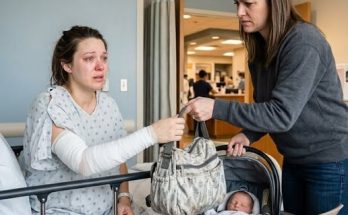
She stepped closer. “You’re at St. Joseph’s. I’m Elena. I was part of the ambulance crew that brought you in.” I blinked. “How long?” “About three hours since we got the call.”
Three hours.
I looked toward the door.
“Where’s my family?”
Elena hesitated. That hesitation told me more than an answer would have. “In the waiting area.” Of course they were. Together. Probably comparing versions. I closed my eyes. The staircase returned immediately.
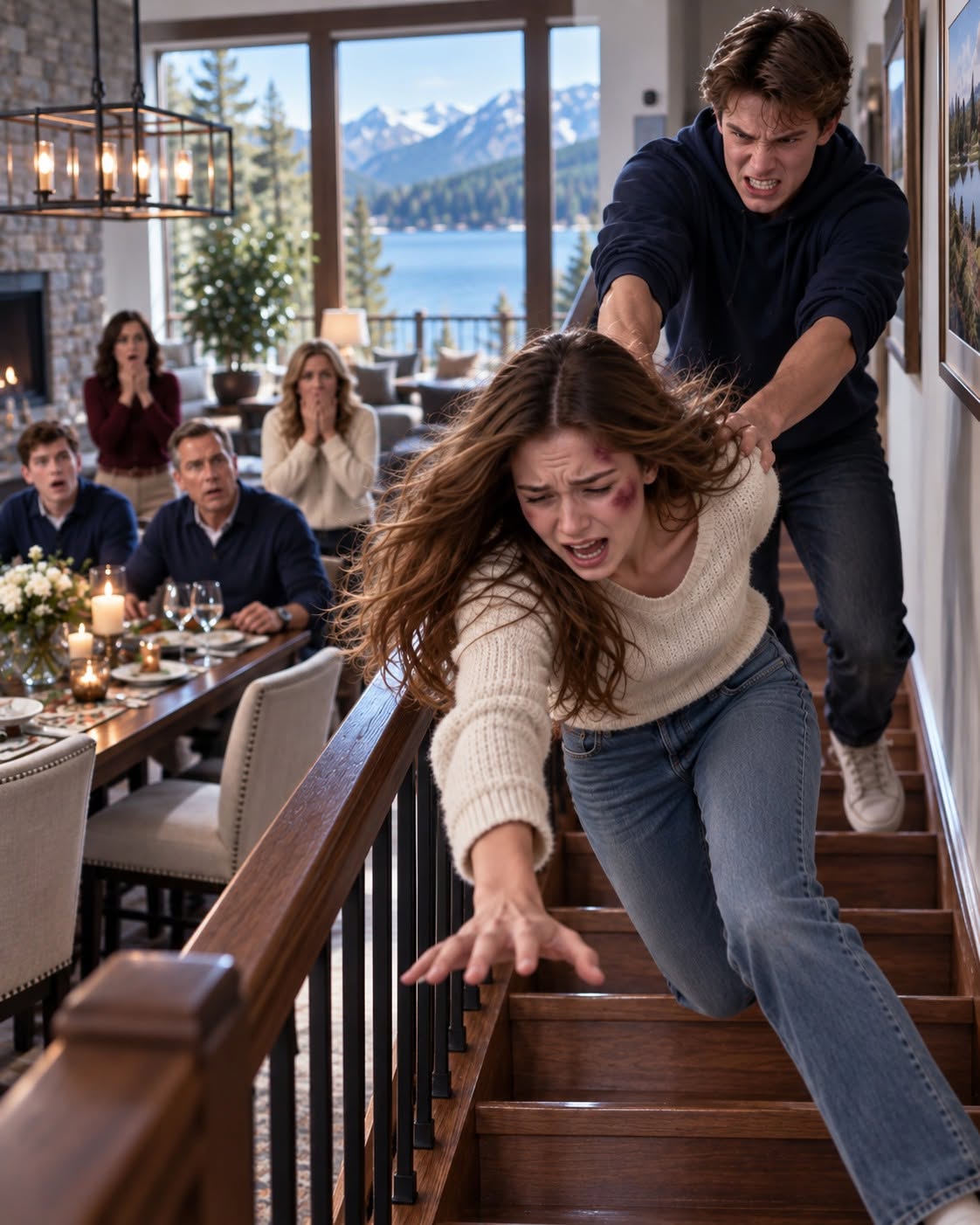
Tyler’s hands.
The surprise on his face afterward.
Dad shouting.
Aunt Susan standing from the couch. Then the steps coming toward me one after another. I opened my eyes again.
“He pushed me.”
Elena didn’t look surprised.
“I know.”
My throat tightened.
“How?”
“Several people told us.”
That was new.
For most of my life, the truth had existed almost entirely inside my own head.
This time other people had seen it.
Elena pulled the visitor chair closer and sat.
“You’re eighteen, correct?”
“I turned eighteen last month.”
“All right. That means the doctors will speak directly with you about your care. Your parents can be involved if you want them involved.”
If I wanted them involved.
Nobody had ever phrased family that way before.
Family had always been automatic.
Family entered rooms without knocking.
Family answered questions for you.
Family decided whether something hurt enough to matter.
I stared at the blanket.
“What did the scan show?”
Her expression changed slightly.
Not alarm.
Something more complicated.
“Your doctor should explain it.”
“That bad?”
“No.” She shook her head. “Not in the way you’re thinking.”
Before I could ask anything else, the door opened.
A doctor in rectangular glasses came in carrying a tablet.
He introduced himself as Dr. Ramirez and pulled up the second chair.
“You’ve had a frightening evening,” he said.
I almost laughed.
That was one way to put it.
He explained the first part carefully.
I had a small compression fracture in one thoracic vertebra. Stable. Painful, but not expected to require surgery.
No spinal cord damage from the fall.
No paralysis.
No internal bleeding.
Each sentence loosened something inside my chest.
Then he said, “There is another finding.”
Elena remained near the door.
Dr. Ramirez turned the screen toward me.
I saw gray shapes I couldn’t understand.
“This is your cervical spine and the lower part of your skull.”
He pointed.
“You have what’s called a Chiari I malformation. It means part of the tissue at the base of your brain extends lower than usual into the opening where the spinal cord begins.”
I stared at him.
“From falling?”
“No. You’ve likely had it for years.”
Years.
The room seemed quieter.
He continued.
“There’s also a very small fluid-filled cavity inside part of the spinal cord. It’s called a syrinx. We need a neurospecialist to evaluate it.”
I swallowed.
“What does that mean?”
“It can mean different things for different people. Some people have a Chiari malformation and never know it. Others have headaches, neck pain, dizziness, balance problems, tingling, weakness, pressure sensations, or symptoms that worsen with exertion.”
My fingers tightened around the blanket.
Headaches.
Dizziness.
Balance.
Pressure.
Words from years of my life suddenly lined up like witnesses.
“What kind of headaches?”
“Often at the back of the head. Sometimes brought on by coughing, straining, laughing hard, exercise.”
I stared at him.
“When I run.”
“That can happen.”
“When I carry things upstairs.”
“Possibly.”
“When I stand up too quickly and everything goes weird?”
“That could have several causes, but it’s worth discussing with the specialist.”
I thought of every time I had stopped halfway up the stairs and waited for the hallway to settle.
Every gym class when I’d asked to sit down.
Every family hike where Tyler had joked that I was trying to get attention.
Every time Dad said I needed to toughen up.
Every time Mom handed me water and told me I worried too much.
“Can it cause numb hands?”
Dr. Ramirez nodded slowly.
“It can.”
My eyes burned.
Not because I was frightened.
Because somebody had finally said yes.
Not maybe you’re imagining it.
Not everybody gets tired.
Not stop making a big deal out of nothing.
Yes.
It can.
Apparently validation could hurt too.
Dr. Ramirez must have noticed.
“You’ve had symptoms before today?”
“For years.”
“How many?”
I laughed once, but there was no humor in it.
“A lot.”
He asked questions.
I answered them.
Occipital headaches since middle school.
Pins and needles in my fingers.
A strange pressure in my neck after exercise.
Occasional ringing in my ears.
A tendency to become dizzy in crowded, hot rooms.
I mentioned the time I nearly fainted during sophomore-year choir practice.
The weekend I left a ski trip early because my neck hurt so badly.
The Thanksgiving when I spent half the day in a dark bedroom because the noise made my head pound.
Dr. Ramirez typed notes.
Nobody interrupted me.
Nobody corrected my memory.
When he finished, he said, “We’ll arrange follow-up with neurosurgery. Tonight, however, we’re focused on pain control and observation after the fall.”
I looked at the screen again.
“So I wasn’t making it up.”
“No.”
Two letters.
One word.
It nearly undid me.
Elena stepped into the hallway with Dr. Ramirez. I heard low voices, then another.
Dad.
“We need to see her.”
“She’ll decide when she’s ready,” Elena replied.
“She’s our daughter.”
“She’s also an adult.”
I closed my eyes.
Even then, a part of me wanted to tell Elena not to upset them.
That reflex embarrassed me.
Five minutes later, Elena returned.
“Do you want visitors?”
I thought about it.
“Yes.”
“All of them?”
“No.”
Another unfamiliar freedom.
“Aunt Susan first.”
Susan entered with her purse clutched against her chest.
She looked different without the lake-house lights and chatter surrounding her. Older. Tired.
She sat down.
For several seconds neither of us spoke.
Then she said, “I saw him push you.”
I looked at her.
“I know.”
“I told the paramedics. And the deputy.”
There had been a deputy?
Apparently someone at the house had called 911, and emergency dispatch had sent both medical help and law enforcement because the fall followed an altercation.
Susan twisted the strap of her purse.
“I should have spoken sooner.”
“Tonight?”
“No.”
That answer landed quietly.
She looked down.
“I’ve seen the way Tyler talks to you. Not this. I never saw anything like what happened on the stairs. But I’ve seen him needle you until you leave the room. I’ve heard your father laugh it off. I’ve done it too.”
I said nothing.
“I told myself it was sibling stuff.”
“Everyone does.”
“I know.”
There was no dramatic apology.
No tears.
No excuses disguised as explanations.
Just a woman sitting beside a hospital bed realizing that being present was not the same as paying attention.
“I’m sorry,” she said.
I believed her.
That didn’t mean I knew what to do with it.
“Did Mom see?”
Susan nodded.
“Everyone did.”
“And what is Tyler saying?”
Her eyes met mine.
“He says he meant to stop you from walking away and pushed harder than he intended.”
I stared at her.
“That doesn’t even make sense.”
“I know.”
For once, someone else said it first.
Susan took a breath.
“He’s scared.”
“Good.”
The word escaped before I could stop it.
She didn’t criticize me.
“He should be,” she said quietly. “Not because anybody wants something terrible to happen to him. Because he finally understands that consequences don’t disappear just because he says he didn’t mean them.”
I looked toward the window.
The city outside had become reflections and scattered lights.
“What happens now?”
“That’s your decision more than anyone else’s.”
That idea frightened me almost as much as the MRI.
For years I’d imagined what it would feel like if somebody finally believed me.
I had never imagined I would then have to decide what came next.
Mom came in after Susan.
She stopped just inside the doorway.
Her mascara was gone.
Her hair, always carefully styled, had fallen loose around her face.
“Can I sit?”
It was probably the first time she had ever asked.
I nodded.
She sat at the foot of the bed.
“I’m sorry.”
I looked away.
“We know about the MRI,” she continued. “The doctor explained it.”
“Did he explain that I’ve probably had symptoms for years?”
Mom’s face tightened.
“Yes.”
“And did that remind you of anything?”
She didn’t answer immediately.
That was enough.
I turned toward her.
“Mom?”
“I remember the headaches.”
“What else?”
“The dizziness.”
“What else?”
Her eyes filled.
“The numbness.”
My stomach dropped.
“You remember?”
“I remember you mentioning things.”
“Mentioning?”
“I don’t mean—”
“I went to the nurse three times sophomore year because my hands were tingling.”
“I know.”
I froze.
“You knew?”
“The school called me.”
I stared at her.
Something had changed in the room.
Not because she had suddenly become cruel.
Because she looked ashamed.
And shame usually had a history.
“What aren’t you telling me?”
Mom folded her hands together.
“When you were sixteen, Dr. Bell suggested we see a neurologist.”
Everything inside me went still.
“What?”
“It was after you nearly fainted at choir.”
“I remember going to the doctor.”
“He thought it was probably dehydration. But because you mentioned headaches and numbness, he said a neurology consult might be worthwhile if it kept happening.”
“Did he give you a referral?”
Mom nodded.
I waited.
“I scheduled it.”
My voice came out small.
“I never went.”
“No.”
“Why?”
She closed her eyes briefly.
“Because the first available appointment was months away. Then your symptoms seemed better. Your father’s company was changing insurance. You were anxious about school. I convinced myself Dr. Bell had only suggested it to be thorough.”
“You canceled it.”
“Yes.”
“Did you tell me?”
“No.”
I turned my face toward the wall.
A referral.
There had been a referral.
For years I had thought nobody had ever found a reason to believe me.
Somebody had.
A doctor had listened.
And I never knew.
Mom started to speak.
I lifted my hand.
“Please don’t.”
She stopped.
I needed room around the discovery.
Not another explanation.
Not yet.
After a minute, she stood.
“I’ll be outside.”
Before leaving, she paused.
“There’s something else.”
I looked back at her.
“I found the old patient portal tonight. Dr. Bell didn’t just suggest neurology.”
She swallowed.
“He documented that he wanted follow-up if the headaches continued.”
My heartbeat seemed louder.
“They did continue.”
“I know.”
“Did you ever tell him?”
“No.”
For the first time that night, Mom didn’t soften the answer.
She simply accepted it.
When she left, Elena appeared a few minutes later carrying a cup of ice chips.
She set them beside me.
“You doing okay?”
“I don’t know.”
“That’s a reasonable answer.”
I looked at her.
“Did you really tell my family to call a lawyer?”
A faint smile crossed her face.
“I said someone should make sure you understood your rights and that your medical decisions weren’t being made by people who were minimizing what happened.”
“That sounds less dramatic.”
“I’m less dramatic than your uncle remembered it.”
Despite everything, I smiled.
Then her expression became serious.
“The scan matters. The fall matters. But there’s something else that matters too.”
“What?”
“You described symptoms tonight very clearly. You shouldn’t have had to become unconscious before somebody wrote them down.”
I looked at the cup in my hands.
She added, “A lawyer can explain options. A doctor can explain an MRI. Neither can tell you what kind of relationship you want with your family after this.”
That was the harder question.
By midnight, Dad had been allowed in.
He stood awkwardly beside the bed.
For once he had no joke.
No lecture.
No command to walk anything off.
“I failed you,” he said.
I almost wanted him to argue instead.
Anger I understood.
This version of Dad frightened me.
“I thought making you tougher would help you,” he said.
“You weren’t making me tougher.”
“I know that now.”
“No. You know I have an MRI now.”
He flinched.
The silence between us stretched.
Finally he nodded.
“That’s fair.”
I studied his face.
“Would you have believed me without it?”
Dad looked toward the floor.
And because he didn’t answer, I had mine.
He left soon afterward.
Tyler never came in.
I learned later that the deputy had spoken with him at the lake house and that Dad had driven him to my uncle’s cabin for the night because I didn’t want him at the hospital.
Nobody argued with that choice.
At two in the morning, I couldn’t sleep.
My back hurt.
My head felt full.
And my future seemed to have been divided into two versions:
the life before somebody listened,
and the life after.
I reached for my phone.
There were twenty-six messages.
Friends.
Relatives.
Dad.
Mom.
None from Tyler.
Then I noticed an email notification.
It was from Mom.
Subject: DR. BELL RECORDS.
Attached were screenshots from the patient portal.
I nearly ignored them.
Then one line in the preview caught my attention.
Patient reports recurrent headaches, paresthesia in both hands, intermittent dizziness. Recommend neurological evaluation if symptoms persist.
I read it twice.
Then I scrolled farther.
There was another note.
Six months later.
A date I recognized.
The week after our family ski trip.
The message wasn’t from Dr. Bell.
It was from my mother.
Symptoms improved. We do not believe specialist appointment is necessary at this time. Please cancel referral.
My chest tightened.
Then I saw something underneath it.
A reply from the clinic.
Understood. However, given the reported neurological symptoms, Dr. Bell recommends reassessment before closing the referral.
There was no reassessment.
No appointment.
Nothing.
Except one final entry.
Appointment declined by family.
I stared at those words until the screen blurred.
My whole life, I had believed the worst part was that no one had known.
But lying awake in that hospital room, I realized something far more complicated.
Someone had known enough to ask questions.
Someone had opened the door.
And my family had quietly closed it.