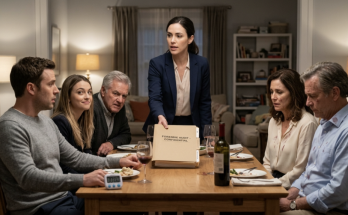
“…the two of you are going to sit very still and explain to Mr. Katz what you did with my pills on the night of October fourteenth.”
The room went silent.
Not ordinary silence.
The kind of silence that seems to suck the air out of a room.
Roy stared at the little black machine on the desk.
Sandra’s face had lost every trace of the sweetness she’d worn at the funeral.
I felt my fingers tighten around the shoebox.
Arthur’s voice continued.
“I know you thought I was asleep.”
Sandra swallowed.
“You were both in my bedroom that night. Helen had gone downstairs to make tea. I was heavily medicated, but I was not unconscious.”
Roy shook his head.
“No.”
The recording continued.
“You opened the drawer beside my bed. You took the medication bottle Helen had organized for me. Then you argued about whether I would remember the following morning.”
Roy stood.
Mr. Katz raised one hand.
“Sit down.”
“This is ridiculous,” Roy said.
“Sit down.”
Something in the lawyer’s voice made him obey.
Arthur continued.
“I heard Sandra say, ‘Just enough to keep him asleep.’ I heard Roy say, ‘He won’t know the difference.’”
Sandra’s eyes filled with tears.
“I never—”
The recording continued over her.
“You replaced the bottle afterward. But you made one mistake.”
Mr. Katz looked at me.
I opened the shoebox.
Inside were twenty-two small plastic evidence bags.
Each one had a date written across the top.
Underneath the dates were medication names, pill counts, photographs, receipts, and handwritten notes.
Twenty-two months.
Twenty-two visits to Mr. Katz.
Twenty-two pieces of a puzzle Arthur had quietly assembled while his children believed he was too weak to understand what was happening around him.
I pulled out the first bag.
“October fourteenth,” I said.
Mr. Katz nodded.
“That was the first.”
I placed it on the desk.
Sandra leaned forward.
“What is that?”
“A pill,” I said.
Roy laughed nervously.
“A pill? That’s your big evidence?”
“No.”
I placed another bag beside it.
“And another.”
Then another.
“And another.”
Soon the desk was covered.
Arthur’s voice filled the room.
“Helen began keeping records after the October incident. She noticed that pills disappeared faster than they should. She noticed that I became unusually sleepy after Roy and Sandra visited. She noticed that the medication bottle was sometimes moved.”
I looked at Roy.
His face had turned pale.
“You didn’t tell me,” I whispered.
The recording answered for him.
“I told her not to confront you. Not yet.”
I closed my eyes.
Even after all those months, hearing Arthur say it hurt.
He had known.
He had known how afraid I was.
He had known how carefully I watched those two.
And he had carried the burden without letting me see how frightened he had become.
The recording continued.
“I wanted evidence, not an argument.”
Mr. Katz reached for one of the bags.
“These are laboratory reports.”
Sandra stared at him.
“What laboratory reports?”
“The medication samples were tested.”
Roy pushed his chair back.
“You can’t test prescription medication like that.”
Mr. Katz looked at him calmly.
“You can when the patient owns it.”
Roy opened his mouth.
Nothing came out.
Mr. Katz continued.
“Arthur had concerns that someone was interfering with his medication. He gave me written authorization to preserve samples and arrange testing if necessary.”
Sandra looked at me.
“You did this?”
“No.”
I shook my head.
“Arthur did.”
For the first time since the funeral, I saw something close to fear in her eyes.
Arthur’s voice came through the speaker again.
“Now we can discuss the house.”
Mr. Katz opened the folder.
“The property at 417 Hawthorne Lane.”
Roy immediately leaned forward.
“That house belongs to the estate.”
“No,” Mr. Katz said.
Roy frowned.
“What?”
“The house does not belong to the estate.”
Sandra stared at him.
“Then who does?”
Mr. Katz looked at me.
“Helen.”
Roy laughed.
It was an ugly, disbelieving sound.
“That’s impossible.”
Mr. Katz removed a document from the folder.
“Arthur transferred the property to Helen eleven months ago.”
Sandra stood so quickly her chair struck the wall.
“He couldn’t.”
“He did.”
“He was sick.”
“He was mentally competent.”
“He was on medication!”
“Yes,” Mr. Katz replied. “Which is precisely why we had repeated capacity evaluations.”
Roy’s face twisted.
“You planned all of this.”
Arthur’s recording answered.
“Yes.”
Roy froze.
The voice of his father filled the room.
“I planned all of this because I watched both of you plan my funeral while I was still alive.”
Nobody spoke.
Arthur continued.
“I watched you measure my garage.”
A photograph appeared on the screen.
Roy standing beside his boat trailer, tape measure extended.
Another photograph.
Sandra carrying the silverware box toward her car.
Another.
Sandra removing framed photographs from the dining room.
Another.
Roy standing in the kitchen with a realtor.
Roy stared at the images.
“You hired someone to follow us?”
“No,” Mr. Katz said.
“Helen?”
“No.”
“Then who?”
Arthur’s voice came again.
“Security cameras.”
Roy looked toward me.
“You put cameras in the house?”
“I didn’t.”
“Then who did?”
“Your father.”
Sandra sank into her chair.
Arthur continued.
“I installed cameras after the first time you entered my bedroom without knocking. They were disclosed to my attorney and properly placed. The recordings are preserved.”
Mr. Katz slid another folder onto the table.
“This contains copies.”
Roy stared at it.
“You can’t use that.”
“I can.”
“You’re threatening us.”
“No,” Mr. Katz said. “I’m informing you.”
He opened the folder.
“The cameras captured the hospice visit.”
Sandra’s breathing changed.
Arthur’s voice faded.
Mr. Katz played the video.
There they were.
Roy and Sandra beside Arthur’s hospice bed.
Arthur looked barely conscious.
Sandra held papers.
Roy held a pen.
The video showed Sandra lifting Arthur’s hand.
She placed the pen between his fingers.
Roy guided his hand toward the bottom of a page.
Then Arthur’s fingers went limp.
The pen dropped.
Sandra looked at Roy.
The video had no sound.
But it didn’t need sound.
Everyone in the room understood what had happened.
The recording stopped.
Roy looked at the floor.
Sandra whispered, “We were trying to protect the inheritance.”
Mr. Katz looked up.
“From whom?”
Sandra’s eyes moved toward me.
“Her.”
I almost laughed.
Not because it was funny.
Because after nine years, it was almost absurd.
Nine years of being called the nurse.
Nine years of being treated like someone who had walked into their father’s life carrying nothing but a medical chart.
Nine years of hearing their mother was his real wife.
Nine years of being told that I was temporary.
But I wasn’t temporary.
I was there when Arthur came home from the hospital after his first heart attack.
I was there when he couldn’t walk from the bedroom to the kitchen without stopping.
I was there when he woke at two in the morning afraid to sleep.
I was there when he learned to trust his own heartbeat again.
And somewhere along the way, we fell in love.
Not loudly.
Not dramatically.
Quietly.
Over coffee.
Over doctor’s appointments.
Over ordinary Tuesdays.
Arthur had never wanted me to replace his children’s mother.
He had only wanted them to accept that his life had continued after hers ended.
They never did.
Mr. Katz removed another document.
“There is something else.”
Roy looked up.
Arthur’s recording began again.
“If you are hearing this part, Helen, I need you to understand something.”
My throat tightened.
“You were never my nurse.”
I covered my mouth.
Arthur continued.
“You were the woman who stayed.”
Tears filled my eyes.
“You stayed when I was difficult. You stayed when I was afraid. You stayed when I couldn’t climb stairs. You stayed when I became angry because I hated needing help.”
My vision blurred.
“You never asked what you would receive.”
I looked down at the shoebox.
“You never asked me to choose you over my children.”
Arthur’s voice softened.
“And I never wanted you to have to defend your place in my life.”
I cried then.
Silently.
Sandra looked away.
Roy stared at the floor.
Arthur continued.
“So I made certain there would be nothing left to debate.”
Mr. Katz placed another document on the table.
“The house is Helen’s.”
Another.
“The investment accounts are Helen’s.”
Another.
“The life insurance policy names Helen as beneficiary.”
Another.
“The remaining estate is divided among several charitable organizations and two grandchildren.”
Roy looked up sharply.
“What?”
“Your father left you each a trust.”
“How much?”
Mr. Katz gave him a look.
“Enough to make sure you aren’t left destitute.”
Roy exhaled.
“So we still get money.”
“Yes.”
“How much?”
“Approximately four hundred thousand dollars each, depending on final accounting.”
Sandra stared.
“Four hundred thousand?”
“Yes.”
She looked at me.
“You get the house, the investments, and the insurance?”
“That’s correct.”
“How much?”
Mr. Katz closed the folder.
“That is not your concern.”
Roy slammed his palm on the table.
“You can’t do this!”
Arthur’s recording came alive again.
“Oh, Roy.”
Roy stopped.
His father’s voice sounded almost amused.
“You’ve always believed everything was a contest.”
The room became still.
“You counted the bedrooms. You counted the furniture. You counted the cars. You counted the acres.”
A pause.
“But you never counted the mornings Helen sat beside me while you were sleeping.”
Roy lowered his head.
“You never counted the nights she spent awake because I was afraid.”
Another pause.
“You never counted the times she drove me to appointments.”
The first Tuesday.
Twenty-two times.
“You counted what you thought was yours.”
Arthur’s voice hardened.
“I counted what was given.”
Mr. Katz stopped the recording.
No one moved.
Then Sandra whispered, “What about the pills?”
Mr. Katz folded his hands.
“That matter is separate.”
Roy looked at him.
“Separate?”
“Yes.”
“You said we’d have to explain.”
“I said explain. I did not say the explanation would end the matter.”
Sandra began to cry.
“I didn’t give him anything.”
Mr. Katz turned to her.
“Laboratory testing found that the medication in Arthur’s bottle had been replaced on two occasions.”
She shook her head.
“No.”
“The bottle was supposed to contain his prescribed pain medication.”
Roy looked at her.
She looked back.
Something passed between them.
Something they had not expected anyone else to notice.
Mr. Katz continued.
“On two occasions, the pills had been substituted with a different medication.”
Sandra whispered, “Roy.”
He stood.
“Don’t.”
“You said—”
“I said don’t.”
I looked between them.
And suddenly I understood.
The pills.
The hospice papers.
The house.
The silver.
It hadn’t been Sandra alone.
It hadn’t been Roy alone.
They had been working together.
Mr. Katz placed a final document on the desk.
“This is the police report.”
Roy’s face went white.
“The police?”
“Yes.”
“You called the police?”
“Arthur did.”
I looked at the lawyer.
“He did?”
Mr. Katz nodded.
“Three weeks before his death.”
Arthur’s voice returned.
“I don’t know whether my children will be prosecuted.”
A long pause.
“I hope not.”
Roy looked up.
“But if they are, it will not be because I wanted revenge.”
Arthur’s voice softened.
“It will be because people must understand that a dying person is still a person.”
Nobody spoke.
“I loved my children.”
Roy closed his eyes.
“I loved them when they were little. I loved them when they left home. I loved them even when they stopped calling unless they wanted something.”
His voice trembled slightly.
“But love does not require blindness.”
I looked at Sandra.
She was crying openly now.
Arthur continued.
“I forgive them.”
Roy’s eyes opened.
“But forgiveness is not permission.”
The recording ended.
For several seconds, all I could hear was the hum of the air conditioner.
Then Roy said something I never expected.
“Dad was afraid of us.”
I looked at him.
He was staring at his hands.
“He shouldn’t have been.”
Sandra whispered, “We didn’t think he knew.”
“I know.”
“He was always so quiet.”
“I know.”
Roy rubbed his face.
“I thought he was weak.”
I said nothing.
Because Arthur had not been weak.
He had been dying.
There was a difference.
Mr. Katz stood.
“The meeting is over.”
Roy didn’t move.
“What happens now?”
“That depends on the district attorney.”
Sandra began shaking.
“Are we going to jail?”
Mr. Katz looked at her.
“I am not the district attorney.”
Then he looked at me.
“Helen, there is one more thing.”
He handed me a small envelope.
My name was written across it in Arthur’s handwriting.
I recognized it immediately.
I didn’t open it until I was back home.
The house was quiet.
Too quiet.
For nine years, I had heard Arthur’s cane against the hallway floor.
Tap.
Tap.
Pause.
Tap.
Now there was nothing.
I sat at the kitchen table.
The same kitchen where Sandra had lifted the key.
The same hook where it had hung.
I opened the envelope.
Inside was a single handwritten page.
Helen,
If you’re reading this, I’ve finally managed to make you sit still for five minutes.
I smiled through my tears.
You will probably be angry that I kept so much from you.
You may even call it stubbornness.
You would be correct.
But there was one thing I could never bear to do.
I could not let my children turn the last years of our life into a courtroom where you had to prove you belonged.
You belonged because I loved you.
That should have been enough.
It was enough for me.
I folded the letter.
Then I found the second page.
It was a list.
Twenty-two dates.
Next to each date was one sentence.
Tuesday, January 4 — Helen drove me.
Tuesday, February 1 — Helen brought coffee.
Tuesday, March 1 — Helen laughed at my terrible joke.
Tuesday, April 5 — Helen told me to stop pretending I wasn’t tired.
Tuesday, May 3 — Helen held my hand in the parking lot.
The list continued.
Every first Tuesday.
Twenty-two months.
Twenty-two little memories.
Nothing about money.
Nothing about property.
Nothing about inheritance.
Just us.
At the bottom he had written:
These were the real appointments.
I pressed the paper against my chest.
And cried.
Three weeks later, the house was still mine.
Roy’s lawyer contacted Mr. Katz about the trust.
Sandra returned the silver.
Every piece.
She left it on the porch in three boxes.
She did not knock.
The police investigation continued, but I never learned every detail.
I didn’t need to.
There are things you can forgive without forgetting.
And there are things you can understand without excusing.
One Saturday morning, I was cleaning the kitchen when someone knocked.
I opened the door.
Roy stood there.
Alone.
He looked older.
Not physically.
Just older in the way grief makes people older.
“I won’t come in,” he said.
“Why are you here?”
He looked down.
“I wanted to give you something.”
He held out a small wooden box.
I recognized it.
It had belonged to Arthur.
Inside was his old watch.
“He wanted you to have it.”
“I already have it.”
“No.”
Roy shook his head.
“This one was mine.”
I stared at him.
“He gave it to me when I turned eighteen.”
He swallowed.
“I sold almost everything he gave me over the years.”
He looked embarrassed.
“But I kept this.”
I took the box.
“Why now?”
“Because I realized something.”
“What?”
Roy looked toward the house.
“You weren’t taking our father’s place.”
I waited.
“You were giving him a life after our mother died.”
My eyes filled.
Roy looked away.
“I don’t expect you to forgive me.”
“I don’t know if I can.”
He nodded.
“I understand.”
He started walking away.
“Roy.”
He stopped.
“You should know something.”
He turned.
“Your father loved you.”
Roy’s face broke.
“I know.”
And for the first time, I believed him.
He walked away.
I closed the door.
Then I looked at the kitchen hook.
The key was still there.
My key.
Not Sandra’s.
Not Roy’s.
Mine.
The following Tuesday, I woke before sunrise.
For a moment, I forgot.
I reached toward the other side of the bed.
My hand touched cold sheets.
Then I remembered.
Arthur was gone.
I made coffee.
I took his old jacket from the closet.
I placed his cane beside the front door.
Then I sat in the driveway.
It was the first Tuesday of the month.
For twenty-two months, this morning had meant a trip downtown.
I had driven him to Mr. Katz’s office.
I had watched him disappear behind a door.
I had waited.
Then he would emerge and smile.
“Housekeeping,” he’d say.
I smiled.
“Housekeeping,” I whispered.
I drove downtown anyway.
Mr. Katz was waiting outside his office.
“You knew I’d come?”
Arthur had arranged everything.
The old lawyer smiled.
“He knew you would.”
We walked inside.
On his desk was a small black machine.
I laughed.
“You’re still using that thing?”
Mr. Katz smiled.
“Arthur bought three.”
He pressed a button.
Arthur’s voice filled the office.
“Helen, if you came here on the first Tuesday after my death, then you are exactly as stubborn as I hoped.”
I laughed through my tears.
“I want you to do something for me.”
The recording continued.
“Don’t spend the rest of your life defending what we had.”
I closed my eyes.
“Live.”
A pause.
“Use the house.”
Another pause.
“Open the windows.”
Another.
“Invite people in.”
His voice became softer.
“Make noise.”
I smiled.
“And when someone asks you whether the house belonged to you…”
I waited.
Arthur laughed quietly.
“Tell them it always did.”
The recording ended.
Mr. Katz handed me a final envelope.
“What is this?”
“The deed.”
“I already have the deed.”
“This is different.”
I opened it.
It was not a legal document.
It was a photograph.
Arthur and me in the kitchen.
I was laughing.
He was pretending to be annoyed.
On the back, in his handwriting, were six words:
For the woman who stayed.
I held the photograph against my heart.
Then I walked outside.
The morning was bright.
The kind of morning Arthur would have complained was too bright.
I got into the car.
Before starting the engine, I looked at the passenger seat.
For just a second, I could almost see him there.
Cane across his knees.
One hand resting on the dashboard.
That familiar half-smile.
“Where are we going?”
I whispered the answer.
“Home.”
And for the first time since Arthur died, I understood what he had been trying to tell me all along.
The first Tuesday had never been about lawyers.
It had never been about money.
It had never been about hiding an inheritance.
It had been about time.
Time for a man who knew his days were numbered to make sure the person who had given him those days would never have to beg for permission to keep living after he was gone.
Roy and Sandra had spent months measuring walls.
They had measured the garage.
They had measured the furniture.
They had measured the value of the silver.
They had measured everything they believed would become theirs.
Arthur had measured something else.
He had measured the years.
The mornings.
The drives.
The cups of coffee.
The quiet jokes.
The first Tuesdays.
And in the end, he left me something no will could ever contain.
Proof that I had not been his nurse.
I had been his home.
I drove back to Hawthorne Lane.
I opened every curtain in the house.
Then every window.
Fresh air moved through the rooms.
The curtains lifted.
Sunlight spilled across the floor.
For nine years, that house had been full of Arthur’s footsteps.
Now it was full of light.
I stood in the kitchen and looked at the hook beside the door.
The key hung there.
I touched it once.
Then I smiled.
Because they had told me to pack a bag.
They had told me the house belonged to real family.
They had called me the nurse.
They had forgotten one important thing.
Arthur had known exactly who his family was.
And he had spent twenty-two first Tuesdays making sure the truth would survive him.
I picked up the wooden box containing his watch.
I placed it beside his photograph.
Then I made myself a cup of coffee.
I sat at the kitchen table.
And for the first time in a very long time, I wasn’t waiting for anyone to come home.
I was home.
And that was exactly where Arthur had wanted me to be.