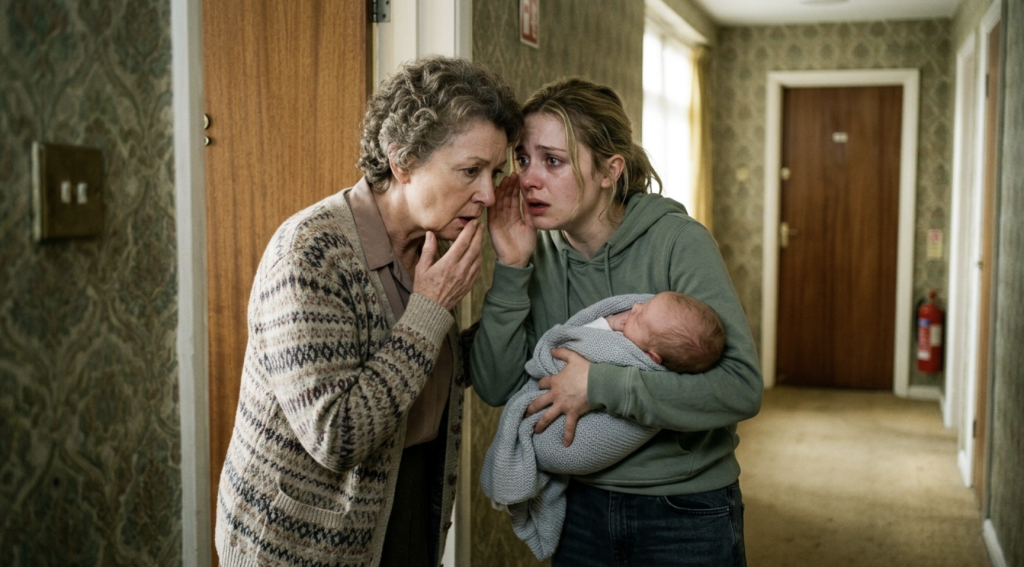
PART 3: I nodded once. Then I did something that surprised even me. I smiled. Not because I felt brave.
Because men like David expected fear, and nothing unsettles a controlling man more than someone who refuses to play the role he has written for them.
I picked up my oak cane and walked to the door.
Sarah grabbed my wrist.
“No…”
I covered her trembling hand with mine.
“Take Leo,” I whispered. “Bathroom. Lock it. If I say the word lavender, climb through the fire escape window. Do you understand?”
She stared at me.
“Lavender?”
“Repeat it.”
“Lavender.”
“Good.”
She disappeared down the hallway with the baby just as I unlocked the deadbolt.
I opened the door only six inches.
David stood there wearing pressed khakis, polished work boots, and the smile of a man who donated to church fundraisers.
If I had passed him in the grocery store, I would have thought he was somebody’s dependable son.
His eyes ruined the illusion.
They weren’t angry.
They were calculating.
“Morning, Mrs. Gable.”
“Morning.”
He leaned slightly, trying to see around me.
“I think Sarah wandered over here.”
“Did she?”
His smile tightened.
“She gets forgetful.”
“So do I,” I answered. “Must be contagious.”
For the first time, irritation flickered across his face.
“She left the baby’s blanket.”
“No blanket here.”
He laughed politely.
“You don’t mind if I check?”
I opened the door another inch.
“No, I do mind.”
His expression froze.
“I don’t think you understand.”
“Oh, son…” I sighed. “I’ve been understanding difficult men since before your mother learned to drive.”
The hallway fell silent.
He stepped closer until one boot crossed my welcome mat.
I tapped my cane against the hardwood floor.
Once.
Sharp.
“You’ll want to move your foot.”
His jaw flexed.
“Are you refusing to cooperate?”
“I am refusing to let a strange man enter my home.”
“I am Sarah’s husband.”
“And this is still my apartment.”
For a few long seconds neither of us moved.
Then, unexpectedly, he smiled again.
But this smile never reached his eyes.
“Well,” he said softly, “if you happen to see my wife… tell her dinner is at six.”
He turned and walked away.
I didn’t close the door immediately.
I watched him disappear around the corner.
Then I waited another full minute before locking every lock.
Only then did my knees begin shaking.
Sarah emerged from the bathroom clutching Leo so tightly the baby protested with sleepy little cries.
“He’ll come back,” she whispered.
“Yes.”
“He always comes back.”
I believed her.
People imagine abusive men explode like storms.
Many do.
But the most dangerous ones arrive like weather reports: calm, predictable, almost comforting.
Until the flood begins.
I handed Sarah the prepaid phone.
“This changes everything.”
She looked at it.
“Is he watching?”
“Probably.”
“He checks my pockets.”
“Then don’t take it home anymore.”
She frowned.
“How will I call you?”
I walked into my bedroom and returned with my late husband’s old hearing-aid case.
It was small enough to fit inside a baby’s diaper.
I placed the phone battery in the case.
“The battery stays with me. The phone stays hidden in Leo’s diaper bag. Separately, they’re useless.”
Sarah stared.
“You’ve done this before.”
I looked toward the framed photograph above my fireplace.
My husband, Walter, smiling in his Navy uniform.
“No,” I said quietly. “But I learned a great deal from helping frightened people during another lifetime.”
She never asked what I meant.
The next morning, Sarah didn’t come.
Neither did the morning after.
By the third day, my coffee tasted like worry.
I stood at my living-room window pretending to water plants while watching apartment 405.
At exactly 8:11, David left carrying a black lunch cooler.
He backed his truck out.
Drove away.
I waited.
Nothing.
No knock.
At 8:22, I made a decision that broke every rule we’d created.
I walked upstairs.
Apartment 405 looked perfectly ordinary.
Children’s chalk sat beside the door.
A tiny pair of sneakers.
Wind chimes moved gently in the breeze.
I knocked.
No answer.
Again.
Still nothing.
Just as I turned away, I heard the faintest sound.
Three soft taps.
Not from the hallway.
From inside the wall.
Tap.
Tap.
Tap.
My heart raced.
“Sarah?”
Silence.
Then another three taps.
I knew Morse code.
Walter had taught me decades ago while we were dating.
Three.
Pause.
Three.
Pause.
Three.
SOS.
I didn’t think.
I pulled my phone from my pocket and dialed 911.
“My neighbor is trapped,” I said. “Domestic violence. Baby inside. Send officers immediately.”
The dispatcher kept me talking.
Within four minutes, two patrol cars arrived.
The apartment manager unlocked the door.
I’ll never forget what I saw.
The apartment looked immaculate.
Too immaculate.
Every cushion perfectly centered.
Every dish washed.
Every toy lined in perfect rows.
It wasn’t a home.
It was a museum curated by fear.
“Bedroom!” an officer shouted.
They found Sarah sitting on the floor inside the walk-in closet.
The door had been locked from the outside.
Leo lay beside her in his car seat.
Both were dehydrated.
Sarah couldn’t even stand.
She simply looked at me through swollen eyes and whispered the same words she’d spoken the first day.
“I knew you’d come.”
David was arrested that afternoon.
But it wasn’t over.
Not even close.
By evening he had made bail.
I wasn’t surprised.
Money often opens doors that bruised women cannot.
The real surprise came at 9:47 p.m.
My apartment phone rang.
The landline.
Almost nobody called it anymore.
I answered.
Silence.
Then David spoke.
“You should’ve stayed lonely.”
Click.
The dial tone hummed in my ear.
I reported the threat.
The officer took notes.
“Do you feel unsafe staying here tonight?”
I looked around my apartment.
The crocheted blanket.
Walter’s photographs.
Leo’s tiny toy elephant sitting forgotten beneath my table.
“Yes,” I answered honestly.
“But I’m not leaving.”
The next morning, something unexpected happened.
Apartment doors opened one after another.
406.
404.
407.
Mrs. Alvarez stepped into the hallway carrying muffins.
Mr. Jenkins came out with his newspaper.
College student Nina appeared with her backpack.
They had all heard.
They had all seen police.
And one by one, they walked to my door.
Mrs. Alvarez spoke first.
“We didn’t know.”
I nodded.
“That’s how abuse survives.”
Nina looked down, ashamed.
“I heard yelling sometimes. I thought… maybe couples just fought.”
“No,” I said gently. “You heard someone asking for help in the only language she was allowed to use.”
Mr. Jenkins cleared his throat.
“What do we do now?”
I looked at the measuring cup still sitting on my kitchen counter.
The one Sarah had carried every morning.
I picked it up.
“No woman in this building should ever have to borrow sugar to escape again.”
That afternoon, the neighbors created something no landlord had ever planned.
We called it the Sugar Circle.
If anyone in the building knocked and asked for sugar, flour, or cinnamon, the door would always open.
No questions.
No hesitation.
Just safety.
For the first time in months, I thought perhaps the worst was finally behind us.
I was wrong.
Because two days later, Sarah’s sister called from Denver with devastating news:
“Eleanor… David is gone. He emptied their bank account last night… and nobody knows where he took Leo’s passport.”
PART 4
David believed a missing passport could keep Sarah trapped forever. He never imagined the woman he called “a lonely old widow” had spent thirty-eight years working in the county clerk’s office—and knew exactly how to prove a child belonged with his mother.
The call came just after sunrise.
I was buttering toast when Sarah’s sister, Emily, spoke through tears.
“Eleanor… the passport is gone. David emptied the checking account, closed the savings account, and Leo’s passport disappeared from the fireproof box.”
Across the kitchen, Sarah sat frozen.
She didn’t cry.
Sometimes grief becomes so large that tears simply cannot carry it anymore.
Leo banged a wooden spoon against the floor, blissfully unaware that adults were discussing the document that could decide whether he remained free or trapped.
I reached for my notebook.
“Emily,” I said calmly, “listen carefully. Did David take Sarah’s passport too?”
“No.”
“Only Leo’s?”
“Yes.”
I nodded.
Good.
That told me everything.
David wasn’t planning a vacation.
He was planning control.
A passport wasn’t valuable because of travel.
It was valuable because Sarah believed she couldn’t leave without it.
And frightened people often stay imprisoned by things they think are irreplaceable.
I turned to Sarah.
“Where was Leo born?”
“St. Mary’s Hospital.”
“Do you have his birth certificate?”
Her eyes widened.
“It’s… it’s in your tea tin.”
Exactly.
Three months earlier, while David counted diapers and controlled grocery receipts, we had quietly rescued every important document that actually mattered.
His birth certificate.
Her identification.
His vaccination records.
Copies of their marriage license.
Everything except the passport.
I smiled for the first time that morning.
“He stole the wrong paper.”
The women at the courthouse
Two days later, Sarah and I walked into the county records office.
The building smelled exactly as I remembered: old paper, polished floors, and coffee that had been sitting on a warmer since dawn.
A young clerk looked up.
“Can I help you?”
Before Sarah could panic, I stepped forward.
“Yes, dear. We need a certified birth certificate and information about replacing a child’s passport.”
The clerk handed us forms.
Sarah stared at them as if they were written in another language.
Her hands shook so badly she couldn’t hold the pen.
I quietly slid the papers toward myself.
“May I?”
She nodded.
As I filled in Leo’s information, another woman emerged from the back office.
Gray curls.
Bright lipstick.
Reading glasses hanging from a chain.
She stopped walking.
“Eleanor Gable?”
I looked up.
For one wonderful second, neither of us spoke.
Then she laughed.
“I knew it was you!”
“Martha Collins?”
She rushed over and hugged me.
We had worked together for twenty-one years before I retired.
She pulled back, smiling.
“You haven’t changed.”
“Oh, that’s a terrible lie.”
She glanced at Sarah and instantly understood this wasn’t a social visit.
Her smile softened.
“What do you need?”
Within fifteen minutes, Martha had guided Sarah through every legal form, explained the replacement process, and connected us with the victim assistance advocate stationed in the courthouse.
When Sarah apologized for crying, Martha reached across the desk.
“Sweetheart,” she said, “I have stamped marriage licenses for couples beginning their lives and death certificates for families ending them. I promise you there is no shame in starting over.”
Sarah broke down completely.
Sometimes kindness accomplishes what courage cannot.
David strikes back
That evening, the television news played quietly while Leo slept in my spare bedroom.
Sarah had finally fallen asleep on my couch.
I was knitting when headlights swept across my curtains.
Too slow.
Not driving by.
Stopping.
I stood.
A black pickup idled outside the building.
David’s truck.
He didn’t get out.
He simply sat behind the wheel.
Watching.
I switched off every light.
Five minutes passed.
Then ten.
Finally, the truck pulled away.
I immediately called Officer Denise Harper, the detective assigned to Sarah’s case.
“She’s violating bail?” I asked.
“No,” Denise sighed. “He can legally drive on public streets. But keep documenting everything.”
“Documenting won’t stop him.”
“No,” she admitted. “But it helps us when he finally makes a mistake.”
I hated that answer.
Because women shouldn’t have to wait for dangerous men to make mistakes.
The birthday invitation
Three days later, an envelope appeared beneath my apartment door.
No stamp.
No address.
Inside was a birthday invitation printed on expensive cream paper.
Leo’s First Birthday
Saturday — 2:00 p.m.
Family Only
Sarah turned pale.
“He’s never celebrated birthdays.”
There was one handwritten sentence at the bottom.
Come alone.
No signature.
None was necessary.
Detective Harper examined the invitation within the hour.
“It’s bait,” she said.
“He wants her to violate the protective order?”
“Or he wants witnesses who’ll later say she came willingly.”
Sarah looked sick.
“What do I do?”
The detective smiled.
“You stay home.”
Saturday arrived warm and cloudless.
At exactly 2:17 p.m., Detective Harper texted me.
He rented the community clubhouse. Thirty-two guests. He told everyone Sarah abandoned the baby months ago.
I looked across my living room.
Sarah was building block towers with Leo.
The irony nearly broke my heart.
The mother David claimed had abandoned her son was sitting barefoot on my rug while Leo squealed every time she pretended a tower had “accidentally” fallen.
Harper called again that evening.
“It got worse.”
“What happened?”
“He introduced another woman as Leo’s future stepmother.”
Sarah closed her eyes.
Not from jealousy.
From relief.
Because for the first time, she understood something profound.
David had never wanted love.
He had always wanted ownership.
The evidence nobody knew existed
A week later, Detective Harper arrived carrying a cardboard evidence box.
“I think you should see this.”
She placed a small digital camera on my table.
Sarah frowned.
“What is it?”
“Your baby monitor.”
She looked confused.
“We didn’t own one.”
“Yes,” Harper said quietly. “You did. David hid it.”
My stomach turned.
The detective explained that technicians searching David’s apartment had discovered miniature cameras disguised as smoke detectors and USB chargers.
He had been recording Sarah for months.
Watching her movements.
Listening to conversations.
Even monitoring the nursery.
Sarah covered her mouth.
“Oh my God…”
“But,” Harper continued, “control cuts both ways.”
She pressed play.
The video appeared on the tiny screen.
David stood in the kitchen speaking to his brother.
Laughing.
His exact words made the room go silent.
“She thinks she stays because she loves me. Truth is, she stays because I took every document she’d ever need. Fear is cheaper than flowers.”
Sarah began shaking.
Not with fear.
With fury.
Detective Harper looked at us.
“He confessed without realizing he was recording himself.”
For the first time since this nightmare began, we possessed something stronger than bruises.
We had his own voice.
His own words.
His own arrogance.
And as Harper carefully returned the camera to its evidence bag, she said the sentence I had been praying to hear for months:
“Eleanor… the prosecutor is filing felony coercive control, unlawful imprisonment, and child endangerment charges Monday morning.”
But none of us knew that David had already disappeared.
And somewhere across state lines, he was driving toward the one place he believed Sarah would eventually try to go—
Her sister’s home in Denver.
PART 5
The final knock did not come from fear. It came from justice—and this time, Sarah did not hide behind the door.
Three days after Detective Harper warned us that David had disappeared, the first snow of the season began falling over our little town.
Sarah stood at my kitchen window with Leo balanced on her hip.
“He’s going to Denver,” she whispered.
I nodded.
Emily had already called twice. She had changed the locks, alerted her neighbors, and given the local police David’s photograph. Still, the feeling that he was moving toward them settled over us like the storm clouds outside.
At exactly 6:42 p.m., my prepaid phone buzzed.
It was Harper.
“We found his truck.”
My heart jumped.
“Where?”
“An interstate rest stop about ninety miles west. Empty.”
Sarah’s knees nearly gave way.
“He left it?”
“Yes. Which means he’s trying not to be found.”
For the next forty-eight hours, every strange sound made us flinch. Every news notification made Sarah reach for Leo a little tighter.
Then, on Friday morning, the phone rang again.
This time Harper’s voice sounded different.
Lighter.
“We have him.”
Sarah stopped breathing.
“He was arrested at the Denver bus terminal. He was carrying Leo’s passport, three thousand dollars in cash, and a one-way ticket.”
The room became impossibly quiet.
Leo laughed because I made my tea kettle whistle for him.
Sarah sank into a chair and cried—not the desperate sobs I had heard months ago, but the exhausted tears of someone whose body finally believed the danger had passed.
The courtroom
Six months later, courtroom 3B was filled beyond capacity.
Neighbors.
Police officers.
Advocates.
Even Martha from the records office came during her lunch break.
David entered wearing a gray suit instead of work boots.
He looked smaller.
Not because prison had changed him, but because the illusion had disappeared.
Controlling men often seem enormous inside their homes.
Outside them, under bright courtroom lights, they become ordinary.
The prosecutor presented photographs of Sarah’s injuries, financial records showing emptied accounts, recordings from the hidden cameras, and the video where David laughed about using fear to control his wife.
His attorney argued it was “a troubled marriage.”
Then Detective Harper played the recording.
“Fear is cheaper than flowers.”
Those five words hung in the courtroom like smoke.
David never looked at Sarah again.
The woman who borrowed sugar
When it was Sarah’s turn to testify, she carried no notes.
She wore a navy blue dress Martha had insisted made her “look like tomorrow.”
She looked at the judge and spoke calmly.
“For a long time, I believed surviving meant staying quiet. I thought if I became smaller, kinder, more careful, he would stop hurting me. I was wrong. He never wanted peace. He wanted permission.”
The courtroom remained silent.
Then she looked toward me.
“The morning I knocked on Mrs. Gable’s door, I wasn’t asking for sugar. I was asking if another human being would believe me without making me prove I deserved help.”
I lowered my eyes because I knew I would cry if I didn’t.
The judge sentenced David to multiple years in state prison for coercive control, unlawful imprisonment, domestic assault, and child endangerment. A permanent protective order followed, along with sole legal and physical custody of Leo being awarded to Sarah.
No one applauded.
Justice is not entertainment.
But I heard something better.
Sarah exhaled.
One long breath she had been holding for years.
One year later
Apartment 405 stayed empty for a long time.
The landlord eventually renovated it.
New paint.
New floors.
Different curtains.
As if walls could forget.
My own apartment changed too.
The silence never returned.
Every Saturday morning, Leo—now walking with determined little steps—ran straight through my front door without knocking.
He called me “Ellie” because he still couldn’t pronounce Eleanor.
I never corrected him.
Sarah found work at the public library.
She loved helping children discover books, and the librarians loved how every frightened child somehow wandered naturally toward her.
Healing recognizes healing.
On the anniversary of the day she first knocked on my door, Sarah arrived carrying a small paper bag.
“I brought you something,” she said.
Inside was a brand-new glass sugar jar.
Its lid was painted with tiny blue flowers.
There was a handwritten label tied around it with ribbon.
For the next woman who needs an excuse.
I couldn’t speak.
I simply placed the jar beside my coffee maker where everyone could see it.
The Sugar Circle
What began as one frightened mother’s excuse became an entire community’s promise.
Every apartment in our building kept a small sugar jar near the front door.
Everyone knew what it meant.
If someone knocked asking for sugar, flour, or cinnamon, the door opened.
No questions.
No judgment.
Just safety.
People from neighboring buildings eventually copied the idea.
Then another neighborhood.
Then another.
The local newspaper called it The Sugar Circle, but I always thought they missed the point.
It was never really about sugar.
It was about believing someone before they had the strength to tell the whole story.
Sometimes the bravest rescue doesn’t begin with sirens or dramatic speeches.
Sometimes it begins with an elderly widow opening her door and saying four ordinary words that quietly change two lives forever:
“Come inside, dear.”