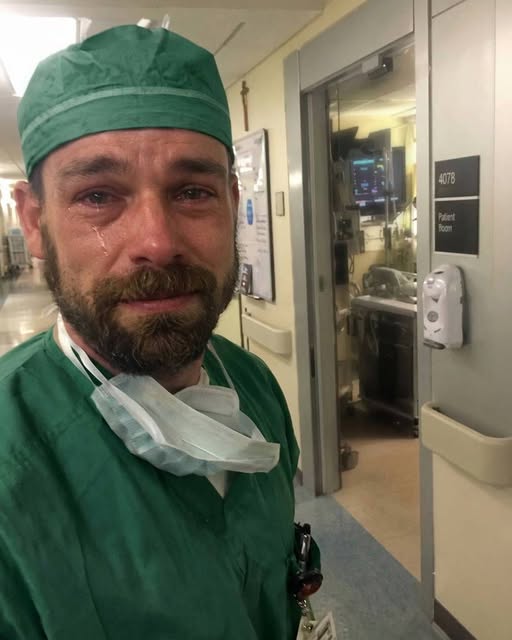
Arnold’s lower lip trembled. He didn’t just look tired—he looked hollowed out, as if some vital piece of machinery inside him had snapped off and left a jagged hole.
The silence at the nurses’ station suddenly grew deafening. The rhythmic beeping of a distant heart monitor and the squeak of rubber-soled shoes on linoleum seemed to fade into a vacuum.
“Arnold?” My voice felt thin, like paper tearing. The plastic lunch container in my hands suddenly weighed a hundred pounds. “What are you talking about? What hasn’t he told me?”
Arnold looked away, scrubbing a trembling hand over his face. He swallowed hard, his Adam’s apple bobbing violently. “Let’s… let’s go somewhere private. Not here.”
“No,” I said, planting my feet. The warmth of the apple pie inside the bag was fading against my fingertips. “No, Arnold, you don’t get to look at me like a ghost and tell me to move. Where is my husband?”
“Clara,” Arnold whispered, his voice cracking. He reached out, his hand hovering near my arm before dropping back to his side as if he were afraid to touch me. “Just… come with me to the doctors’ lounge. Please.”
The walk down the corridor felt like wading through wet cement. Every nurse, every orderly we passed suddenly found something intensely fascinating on their clipboards or the floor tiles. No one met my eyes. The institutional smell of bleach and hand sanitizer turned my stomach.
When Arnold pushed open the heavy wooden door to the doctors’ lounge, the room was empty. The morning coffee pot was still half-full, a greasy paper bag from the cafeteria sitting next to it.
Arnold closed the door behind us with a heavy, final click. He leaned back against it, his chest heaving under his white coat.
“Start talking,” I demanded. My heart was hammering against my ribs like a trapped bird. “Is he sick? Did he collapse? Is that why he hasn’t been coming home—is he sick, Arnold?”
“He’s not sick, Clara,” Arnold said, his voice barely a breath.
“Then what is it? Is it malpractice? Did something go wrong in the O.R.? Is he suspended?” A dozen catastrophic scenarios raced through my head, each one more terrifying than the last, and yet—none of them matched the sheer terror vibrating in Arnold’s posture.
“Ben hasn’t worked at this hospital in six months.”
The words hit the quiet room with the force of a physical blow. I stared at him, my mouth slightly open, waiting for the punchline. Waiting for him to crack a weak smile, to say *gotcha*, to tell me Ben was scrubbed in on a twelve-hour neurosurgery and couldn’t be disturbed.
“Don’t,” I breathed, a wet, hysterical laugh catching in my throat. “Don’t joke about that. I watched him walk out of our house this morning. I ironed his shirts yesterday. I packed his badge—”
“No, you didn’t,” Arnold interrupted gently, tears finally spilling over his eyelashes and tracking down his pale cheeks. “You packed his clothes, you watched him leave the driveway. But he didn’t come here, Clara. Not for a very long time.”
“He leaves at five-thirty every single morning!” My voice rose, cracking with a sudden, violent fury. “He comes home smelling like antiseptic and coffee! He talks about his cases—he tells me about the pressure, the interns, the late-night trauma cases! Are you out of your mind? What kind of sick game are you playing?”
Arnold didn’t flinch. He just reached into his coat pocket, pulled out his phone, and fumbled with the screen before holding it out toward me.
“Look at the staff directory,” he whispered. “Check the active roster. Look at the parking garage logs. Ben hasn’t held a scalpel here since October.”
I didn’t take the phone. I couldn’t. If I took it, if I looked at the cold, hard pixels of truth, the fragile glass house I had lived in for eleven years would shatter into a million irreparable pieces.
“Why?” I choked out, sliding backward until the edge of the laminate table caught me behind the knees. “Why would he lie to me? Where does he go? If he’s not here… where has he been going every day for six months?”
Arnold lowered his head, his shoulders shaking. “I don’t know, Clara. None of us do. But… God help you, you need to find out.”
—
The drive home was a blur of red lights, angry horn blasts, and tears streaming so fast I could barely see the road. My hands shook so violently on the steering wheel that the car drifted across lanes twice.
*Six months.*
How do you miss six months of your life? How does a man put on a clean shirt, kiss his wife on the forehead, whisper *“Love you, see you tonight,”* and walk out into a complete and total fabrication?
When I pulled into the driveway, Ben’s car was already there.
A wave of dizzying nausea rolled over me. My breath hitched. He wasn’t supposed to be home. It was only two in the afternoon. His shifts never ended before seven, sometimes eight at night.
I cut the engine, sat in the suffocating silence of the car, and stared at our front door. The brass numbers—*1424*—shone in the midday sun. It looked like a normal house. A happy house. A house where an eight-year-old girl played with her dolls and a devoted doctor came home to his loving wife.
I got out of the car, leaving the plastic bag with the uneaten apple pie on the passenger seat.
When I unlocked the front door, the house was dead quiet. Lily was at school, and the dog was asleep on the rug.
“Ben?” I called out. My voice sounded small, alien.
No answer.
I walked down the short hallway toward his home office—the sanctuary he claimed he needed for reviewing medical journals, writing case studies, and catching up on administrative paperwork. He always kept it locked. *“Patient confidentiality, honey,”* he’d told me a hundred times. *“HIPAA laws. Even at home, I can’t leave files lying around where Lily might see them.”*
I walked to the kitchen, opened the junk drawer by the pantry, and reached all the way to the back, past the old batteries and takeout menus. My fingers brushed against a cold, heavy piece of metal.
His spare key.
I had never used it. In eleven years, I had respected his boundaries, his privacy, his immense burden as a healer.
My hand trembled so hard the key clattered against the drawer handle before I managed to pry it free.
Walking back to the study, every footstep felt like I was walking to the gallows. I slid the key into the brass lock. It turned with a smooth, oiled click.
I pushed the door open.
The room didn’t smell like a study. It didn’t smell like old leather books, printer paper, or coffee.
It smelled like damp cardboard, cheap instant noodles, and unwashed laundry.
I flipped the wall switch, and the overhead light flickered on, revealing a nightmare of deception.
The expensive mahogany desk Ben supposedly worked at was covered not in medical journals, but in stacks of past-due utility notices, bank statements, and collection letters. Hundreds of them. Spread across the center of the desk was a laptop, its screen glowing in screensaver mode, surrounded by empty energy drink cans and a half-eaten sleeve of saltine crackers.
But it was the walls that made the breath rush out of my lungs.
Corkboards had been nailed directly into the pristine drywall. Pinned to them were hundreds of photographs, printouts of hospital schedules, handwritten timelines, and sticky notes color-coded by date and location.
At the center of it all was a large map of the city, crisscrossed with red yarn.
I stepped inside, my shoes crunching on something gritty on the hardwood floor. I approached the desk, my gaze locking onto the top bank statement.
*Account Ending in 4492 – Past Due: $14,280.00. Final Notice.*
I picked up the statement, my eyes scanning the numbers. Our main savings account—the one Ben managed, the one he swore had been growing steadily for Lily’s college fund—wasn’t just empty. It was deeply in the negative. Maxed-out credit cards, second mortgages I never signed for, emergency loans taken out against our house.
He was bankrupt. Completely, utterly, catastrophically ruined.
“Clara?”
The voice came from the doorway, soft, flat, and completely devoid of the warm baritone I had loved for over a decade.
I spun around.
Ben stood in the frame. He was still wearing his white coat, his stethoscope draped around his neck, holding his hospital badge in his hand. But without the armor of his professional confidence, he looked shrunken. His cheeks were hollow, his eyes sunken into dark, purple hollows.
He looked like a man who had been slowly starving himself to death for years.
“You’re home early,” he said. It wasn’t an accusation. It was just a tired observation, like a man commenting on the weather.
“Ben,” I whispered, the paper shaking in my hand. “What is this? What is all of this?”
Ben didn’t run. He didn’t yell. He didn’t even try to lie. He just closed the study door behind him, locked it with a small click, and leaned his forehead against the wood for a long, agonizing moment.
“I tried,” he whispered to the door. “God, Clara, I tried so hard to keep it away from you.”
—
“Keep what away?” I stepped toward him, my voice rising, terror and rage warring in my chest. “Bankruptcy? Ruin? Lying to me every single day for six months? Ben, you don’t work at the hospital! Arnold told me! You haven’t worked there since October! Where have you been going? What have you been doing?”
Ben slowly turned around. He slid down the door until he was sitting on the floor, his knees drawn up to his chest, clutching his hospital badge in his fist like a talisman.
“I was fired,” he said, the words flat and dead.
The room spun. “Fired? A brilliant surgeon? Chief of trauma—”
“I made a mistake,” Ben interrupted, his voice dropping to a gravelly rasp. “October fourteenth. A complicated aortic dissection. Patient was seventy-four. I was… I was exhausted, Clara. I hadn’t slept in thirty-six hours. My hands… they slipped. Just for a second. But it was enough.”
He looked up at me, his eyes shining with unshed tears. “The patient didn’t make it. The review board found gross negligence due to fatigue. They stripped my license, Clara. Suspended indefinitely, pending a full psychiatric evaluation and retraining that I couldn’t afford.”
The rage inside me faltered, replaced by a cold, numbing shock. “You lost your license… and you didn’t tell me? You let me think you were saving lives? You let me worry about you being overworked, you let me pack your lunches and kiss you goodbye while you drove off into the damn void?”
“What was I supposed to say?” Ben shouted suddenly, his voice cracking with a raw, ugly desperation that made me jump back. “What was I supposed to tell the woman who looked at me like I hung the damn moon? *’Hey honey, I destroyed our family, I killed a man on the table because I was too proud to admit I was burning out, and now we’re losing the house’*?”
He buried his face in his hands, his shoulders heaving.
“I couldn’t bear to see the look in your eyes,” he sobbed. “I couldn’t bear to watch you look at me and realize that the man you married—the brilliant, successful doctor—was a fraud. A failure. So I bought a white coat online. I printed a replica badge. And every morning at five-thirty… I got dressed, I got in my car, and I drove away because I had nowhere else to go.”
The silence in the room stretched out, heavy and suffocating.
“Where did you go, Ben?” I asked, my voice barely audible.
“Nowhere,” he whispered. “The public library downtown. The park benches. Sometimes parking garages. I sat in my car for twelve hours a day, reading old medical textbooks on my phone, pretending I was on call, waiting for the clock to hit six so I could come home and pretend I was still a whole person.”
I looked down at the bank statements, the collection letters, the red yarn mapping out a life that had collapsed long ago. My chest felt tight, constricted by a grief so profound it felt like physical pain. Eleven years. An entire lifetime built on trust, respect, and shared dreams—all of it vanishing into a cloud of shame and deception.
“We have a daughter, Ben,” I said, my voice shaking. “We have a mortgage. We have bills piling up to the ceiling. You didn’t just lie to protect my feelings—you lied because you couldn’t face the consequences, and you let our family drown while you sat in a parking garage.”
Ben didn’t defend himself. He didn’t look up. He just sat there on the floor, a broken man clutching a fake badge.
“I’m sorry,” he whispered, the words sounding hollow, useless, and entirely too late. “I’m so sorry, Clara.”
—
The next forty-eight hours were a blur of cold efficiency that terrified even me.
I didn’t yell anymore. The anger had burned itself out, leaving behind a hard, crystalline clarity. While Lily was at school, Ben and I sat at the kitchen table—not looking at each other—and began dismantling the illusion piece by piece.
We called the bank. We called the mortgage company. We found out the brutal truth: we were ninety days away from foreclosure. The car loans were in default. Ben’s severance and savings had vanished months ago into quiet, desperate cash advances and high-interest loans he had taken out to pay the minimum balances.
“We have to sell the house,” I said quietly, staring down at a spreadsheet I had pulled up on my laptop.
Ben flinched as if I had struck him. “Clara, no. Lily’s school is here. Her friends are here. This is our home.”
“It’s not our home, Ben,” I said, looking him dead in the eye for the first time since the truth came out. “It’s a stage set. And we can’t afford the rent anymore. The rent being our sanity.”
He didn’t argue. He couldn’t.
That evening, after Lily went to sleep, I sat on the edge of our bed. Ben stood by the window, staring out into the dark street.
“What are you going to do?” I asked him.
“I don’t know,” he murmured, his back to me. “I talked to a lawyer friend—off the record. If I cooperate with the medical board, if I complete mandatory rehabilitation for burnout and psychological distress, there’s a slim chance—a very slim chance—I could petition for reinstatement in two or three years. But I’ll never practice surgery again. At best, general medicine. Clinic work. Something small.”
“And until then?”
“I’ll get a job,” Ben said, turning around, his face etched with a grim, exhausted resolve. “Retail, warehousing, night shifts, driving a truck—anything. I’ll do whatever it takes to keep a roof over your heads, even if I’m not under it with you.”
I looked at him—really looked at him. The man I had loved for eleven years was gone. In his place was a flawed, broken human being who had made catastrophic, cowardly choices, but who was finally, painfully, standing in the harsh light of reality.
“I’m not leaving you yet, Ben,” I said slowly, choosing every word with care. “Not because of what you did. But because we have a daughter who deserves to see how adults clean up a mess instead of hiding from it.”
Ben swallowed hard, a single tear cutting a clean path through the stubble on his cheek. He didn’t move toward me. He didn’t ask for forgiveness. He just nodded once.
“Thank you,” he whispered.
—
Three months later, the house was sold.
We moved into a modest, two-bedroom apartment on the other side of town, close to Lily’s new school. The boxes were barely unpacked when Ben came home from his new job—not in a pristine white coat, but in the heavy canvas jacket of a logistics warehouse supervisor, smelling of cardboard and dust.
He dropped his keys on the small entryway table, kicked off his steel-toed boots, and walked into the cramped kitchen where I was standing at the counter, sorting through bills.
He didn’t say anything. He just reached around me, picked up the sponge, and quietly began wiping down the counter.
I stopped what I was doing, leaned my hip against the edge of the sink, and watched him.
“Rough day?” I asked softly.
Ben paused, the sponge in his hand dripping water into the basin. He looked at me, a faint, weary shadow of a smile touching the corners of his mouth.
“Long day,” he said, setting the sponge down. He reached out, his hand steady for the first time in months, and tucked a stray strand of hair behind my ear. “But I’m home. And this time… I’m actually here.”
I covered his hand with mine, feeling the calluses from his new work, the rough edges of a life we were rebuilding from the ground up.