0 views
“Where did you go, Ben?” I asked, my voice barely audible.
“Nowhere,” he whispered. “The public library downtown. The park benches. Sometimes parking garages. I sat in my car for twelve hours a day, reading old medical textbooks on my phone, pretending I was on call, waiting for the clock to hit six so I could come home and pretend I was still a whole person.”
I looked down at the bank statements, the collection letters, the red yarn mapping out a life that had collapsed long ago. My chest felt tight, constricted by a grief so profound it felt like physical pain. Eleven years. An entire lifetime built on trust, respect, and shared dreams—all of it vanishing into a cloud of shame and deception.
“We have a daughter, Ben,” I said, my voice shaking. “We have a mortgage. We have bills piling up to the ceiling. You didn’t just lie to protect my feelings—you lied because you couldn’t face the consequences, and you let our family drown while you sat in a parking garage.”
Ben didn’t defend himself. He didn’t look up. He just sat there on the floor, a broken man clutching a fake badge.
“I’m sorry,” he whispered, the words sounding hollow, useless, and entirely too late. “I’m so sorry, Clara.”
—
The next forty-eight hours were a blur of cold efficiency that terrified even me.
I didn’t yell anymore. The anger had burned itself out, leaving behind a hard, crystalline clarity. While Lily was at school, Ben and I sat at the kitchen table—not looking at each other—and began dismantling the illusion piece by piece.
We called the bank. We called the mortgage company. We found out the brutal truth: we were ninety days away from foreclosure. The car loans were in default. Ben’s severance and savings had vanished months ago into quiet, desperate cash advances and high-interest loans he had taken out to pay the minimum balances.
“We have to sell the house,” I said quietly, staring down at a spreadsheet I had pulled up on my laptop.
Ben flinched as if I had struck him. “Clara, no. Lily’s school is here. Her friends are here. This is our home.”
“It’s not our home, Ben,” I said, looking him dead in the eye for the first time since the truth came out. “It’s a stage set. And we can’t afford the rent anymore. The rent being our sanity.”
He didn’t argue. He couldn’t.
That evening, after Lily went to sleep, I sat on the edge of our bed. Ben stood by the window, staring out into the dark street.
“What are you going to do?” I asked him.
“I don’t know,” he murmured, his back to me. “I talked to a lawyer friend—off the record. If I cooperate with the medical board, if I complete mandatory rehabilitation for burnout and psychological distress, there’s a slim chance—a very slim chance—I could petition for reinstatement in two or three years. But I’ll never practice surgery again. At best, general medicine. Clinic work. Something small.”
“And until then?”
“I’ll get a job,” Ben said, turning around, his face etched with a grim, exhausted resolve. “Retail, warehousing, night shifts, driving a truck—anything. I’ll do whatever it takes to keep a roof over your heads, even if I’m not under it with you.”
I looked at him—really looked at him. The man I had loved for eleven years was gone. In his place was a flawed, broken human being who had made catastrophic, cowardly choices, but who was finally, painfully, standing in the harsh light of reality.
“I’m not leaving you yet, Ben,” I said slowly, choosing every word with care. “Not because of what you did. But because we have a daughter who deserves to see how adults clean up a mess instead of hiding from it.”
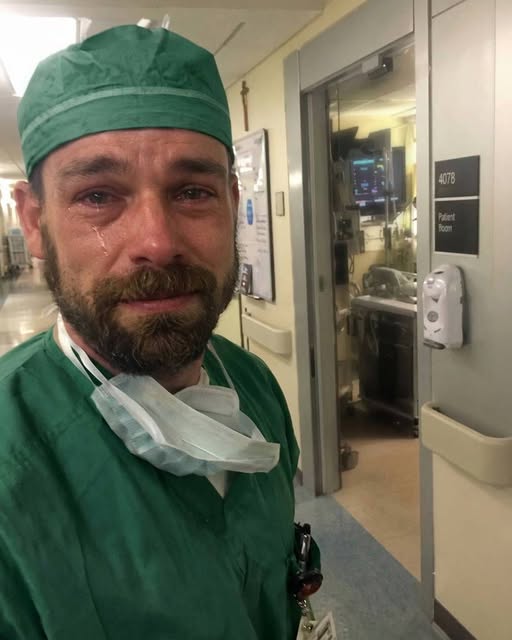
Ben swallowed hard, a single tear cutting a clean path through the stubble on his cheek. He didn’t move toward me. He didn’t ask for forgiveness. He just nodded once.
“Thank you,” he whispered.
—
Three months later, the house was sold.
We moved into a modest, two-bedroom apartment on the other side of town, close to Lily’s new school. The boxes were barely unpacked when Ben came home from his new job—not in a pristine white coat, but in the heavy canvas jacket of a logistics warehouse supervisor, smelling of cardboard and dust.
He dropped his keys on the small entryway table, kicked off his steel-toed boots, and walked into the cramped kitchen where I was standing at the counter, sorting through bills.
He didn’t say anything. He just reached around me, picked up the sponge, and quietly began wiping down the counter.
I stopped what I was doing, leaned my hip against the edge of the sink, and watched him.
“Rough day?” I asked softly.
Ben paused, the sponge in his hand dripping water into the basin. He looked at me, a faint, weary shadow of a smile touching the corners of his mouth.
“Long day,” he said, setting the sponge down. He reached out, his hand steady for the first time in months, and tucked a stray strand of hair behind my ear. “But I’m home. And this time… I’m actually here.”
I covered his hand with mine, feeling the calluses from his new work, the rough edges of a life we were rebuilding from the ground up.