0 views
The January wind off the water was sharp enough to sting my cheeks. I had been driving since dawn from Philadelphia, my overnight bag still in one hand and my keys in the other, my back aching from too many hours behind the wheel. I had spent the last hundred miles imagining only two things. Silence and sleep. Sleep in my own bed under the slanted ceiling, with the sound of the Atlantic moving beyond the dunes like slow breathing.
That house was not a gift. Nobody handed it to me. I built it the same way I built every secure thing in my life after widowhood: one small stubborn stitch at a time.
When Winston died I was fifty years old with bills, grief, a teenage son, and a sewing machine that groaned every time I asked too much of it. I took alterations from anyone who asked. Wedding hems. School uniforms. Bridesmaid dresses bought in the wrong size. Broken zippers. Pants let out after babies or heartache. I worked with cheap coffee at midnight and pins in my mouth and swollen fingers in February. I saved whatever was left in an envelope I kept inside a flour tin over the refrigerator. I called it my little piece of air.
Twelve years later, that little piece of air became a half-rotted cottage on the Rhode Island coast with damp walls and cracked porch railings and a garden everyone else in town thought was too far gone to bother with.
I bothered. I painted walls until my shoulders burned. I ripped out moldy cupboards. I sanded floors myself. I changed locks. I planted hydrangeas and rosemary and a stubborn strip of lavender that survived two terrible winters simply because I refused to let it die. I sewed cushions for the wicker chairs on the back terrace and stitched my initials into the hems because for the first time in my adult life I owned something that belonged only to me.
So when I turned onto my street and saw three unfamiliar SUVs lining the curb, towels hanging over my wicker chairs, music thumping through my open windows, and a plastic sand bucket tipped over in my herb bed, what I felt first was confusion. Then anger. Then something colder than anger.
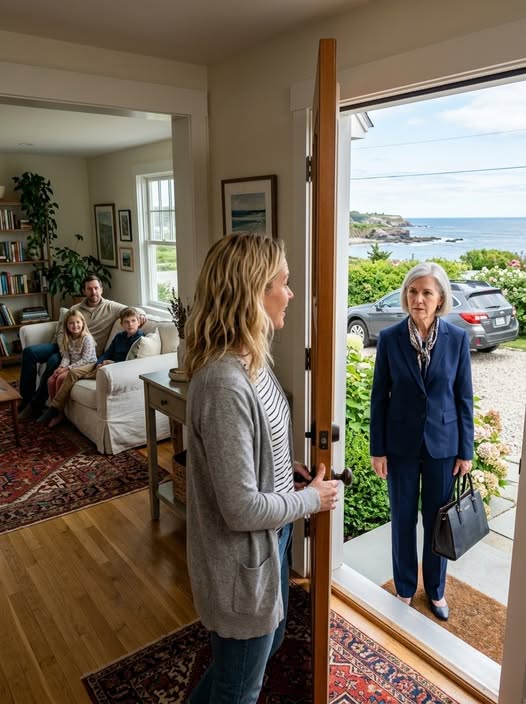
Inside, children I did not recognize raced across my back terrace with wet feet. My blue throw pillows had been tossed onto the floor. A woman I recognized as Tiffany’s sister was stretched across my sofa with her shoes on, scrolling her phone. Tiffany’s mother rifled through my kitchen cabinets as if she had every right to examine my dishes. On the couch by the front window, my reading place, there was a baby asleep in a portable nest surrounded by someone else’s things.
Then Tiffany appeared. Polished, smiling, my apron tied around her narrow waist like a costume.
“I told Peter I’d be here today,” I said.
She smiled, but her eyes did not. “Well, we’re here now. And honestly, there’s no room for extra guests.”
Extra guests. In my own house.
It was such a perfect sentence that for a moment I almost admired its cruelty. She had prepared it. I could tell. It was not a slip. It was a message.
Everyone inside had stopped moving. They were watching. Waiting to see if the old woman would cry, or shout, or beg her place back like some foolish sentimental widow no one had to take seriously.
I looked at the keys in my palm. Then at the muddy shoe print on the rug I had cleaned on my hands and knees.
“All right,” I said softly.
Relief flashed across her face.
“I’ll find somewhere else to stay.”
I smiled back at her with a calm I did not remotely feel, carried my bag down the porch steps, and walked to my car with my spine straight and my pulse hammering in my ears.
I drove three miles inland to a small hotel with a side view of the water if you leaned far enough over the balcony and ignored the parking lot. I set my bag down, sat on the edge of the bed, and let myself be still.
I did not cry.
Clarity was what filled me that evening. Because the humiliation at the door had been too clean to be spontaneous. Too deliberate. Too theatrical. Tiffany had not just wanted the house for a week. She had wanted me to understand something. That I was no longer expected to arrive. That my own property had become, in someone else’s mind, negotiable. And if I had learned anything in seventy years, it was that when someone goes out of their way to humiliate you instead of merely inconveniencing you, there is almost always a darker reason underneath.
I made tea with the little in-room kettle and carried the cup onto the balcony in my coat. I stood there a long time thinking about Winston, about Peter, about the boy who used to race ahead on the boardwalk collecting smooth stones and pieces of rope he believed could be useful someday.
The more I thought, the less this looked like a thoughtless family overstep.
Peter knew I kept that house like a chapel. Peter knew I had texted him three days earlier saying I was arriving Friday. He had answered with a thumbs-up.
That question kept me awake until dawn.
The next morning I dressed carefully. Dark slacks, wool sweater, the camel coat Winston used to say made me look like a woman who knew things. I put on lipstick though I rarely bothered with it in winter. Then I drove back to the house.
My key did not fit the front door.
Not because I was shaking. Because the lock had been changed.
I stood there with the key in my fingers and the new brass cylinder glinting in the weak sunlight, and something inside me turned hard.
Changing the lock meant intention. Preparation. Permanence, or at least an attempt at it.
I remembered the side gate, old cedar with a latch I had installed myself. The small skeleton key for that gate was still on my ring. I slipped through into the narrow path between the house and the neighbor’s fence and moved toward the kitchen window, which was cracked open.
Tiffany’s voice drifted out.
“Once the paperwork is filed, the rest is easy.”
Her mother answered. “And what if she fights?”
Tiffany laughed. “Rosalind? Please. She folds. Peter says she hates conflict more than anything.”
My hand tightened around my key ring until the metal points bit into my palm.
Her mother made a doubtful sound. Tiffany’s voice dropped lower, almost impatient. “By the time she realizes what’s happening, the conservatorship petition will already make her look unstable. Peter has examples. The doctor’s appointment. The confusion with the pharmacy. That time she forgot her charger and drove back to Philly without it. We don’t need much. Just enough to say she’s having memory problems.”
My vision narrowed.
Conservatorship.
Her mother sucked in a breath. “That sounds extreme.”
“It sounds necessary. The house is worth almost triple what she paid.”
Then Tiffany again, in the bright voice she used when pretending to be charming: “Once the sale goes through, we can put her somewhere lovely. She’ll have a little room, meals, people her own age. She should be grateful.”
I don’t remember breathing. I remember the cold siding under my fingers and the taste of metal in my mouth and the sound of a spoon clinking against a mug inside my own kitchen while they discussed filing me away like inconvenient furniture.
I waited until footsteps receded. Then I slipped through the side mudroom door, which used the old lock Tiffany had apparently forgotten to change. My key slid in.
I crossed the kitchen in silence and went straight to the printer in the built-in nook. Four pages in the tray.
The first was a listing packet from a real estate office in Newport with my property address across the top. The second was a draft for a luxury short-term rental transition. The third was a preliminary valuation with a figure that made my stomach drop.
The fourth stopped my breath entirely.
Petition for Emergency Temporary Conservatorship of Rosalind Margaret Hale.
My name. My date of birth. Language describing recent cognitive decline, disorganized financial judgment, inability to independently manage secondary residential property.
Applicant: Peter Hale, son.
I snatched the pages from the tray, pressed them under my coat, eased the mudroom door closed without letting it click, went through the gate and around the block and did not stop walking until I reached my car.
Only then did I sit down behind the wheel and look at the papers properly.
There was no confusion left after that. No room for misunderstanding or family diplomacy or maybe-they-meant-well foolishness. Whatever still lived inside me that wanted to protect Peter broke cleanly in that parking spot.
Because Peter’s name was right there. He had not been manipulated from the sidelines. He was inside it. Signing it. Building it.
I drove not to the hotel but straight into town.
There are names that rise in your mind in moments of true urgency the way flares rise in darkness. One of those names was Mara Quinn. She was a real estate attorney in Newport, a woman ten years younger than I was and as sharp as cut glass.
Twenty-two years earlier, when her daughter needed a prom dress altered in forty-eight hours during the worst period of Mara’s life, she had come to my workroom with panic in her eyes. I had stayed up all night and refused extra money. She had never forgotten it.