0 views
She answered on the second ring.
I set my purse on her desk, took out the conservatorship petition and the listing pages, and told her everything. The arrival. Tiffany at the door. The changed lock. The conversation through the window. Peter’s name on the petition.
Mara read every page twice. Then she leaned back and exhaled through her nose.
“That little snake,” she said with admirable clarity.
She asked the questions I should have asked myself sooner. Who holds title? Me, alone. Any power of attorney to Peter? Never. Any authorization to list or manage? No. Discuss conservatorship with anyone? No.
“Good,” she said. “Then what they’ve drafted is not only obscene. It may also be stupid.”
She made calls. The title company. The bank. A detective named Ruiz who handled property fraud. A judge’s chambers clerk about emergency relief.
Then she walked me to the county records office.
The clerk pulled up the parcel records, frowned, and said, “There is a recently recorded quitclaim deed.”
From: Rosalind Margaret Hale. To: Peter Winston Hale. Recorded three days earlier.
Three days earlier I had been in Philadelphia fitting a bride for a last-minute sleeve adjustment while my son, somewhere else, was recording a deed transferring my house into his name.
The signature was mine in shape but not in soul. Anyone who had seen me sign enough things could have imitated the loops. The notarization was from New Jersey. Notary public: Anthony Bell.
“Tiffany’s cousin,” I said at once.
There were more documents. A pending home equity line application tied to Peter’s name using the property as collateral. A valuation request from a brokerage. Nothing had closed yet, but enough had been set in motion to frighten any sensible woman out of a decade.
Peter was in debt. The bank representative, careful but unable to hide the shape of it, made that clear. A failed investment in luxury event spaces, personal guarantees, a collapse he had not told me about. My house, fully owned in a rapidly appreciating coastal market, had become the easiest source of
money available to him. He had likely started by persuading himself it was temporary. Then practical. Then deserved. And Tiffany had added style and audacity and poison.
The house would not just be collateral. It would be sold. And the conservatorship was their insurance policy: if I objected, I would be painted as confused, emotional, declining.
By late afternoon, Mara had secured an emergency hearing for Monday morning and a temporary administrative hold on any sale, financing, or transfer. Detective Ruiz had begun a fraud inquiry. The bank had frozen the line.
That evening my phone rang. Peter.
I answered.
“Mom,” he said, in the exact tone men use when they know they have been caught but hope warmth might still save them. “I’ve been trying to reach you.”
“I know.”
“Can we not do this over the phone?”
“You recorded a deed stealing my house. We can do it however you like.”
His inhale hit the receiver sharp and audible.
Did you think I wouldn’t find out, I asked. I told him what I knew. The deed. The petition. The realtor. The conversation through the kitchen window.
When I mentioned the conservatorship, the line went silent for six seconds.
Then he said, so quietly I almost missed it, “Tiffany found that?”
“I found it.”
He let out a curse under his breath.
“You were going to tell a court I’m incompetent,” I said.
“It wasn’t supposed to go that far.”
“Your name is on the petition.”
“I know.”
There are certain heartbreaks too old for tears. I had not raised a cruel boy. I had raised a boy who once gave away his allowance to a classmate whose lunch had been stolen. Hearing that same son breathe into a phone line after trying to legally erase me did not feel like grief. It felt like watching a house burn where the rooms still exist in memory while the walls go black.
“Why, Peter?”
He said he had gotten in over his head. He mentioned the investment collapse, the tax issues, Tiffany’s family getting involved. His voice turned defensive, recognizable from adolescence: “You have two houses, Mom.”
I did not speak because if I had I might have screamed.
He rushed on: “I thought if we sold the place or leveraged it—”
“Did you know she changed my front lock?”
Silence.
“Did you know she told me to leave?”
Still silence.
“You were going to let her bully me into surrendering the house,” I said. “Weren’t you.”
“That’s not fair.”
“From this point forward,” I said, “you speak to my attorney.”
I hung up.
Sunday morning. Mara called. The realtor had scheduled a private walk-through with a boutique hospitality investor from Providence, believing Peter had inherited the property.
Because of the hold and the fraud inquiry, the investor had been informed that title was disputed and declined to come. But Tiffany and her family did not know that yet, and Peter was driving up from Philadelphia to explain.
I put on my navy wool dress, pearl studs, and the silver brooch Winston gave me on our twenty-fifth anniversary, a small etched gull in flight. Not because I am theatrical, but because some battles deserve dignity in dress.
At two-forty we drove to my house. Mara. Detective Ruiz. A uniformed officer. The locksmith in his van three blocks away. And me.
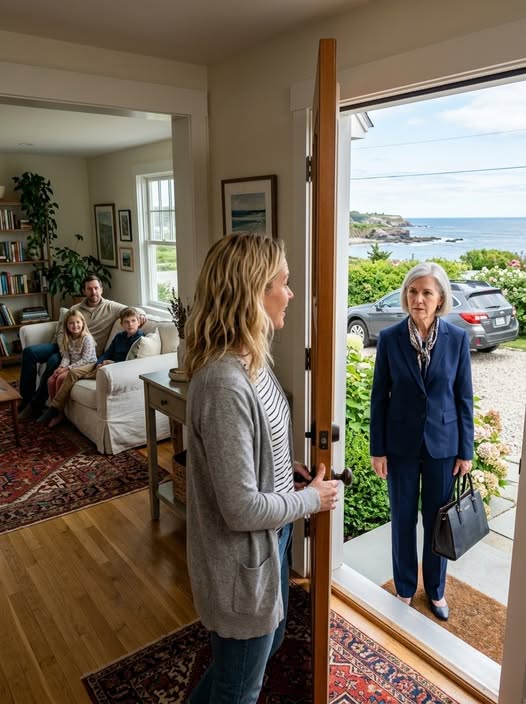
Tiffany answered when Ruiz knocked. She had dressed to impress the investors in my house, cream trousers and cashmere, candles lit in the entryway as if stealing a widow’s refuge required ambiance. Her face changed in layers when she saw who stood on the porch.
“Rosalind,” she said, recovering fast. “What is all this?”
“My house,” I said, “being returned to me.”
Detective Ruiz presented his identification and informed all unauthorized occupants that they must gather their belongings and leave immediately.
Her smile came back, thinner. “My husband owns this property.”
“He does not,” Mara said. “The recorded deed is disputed as fraudulent, lending is frozen, title is under review, and your occupancy is unauthorized.”
Tiffany gave a soft incredulous laugh, the kind she used when trying to make authority sound embarrassing. “Rosalind, have you really involved the police in a family misunderstanding?”
“A misunderstanding is using the wrong tablecloth,” I said. “This is forgery.”
The next thirty minutes were chaos, not the kind they had scripted for me. Children stomped upstairs. Suitcases thudded.
Tiffany’s mother hissed about humiliation while shoving toiletries into bags. A lamp went over somewhere. The baby cried without stopping. I stood in my own entryway and watched them dismantle their occupation piece by piece.
At one point Tiffany swept past me and said, low enough that only I could hear, “You always were dramatic.”
“No,” I said. “I was patient. That was your mistake.”
She flinched.
Peter arrived at three-twelve. He saw Ruiz. He saw Mara. He saw Tiffany on the porch with packed bags. Whatever hope he had brought with him vanished from his face.
He looked terrible. Too thin around the mouth, the expensive coat unable to disguise the collapse underneath.
“Mom,” he said.
“Did you forge my deed?” I asked.
He closed his eyes.
“Did you?”
“Yes,” he said.
The rain, the gulls, the distant traffic. All of it seemed to recede around that single syllable.
“I had the deed prepared. I had it recorded. I told myself I’d reverse it once I solved everything.”
“When would you have reversed selling my house?”
He had no answer.
Tiffany stepped forward. “He did what he had to do. We’re family.”
I turned to her. “No,” I said. “You are a thief with good lipstick.”
Her mouth fell open.
Ruiz quietly advised Peter not to continue discussing the matter without counsel. Peter looked at the detective as if criminality had only just arrived as a concept.
He turned back to me, rain dripping from his hairline. “I can fix this,” he said.
I looked at the packed bags on the porch. At the broken planter. At the changed lock. At the son I had once believed would never knowingly wound me.
“No, Peter. You can’t.”
Tears rose in his eyes. Real ones. “I never wanted to hurt you.”
“You wanted to avoid hurting yourself more.”
“That’s not the same.”
“It is when you choose my life to absorb the blow.”
Mara handed him the notice papers and explained what he was forbidden from doing with the property. He took them because his fingers needed somewhere to go.
I spoke once more before turning away.
“You told your wife I would fold,” I said. “Look at me.” He lifted his head. “This is what you forgot while you were busy underestimating me. I buried my husband. I raised you alone. I built a business with one machine and swollen hands.
I bought this house from hems and broken zippers and nights without sleep. You were never going to bully me out of it. You were only going to teach me how little room I have left in my life for people who mistake kindness for weakness.”
By four o’clock they were gone.
The locksmith changed the front lock, then the side, then the mudroom deadbolt, and handed me three fresh keys on a brass ring that felt almost absurdly heavy in my palm. The patrol car pulled away. Mara squeezed my shoulder once before leaving. Ruiz gave me his card. Then they were all gone.
And just like that, it was me, my house, and the aftermath.
I stepped inside and closed the door.
The smell was wrong. Too much fabric softener and fried food. Sand had tracked across my floors. Someone had moved the wicker chair I kept beside the reading corner and not put it back.