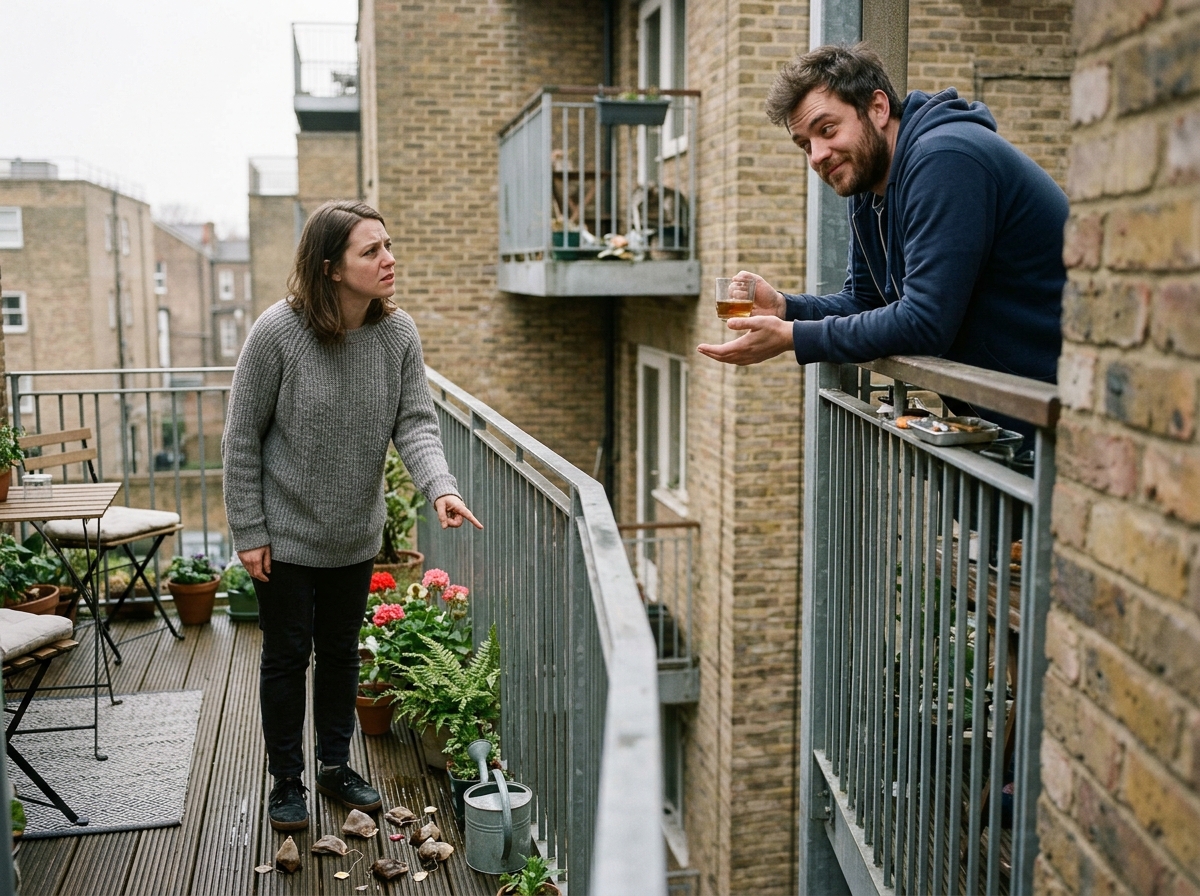
At 7:03 that morning, I heard the sliding door upstairs open.
I didn’t look up immediately.
I kept my coffee in my hand and pretended to be reading something on my phone.
For the past three weeks, I had learned the rhythm of apartment 4B better than I wanted to.
The television usually came on around six-thirty.
The balcony door opened sometime after seven.
Then came the tea.
Every morning.
Every evening.
Sometimes more than once.
I heard footsteps overhead.
A chair scraped against the balcony floor.
Then silence.
I glanced at the clock.
7:04.
A shadow appeared across the railing above me.
Then his hand came into view.
Two fingers held a small, dripping tea bag by its string.
He released it.
The tea bag dropped toward my balcony.
Except this time, it didn’t land where he expected.
It stopped halfway.
A small nylon mesh stretched across the upper edge of my balcony railing caught it perfectly.
The tea bag bounced once and hung there, dripping.
I slowly stood up.
Above me, there was silence.
I looked at the tea bag.
Then I looked upward.
His hand disappeared.
A second later, his head appeared over the railing.
He stared at the mesh.
Then at me.
I raised my coffee cup.
“Good morning.”
He didn’t answer.
Instead, he disappeared back inside.
I waited.
Thirty seconds.
A minute.
Then his balcony door slammed shut.
I smiled.
Not because I had won anything.
I hadn’t.
But because for the first time in weeks, the problem was no longer invisible.
I took a photograph.
Then I removed the tea bag from the mesh, placed it inside a small plastic bag, and labeled it with the date and time.
April 14.
7:04 a.m.
Tea bag.
I had started keeping records two days earlier.
Not because I wanted revenge.
Because I had finally realized that if this continued, I needed proof.
The afternoon before, I had gone to the hardware store and bought the mesh.
It wasn’t a trap.
It wasn’t dangerous.
It was simply a lightweight balcony screen designed to keep leaves and debris from blowing through.
I installed it along the upper inside edge of my railing.
Anything tossed from above would hit the screen before reaching my balcony.
I had also purchased a small outdoor camera.
It pointed only toward my balcony and the section of railing above it.
I deliberately positioned it so that it didn’t look into his apartment.
I didn’t want to spy on him.
I wanted evidence of what landed on my property.
There was another reason I had prepared so carefully.
Two days earlier, something had happened that made me realize the tea bags weren’t just annoying anymore.
My downstairs neighbor, Mrs. Alvarez, had knocked on my door.
She was seventy-eight and lived in apartment 2B.
She stood there holding a small plastic bag.
Inside was a soggy tea bag.
“I found this outside my window,” she said.
I stared at it.
“From upstairs?”
She nodded.
“I think so.”
“Has he been throwing them toward your apartment too?”
She hesitated.
“I didn’t want to complain.”
“Why not?”
She smiled sadly.
“People don’t like being called difficult.”
That sentence stayed with me.
People don’t like being called difficult.
It was the exact reason I had kept quiet for so long.
I didn’t want to be the difficult woman downstairs.
The overly sensitive neighbor.
The person who complained about everything.
So I had accepted it.
A stained towel.
A stained cushion.
Tea bags beside my plants.
Tea bags on my welcome mat.
Once, one landed inside the open door of my apartment.
I cleaned them up.
I said nothing.
But now I knew Mrs. Alvarez was dealing with it too.
And she wasn’t the only one.
Over the next day, I quietly asked two other neighbors whether they had experienced the same thing.
They had.
One had found tea bags on his windowsill.
Another had discovered one in a planter.
Nobody had complained formally.
Everyone had simply decided it wasn’t worth the trouble.
That was when I understood what my upstairs neighbor had been counting on.
Not that people couldn’t stop him.
That people wouldn’t bother.
So I bothered.
Not angrily.
Methodically.
The first morning after I installed the screen, I expected him to stop.
Instead, he adapted.
At 9:17 that night, another tea bag came flying over the railing.
It struck the screen and dropped onto my balcony floor.
I looked at the camera.
The red indicator light blinked.
I picked up the tea bag.
Photographed it.
Recorded the time.
Then I went inside.
The next morning, another appeared.
Then another that evening.
For five days, it continued.
Seven tea bags.
Five photographs.
Five videos.
And one very irritated man upstairs.
On the sixth day, I heard him shouting from his balcony.
“Hey!”
I looked up.
He was standing there.
“You put that net up because of me?”
I took a sip of coffee.
“I put it up because things keep falling onto my balcony.”
“You know exactly what you’re doing.”
“I know exactly what I’m doing.”
He stared at me.
“Take it down.”
“No.”
His face hardened.
“I’m serious.”
“So am I.”
He leaned over the railing.
“You can’t just put things up there whenever you want.”
“I checked the building rules.”
He paused.
“I did too.”
“Then you know the screen is allowed.”
He didn’t answer.
Instead, he pointed toward the mesh.
“That thing is ugly.”
I shrugged.
“You’re entitled to your opinion.”
Then I went inside.
I thought that would be the end of it.
It wasn’t.
That evening, someone knocked on my door.
When I opened it, the building manager, Mr. Collins, stood in the hallway.
He was holding a clipboard.
“Can we talk?”
“Of course.”
He stepped inside.
“I’ve received a complaint.”
“From apartment 4B?”
He nodded.
“He says you’ve installed some kind of barrier that interferes with his balcony.”
“It doesn’t.”
“That’s what I told him.”
I smiled.
Mr. Collins sighed.
“He’s also claiming you’re harassing him.”
I nearly laughed.
“By sitting on my own balcony?”
“That’s what he says.”
I walked to my kitchen table.
Then I opened a folder.
Inside were photographs.
Dates.
Times.
A copy of the building rules.
And a printed statement from Mrs. Alvarez.
I handed the folder to him.
Mr. Collins looked through the pages.
His expression slowly changed.
“You’ve been documenting this?”
“Yes.”
“How long?”
“Three weeks.”
He looked at the photographs.
Then the timestamps.
Then the video stills.
“He actually throws them?”
“Yes.”
“Intentionally?”
I nodded.
“I asked him three times to stop.”
Mr. Collins was quiet.
Then he reached the final page.
It was a photograph of a tea bag sitting on the cushion of my chair.
The brown stain was clearly visible.
“Did you report this before?”
“No.”
“Why?”
I thought about it.
“Because I thought I could handle it myself.”
Mr. Collins closed the folder.
“I wish you’d come to me sooner.”
“I didn’t want to make a big deal out of it.”
“You weren’t making a big deal.”
He stood.
“You were trying to solve it yourself.”
Before he left, he asked one more question.
“Do you still have the tea bags?”
“All of them.”
His eyebrows lifted.
“You kept them?”
“Most of them.”
He smiled faintly.
“Don’t throw them away.”
That surprised me.
“Why?”
“Because I’m going upstairs.”
He walked toward the door.
“I think it’s time we have a conversation with your neighbor.”
The meeting happened the following afternoon.
Mr. Collins, me, and the man from 4B stood in the hallway.
His name was Derek.
I’d known his name for years.
But until then, I’d never actually spoken to him for more than a few minutes.
Derek folded his arms.
“This is ridiculous.”
Mr. Collins remained calm.
“You’ve been throwing used tea bags onto another resident’s balcony.”
“They’re just tea bags.”
“That isn’t the point.”
“They’re biodegradable.”
I almost laughed.
Mr. Collins didn’t.
“They’re still litter.”
Derek looked at me.
“She never complained about anyone else.”
“I didn’t complain because nobody else was throwing things onto my balcony.”
He shook his head.
“She has some personal problem with me.”
“No,” I said.
“I have a problem with things being thrown onto my property.”
Mr. Collins opened the folder.
“We have photographs and video.”
Derek’s face changed.
“You recorded me?”
“The camera records my balcony.”
“That’s creepy.”
“It doesn’t record inside your apartment.”
Mr. Collins interrupted.
“The footage is sufficient to establish what happened.”
Derek stared at him.
“So what?”
“So stop.”
There was silence.
Derek finally nodded.
“Fine.”
Mr. Collins closed the folder.
“Good.”
The meeting ended.
I thought the problem was solved.
For two days, nothing happened.
No tea bags.
No shouting.
No footsteps lingering above my balcony.
I started relaxing.
On the third morning, I woke up and realized I hadn’t heard the balcony door upstairs.
I smiled.
Maybe that was it.
Maybe everything really was finished.
At 8:30, there was a knock on my door.
It was Derek.
I opened it cautiously.
He was holding something.
A small cardboard box.
“What is that?”
He held it toward me.
“Open it.”
I hesitated.
Then I took it.
Inside was a new balcony cushion.
The same size as the one he had stained.
I looked up.
“What is this?”
He shrugged.
“For the chair.”
I stared at him.
“You don’t have to—”
“I know.”
He looked uncomfortable.
“I shouldn’t have laughed.”
That caught me off guard.
He rubbed the back of his neck.
“My mother used to drink tea all day. When she passed, I started drinking it too.”
I didn’t know what to say.
“I guess I got into this habit.”
He looked down the hallway.
“But that’s not an excuse.”
“No.”
“I thought you were being dramatic.”
“I wasn’t.”
“I know.”
He took a breath.
“I’m sorry.”
It sounded different this time.
Not like the first apology.
Not rushed.
Not embarrassed.
Not something he was saying because he wanted me to leave.
This one sounded like he had actually thought about it.
“Thank you,” I said.
He nodded.
Then he turned around.
Before he left, I said, “Derek?”
He stopped.
“The screen isn’t going anywhere.”
He smiled.
“I figured.”
Then he walked upstairs.
For several weeks, everything was peaceful.
No tea bags.
No arguments.
No stains.
I replaced the old cushion with the one he had bought.
The balcony slowly returned to being my favorite place in the apartment.
I planted new flowers.
Hung a string of small lights.
Bought a little table.
And started eating breakfast outside again.
Then one Saturday morning, I heard something fall.
I froze.
A soft sound.
*Plop.*
I looked at the balcony floor.
A tea bag.
My first thought was Derek.
But then I noticed something.
It wasn’t wet.
It was completely dry.
I looked upward.
Nothing.
I picked it up.
There was a folded piece of paper attached to the string.
I unfolded it.
Three words were written on it.
“I’m sorry. Again.”
I looked toward the balcony above.
Derek was standing there.
He held up both hands.
“Not mine.”
I laughed.
“Then whose is it?”
He pointed toward the building across the courtyard.
I turned.
On the roof of the neighboring building, two workers were drinking tea.
One of them looked down.
Then quickly disappeared.
Derek called up.
“Hey!”
The worker leaned over.
Derek pointed at my balcony.
“Don’t throw things down here!”
The worker apologized.
I looked at Derek.
He looked at me.
And for the first time, we both laughed.
The whole ridiculous saga had somehow turned into something neither of us expected.
A week later, Mr. Collins organized a building meeting.
The subject wasn’t tea bags.
It was something bigger.
Trash.
Noise.
Common areas.
Balconies.
Small things people ignored because they didn’t want conflict.
During the meeting, Mr. Collins said something that stayed with me.
“Buildings don’t become unpleasant because of one major problem. They become unpleasant when everyone decides small problems aren’t worth addressing.”
Nobody spoke.
Then Mrs. Alvarez raised her hand.
“I agree.”
She told everyone about the tea bags she had found.
Several residents laughed.
Not cruelly.
More like they couldn’t believe how long everyone had tolerated it.
Then another neighbor spoke about cigarette butts.
Someone else mentioned food wrappers.
Another complained about packages left blocking the stairs.
The meeting lasted almost two hours.
And surprisingly, nobody fought.
Instead, we made rules.
Simple ones.
Don’t throw anything from balconies.
Don’t leave trash in common areas.
Report repeated problems instead of confronting neighbors indefinitely.
And if someone apologizes, accept the apology—but still expect the behavior to change.
After the meeting, Derek came over to me.
“You know,” he said, “I thought you were going to destroy me when this started.”
“I considered several dramatic speeches.”
He laughed.
“But you didn’t.”
“No.”
“Why?”
I looked at the balcony.
“Because I didn’t want revenge.”
He nodded.
“I know that now.”
I thought about the first tea bag.
The towel.
The cushion.
The three conversations.
The laughter.
The words, *You should probably be grateful it’s only tea.*
At the time, those words had made me furious.
But now I understood something.
People sometimes become comfortable with bad behavior because nobody makes them confront its consequences.
Derek had been doing something small.
So small that he could convince himself it didn’t matter.
But every time he tossed something over that railing, someone else had to pick it up.
Someone else’s property got stained.
Someone else’s morning was interrupted.
Someone else had to clean up a mess they didn’t create.
That was the part he hadn’t understood.
Not the tea.
The responsibility.
Months passed.
The tea bags stopped completely.
The screen remained on my balcony, though I eventually covered most of it with climbing plants.
One evening, I was watering them when I heard Derek’s balcony door slide open.
“Hey!”
I looked up.
He held something over the railing.
My heart stopped for half a second.
Then he smiled.
It was a tiny paper airplane.
“Don’t worry,” he said. “This one isn’t trash.”
He tossed it.
It floated gently downward.
I caught it.
Written across the folded paper were the words:
“Coffee tomorrow?”
I looked up.
“Are you inviting me for coffee?”
“Yeah.”
“Why?”
He shrugged.
“You’ve lived underneath me for eleven years. Seems strange that we never actually knew each other.”
I smiled.
“Fair enough.”
The next morning, we met in the little café around the corner.
Derek told me about his mother.
I told him about the flowers on my balcony.
He admitted he had always been embarrassed by the fact that I had complained about the tea bags because he knew I was right.
“I just hated being told what to do,” he said.
I laughed.
“That’s a terrible reason.”
“I know.”
We drank coffee.
We talked about the building.
The weather.
Work.
Neighbors.
Life.
And eventually, Derek said something that surprised me.
“You know what bothered me most?”
“What?”
“That you stopped asking.”
I looked at him.
He stared into his coffee.
“When you came upstairs the third time, I expected another argument. Instead, you just stopped.”
“I figured you weren’t listening.”
“I wasn’t.”
He sighed.
“But when you stopped talking to me, I realized I had no idea what you were thinking.”
I smiled.
“I wasn’t thinking anything dramatic.”
“What were you thinking?”
I took a sip of coffee.
“That I was done asking someone to respect something they already knew they were doing.”
He nodded slowly.
“That makes sense.”
Outside the café window, people walked along the sidewalk.
Cars passed.
A bus stopped at the corner.
Ordinary life continued.
And I realized how strange it was that a handful of tea bags had taught me something I hadn’t expected to learn.
Sometimes the loudest response isn’t the strongest one.
Sometimes the best response is documentation.
Sometimes it’s setting a boundary.
Sometimes it’s asking for help.
And sometimes, when someone finally understands what their behavior has been doing to another person, the right response is simply to let them change.
I never needed to humiliate Derek.
I never needed to get even.
I only needed the behavior to stop.
That was the entire point.
When I returned home that afternoon, I stepped onto my balcony.
The flowers were blooming.
The chair was clean.
The new cushion looked almost brand-new.
And the railing was completely clear.
No tea bags.
No stains.
No trash.
Just sunlight.
I sat down.
For the first time in months, I didn’t look at the clock.
I didn’t listen for footsteps upstairs.
I didn’t wonder whether something would come flying over the railing.
I simply sat there.
Then I heard a voice from above.
“Hey!”
I looked up.
Derek leaned over his balcony.
“Want some tea?”
I laughed.
“Absolutely not.”
He laughed too.
“Fair enough.”
He disappeared inside.
A few seconds later, he came back holding two cups.
“I made coffee instead.”
He lowered one carefully over the railing using a small basket tied to a rope.
I took it.
“Much better.”
He smiled.
And as ridiculous as it sounds, I think that was the real ending to the whole story.
Not the screen.
Not the photographs.
Not the building meeting.
Not even the apology.
It was the moment when something that had once been thrown carelessly over a railing became something offered carefully from one neighbor to another.
Because sometimes people don’t need to be punished.
They need to understand.
And sometimes the most powerful thing you can do after being ignored three times…
is stop asking—
and start setting boundaries.
The tea bags stopped.
The friendship started.
And my balcony stayed clean.