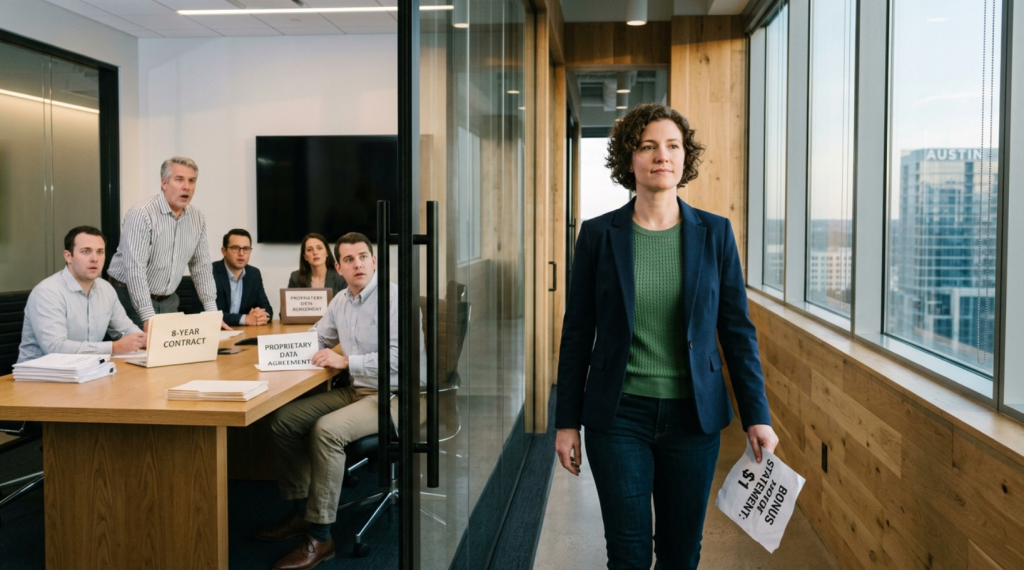
PART 3: Ben moved the cursor over the name. Then he pulled his hand away from the mouse. “You don’t want to know.”
“Yes, I do.”
He looked around the finance office. Nobody seemed to be paying attention. Then he whispered the name.
“Monica.”
I leaned back.
For several seconds, neither of us spoke. Monica had looked me directly in the eyes and told me the number was a temporary adjustment. She had told me not to make an emotional decision. She had told me the company needed me.
And now I knew she had personally approved taking $236,399 away from me. But something bothered me more than the money.
I pointed at the screen.
“Why was mine manually changed?”
Ben shook his head.
“I don’t know.”
“Then let’s find out.”
He looked nervous.
“Mason, I’m serious. Leave this alone.”
“Why?”
“Because I’ve been here long enough to know when something isn’t supposed to be seen.” That sentence stayed with me. I closed the screen.
“Thanks.”
Ben looked relieved.
Then I stood.
Before I walked away, he quietly said,
“Mason.”
I turned.
“There was something else.”
“What?”
He lowered his voice.
“Your distribution wasn’t the only one manually adjusted.”
My stomach tightened.
“Whose?”
“Three other people.”
“Who?”
He looked at me.
“People who left the company last year.”
I frowned.
“What happened to their money?”
Ben hesitated.
“That’s the strange part.”
“What?”
“The system says their distributions were reduced to zero.”
I stared at him.
“Zero?”
“Zero.”
“And they didn’t know?”
“I don’t know.”
I walked back to my desk with a strange feeling in my chest.
Until that morning, I had thought I was dealing with corporate unfairness.
Now I wasn’t sure.
I opened the eight-year agreement again.
I read every page.
Not quickly.
Not like an employee trying to understand a new compensation package.
I read it like someone preparing for a lawsuit.
The salary was $175,000.
The equity sounded impressive.
The milestone compensation sounded even better.
But then I reached the section I’d ignored the night before.
Assignment of Inventions and Intellectual Property.
I read it twice.
Then a third time.
Every invention, improvement, design, architecture, algorithm, process, system, documentation, or technical development I created during the eight-year term would belong exclusively to Northstar.
That wasn’t unusual by itself.
What was unusual was the language underneath it.
The agreement attempted to define several categories of work created before the new contract as company property.
I grabbed a pen.
I circled the paragraph.
Then I found another section.
Prior Contributions.
My hands became cold.
The company was trying to establish ownership over certain technical work I had created years before.
Work that existed before the new agreement.
Work I had never formally assigned to Northstar.
I kept reading.
Then I reached the section that made me sit completely still.
Equity and Deferred Participation.
There was a reference to a separate schedule.
Schedule C.
I flipped through the document.
No Schedule C.
I checked again.
Nothing.
I called Monica’s assistant.
“Could you send me Schedule C from the retention agreement?”
There was silence.
“Mr. Reed, I believe everything is included.”
“No. It isn’t.”
“I’ll check.”
Ten minutes later, I received an email.
Schedule C — Not Applicable.
I stared at those three words.
Not applicable.
Then why did the contract reference it?
I opened the company’s internal equity portal.
My account showed almost no equity.
That didn’t make sense.
For eight years, I had been told that certain projects would eventually participate in the company’s success.
Nothing extravagant.
Nothing guaranteed.
But I had accumulated what I thought was meaningful equity.
I had received emails about grants.
I had signed documents.
I remembered every one.
I searched my personal email.
There they were.
Grant notices.
Acknowledgment forms.
Equity award summaries.
One email from five years earlier caught my attention.
Subject: Northstar Strategic Contributor Equity Grant
I opened it.
The attachment was still there.
My original award.
Then I looked at the company’s current system.
The grant didn’t exist.
I searched again.
Nothing.
I called Ben.
“Do you have access to historical equity records?”
“Why?”
“Just answer me.”
“Yes.”
“I need something.”
“What?”
“Search my name for the Strategic Contributor Grant from five years ago.”
There was a pause.
Then I heard typing.
“Found it.”
“What does it say?”
“Grant issued.”
“How many shares?”
Silence.
“Ben?”
He finally answered.
“Mason…”
“What?”
“This says you were issued 480,000 restricted units.”
I stopped breathing.
“How many?”
“Four hundred eighty thousand.”
“That can’t be right.”
“I’m reading it.”
“What happened to them?”
“I don’t know.”
I walked into an empty conference room and shut the door.
“Are they vested?”
“Some.”
“How many?”
“About 300,000.”
I gripped the edge of the table.
“Where are they now?”
Ben didn’t answer.
Then he said,
“They were transferred.”
“To whom?”
“I can’t see the destination.”
“Why?”
“Because it’s outside the employee system.”
I closed my eyes.
“Can you get the transaction record?”
“I shouldn’t.”
“Ben.”
“Mason, I’m already doing something I could get fired for.”
“I know.”
He was quiet.
Then he said,
“I’ll see what I can find.”
The call ended.
I stood alone in the conference room.
Outside the glass walls, people were laughing.
Someone was celebrating a new bonus.
Someone else was talking about buying a house.
And I suddenly realized I had spent eight years believing I was building my future inside that building.
Maybe I had been building someone else’s.
That afternoon, Monica summoned me again.
She didn’t ask me to sit.
“You’ve been asking questions in finance.”
I said nothing.
She folded her arms.
“Mason, I hope you understand that internal compensation information is confidential.”
“My compensation information?”
“Company compensation structures.”
“My compensation.”
She stared at me.
“You’re becoming confrontational.”
“No.”
I pulled a chair out and sat.
“I’ve become curious.”
Her jaw tightened.
“What exactly are you asking?”
“Why was my distribution changed from $236,400 to $1?”
She didn’t blink.
“You’ve already been told.”
“Then why does the approval history show you manually authorized the change?”
For the first time, Monica’s expression changed.
Only slightly.
But I saw it.
“You accessed restricted records.”
“I accessed my compensation record.”
“That’s not how the system works.”
“Then explain it.”
She walked to the window.
For several seconds, she looked down at the city.
Finally she said,
“You’re making a mistake.”
“What mistake?”
“Thinking the number is the story.”
I stared at her.
“What does that mean?”
She turned.
“You’re focused on $236,400.”
“Because that’s what I was supposed to receive.”
“Maybe.”
“Maybe?”
She took a slow breath.
“You’ve been here eight years, Mason. You know how complicated the company’s structure has become.”
“No. I know how complicated you’ve made it.”
Her expression hardened.
“You’re angry.”
“Yes.”
“That’s understandable.”
“But I’m not confused.”
She walked back to the desk.
Then she lowered her voice.
“Listen carefully.”
I waited.
“If you leave Northstar, you will be walking away from more than a paycheck.”
I almost laughed.
“What exactly am I walking away from?”
She looked at me.
“You’ll find out.”
I stood.
“Is that a threat?”
“No.”
“Then what is it?”
“A warning.”
I walked toward the door.
Behind me, she said,
“Mason.”
I stopped.
“Don’t assume everyone who works here is your enemy.”
I turned around.
“I’m not.”
“Good.”
“I’m trying to figure out who is.”
I left.
That night, I told Clare everything.
She listened without interrupting.
When I finished, she sat quietly at the kitchen table.
“So they may have taken money you were supposed to receive.”
“Yes.”
“And possibly equity.”
“Yes.”
“And now they’re trying to get you to sign an eight-year contract that might transfer ownership of work you created before the contract.”
“Yes.”
She looked at me.
“Then don’t sign it.”
I nodded.
“I wasn’t going to.”
She reached across the table and took my hand.
“Are you scared?”
I thought about it.
“Yes.”
“Of losing your job?”
“No.”
I looked toward the dark window.
“I’m scared that I’ve spent eight years trusting people who knew exactly what they were doing.”
Clare squeezed my hand.
“You trusted yourself too.”
I looked at her.
“And that’s what you need to trust now.”
The next morning, I arrived at work at 6:15.
The building was almost empty.
I went straight to the archive room.
My access still worked.
I searched old project folders.
Northstar’s flagship platform had originally been called Atlas.
I had designed the architecture.
I remembered the first prototype.
I remembered the weekend we nearly lost the entire system.
I remembered writing the core framework at three in the morning while everyone else slept.
I searched for my original design documents.
Most were still there.
But one folder was missing.
Atlas — Ownership and Contribution Records.
I checked the backup.
Missing.
I checked the archived server.
Missing.
Then I searched my email.
I found an old message from the company’s former general counsel.
Mason, please retain the attached technical contribution statement for your personal records. It may be important during the next corporate restructuring.
The attachment was there.
I opened it.
My heart started pounding.
It wasn’t just a technical contribution statement.
It was a signed acknowledgment.
The document listed the original creators of Atlas.
There were five names.
Mine was first.
Underneath the names was a percentage breakdown.
Mason Reed — 34%.
Another engineer — 18%.
Another — 12%.
The remaining percentage belonged to Northstar under the original development agreement.
I stared at the number.
34%.
Then I saw the date.
This document had been signed before Northstar’s first major funding round.
Before the company became what it was now.
Before the executives received their enormous compensation packages.
Before the company began preparing for the public market.
And suddenly I understood something.
If that document was valid, my contribution wasn’t merely an employee accomplishment.
It might have created an ownership claim.
I printed it.
Then I heard footsteps outside.
I quickly closed the folder.
The door opened.
Ryan stood there.
He looked surprised to see me.
“What are you doing?”
“Working.”
“At six in the morning?”
“Couldn’t sleep.”
He glanced at the printer.
“What did you print?”
I smiled.
“Old architecture documentation.”
He stared at me for a second too long.
Then he said,
“You should let this go.”
My smile disappeared.
“What?”
“The bonus.”
“I haven’t mentioned the bonus.”
“You don’t have to.”
He stepped inside and closed the door.
“Mason, I’m trying to help you.”
“Then help me.”
He lowered his voice.
“People above us are getting nervous.”
“Why?”
“Because you’re asking questions.”
“Questions about my own compensation.”
“No.”
He looked directly at me.
“Questions about Atlas.”
The room went silent.
I watched him carefully.
“How do you know I’m asking about Atlas?”
He didn’t answer.
“Ryan.”
He looked away.
Then he said something I never expected.
“I was told to keep an eye on you.”
My chest tightened.
“By who?”
He shook his head.
“I can’t.”
“You owe me that much.”
“I don’t owe you anything.”
I stared at him.
He immediately regretted the words.
“You’re right,” he said quietly. “I don’t.”
He turned to leave.
I said,
“Ryan.”
He stopped.
“Did you know about the one dollar?”
He didn’t turn around.
“Yes.”
“Before I received it?”
“Yes.”
“Did you know my original distribution was $236,400?”
Silence.
“Yes.”
“Did you know my equity was transferred?”
He finally turned.
His face had gone pale.
“I don’t know what you’re talking about.”
“Then why are you afraid?”
He didn’t respond.
He walked out.
I stood alone.
Five minutes later, my phone vibrated.
Unknown number.
One message.
Stop looking for Atlas.
I stared at it.
Then another message appeared.
You have no idea who owns what.
I took a screenshot.
A third message came.
And if you sign the new agreement, you’ll never find out.
I read it twice.
Then I smiled.
Not because I wasn’t afraid.
Because for the first time in eight years, I knew exactly what I needed to do.
I wasn’t going to sign anything.
I wasn’t going to argue.
I wasn’t going to threaten anyone.
I was going to document everything.
And if Northstar wanted me gone, they were going to have to explain why they were so desperate to make sure I left without asking questions.
At 9:00 that morning, I received an email from Monica.
Subject: Final Retention Discussion
The message contained only one sentence.
Please come to the executive conference room at 2:00 p.m. Bring the signed agreement.
I read it.
Then I looked at the printed Atlas document sitting inside my desk drawer.
For eight years, I had walked into meetings believing I was an employee asking for permission.
This time would be different.
At 1:58 p.m., I walked toward the executive conference room.
Monica was there.
Carl was there.
The CFO was there.
And sitting beside them was someone I had never seen before.
A man in a dark suit with a leather briefcase.
He stood when I entered.
“Mr. Reed,” he said.
“Who are you?”
He extended his hand.
“David Mercer.”
I didn’t shake it.
“What do you do here?”
He smiled.
“I represent the investment group preparing Northstar’s next phase.”
I looked at Monica.
She avoided my eyes.
David placed a folder on the table.
“We’ve reviewed your situation.”
“My situation?”
“The compensation dispute.”
I sat down.
David opened the folder.
“You’ve been with Northstar for eight years.”
“Yes.”
“You’ve made significant contributions.”
“Yes.”
“You’re frustrated.”
“Yes.”
“And you believe you’ve been treated unfairly.”
“I don’t believe it.”
I looked directly at him.
“I have documentation.”
His smile disappeared.
For the first time, nobody in the room spoke.
Then David slowly closed the folder.
“Perhaps,” he said, “we should talk about Atlas.”
And that was the moment I realized the one-dollar payment had never been about punishing me.
It had been about buying my silence.
And they were about to discover that I wasn’t selling it.
PART 3
David Mercer sat back in his chair.
“Let’s start with a simple question,” he said. “What do you know about Atlas?”
I looked at Monica.
Then Carl.
Then the CFO.
Finally, I looked at David.
“I know I helped build it.”
David nodded.
“I know you did.”
“I know my name was on the original contribution agreement.”
His expression changed.
Only slightly.
But enough.
“And I know that agreement says I contributed thirty-four percent of the original architecture.”
The room became completely silent.
David slowly leaned forward.
“Where did you get that document?”
“My files.”
“Interesting.”
“Why?”
“Because Northstar’s current records don’t contain it.”
“That’s not my problem.”
“No,” he said. “It may become your problem.”
I smiled.
“You’re still trying to scare me.”
“I’m trying to explain the situation.”
“No. You’re trying to make me feel like I’m holding something dangerous when you’re the one who spent years hiding it.”
Monica finally spoke.
“Mason, this isn’t productive.”
I turned toward her.
“Then tell me why my original distribution was $236,400.”
She didn’t answer.
“Tell me why you manually changed it to one dollar.”
Silence.
“Tell me where my 480,000 equity units went.”
Still nothing.
I reached into my folder and placed the old contribution agreement on the table.
The CFO’s face changed immediately.
David looked at the document without touching it.
“You’ve kept a copy.”
“I kept everything.”
“That was wise.”
“Unlike what your company did.”
David looked at Monica.
Then back at me.
“Mr. Reed, I’m going to be very direct.”
“Please.”
“The company is preparing for a major transaction.”
“I know.”
“A transaction significantly larger than anything Northstar has previously undertaken.”
“I know that too.”
“And certain historical ownership issues could complicate that transaction.”
I stared at him.
“Such as?”
He paused.
“Legacy intellectual property.”
I laughed quietly.
“So Atlas.”
“Yes.”
“And my contribution.”
“Yes.”
“And the other engineers.”
“Yes.”
“And the equity that was issued based on those contributions.”
David didn’t respond.
I leaned forward.
“So the one-dollar payment was designed to make me angry enough to quit.”
Nobody spoke.
I continued.
“And the eight-year agreement was designed to make me sign away whatever rights I still had before I left.”
David finally said,
“That is one interpretation.”
“Then give me another.”
He looked down.
“I can’t.”
“Exactly.”
Monica stood.
“This meeting is over.”
David raised a hand.
“No.”
She looked at him.
He remained seated.
“It’s not over.”
For the first time, I saw Monica look genuinely uncomfortable.
David turned toward me.
“There are documents you haven’t seen.”
“Then show me.”
“I can’t simply hand you confidential corporate records.”
“Then don’t.”
I stood.
“Have your attorneys send them through the proper channels.”
David looked surprised.
“You’re not going to sign?”
“No.”
“You’re not going to negotiate?”
“Not until I know what I’m negotiating.”
He nodded slowly.
“That may be the smartest thing you’ve said today.”
I almost smiled.
“It’s the first time anyone here has admitted I might have a point.”
I walked out.
The next morning, my employee badge stopped working.
I couldn’t enter the building.
Security told me my access had been “temporarily suspended pending an administrative review.”
I stood outside the glass doors holding my coffee.
Eight years.
Eight years of entering that building before sunrise.
Eight years of leaving after dark.
Now a security guard I’d never met was politely telling me I couldn’t come inside.
I called HR.
No answer.
I called Monica.
Straight to voicemail.
Then I called Ben.
He answered immediately.
“They locked you out too?”
I frowned.
“Too?”
He was quiet.
“What happened?”
“I was terminated this morning.”
“What?”
“Effective immediately.”
I leaned against the wall.
“Why?”
“They said I violated internal data-access policy.”
My stomach tightened.
“Because you showed me my own records?”
“I guess.”
“Did they give you severance?”
“Nothing yet.”
I looked through the glass doors.
Employees were walking past me.
Some looked away.
Some stared.
Then I saw Ryan.
He stopped when he saw me.
For a moment, we simply looked at each other.
He came outside.
“I didn’t know they were going to do this.”
I nodded.
“Did you know they were planning to?”
He hesitated.
“Yes.”
I waited.
“Why didn’t you tell me?”
“Because I was scared.”
“At least you’re honest now.”
He looked miserable.
“They’re going after anyone connected to the old Atlas team.”
My stomach tightened.
“How many?”
“Everyone who had access to the original documentation.”
“Who else?”
“Three engineers.”
“Ben?”
“Yes.”
I nodded.
“And you?”
Ryan looked away.
“They haven’t fired me.”
“Why?”
He finally looked at me.
“Because I’m still useful.”
I understood.
“You’re cooperating.”
He didn’t deny it.
I started to walk away.
“Mason.”
I stopped.
Ryan reached into his jacket.
“I kept something.”
He handed me a small USB drive.
“What is this?”
“The original Atlas repository.”
I looked at him.
“Why give it to me?”
“Because I finally realized something.”
“What?”
“They’re not afraid you stole anything.”
He swallowed.
“They’re afraid you can prove you owned something.”
I took the drive.
“Thank you.”
He nodded.
Then he walked back inside.
I went home.
Clare was waiting.
She knew something was wrong before I opened the door.
“They fired you.”
I nodded.
She hugged me.
For the first time in days, I let myself stop pretending I was fine.
I sat at the kitchen table.
“They locked me out.”
Clare placed a cup of coffee in front of me.
“Then maybe it’s time to stop thinking like their employee.”
I looked at her.
“What do you mean?”
“Think like the person they should have been afraid of.”
I laughed.
“I don’t know what that means.”
“You don’t have to.”
She pointed at the USB drive.
“Find someone who does.”
That afternoon, I called an attorney.
Not a corporate attorney.
An intellectual-property attorney.
Her name was Evelyn Shaw.
She spent almost three hours reviewing everything I had.
The old contribution agreement.
The compensation statements.
The equity grant.
The emails.
The retention agreement.
The one-dollar distribution.
Finally, she closed the folder.
“Mason.”
“Yes?”
“Do you have any idea what you have?”
I shook my head.
She tapped the old agreement.
“This is significant.”
“How significant?”
“That depends on whether it was superseded by another agreement.”
“Could it have been?”
“Yes.”
“Was it?”
She looked at the documents.
“Not from what you’ve shown me.”
I leaned back.
She continued.
“The company appears to have treated the intellectual property as though it was entirely theirs.”
“Yes.”
“But this agreement suggests the original development arrangement was different.”
“What about the equity?”
“That is more complicated.”
She opened the grant document.
“These units were granted.”
“Yes.”
“They were partially vested.”
“Yes.”
“Then they were transferred.”
“Without my permission?”
She looked at me carefully.
“That is what we need to establish.”
I felt my pulse rise.
“What do you think happened?”
“I don’t want to speculate.”
“Then tell me what you need.”
“Everything.”
I gave her everything.
She spent the next week digging through records.
And then she found something.
A transaction.
Not just the transfer of my equity.
A transfer involving the entire original Atlas team.
All five founders of the platform had their equity moved into a special holding entity.
The name of that entity was:
Northstar Strategic Holdings LLC.
I stared at the document.
“Who owns it?”
Evelyn scrolled.
“There are several ownership layers.”
“Keep going.”
She did.
Then she stopped.
Her face changed.
“What?”
She turned the laptop toward me.
I read the ownership structure.
Northstar Strategic Holdings was controlled by a parent entity.
That entity was controlled by another entity.
And that entity ultimately traced back to an investment partnership.
David Mercer’s investment group.
I looked at Evelyn.
“So the people buying Northstar already control the equity that was supposed to belong to us?”
“That’s what the documents suggest.”
“But how?”
“That’s the question.”
She clicked another document.
“There was a restructuring six years ago.”
I remembered the year.
That was when Northstar had raised its largest funding round.
“The restructuring agreement appears to have reclassified certain employee equity grants.”
“Without telling us?”
“That’s what we need to establish.”
I leaned back.
Then I remembered something.
“My wife.”
Evelyn looked confused.
“What about her?”
“When Sophie was born, I was working on Atlas. I remember signing something from HR because they said my equity would be protected during parental leave.”
“Do you have it?”
“I might.”
I went home and searched an old storage box.
Inside was a folder Clare had kept for years.
Tax documents.
Insurance records.
Employment paperwork.
And there it was.
A four-page amendment.
I handed it to Evelyn.
She read it.
Then read it again.
“Mason.”
“What?”
“This is important.”
“What does it say?”
“It says your original Atlas equity was not subject to the six-year restructuring.”
I stared at her.
“Why?”
“Because the company acknowledged it as a separate contractual interest.”
I sat down.
“So they knew.”
“Yes.”
“And then they transferred it anyway.”
“It appears so.”
I felt something inside me shift.
For eight years, I had thought I was fighting for recognition.
Now I understood.
I wasn’t asking them to recognize me.
They had already recognized me.
They had simply decided they could take it back.
Evelyn prepared a formal demand.
We sent it to Northstar.
We requested:
Northstar responded in less than twelve hours.
Their letter was cold.
They denied wrongdoing.
They claimed my old agreement had been “superseded by subsequent employment arrangements.”
They claimed the one-dollar payment was “a discretionary administrative allocation.”
They denied that I had any independent ownership rights.
Then came the final sentence.
Northstar reserves all rights regarding any unauthorized disclosure or use of proprietary information.
Evelyn read it twice.
Then she smiled.
“What?”
“They’re scared.”
I looked at her.
“You said we shouldn’t speculate.”
“I said I wouldn’t speculate about their motives.”
She tapped the letter.
“But legally, this tells me something.”
“What?”
“They’re not denying that the documents exist.”
That changed everything.
We filed for discovery.
Northstar’s lawyers fought it.
Then they fought harder.
Then something unexpected happened.
The Securities and Exchange Commission announced that it was reviewing Northstar’s planned public transaction.
The company immediately issued a statement saying the review was routine.
I wasn’t surprised.
Because two days later, I received a call from a former Northstar engineer.
His name was Daniel.
He had been one of the three people whose equity had been reduced to zero.
“I saw your story,” he said.
“What story?”
“The lawsuit.”
“It isn’t public.”
He laughed.
“Nothing stays private in Austin.”
I asked him what he knew.
He said,
“I have something.”
“What?”
“A recording.”
My heart stopped.
“Of what?”
“An executive meeting.”
“When?”
“Six years ago.”
“What was discussed?”
“Atlas.”
I met him at a coffee shop the next morning.
He handed me a folder.
Inside was a transcript.
The recording itself had been made legally under the rules applicable at the time, but Daniel had kept it hidden because he was afraid.
The transcript contained one sentence that changed everything.
“The engineers think the equity is theirs, but we’ll clean up the language during the restructuring.”
I stared at it.
“Who said that?”
Daniel pointed to the name.
The CFO.
I read it again.
Then again.
Evelyn took the transcript.
“This is potentially very important.”
Daniel looked at me.
“I’m sorry.”
“For what?”
“I should’ve spoken sooner.”
I shook my head.
“You were afraid.”
“So were you.”
“Yes.”
He smiled sadly.
“Not anymore.”
The case moved quickly after that.
Northstar’s attorneys suddenly offered a settlement.
Five hundred thousand dollars.
Evelyn looked at me.
“What do you think?”
I shook my head.
“No.”
“They’re offering money.”
“They’re offering silence.”
“They’ll increase it.”
“Probably.”
She nodded.
“Then what do you want?”
I thought about the one-dollar statement.
The old office.
The sleepless nights.
Sophie being born while I was on a work call.
Clare replacing plans with patience because I kept saying someday.
And then I thought about the young engineers still inside that building.
People who believed hard work would automatically be rewarded.
People who didn’t know that contracts mattered more than promises.
“I want the truth.”
Evelyn smiled.
“Then that’s what we’ll pursue.”
Three weeks later, Northstar’s planned transaction was delayed.
The company issued another statement.
Then another.
Investors began asking questions.
Former employees came forward.
The three engineers whose equity had disappeared provided documents.
Daniel provided the recording.
Ben provided internal compensation records.
And Ryan did something none of us expected.
He resigned.
Then he submitted a sworn statement describing how management had instructed him to monitor me.
He admitted he had been told that I was considered a “retention risk” because of my knowledge of Atlas.
He also confirmed that executives knew about my original compensation calculation.
Northstar could no longer call it a misunderstanding.
There were too many records.
Too many witnesses.
Too many signatures.
Too many dates.
Eventually, a mediation was ordered.
I sat across from David Mercer.
He looked different.
Older.
Tired.
The confidence from our first meeting was gone.
He slid a document across the table.
“Thirty million.”
I stared at it.
“What?”
“Thirty million dollars.”
“For what?”
“Settlement.”
Evelyn looked at me.
I didn’t touch the document.
“Where did that number come from?”
David answered quietly.
“Your ownership claim.”
I looked at him.
“And the other engineers?”
“They’ll be compensated separately.”
“And the company?”
“Will retain operational ownership.”
I leaned back.
“So you’re offering me thirty million dollars to walk away.”
“Yes.”
“And sign away everything.”
“Yes.”
I looked at Evelyn.
She didn’t tell me what to do.
She simply waited.
I thought about the one-dollar payment.
Then I thought about the number on the settlement.
Thirty million.
The difference was almost absurd.
But I realized something.
The money wasn’t what mattered anymore.
I looked at David.
“I’ll accept.”
He looked relieved.
Then I continued.
“On three conditions.”
His expression tightened.
“What conditions?”
“First, the original Atlas engineers receive the ownership they were contractually promised, or an equivalent settlement.”
He nodded.
“Second, Northstar must establish an independent employee equity audit.”
He frowned.
“That’s unusual.”
“Then don’t accept.”
He stared at me.
Finally he said,
“Continue.”
“Third, the company must acknowledge in writing that the one-dollar distribution was not my actual calculated profit-sharing amount.”
David looked at me for a long moment.
“You care about that?”
“Yes.”
“Why?”
I looked at him.
“Because somewhere in that building, someone is going to get another piece of paper with a number on it.”
I paused.
“I want them to know the number wasn’t the truth.”
David was silent.
Then he signed.
The settlement was finalized two months later.
The money changed my life.
But strangely, it didn’t change what I wanted.
We replaced the washing machine.
We paid off our remaining debts.
We put money aside for Sophie’s education.
Clare and I finally took the vacation we’d postponed for eight years.
But the biggest change happened somewhere else.
The Atlas engineers received compensation.
The company’s equity practices were audited.
Several executives resigned.
The planned transaction was restructured.
And Northstar was required to disclose the historical dispute as part of its corporate filings.
I never returned to the building.
I didn’t want to.
Instead, I started a small technology company with two of the engineers who had been pushed out.
We built something new.
Something simpler.
Something transparent.
Our first employee handbook contained a sentence I insisted on writing myself:
No employee should have to guess what their work is worth.
Two years later, I received an envelope from Northstar.
Inside was a framed copy of my original Atlas contribution agreement.
The company had returned the original rights documentation to me as part of the settlement.
Underneath it was a short letter from the new CEO.
He wrote:
You were right to question the number.
I put the letter in a drawer.
The agreement went on my office wall.
Not because I wanted to remember Northstar.
Because I wanted to remember myself.
The version of me who had stayed too long.
The version of me who thought loyalty was enough.
The version of me who believed that if he worked hard enough, someone else would eventually decide to do the right thing.
I had been wrong about that.
Hard work mattered.
Loyalty mattered.
But so did knowing what you had actually agreed to.
And so did being willing to ask questions when something didn’t make sense.
One Friday afternoon, years after I left Northstar, I was walking through our office when I noticed one of our youngest engineers sitting alone at his desk.
He looked worried.
I walked over.
“Everything okay?”
He handed me a compensation statement.
His face was pale.
“I think there’s a mistake.”
I took the paper.
I looked at the number.
Then I looked at him.
“Did you check the calculation?”
“Yes.”
“Did you check the policy?”
“Yes.”
“Then let’s find out what happened.”
He looked surprised.
“You’re not angry?”
I smiled.
“No.”
“Why not?”
“Because questions are how you find mistakes.”
He smiled.
We walked toward the finance office together.
And as we passed the glass wall of my office, I caught sight of the old Atlas agreement hanging there.
For a moment, I remembered the morning I had received a statement showing exactly one dollar.
Back then, I thought that number represented how little the company valued me.
Now I understood something completely different.
The dollar had been the moment they accidentally gave me the most valuable thing they had ever given me.
Clarity.
Because without that dollar, I might have signed the eight-year contract.
I might have spent another eight years believing the promises.
I might have retired from Northstar having never discovered what had happened.
Instead, one dollar forced me to ask a question.
The question led to a document.
The document led to another.
And eventually, the truth had nowhere left to hide.
That evening, I drove home.
Clare was waiting on the porch.
She looked at me and smiled.
“Long day?”
I nodded.
“Good one?”
I smiled back.
“Yeah.”
She handed me a cold drink.
“Still miss Northstar?”
I looked at her.
Then I shook my head.
“Not even a little.”
She laughed.
“Good.”
I sat beside her.
For a while, neither of us spoke.
Then she asked,
“Do you ever think about what would’ve happened if they had just paid you?”
I looked toward the sunset.
“Sometimes.”
“And?”
I thought about it.
“If they had given me the $236,400, I would’ve thanked them.”
“And if they’d offered you the eight-year contract?”
“I probably would’ve signed it.”
She smiled.
“So the dollar saved you.”
I laughed.
“Strangest rescue I’ve ever had.”
She leaned her head against my shoulder.
I looked at the house.
The washing machine was new.
The mortgage was paid.
Sophie was preparing for college.
Clare and I had finally learned how to have dinner without checking work emails.
Everything I’d once told myself I was working toward had somehow arrived after I stopped chasing it.
I reached into my pocket.
I still had a copy of that original one-dollar statement.
Not the original.
Just a photocopy.
I had kept it for years.
I looked at it one last time.
Distribution: $1.00.
For a long time, I had hated that number.
Now I didn’t.
I folded the paper and placed it back in my pocket.
Because the number had never measured my worth.
It had measured the moment I finally understood that my worth was something I had to protect myself.
And that was the lesson I wished I’d learned eight years earlier.
A company can give you a title.
A company can give you a salary.
A company can give you a bonus.
A company can even tell you that you’re indispensable.
But none of those things should replace knowing what you signed, what you earned, and what you created.
Sometimes the smallest number on a piece of paper can expose the biggest truth in the room.
For me, it was one dollar.
And it was enough.
THE END