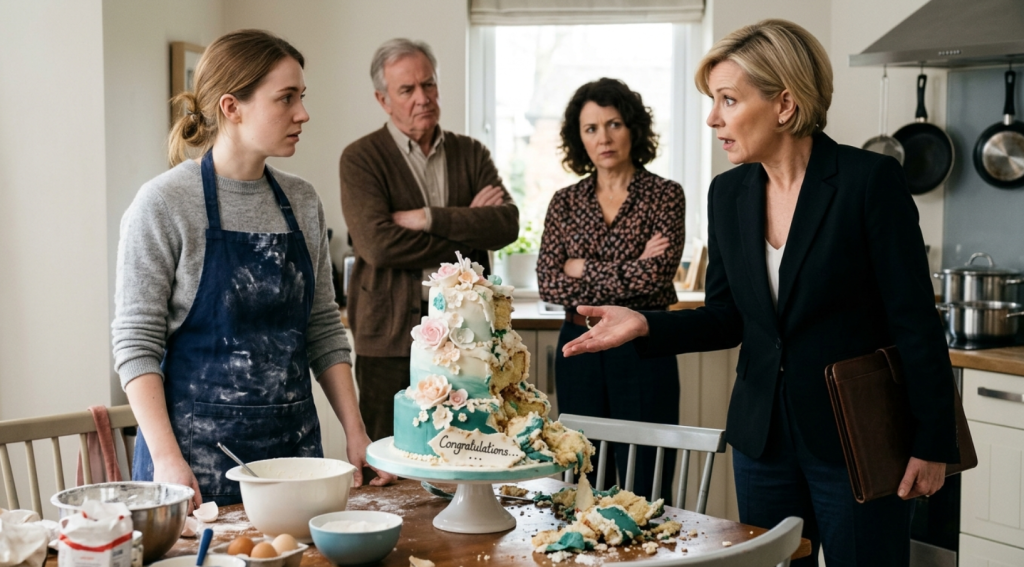
PART : Vanessa nodded. “What about the flowers?” I picked up several pieces from the floor. “Some are ruined. Some can be cleaned. These…” I held up a cluster of pale blue sugar roses.
“…these are fine.”
“How long?”
I looked at the clock. Forty-two minutes until the event pickup window I had promised her. My heart sank. “I can save enough to make something presentable.” Vanessa looked at me.
“I didn’t ask whether you could make it presentable.”
I swallowed.
She pointed at the wreckage. “I asked how much you can save.” I looked around the kitchen again. For the first time, I stopped seeing a destroyed cake. I saw ingredients. I saw structure. I saw possibilities.
“I can save the bottom tier,” I said.
“The middle tier needs to be rebuilt.” “The top is gone.” “I have extra sponge layers in the freezer.” Vanessa’s eyebrows lifted. “You have backup?” “I always have backup.” “Then let’s work.”
I stared at her.
“You’re not canceling?”
“Why would I?”
I glanced toward Natalie.
She was standing near the kitchen doorway, arms folded.
Dad stood behind her.
Both looked confused.
Vanessa stood up.
“Claire, I’ve worked with dozens of bakers. Most people would have frozen in place after seeing this.”
She pointed toward the clock.
“You didn’t.”
“You started calculating.”
She looked at the ruined cake.
“That tells me everything I need to know.”
I didn’t have time to cry.
I didn’t have time to argue.
I grabbed my apron.
“Okay.”
Vanessa smiled.
“Good.”
Then she looked at Dad and Natalie.
“And I assume the person responsible for this is going to pay for the damage?”
The room went silent.
Natalie immediately said, “It was an accident.”
Vanessa looked at her.
“I heard Claire say otherwise.”
Dad stepped forward.
“Let’s not make this bigger than it needs to be.”
Vanessa’s expression changed.
Not angry.
Just professional.
“Mr. Whitaker, I paid Claire for a commissioned cake. I did not commission a family argument.”
Dad looked uncomfortable.
“This is a private matter.”
“No.”
Vanessa shook her head.
“It stopped being private when a $4,650 client order was destroyed.”
I almost smiled.
Almost.
Because for years, my family had treated my baking as though it were a hobby.
Something cute.
Something I could do whenever they wanted.
Something that didn’t deserve a price tag.
Vanessa had just called it what it was.
A business.
A professional service.
My work.
I turned away from them.
“Can you help me move the bottom tier?”
Vanessa rolled up her sleeves.
“Absolutely.”
For the next thirty minutes, the kitchen became chaos.
But it was productive chaos.
I stripped the damaged buttercream.
Cut away the exposed section.
Releveled the cake.
Rebuilt the edges.
Vanessa handled the packaging.
I thawed the backup sponge layers in the microwave in short intervals.
I mixed a fresh batch of buttercream.
Then another.
My fingers moved almost automatically.
Mom had taught me that.
When something goes wrong, don’t panic.
Look at the structure.
Find what survived.
Build from there.
I remembered being seven years old, standing on that wooden stool.
Mom had handed me a piping bag.
“Don’t fight the frosting,” she had said.
“What do I do?”
“Listen to it.”
I had laughed because I thought she was joking.
She wasn’t.
“Your hands will tell you what the frosting needs.”
Now, twenty years later, I understood.
My hands knew what to do.
The middle tier was salvageable.
The top tier wasn’t.
So I changed the design.
Instead of three identical tiers, I created a slightly asymmetrical arrangement with the bottom and middle tiers stacked and a smaller decorative platform above them.
I surrounded the top with flowers.
It wasn’t what Vanessa originally ordered.
But it was elegant.
Different.
Intentional.
When I finally stepped back, I stared at it.
It wasn’t perfect.
But it was beautiful.
Vanessa came around the corner.
She stopped.
“Oh.”
I held my breath.
She walked around the cake slowly.
Then she smiled.
“Claire.”
“Yes?”
“This is better than the original.”
I laughed nervously.
“You don’t have to say that.”
“I wouldn’t.”
She pointed to the top.
“The asymmetry makes it look designed.”
Then she pointed toward the flowers.
“And those blue roses?”
“Yes?”
“They make the whole thing look intentional.”
I looked at the cake.
For the first time that morning, I breathed.
Vanessa took out her phone.
“I want pictures.”
“Now?”
“Right now.”
She photographed the cake from every angle.
Then she photographed me standing beside it.
I didn’t understand why.
Until she said something that changed my life.
“I want my clients to know who made this.”
My eyes filled with tears.
“Vanessa…”
She put her phone away.
“I have twelve events next year that need dessert work.”
I stared at her.
“Twelve?”
“Twelve confirmed.”
My heart started pounding.
“And I need someone who can handle pressure.”
She looked toward the destroyed kitchen.
“Someone who can improvise.”
Then she looked back at me.
“Someone who doesn’t collapse when something goes wrong.”
I didn’t know what to say.
“So…”
She smiled.
“I’d like to discuss a preferred-vendor arrangement with you.”
My mouth fell open.
“You mean…”
“I mean I want Claire’s Table on my vendor list.”
For a second, I couldn’t speak.
That list was the reason I had admired Vanessa’s company.
Her clients included corporate events, weddings, anniversaries, charity galas, and luxury private celebrations.
Being on that list could change everything.
My bakery savings had been growing slowly.
But this could turn my dream into a real business.
I glanced toward Dad.
He was watching us.
For once, he looked uncertain.
Vanessa handed me her business card.
“Call me Monday.”
Then she looked at the clock.
“I have to get this cake to the venue.”
She smiled.
“And Claire?”
“Yes?”
“Send me the invoice.”
I hesitated.
“Even after all this?”
“Especially after all this.”
She looked toward Natalie.
“Your family situation isn’t part of my invoice.”
Then she looked back at me.
“Your work is.”
I nodded.
“I will.”
Vanessa left with the cake.
The front door closed.
Silence filled the kitchen.
I turned around.
Natalie was still standing there.
Dad was beside her.
Brooke had apparently arrived sometime during the chaos and was now standing in the hallway.
She looked at me.
Then at the empty cake table.
“What happened?”
Natalie immediately answered.
“Your sister had a little accident.”
Brooke frowned.
“What kind of accident?”
I didn’t say anything.
Dad did.
“Claire’s cake was damaged.”
Brooke looked at me.
“Your client’s cake?”
“Yes.”
“Why?”
I looked at Natalie.
Then at Dad.
Then at Brooke.
“Because I wouldn’t make your wedding cake for free.”
Brooke’s face changed.
“What?”
Natalie stepped forward.
“Claire has been selfish about your wedding.”
Brooke looked confused.
“I thought you said she agreed.”
“No,” I said.
“I never agreed.”
Brooke stared at her mother.
“You told me Claire was making my cake.”
Natalie went silent.
Dad rubbed his forehead.
“Brooke…”
She looked at him.
“You told me she was doing it.”
“I thought she would eventually.”
Brooke looked back at me.
“You really weren’t going to make it?”
“I offered you a discount.”
“But Mom said…”
“I know what Mom said.”
Brooke looked embarrassed.
Then she said something I wasn’t expecting.
“I never asked you to do it for free.”
Natalie snapped.
“Brooke!”
“What?”
Her voice cracked.
“You told me Claire was being difficult.”
“I was trying to help you.”
“You were trying to get her to do a $3,000 cake for free.”
Natalie looked stunned.
Brooke turned toward me.
“I thought you just didn’t want to make my cake.”
“I wanted to.”
“Then why didn’t you?”
I stared at her.
“Because wanting to do something doesn’t mean I can afford to give away two weeks of work.”
She looked down.
“I didn’t know.”
“I know.”
That was the problem.
Nobody had bothered to ask.
They had simply assumed.
Dad finally spoke.
“Claire, we can talk about this later.”
I looked at him.
“No.”
He frowned.
“No?”
“I don’t want to talk about this later.”
I walked toward the sink.
“I’ve spent years letting things happen because I didn’t want conflict.”
I picked up a towel.
“I made cakes for birthdays.”
Another plate.
“Graduations.”
Another.
“Baby showers.”
I looked at Natalie.
“Anniversaries.”
Then I looked at Dad.
“And every time I asked to be paid for ingredients, you told me family doesn’t charge family.”
Dad said nothing.
“So I stopped asking.”
I turned off the faucet.
“But my business is not a family resource.”
Natalie crossed her arms.
“You’re making this sound like we exploited you.”
I looked at her.
“I don’t need to make it sound like anything.”
I pointed toward the floor.
“The evidence is right there.”
She opened her mouth.
Nothing came out.
Brooke quietly said, “Mom…”
Natalie looked at her.
“What?”
“You shouldn’t have done that.”
Natalie stared at her daughter.
“I did it because I love you.”
Brooke shook her head.
“You did it because you wanted her to give me something.”
Natalie’s expression hardened.
“You don’t understand.”
“I understand enough.”
Brooke looked at me.
Then she said, “I’m sorry.”
It was the first time she had ever apologized to me for anything.
I didn’t know what to do with it.
So I simply nodded.
“Thank you.”
Dad sighed.
“Can we all just calm down?”
I almost laughed.
Calm down.
That was always his solution.
Not fix it.
Not admit it.
Not protect anyone.
Just calm down.
I looked at him.
“You know what hurts the most?”
He didn’t answer.
“It wasn’t Natalie destroying the cake.”
He looked at me.
“It was you standing there and telling me I caused it.”
His face fell.
I continued.
“You watched her destroy something I spent two days making.”
“I didn’t know she would do that.”
“But you saw it.”
He looked away.
“And instead of asking if I was okay, you told me it was my fault.”
His jaw tightened.
“Claire…”
“I needed you to be my father.”
The words came out quieter than I expected.
Not angry.
Just tired.
“I didn’t need you to take my side because I’m always right.”
I swallowed.
“I needed you to tell me that nobody gets to destroy my work because I said no.”
Dad stared at me.
For several seconds, neither of us spoke.
Then he said, “You’re right.”
Natalie looked at him.
“What?”
Dad didn’t look at her.
“She’s right.”
It was the first time he had ever said those words to me.
But strangely, they didn’t make me feel better.
Because sometimes an apology arrives after you’ve already learned how to live without it.
I went upstairs.
I closed my bedroom door.
Then I sat on the floor beside my bed.
Mom’s photograph was on the nightstand.
I picked it up.
For a long time, I just looked at her.
“I almost quit today.”
I smiled sadly.
“But I didn’t.”
My phone buzzed.
It was an email.
From Vanessa.
Subject:
Claire’s Table — Preferred Vendor Partnership
I opened it.
She had written a short message.
She wanted to discuss a six-month trial arrangement.
Minimum twelve events.
Potential annual revenue significantly higher than anything I had made through family orders.
I read it three times.
Then I started crying.
Not because I was sad.
Because for the first time, someone had looked at my work and seen a future.
I wiped my face.
Then I opened Mom’s recipe notebook.
A loose piece of paper fell out.
I had never seen it before.
It was folded in half.
I opened it.
Mom’s handwriting filled the page.
There were only a few sentences.
I read them once.
Then again.
“Claire, if you’re reading this someday, remember this: never confuse being needed with being loved. People may need what your hands can make. That doesn’t mean they own your hands.”
I froze.
I didn’t know when she had written it.
Maybe she had never intended for me to find it.
Maybe it had been tucked there for years.
But suddenly, everything made sense.
I pressed the paper against my chest.
And I whispered,
“I understand now, Mom.”
The next morning, I made a decision.
I wasn’t going to open my bakery someday.
I was going to start planning it now.
I transferred $18,000 from my savings into a separate business account.
I kept the remaining money for emergencies.
Then I called a commercial realtor.
And that was when I discovered that the small storefront two blocks from the café where I had worked at nineteen was available.
It had been empty for eight months.
The rent was higher than I wanted.
But it had everything I needed.
A front display window.
A commercial kitchen space.
A small storage room.
And enough room for six tables.
I toured it that afternoon.
The realtor asked,
“Are you sure you’re ready?”
I looked through the front window.
I imagined cakes behind the glass.
Bread in the morning.
Children sitting at the tables.
Couples sharing coffee.
People walking past and smelling butter and vanilla.
I imagined a small photograph of Mom somewhere near the register.
“Yes.”
I signed the preliminary paperwork.
Then I called Vanessa.
She answered immediately.
“How’s my favorite disaster-recovery baker?”
I laughed.
“I’m opening a bakery.”
There was silence.
Then she said,
“I knew you would.”
I smiled.
“Really?”
“Claire, people who are meant to build something don’t spend all their energy protecting the broken pieces.”
She paused.
“They rebuild.”
Three months later, Claire’s Table opened its doors.
The first morning, I arrived before sunrise.
I unlocked the front door.
Turned on the lights.
And stood alone in the empty bakery.
The display cases were filled.
The ovens were warm.
The walls smelled like fresh paint.
Mom’s photograph was framed beside the register.
Under it, I had placed her old offset spatula.
Not because I needed luck.
Because I wanted to remember where I started.
At seven fifteen, the first customer walked in.
Then another.
Then five more.
By nine, every table was occupied.
At eleven, Vanessa arrived with two of her event coordinators.
She looked around.
Then she smiled.
“You did it.”
I nodded.
“We did it.”
She shook her head.
“No.”
She pointed at me.
“You did.”
I smiled.
Later that afternoon, the bell above the door rang.
I looked up.
Dad walked in.
He was alone.
No Natalie.
No Brooke.
He stood near the entrance holding a small cardboard box.
“Can we talk?”
I wasn’t sure I wanted to.
But I nodded.
He came to the counter.
“I owe you something.”
He placed the box down.
I opened it.
Inside was the old wooden stool Mom used when I was seven.
I stared at it.
“I thought Natalie threw it away years ago.”
“She wanted to.”
Dad looked down.
“I kept it.”
My eyes filled with tears.
“Why?”
He took a breath.
“Because every time I saw it, I remembered that I had failed you.”
I didn’t know what to say.
He continued.
“I thought being a good father meant keeping peace.”
He shook his head.
“I was wrong.”
I looked at him.
“I can’t change what happened.”
“No.”
“But I can stop pretending it didn’t.”
He reached into his pocket.
There was an envelope.
“I paid for the cake damage.”
I looked at him.
“How much?”
“The full amount.”
I didn’t touch the envelope.
He pushed it toward me.
“And I’ve been paying you for every cake you made for our family that I can remember.”
I stared at him.
“You don’t have to.”
“Yes.”
His voice was firm.
“I do.”
I opened the envelope.
There was a check.
Not for thousands.
For $8,360.
The approximate cost of ingredients and labor for years of unpaid cakes.
I looked up.
“Dad…”
“I know it’s not enough.”
“No.”
I shook my head.
“It isn’t.”
He nodded.
“I know.”
For a moment, neither of us spoke.
Then he said,
“But I hope it’s a beginning.”
I looked toward Mom’s photograph.
Then back at him.
“Maybe.”
He nodded.
He started walking toward the door.
Then he stopped.
“Claire?”
“Yes?”
“I’m proud of you.”
I smiled.
“Thank you.”
He left.
I didn’t chase him.
I didn’t need to.
Some relationships aren’t repaired by one conversation.
Some aren’t repaired at all.
But boundaries can be built where apologies once failed.
And sometimes, that’s enough.
As evening came, I sat behind the counter.
The bakery was quiet.
I touched Mom’s old spatula.
Then I looked at the photograph.
My first ugly buttercream flower had been terrible.
Mom had told me to leave it.
Because the next one would be better.
She was right.
The first version of my life had been messy.
Uneven.
Full of things I couldn’t control.
But I had finally learned something important.
I didn’t have to destroy myself to prove that I loved my family.
I didn’t have to say yes to every request to deserve a place at the table.
And I didn’t have to give away my work just because someone shared my last name.
Love could be generous.
But love also needed boundaries.
That night, I locked the bakery door.
Before turning off the lights, I looked once more at Mom’s photograph.
“Tomorrow,” I whispered, “we bake again.”
And for the first time in years, I wasn’t baking to earn anyone’s approval.
I was baking because I loved it.
Because Mom had taught me to.
Because my hands could build something beautiful.
And because finally, the life I was creating belonged to me.
PART 4
The following Monday began like any ordinary morning at Claire’s Table.
At least, that was what I thought.
I arrived before six, unlocked the front door, turned on the lights, and started preparing the first batch of cinnamon rolls.
The bakery had been open for almost eight months.
Eight months.
Sometimes I still had to remind myself that it was real.
The little storefront that had once been an empty shell was now warm and bright. The front windows displayed cakes, pastries, and handwritten cards from customers. The walls carried photographs of celebrations I had catered.
And above the register was Mom’s photograph.
Beside it sat her old offset spatula.
I had learned to stop asking whether she would have been proud.
I knew.
She would have been.
My business had grown faster than I expected.
Vanessa had kept her promise.
The six-month partnership became a year-long contract.
Then other event planners started calling.
Corporate celebrations.
Wedding receptions.
Charity dinners.
Anniversary parties.
One month, I had to turn down eleven orders because I simply didn’t have enough ovens.
That was when I finally hired two assistants.
I had gone from being the woman baking alone in a kitchen while her family demanded free cakes to becoming the owner of a real bakery with employees depending on me.
But there was one thing I hadn’t expected.
Success didn’t erase the past.
It simply gave me enough distance to see it clearly.
And sometimes that was harder.
Especially when my family came back.
It started with Brooke.
She called me on a Thursday afternoon.
I almost didn’t answer.
When I did, there was silence on the other end.
“Claire?”
“Yes.”
“It’s me.”
“I know.”
Another pause.
“Can I come see you?”
I looked around the bakery.
“I have customers.”
“I can come after closing.”
I hesitated.
“Why?”
She took a breath.
“I need to apologize.”
I leaned against the counter.
“You already apologized.”
“Not really.”
She sounded different.
Older somehow.
“I said sorry because everything blew up that day.”
She paused.
“I didn’t understand what you had been dealing with.”
I didn’t respond.
She continued.
“Mom told me you were refusing because you didn’t care about my wedding.”
My stomach tightened.
“And you believed her.”
“Yes.”
She sounded ashamed.
“I believed her.”
“What changed?”
“Everything.”
She laughed softly.
“Actually, nothing changed.”
Then she said,
“I just finally started looking at things myself.”
We agreed to meet after closing.
At seven thirty, Brooke walked through the door.
She looked nervous.
She was wearing a simple coat and carrying a small paper bag.
She put it on the counter.
“I brought you something.”
I opened it.
Inside was a framed photograph.
It was Mom’s old wooden stool.
Or rather, a photograph of it.
I looked at Brooke.
“Why?”
“Because Dad told me what he gave you.”
I nodded.
“He said you were keeping it here.”
“He did.”
Brooke looked toward the photograph of Mom.
“I barely remember her.”
“You were young.”
“I remember that you loved her.”
I smiled sadly.
“She was my best friend.”
Brooke swallowed.
“I think I was jealous of that.”
I looked at her.
She continued.
“After my dad left, I always felt like I was the second person in the family.”
I had never known that.
“Then Dad married Natalie, and suddenly everything revolved around keeping her happy.”
She looked down.
“I learned very early that if I wanted something, Mom would make sure I got it.”
“And I learned that if I wanted something, I had to earn it.”
Brooke nodded.
“Exactly.”
Neither of us spoke.
Then she said,
“I don’t want to be like her.”
I looked at her.
“You aren’t.”
“I’m scared I might be.”
“You have a choice.”
She smiled faintly.
“I know.”
She reached into her bag.
“This is for you.”
It was an envelope.
Inside was a handwritten letter.
I recognized the handwriting immediately.
Mom’s.
My hands began to tremble.
“Where did you get this?”
Brooke looked at me.
“Dad gave it to me.”
I opened it.
It was another note.
Short.
Probably written sometime during the last year of Mom’s life.
I read it slowly.
“Claire, people will sometimes ask you to make yourself smaller so they can feel bigger. Don’t do it. Kindness isn’t weakness, and saying no doesn’t make you cruel. One day, you’ll build something with your own hands. Protect it.”
I couldn’t breathe for a moment.
I looked at Brooke.
“Why did Dad have this?”
“He said he found it after Mom died.”
“And he kept it?”
“Yes.”
I folded the letter carefully.
“He should have given it to me years ago.”
Brooke nodded.
“I know.”
She looked toward the door.
“I should go.”
“Brooke.”
She stopped.
“Thank you.”
She smiled.
“I meant what I said.”
Then she left.
I thought that was the end of it.
It wasn’t.
Two weeks later, Dad came back.
This time, Natalie was with him.
I knew something was wrong immediately.
Natalie walked into the bakery wearing the same expression she had worn the morning she destroyed my cake.
Only now, there was something different behind it.
Fear.
She approached the counter.
“Claire.”
“Natalie.”
Dad stood behind her.
He looked uncomfortable.
Natalie placed a folder on the counter.
“We need to discuss something.”
I didn’t touch it.
“What?”
“Brooke’s wedding.”
I stared at her.
“That wedding was almost a year ago.”
“We’re planning the anniversary celebration.”
I blinked.
“You’re planning a wedding anniversary party?”
“Yes.”
“And?”
Natalie took a breath.
“We want you to cater it.”
I almost laughed.
“No.”
She frowned.
“You haven’t even heard the offer.”
“I don’t need to.”
“You’d be paid.”
That caught my attention.
Not because I wanted the job.
Because it was the first time she had ever mentioned payment before asking me to work.
“How much?”
She named a figure.
It was fair.
Actually, it was generous.
I looked at Dad.
“Did you agree to this?”
He nodded.
“I told her if she wanted Claire’s Table, she had to pay Claire’s Table.”
Natalie looked irritated.
But she didn’t argue.
I opened the folder.
There was a contract.
A real contract.
Not a favor.
Not a family promise.
Not “you don’t charge family.”
A contract.
I read it carefully.
Then I closed it.
“I’ll consider it.”
Natalie looked surprised.
“Really?”
“Yes.”
“But there’s one condition.”
“What?”
“Everything goes through my business.”
She nodded.
“No special favors.”
“No unpaid extras.”
“No changing the menu the day before.”
“And nobody enters my kitchen without permission.”
Natalie hesitated.
Then she said,
“Fine.”
I looked at Dad.
He smiled.
I signed the contract.
Not because I had forgiven everything.
Not because I needed their approval.
But because I had finally reached a place where working with them didn’t mean surrendering myself.
It meant I had boundaries.
The anniversary celebration took place three months later.
I catered the entire dessert table.
But this time, when I delivered the cakes, Natalie didn’t tell me they weren’t enough.
She thanked me.
And when she handed me the final payment, she looked at me for several seconds.
“I was wrong.”
I said nothing.
She continued.
“I thought because you were family, you owed us.”
I looked at her.
“You did make me feel that way.”
“I know.”
Her voice was quiet.
“I destroyed something you worked hard on because I was angry.”
“Yes.”
“I’ll regret that for the rest of my life.”
I didn’t know whether she meant it.
Maybe she did.
Maybe she didn’t.
But I didn’t need to decide.
“I hope you don’t do it to anyone else,” I said.
She nodded.
“I won’t.”
Then she walked away.
Dad stayed behind.
He looked at me.
“Are you okay?”
I smiled.
“I’m getting there.”
He nodded.
Then he looked at the cake.
“Your mother would have loved this.”
I smiled.
“I think so too.”
He pointed toward the sugar flowers.
“She taught you that?”
“Every flower.”
He smiled.
“I wish I’d paid more attention.”
I looked at him.
“So do I.”
He laughed quietly.
Then he hugged me.
I let him.
It wasn’t a perfect reconciliation.
There were still things we hadn’t discussed.
Years of favoritism couldn’t disappear because of one apology.
But sometimes healing isn’t about pretending nothing happened.
Sometimes it’s about finally being able to remember what happened without allowing it to control what happens next.
A year after opening Claire’s Table, I expanded.
I rented the empty space next door and turned it into a small teaching kitchen.
I named it the Laura Whitaker Baking Room.
The first class was for children.
I bought small stools.
Aprons.
Piping bags.
Plastic spatulas.
On opening day, seven children arrived.
One little girl climbed onto a stool.
She looked at the frosting in front of her.
Then she made a crooked flower.
She frowned.
“This is ugly.”
I smiled.
“Leave it.”
She looked at me.
“Why?”
I picked up the piping bag.
“Because the next one will be better.”
She smiled.
And suddenly I could see Mom standing behind me.
Not as a memory.
As a feeling.
A part of me.
That evening, after everyone left, I sat alone in the teaching kitchen.
The bakery was quiet.
The ovens had cooled.
The lights from the street came through the windows.
I opened Mom’s recipe notebook.
Between two pages was the photograph of us.
I touched the corner.
“Mom,” I whispered.
“I finally did it.”
I looked around the room.
At the ovens.
The tables.
The children’s drawings taped to the wall.
The little wooden stools.
Everything I had built.
Everything I had once thought I needed permission to become.
I finally understood something.
The cake Natalie destroyed had been worth $4,650.
But what she destroyed that morning was worth much more to me.
It was the belief that my work mattered.
For years, I had allowed people to treat my talent like something I owed them.
I thought saying yes made me a good daughter.
A good sister.
A good person.
But Mom had been right.
Kindness without boundaries eventually becomes self-abandonment.
And love isn’t measured by how much of yourself you are willing to give away.
Sometimes love means helping.
Sometimes it means forgiving.
And sometimes it means saying,
“No.”
Not because you don’t care.
But because you finally care enough about yourself to stop disappearing.
I closed the notebook.
Then I looked at Mom’s photograph one last time.
The first buttercream flower I ever made had been ugly.
But she hadn’t scraped it away.
She had left it there.
Because she knew something I didn’t.
Beautiful things don’t always begin beautifully.
Sometimes they begin broken.
Sometimes they begin with disappointment.
Sometimes they begin with someone telling you that you’re selfish for wanting something of your own.
And sometimes they begin with a ruined cake on a kitchen floor.
But what matters isn’t what gets destroyed.
What matters is what you decide to build afterward.
I turned off the lights.
Before leaving, I touched Mom’s old spatula.
“Goodnight, Mom.”
Then I locked the door.
Above me, the sign glowed softly in the darkness:
CLAIRE’S TABLE
Underneath it was a smaller line I had added after the bakery opened.
Made with love. Never without boundaries.
And for the first time in my life, I didn’t wonder whether I had finally become enough.
I knew.
I had been enough all along.