0 views
The nurse set a folded index card beside me and explained that it had been tucked into Drew’s clothing when he arrived. Three short sentences were written across it in heavy block letters, simple enough for a six-year-old to memorize.
“Drew fell in the yard. Lily was sleeping. We stay inside because we get sick.”
I read it twice.
Then I looked through the glass toward the room where Drew was lying with his injured leg supported and Lily was curled beneath a hospital blanket nearby.
The note did not sound like a child’s explanation.
It sounded rehearsed.
The nurse did not tell me what to think. She simply asked whether I recognized the handwriting.
I didn’t.
But when Drew was awake enough to answer a few questions, I held the card where he could see it and asked him something much simpler.
“Do you know what this is?”
His whole body tightened.
He nodded.
“What is it for?”
Drew stared at the blanket over his legs.
“What we’re supposed to say.”
I felt something cold move through me.
“Who told you to say it?”
He did not answer immediately. His eyes moved toward Lily first, the same way they had in my living room when he was hurt and still checking whether she was okay.
Finally he whispered, “Mom.”
That one word changed the shape of everything.
For three years, I had treated Reena’s explanations like boundaries I was supposed to respect.
The kids were tired.
The kids were sick.
The kids were having a difficult week.
They needed routine.
They needed quiet.
They needed stability.
Now a six-year-old boy was lying in a hospital bed with a fracture that had gone untreated, and he had carried a written version of the story he was expected to tell if anybody noticed.
The doctor returned later and explained the X-rays more carefully. Drew’s leg had not been injured during the seven-block trip to my house. The damage was older. His body had already started trying to heal around an injury that should have received medical care much earlier.
I asked the question I was afraid to hear answered.
“Could he have walked on it?”
The doctor paused before answering.
“A child can sometimes force himself to move through remarkable pain when he believes he has no other choice.”
I looked at Drew.
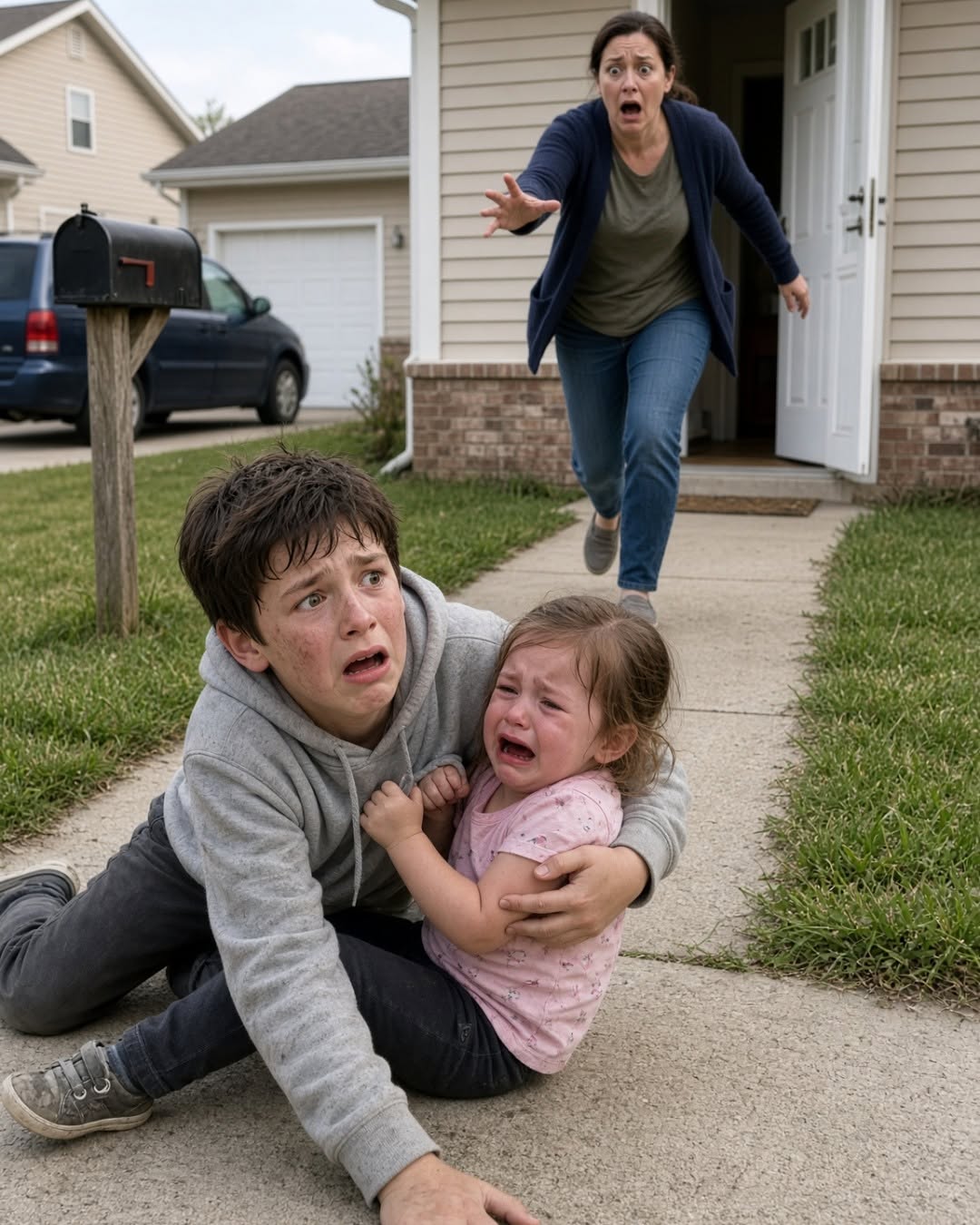
Seven blocks.
Both hands pulling him forward whenever his leg would not cooperate.
Lily crying against him.
And no adult beside them.
The hospital staff kept their questions short. Nobody crowded him. Nobody demanded a complete story while he was exhausted.
That mattered.
Because Drew had spent so long watching adults for danger that even kindness seemed to make him suspicious.
When someone brought him juice, he asked whether Lily could have one too.
When someone adjusted his blanket, he wanted to know where Lily was.
When Lily finally fell asleep, he watched her for another minute before closing his own eyes.
He was six years old, and somewhere along the way he had learned that his job was to keep a three-year-old safe.
I kept remembering Aaron.
My brother had been the kind of father who carried extra crackers in his coat pocket because Drew got hungry in the car. He used to send me pictures of ridiculous little things: Drew asleep sideways across the couch, baby Lily gripping Aaron’s finger, a pile of children’s shoes by the front door.
After Aaron died, those pictures stopped.
At first, of course they stopped.
Everything stopped for a while.
Then Reena began shutting people out.
Not dramatically.
That was what fooled me.
She never screamed at me to stay away. She never announced that I could not see the children again. She simply made every visit impossible one excuse at a time.
I would text about Saturday.
They were busy.
I would ask about Sunday.
Lily had a cold.
I would leave groceries on the porch.
Reena would thank me afterward instead of opening the door.
I mistook politeness for proof that everything inside the house was normal.
The next morning, Drew finally told more of the story.
Not all at once.
Children rarely tell frightening things in neat chronological order. He talked about cereal first. Then a toy truck. Then how Lily hated the dark. Then he asked whether he was going home.
I told him the only thing I knew for certain.
“You’re staying somewhere safe while the adults figure this out.”
He studied my face.
“With Lily?”
“Yes.”
His shoulders loosened slightly.
Only then did he start talking about the room.
Reena called it the quiet room.
Drew called it the punishment room.
When either child cried too much, spilled something, argued, woke Reena, or refused to stay where she wanted them, she would put them inside and close the door.
Sometimes it was only for a short while.
Sometimes, Drew said, it felt much longer.
The detail he remembered most was not the darkness.
It was listening.
He had learned to listen for Reena’s footsteps so he would know when she was approaching. He had learned how to tell whether Lily was about to panic from the way her breathing changed. He had learned to distract her with stories about Aaron because she barely remembered their father anymore.
“I tell her Daddy would’ve opened it,” he said.
I had to look away for a moment.
The phrase that had been haunting me was the last word Drew said in my yard.
Again.
She locked us in there again.
I had understood immediately that it meant the confinement had happened before.
I had not understood how much of Drew’s childhood had been organized around preparing for the next time.
When I asked about his leg, he stopped talking.