0 views
So I did not push.
Later, with someone trained to speak with children present, Drew explained only what he could manage.
He had hurt the leg before the day he escaped. He had cried about it. Reena told him he was being dramatic and needed to stop making Lily upset.
Afterward, he learned to drag himself instead of asking her again.
The day he came to my house, Reena had put both children in the room and closed the door.
Something about the latch did not hold the way it usually did.
Drew realized the door could move.
He pushed until it opened far enough for Lily to squeeze through.
Then he followed.
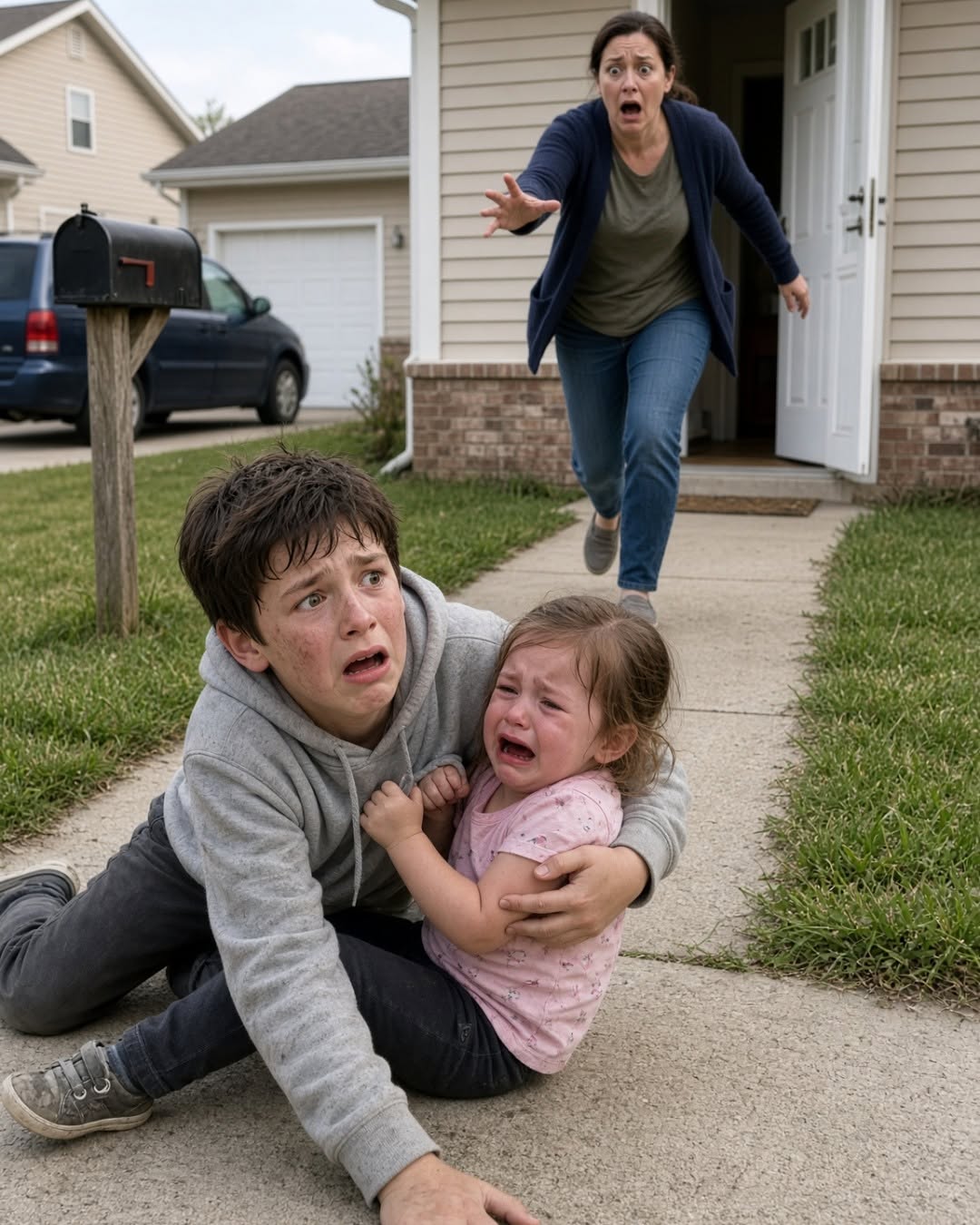
He knew my house was several blocks away because Aaron had walked the route with him before he died.
Drew remembered the mailbox.
He remembered my porch.
He remembered that I had once told him he could come to me if he ever needed anything.
Apparently, a six-year-old had remembered a sentence that I had forgotten saying.
He could not carry Lily the entire distance. She walked when she could. When she became frightened or tired, he pulled her against his chest and kept moving.
At some point his leg hurt badly enough that he stopped trying to stand.
He continued anyway.
By the time he reached my sidewalk, he was dragging himself with his hands.
There was no dramatic explanation for how he did it.
He was afraid that if he stopped, Reena would find them.
Fear carried him farther than his injured body should have been able to go.
The written card mattered because it showed something beyond one bad day.
Drew said Reena had made him practice the sentences.
If someone asked why he limped, he had fallen outside.
If someone asked about Lily, she was sleeping.
If someone asked why relatives rarely saw them, the children got sick easily and needed to stay home.
One prepared explanation covered three different problems.
The injury.
The isolation.
The absence of witnesses.
I kept thinking about every time Reena had told me I was making things harder by asking to visit.
She had understood something about me that I had not understood about myself.
I was terrified of becoming the intrusive brother-in-law who made a grieving widow’s life worse.
So every time she pushed me back politely, I retreated.
My guilt did the rest of her work for her.
When Reena finally contacted me, her message was almost shockingly normal.
She asked whether the children were with me.
Not whether Drew was alive.
Not why an ambulance had been called.
Not whether Lily was safe.
Just whether they were with me.
I did not answer immediately.
I showed the message to the appropriate people at the hospital and let them handle the next steps.
Reena sent another.
Then another.
Her tone changed from worried to irritated.
She said Drew had a habit of exaggerating when he wanted attention. She said his leg had been fine earlier. She said Lily copied everything her brother did.
Then she wrote something that made the index card on the chair beside me feel even heavier.
She said Drew must have injured himself after leaving the house.
But the X-rays had already taken that possibility away.
For the first time in three years, Reena’s version of events had run into something she could not talk around.
A medical image did not care whether she sounded calm.
Drew’s body had kept its own timeline.
The following days moved in small pieces.
Drew received the care his leg had been missing. Lily stayed close to him whenever she was allowed. I answered questions, provided old messages, and went through the records of every attempted visit I still had on my phone.
I had not saved them as evidence.
I had saved them because I kept hoping one of those conversations would eventually end with, “Come over. The kids would love to see you.”
Instead they formed a pattern.
My offers became more specific over time.
I could take Drew for an afternoon.
No.
I could bring dinner and leave immediately.
Not tonight.
Could I drop off Lily’s birthday present myself?
She was already asleep.
Could I speak to Drew on the phone?
He did not feel like talking.
One message meant nothing.
Dozens meant something different.
Reena had not simply been overwhelmed and forgetting to return calls.
She had been controlling contact.
The hardest part was realizing there had been moments when my instincts had warned me.
Once, months earlier, I had heard a child’s voice when Reena answered the phone. I asked if it was Drew.
There was a pause.
Then Reena said he was watching television and did not want to talk.
I accepted that.
Another time I left groceries and noticed the curtains move upstairs.
I waved.
Nobody waved back.
I told myself not to be strange about it.
Grief makes families complicated, I thought.
That sentence became my excuse for not asking harder questions.
But guilt was useless if I turned it into another reason to freeze.
So I focused on what Drew and Lily needed next.
Food that did not disappear after one serving.
A predictable bedtime.
Clean clothes.
Medical appointments.
People who knocked before entering.
Doors that opened.
At first Drew asked permission for everything.
Could Lily have another banana?
Could he leave a cup beside his bed?
Could they watch television after dinner?
Could he take a cracker for later?
That last one nearly broke me.
“You don’t have to hide food here,” I told him.
He looked embarrassed.
“I wasn’t hiding it.”
I nodded.
“Okay. You can still keep it.”
He slipped the cracker into his pocket.
I did not mention it again.