The Day I Disappeared on a Year-Long Cruise, My Son Finally Learned That His Mother Wasn’t His Servant
A story of grief, family betrayal, unexpected freedom, and a mother’s decision to reclaim her life.
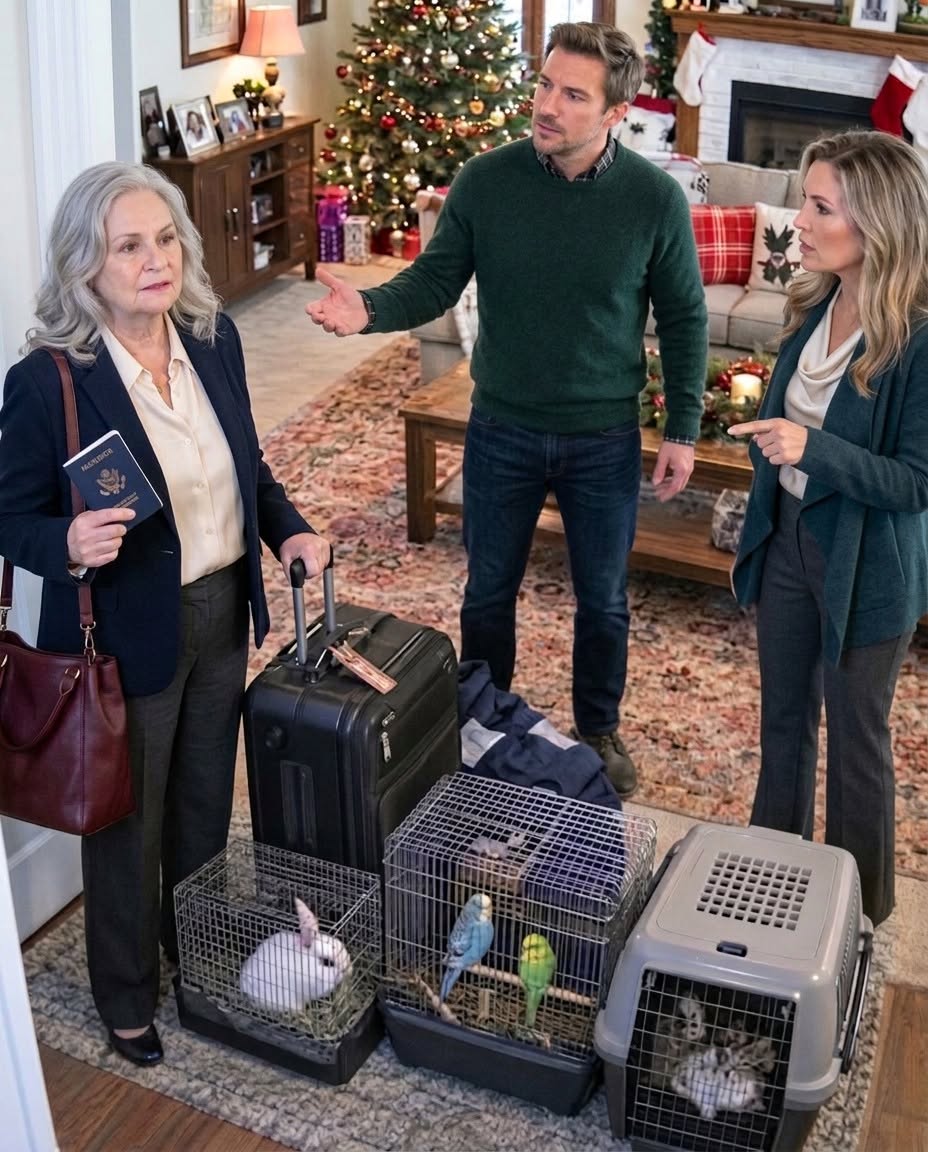
After Austin and Chloe left, I stood in the middle of my living room, staring at the three cages they had abandoned beside my husband’s photograph.
The house was painfully quiet except for the parakeets, who continued chirping nervously. The rabbit had pushed itself into the farthest corner of its cage, and the cat was staring at me through the metal bars.
I looked at Ernest’s photograph.
He was smiling in it, wearing his favorite blue shirt, with one arm wrapped around my shoulders. We had taken that picture during our anniversary trip to Key West, three years before he became ill.
“Well, Ernest,” I whispered, “it looks like your son has finally found a way to surprise me.”
For a moment, I almost laughed.
Then I cried.
Not because Austin had hurt my feelings. Not even because Chloe had treated me like a housekeeper.
I cried because I suddenly remembered how many years I had spent convincing myself that being needed was the same as being loved.
I had spent forty years making sure everyone else was comfortable.
And somewhere along the way, I had forgotten that I was allowed to be comfortable, too.
But that afternoon, something changed.
I wiped my cheeks, picked up my phone, and opened the email containing my cruise reservation.
The ship was scheduled to depart Miami at eight the following morning.
I had purchased the ticket under my maiden name, using money from an account Ernest and I had quietly maintained for years. The account had been intended for our retirement, but after his diagnosis, we had postponed our plans again and again.
There was enough money left for the cruise.
And I had decided I was going.
What Austin and Chloe didn’t know was that I had already arranged everything.
My passport was ready. My luggage had been delivered to a small hotel near Miami International Airport. My bank had confirmed my travel arrangements, and my attorney had reviewed the documents concerning my house.
All I needed to do was leave.
But before I disappeared, I had one more thing to take care of.
The three animals.
I couldn’t simply abandon them. Whatever their owners thought of me, the animals hadn’t done anything wrong.
I called a local animal rescue organization and explained the situation. They agreed to arrange temporary care and help me contact Austin about taking responsibility for them.
Then I made a second call.
This one was to Margaret, my attorney.
“Theresa,” she answered, “I was wondering when you’d call.”
“I’ve made up my mind, Margaret.”
“About the cruise?”
“About everything.”
There was a brief silence.
“Then we should finish the paperwork tonight.”
I glanced at Ernest’s photograph.
“Yes,” I said. “Tonight.”
## Chapter 1: The Woman Everyone Took for Granted
My name is Theresa Bennett. I was sixty-eight years old when I finally decided to stop living my life according to everyone else’s expectations.
For most of my adult life, I had believed that a good mother was someone who sacrificed without complaint.
When Austin was born, I left my job at a local accounting office because Ernest’s work required him to travel frequently. I told myself it was temporary.
Temporary became twenty years.
When Austin married Chloe, I welcomed her into our family with open arms. I helped them furnish their first apartment, contributed to their wedding expenses, and spent countless weekends preparing meals for them.
Whenever Austin called with a problem, I answered.
Whenever Chloe needed a favor, I agreed.
When their refrigerator broke, I paid for a replacement. When Austin lost his job, I covered several months of expenses. When they wanted to move into a larger apartment, I lent them money for the deposit.
I never kept a record of those favors.
I never expected repayment.
At least, that’s what I told myself.
But Ernest saw things differently.
“Theresa, you know you can say no, don’t you?” he once asked me.
We were sitting on the back porch after another Sunday dinner with Austin and Chloe. I had spent the entire afternoon cooking while Chloe complained about the restaurant she had originally wanted to visit.
“He’s our son,” I replied.
“And you’re his mother. That doesn’t mean you have to solve every problem he creates.”
I laughed and dismissed his concerns.
Ernest never argued for long. He was a quiet man, but he had a remarkable ability to recognize when someone was taking advantage of kindness.
During the last year of his life, when his illness made ordinary activities difficult, I became his primary caregiver.
I managed his medications, attended appointments, prepared his meals, and slept lightly in case he needed anything during the night.
Austin visited occasionally.
Chloe came even less often.
Yet when they did appear, they often brought requests.
One afternoon, while I was helping Ernest into bed, Austin called to ask whether I could transfer money to his account.
I explained that we had just paid a large medical bill.
He sounded irritated.
“Mom, it’s only a temporary problem. You know I’ll pay you back.”
I transferred the money.
Ernest heard the conversation.
When I returned to the bedroom, he held my hand.
“Promise me something, Theresa.”
“What is it?”
“When I’m gone, don’t let anyone turn your kindness into an obligation.”
I kissed his forehead.
“Don’t talk like that.”
“Promise me.”
I couldn’t bring myself to answer.
Now, after his funeral, I understood why he had insisted.
## Chapter 2: The Secret Ticket
The idea of the cruise had begun months before Ernest died.
One evening, while sorting through an old drawer, I discovered a photograph of us standing beside a large white cruise ship.
We had taken it twenty-five years earlier during a short Caribbean vacation.
Ernest had been wearing a ridiculous straw hat, and I was laughing so hard that my eyes were nearly closed.
On the back of the photograph, he had written:
One day, we’ll see the world together.
I sat on the floor for nearly an hour, holding that picture.
We never saw the world together.
There was always something more urgent.
Austin needed tuition.
Then there was a house payment.
Then came the grandchildren we had hoped for but never had, followed by Ernest’s illness and the endless medical expenses.
Our plans were postponed until they eventually disappeared beneath the weight of daily responsibilities.
A few weeks before Ernest passed away, he asked me to bring him his old travel notebook.
Inside were dozens of places he had wanted us to visit.
Lisbon. Barcelona. Rome. Athens. Istanbul. Singapore.
He had even circled Sydney.
“You should go,” he told me one evening.
“Without you?”
He smiled weakly.
“Especially if I can’t go.”
I shook my head.
“I couldn’t enjoy it without you.”
“Then take me with you in your memories.”
At the time, I thought he was simply trying to comfort me.
But after his death, those words became impossible to ignore.
I spent several nights researching long cruises. Eventually, I found a ship departing from Miami that would spend nearly a year traveling between continents.
The itinerary included ports in Europe, Asia, Australia, and South America.
It was expensive, but I could afford it without borrowing money.
I booked a cabin.
Then I booked my flight.
I didn’t tell Austin.
I didn’t tell Chloe.
I didn’t even tell my closest neighbor until the morning I was preparing to leave.
It wasn’t because I wanted to punish anyone.
I simply wanted one decision in my life to belong entirely to me.
## Chapter 3: The Instructions
After my conversation with Margaret, I returned to the living room.
The pet-care instructions were still lying on the coffee table.
Chloe had written them on a sheet of expensive stationery.
At the top, she had written:
MRS. BENNETT’S PET RESPONSIBILITIES
I read the list again.
Feed the parakeets at seven in the morning.
Clean the rabbit’s enclosure.
Check the cat’s water.
Vacuum the living room.
Keep the house tidy.
And, beneath all those instructions, a final sentence:
Please don’t call us unless it’s an emergency. We intend to enjoy our trip without unnecessary interruptions.
I stared at that last sentence for a long time.
Then I picked up my phone and photographed the page.
I wasn’t planning to use it to embarrass them.
I simply wanted to remember the moment when I finally understood how they saw me.
Not as a grieving mother.
Not as a woman who had just lost her husband.
Not even as a person with her own plans.
They saw me as a convenient service.
I called the animal rescue organization again and confirmed that someone would arrive the next morning.
Then I contacted a trusted neighbor, Mrs. Collins, who agreed to stay with the animals until the rescue worker arrived.
I left enough money to cover their food and any immediate expenses.
After that, I packed the last few things I needed.
My suitcase was already waiting at the hotel in Miami, but I kept a small overnight bag beside the bedroom door.
Inside it were my passport, medications, wallet, Ernest’s travel notebook, and the photograph from Key West.
I placed his wedding ring in a small velvet pouch.
He had given it to me forty years earlier, and I had never taken it off.
Now I carried it everywhere.
At midnight, I walked through the house one last time.
The dining table still had a few flowers from the funeral.
His slippers remained beside the bed.
His reading glasses were on the nightstand.
I picked them up and held them against my chest.
“I wish you were here,” I whispered.
For the first time since the funeral, I felt something other than sorrow.
I felt ready.
## Chapter 4: The Morning They Didn’t Expect
At five thirty the next morning, I woke before my alarm.
Outside, the sky was still dark.
I made myself a cup of tea and sat at the kitchen table.
The three cages were waiting in the living room, exactly where Austin and Chloe had left them.
Mrs. Collins arrived shortly after six.
She was seventy-two, a retired schoolteacher, and one of the few people who had continued checking on me after Ernest’s funeral.
When I opened the door, she immediately noticed my suitcase.
“Theresa, are you going somewhere?”
“Yes, Margaret. I’m going on a little trip.”
She looked at the suitcase, then at me.
“How little?”
I laughed.
“About a year.”
Her mouth fell open.
“You’re serious?”
“Completely.”
She hugged me so tightly that I almost spilled my tea.
“I’m so happy for you!”
I hadn’t realized how badly I needed to hear those words until she said them.
Mrs. Collins helped me check the cages one last time while we waited for the rescue worker.
At six forty-five, the worker arrived.
I explained the feeding instructions, handed over the supplies, and gave her Austin’s contact information.
She promised to update me once the animals had been transferred to appropriate care.
Then I locked the front door.
For a moment, I stood on the porch, looking at the house where Ernest and I had built our life.
I wasn’t selling it.
I wasn’t abandoning it.
I was simply leaving it behind for a while.
My attorney had arranged for a property manager to inspect it regularly, collect mail, and handle any urgent maintenance. The house would remain in my name, and no one would be allowed to move in without my written permission.
That was important because, two days earlier, Margaret had discovered something concerning.
Austin had apparently been discussing the possibility of moving into my house.
He had mentioned it casually to a real estate acquaintance, suggesting that the property might become available now that his father had died.
He hadn’t asked me.
He had simply assumed.
Margaret advised me to make my intentions clear in writing.
So I had.
A signed letter was waiting in her office, explaining that I would be away for an extended period and that no one had permission to occupy or make decisions about the property.
I didn’t know how Austin would react.
But for the first time, his reaction wasn’t going to determine what I did.
## Chapter 5: The Empty House
At eight fifteen, my plane departed Miami.
I watched the coastline disappear beneath the clouds and felt an unexpected lightness.
My phone vibrated.
Austin.
I stared at his name for a few seconds before answering.
“Hello, sweetheart.”
“Mom, where are you?”
“Good morning to you, too.”
“Don’t play games. Chloe says you aren’t answering her messages.”
“I’m on a plane.”
“What?”
“I’m traveling.”
There was a pause.
“Traveling where?”
“Miami.”
“Why are you in Miami?”
I looked out the window.
“Because my ship leaves this morning.”
Another pause.
“What ship?”
“A cruise ship, Austin.”
He laughed.
It wasn’t a happy laugh.
“Mom, this isn’t funny. We left the animals with you.”
“I arranged for someone to care for them.”
“Who?”
“An animal rescue organization.”
“What? You can’t just give our pets away!”
“I haven’t given them away. They’re receiving temporary care because I won’t be home.”
“Where are you going?”
“On a year-long cruise.”
For several seconds, he said nothing.
Then his voice rose.
“A year? Are you out of your mind?”
I closed my eyes.
“No, sweetheart. I’m finally thinking clearly.”
“Mom, you can’t leave like this! We have plans!”
“Your plans aren’t my responsibility.”
“Chloe and I are on vacation!”
“I know. You told me.”
“Then why would you do this?”
I almost laughed again.
Because they had left three cages beside my husband’s photograph and handed me a list of chores.
Because they had treated my grief as an inconvenience.
Because my son had kissed my forehead and thanked me for being dependable without ever wondering whether I wanted to help.
But I didn’t say any of those things.
Instead, I told him the truth.
“Because I want to live my life, Austin.”
He sounded stunned.
“Mom, you’re being selfish.”
I looked at the photograph resting in my lap.
“Perhaps I should have learned how to be selfish a long time ago.”
Then I ended the call.
For the first time in decades, I didn’t spend the next hour worrying about whether I had upset him.
I switched off my phone and watched the clouds pass beneath the airplane.
## Chapter 6: The First Message
By the time I boarded the cruise ship, I had received eleven missed calls.
Eight were from Austin.
Three were from Chloe.
There were also several messages.
The first was angry.
Mom, this is ridiculous. Call me immediately.
The second was demanding.
We need to know where you left the animals.
The third was almost comical.
You can’t just disappear when we need you.
I read that one twice.
When exactly had they decided that my life was something they could schedule around their convenience?
I didn’t reply.
Instead, I walked onto the ship’s upper deck.
The ocean stretched in every direction, shimmering beneath the morning sun.
Passengers were taking photographs, families were waving goodbye, and crew members were welcoming everyone aboard.
I found a quiet chair overlooking the water and sat down.
For the first time in months, nobody was asking me to do anything.
Nobody needed me to prepare a meal.
Nobody needed money.
Nobody needed me to solve a problem.
I could simply sit.
And breathe.
A woman about my age approached me.
“Is this seat taken?”
“No. Please.”
She introduced herself as Margaret Ellis, a retired librarian from Oregon.
We began talking about the ship, the itinerary, and the places we hoped to visit.
Eventually, she asked whether I was traveling with family.
“My husband passed away recently,” I said. “He always wanted to see the world.”
Margaret’s expression softened.
“I’m sorry.”
“Thank you.”
“Are you traveling alone?”
I looked at the ocean.
“Yes. But I don’t think I’ll be lonely.”
She smiled.
“Then perhaps we’ll have some adventures together.”
I had no idea how important that conversation would become.
## Chapter 7: The Son Who Couldn’t Understand
Back home, Austin’s vacation had taken an unexpected turn.
He called again the following afternoon.
This time, his voice was quieter.
“Mom, please tell me where you are.”
“I told you. I’m on the cruise.”
“Which ship?”
I gave him the name.
“You’re serious about staying away for a whole year?”
“Yes.”
“Who is looking after the house?”
“My property manager.”
“What property manager?”
“The one I hired.”
He sighed.
“Mom, you could have told us.”
I leaned against the railing outside my cabin.
“I could have. But I didn’t need your permission.”
“That’s not what I meant.”
“Then what did you mean?”
He hesitated.
Finally, he said, “Chloe is upset.”
I waited.
“She’s saying the whole vacation is ruined.”
“I’m sorry to hear that.”
“Mom, you don’t sound sorry.”
“Because I didn’t arrange your vacation, Austin.”
He became defensive.
“We trusted you!”
I was silent for a moment.
Then I asked a question I had wanted to ask for years.
“Did you ever consider trusting me with my own decisions?”
He didn’t answer.
Instead, he changed the subject.
“What are we supposed to do about the house?”
There it was.
The question that had haunted me since Ernest’s funeral.
Not whether I was safe.
Not whether I was happy.
Not whether I needed anything.
The house.
I spoke slowly.
“The house belongs to me. Margaret has all the documents. If you need anything concerning it, speak with her.”
“Why are you making this so complicated?”
“Because it was already complicated before I left.”
He hung up.
I stood on the balcony for several minutes, thinking about the conversation.
Then I went downstairs for dinner.
I had no intention of allowing another phone call to ruin an evening I had waited forty years to enjoy.
## Chapter 8: A Letter from Ernest
Three weeks into the cruise, something unexpected happened.
The ship had stopped in Lisbon, and I was sitting in a small café overlooking a narrow street when an email arrived from Margaret, my attorney.
The subject line read:
A Letter Ernest Asked Me to Keep
My hands trembled as I opened it.
Margaret explained that shortly before Ernest’s final hospitalization, he had visited her office alone.
He had brought an envelope and asked her to keep it until I was ready to make certain decisions about my future.
Inside the envelope was a handwritten letter.
My dearest Theresa,
If you’re reading this, then I have probably left you with more memories than answers.
I know how much you have sacrificed for me and for Austin. I have watched you give away your time, your energy, your savings, and sometimes even your happiness because you believed that was what love required.
But love should never require you to disappear.
I don’t want you to spend the rest of your life sitting in our house, waiting for someone to need you.
If you ever decide to travel, travel. If you want to sell the house someday, sell it. If you want to sit quietly and do absolutely nothing, then do that.
You don’t owe anyone an explanation for being alive.
I wish I could have given you more adventures. Since I cannot, I hope you’ll find a few of your own.
And when you see the ocean, think of me.
I’ll be thinking of you.
Forever yours, Ernest.
I read the letter once.
Then again.
By the third reading, my tears had blurred the words.
For several minutes, I sat in the café with the letter pressed against my chest.
I had spent so much time wondering whether I was betraying Ernest by leaving our home.
Now I understood that staying out of fear would have been the greater betrayal.
That evening, I walked along the waterfront and watched the sunset.
I imagined Ernest beside me, wearing that ridiculous straw hat.
And for the first time, I smiled without feeling guilty.
## Chapter 9: The House That Wasn’t Theirs
While I traveled, Margaret kept me informed about developments at home.
Two months after the ship departed, Austin contacted her.
He wanted to know whether he and Chloe could move into my house temporarily.
Their apartment lease was ending, and they had apparently decided that staying with me would be easier than finding another place.
Margaret politely informed him that the property was not available.
Austin became angry.
He insisted that Ernest had always intended for him to inherit the house.
Margaret explained that inheritance discussions were not permission to occupy a property while its owner was alive.
Austin demanded a copy of the will.
She provided the appropriate documents.
There was no provision giving him immediate ownership or occupancy rights.
Ernest had left the house to me.
Only after my death would certain inheritance arrangements take effect, subject to the terms of his estate plan.
Austin was furious.
He called me repeatedly.
Eventually, I answered.
“Mom, why didn’t you tell me Dad left you the house?”
I was sitting in my cabin, watching the Mediterranean coast drift past.
“Because your father and I didn’t think it was necessary to discuss our estate arrangements with you while he was alive.”
“But I’m his son!”
“Yes, you are.”
“So why should I have to rent a house when my own family owns one?”
I was quiet for a moment.
Then I said, “Austin, the house isn’t yours.”
He seemed unable to process the sentence.
“But I’m your only child!”
“And I’m your mother. That doesn’t mean you own everything I have.”
He hung up.
For the rest of the day, I felt unsettled.
Not because I doubted my decision, but because I finally recognized how deeply my son had confused family with entitlement.
I hoped he would eventually understand.
But I no longer considered it my responsibility to teach him.
## Chapter 10: Chloe’s Apology
Several months into my journey, I received a message from Chloe.
It was the first time she had contacted me without demanding something.
Mrs. Bennett, I hope you’re well. Austin told me about the letter from your attorney. I think we need to talk.
I read it several times before replying.
I’m happy to talk when we’re both ready to have a respectful conversation.
She responded almost immediately.
I know I haven’t treated you well. I was angry about the animals and the vacation, but I understand that wasn’t fair.
I didn’t reply right away.
The next day, she sent another message.
I also owe you an apology for how I behaved after Ernest’s funeral.
That one made me pause.
I had imagined receiving an apology many times.
Sometimes I had imagined it arriving with tears and dramatic declarations.
Sometimes I had imagined simply walking away without listening.
But now that the apology had arrived, I realized I didn’t know what to do with it.
I called her that evening.
“Chloe?”
“Mrs. Bennett.”
“You can call me Theresa.”
There was a long silence.
Then she began to cry.
“I’m sorry.”
I listened.
She told me that she had been overwhelmed by financial problems, that Austin was under pressure at work, and that they had argued about their future.
She admitted that she had treated me as though I were responsible for solving their difficulties.
I didn’t interrupt.
When she finished, I asked one question.
“Chloe, if I had been unable to care for those animals, what would you have done?”
She was quiet.
“I don’t know.”
“Would you have found someone else?”
“Probably.”
“Then why didn’t you ask me whether I was willing?”
She began crying again.
“I thought you’d say yes.”
“And that was the problem.”
For a moment, neither of us spoke.
Then she said something I hadn’t expected.
“I think I took your kindness for granted.”
I looked out at the ocean.
“Yes,” I said gently. “You did.”
I didn’t tell her everything was forgiven.
I didn’t promise to return home.
But I thanked her for apologizing.
It was a beginning, not a conclusion.
## Chapter 11: The Unexpected Visit
By the sixth month of my cruise, I had begun to feel at home on the ship.
I had made friends with Margaret Ellis and several other passengers.
I attended language classes, joined photography walks, and volunteered to help organize a small reading group.
In Barcelona, I visited museums I had only seen in books.
In Rome, I spent an entire afternoon wandering through streets without checking the time.
In Athens, I sat beside an ancient temple and wrote in Ernest’s old travel notebook.
Every evening, I recorded one thing I had enjoyed that day.
Some entries were simple.
Today I ate the most wonderful peach.
Today I watched the sunrise from the upper deck.
Today I laughed so hard at dinner that I nearly spilled my water.
Others were more emotional.
Today I realized that happiness doesn’t have to be earned through sacrifice.
One morning, while the ship was preparing to depart from Barcelona, I received a call from Austin.
His voice sounded different.
“Mom, I’m in Spain.”
I blinked.
“What?”
“I’m in Barcelona. Chloe and I flew here.”
I was speechless.
He continued.
“We found out your ship was stopping here, and I thought maybe we could talk.”
I looked toward the harbor.
Part of me was angry that he had appeared without asking.
Another part was curious.
“Where are you?”
“At the passenger terminal.”
I closed my eyes.
“Did you arrange a visitor appointment with the ship?”
“Not yet. I thought you could help.”
I almost laughed.
Even after everything, he still expected me to arrange things for him.
“Let me speak with the guest services team. I can’t promise anything.”
I checked with the ship’s staff and learned that visitors were not permitted to board without prior authorization.
Austin and Chloe would need to arrange a meeting on shore.
I agreed to meet them at a café near the terminal.
When I arrived, they were already waiting.
Austin stood up awkwardly.
Chloe looked nervous.
For several seconds, none of us knew what to say.
Then Austin stepped forward.
“Mom.”
He tried to hug me.
I accepted the hug, but I didn’t hold on for long.
We sat down.
The conversation began with small talk about the ship and my travels.
Eventually, Austin leaned forward.
“Mom, I need to apologize.”
I studied his face.
He looked tired.
Not because of the journey, I suspected, but because he had finally been forced to confront a situation he couldn’t solve by asking me for help.
“I know I treated you badly after Dad died,” he continued. “I shouldn’t have left those animals with you. I shouldn’t have assumed you’d take care of everything.”
I said nothing.
He looked down at his hands.
“I think I expected you to keep doing what you’d always done.”
“And what was that?”
“Putting us first.”
I nodded.
“Yes. I did that for a long time.”
He looked at me.
“I didn’t realize how much.”
I took a slow breath.
“That’s why we’re having this conversation now.”
## Chapter 12: The Truth About the Money
The conversation took an unexpected turn when Austin mentioned his financial problems.
His company had reduced his hours, and he and Chloe were struggling to cover their expenses.
They had accumulated debt, and their apartment had become increasingly expensive.
He asked whether I could help.
For a moment, I felt the familiar urge to reach for my purse.
It was automatic.
A habit developed over decades.
Then I remembered Ernest’s letter.
I remembered the cruise ticket.
I remembered how peaceful it had felt to make a decision without considering whether Austin would approve.
I folded my hands on the table.
“Austin, I’m sorry you’re struggling.”
He looked hopeful.
“But I can’t solve this for you.”
His expression changed.
“Mom, I’m not asking for much.”
“How much?”
He hesitated before naming a figure.
It was a substantial amount.
I shook my head.
“No.”
“Why not?”
“Because I have my own expenses, and I intend to keep the money I saved for my future.”
“But you have plenty!”
I looked directly at him.
“How do you know what I have?”
He didn’t answer.
I continued.
“Your father and I worked for decades. We saved carefully. We paid our bills. We planned for retirement. I sold jewelry to pay for his medication, and I used savings to help you when you needed it. I’m not ashamed of helping you. But I won’t spend the rest of my life giving away everything I saved.”
Chloe lowered her eyes.
Austin looked frustrated.
“So what are we supposed to do?”
“Make a plan. Talk to your bank. Review your expenses. Find a place you can afford. Ask for professional financial advice if you need it.”
He shook his head.
“That’s easy for you to say.”
“No, sweetheart. It isn’t easy. But it is your responsibility.”
For a long time, he said nothing.
Then he asked, “Are you really never coming back?”
I looked at the harbor.
“I’ll come back when I’m ready.”
“And the house?”
“It’s still my home.”
“Can we stay there when you return?”
“That depends on the circumstances and whether we can agree on reasonable boundaries.”
He looked surprised.
“Boundaries?”
“Yes, Austin. I have some now.”
## Chapter 13: A Different Kind of Goodbye
Our meeting lasted almost two hours.
By the time we stood up, the afternoon sun was shining across the harbor.
Chloe hugged me.
This time, I returned the hug.
Austin stood awkwardly beside us.
“Can we call you sometimes?” he asked.
“Of course.”
“Will you answer?”
“When I can.”
He seemed disappointed by that answer, but he didn’t argue.
Before leaving, he turned toward me.
“Dad would have been proud of you.”
The words caught me off guard.
For a moment, I couldn’t speak.
Then I smiled.
“I hope so.”
As they walked away, I felt no desire to chase after them.
I didn’t feel the need to offer money or promise to return early.
I simply watched them disappear into the crowd.
Then I turned toward the ship.
Margaret Ellis was waiting near the entrance.
“How did it go?” she asked.
“Honestly?”
“Always.”
“It was difficult.”
She nodded.
“Family conversations often are.”
“But I think it was necessary.”
We walked back toward the ship together.
That evening, I sat alone on the upper deck with Ernest’s letter in my hands.
The sun was setting, painting the horizon in shades of orange and gold.
I thought about the woman I had been before the cruise.
She had believed that love meant always being available.
She had believed that a good mother never said no.
She had believed that being needed was proof that she mattered.
Now I understood something different.
Love could exist alongside boundaries.
Family could matter without controlling every decision.
And a mother could love her son while refusing to solve every problem he encountered.
I folded Ernest’s letter carefully and placed it inside my notebook.
Then I wrote a new entry.
Today I learned that leaving doesn’t always mean abandoning someone. Sometimes it means giving everyone the opportunity to stand on their own.
## Chapter 14: The Return
Eleven months after leaving Miami, the cruise ship began its final journey toward Florida.
I stood on the deck as the coastline appeared in the distance.
The year had changed me in ways I couldn’t have imagined.
I had learned enough Italian to order meals without relying on a translator.
I had made friends from countries I had previously known only through books.
I had visited places Ernest and I had once dreamed about seeing together.
Most importantly, I had discovered that my life didn’t have to end simply because one chapter had closed.
When the ship finally docked, I collected my luggage and stepped onto the terminal floor.
Margaret Ellis had already arranged to travel home separately, but we promised to meet again.
I took a taxi to a hotel near the airport and spent the afternoon resting.
The following morning, I returned to the house.
It looked almost exactly as I had left it.
The garden had been maintained, the windows were clean, and the porch furniture was still in place.
I stood outside for several minutes before unlocking the door.
Inside, the house smelled faintly of cedar and fresh paint.
The property manager had kept everything in good condition.
Ernest’s photograph remained on the mantelpiece.
Beside it was a small vase of fresh flowers.
I walked slowly through every room.
Our bedroom.
The kitchen.
The back porch.
The dining room where Austin had once celebrated his birthdays.
Every corner contained a memory.
But the memories no longer felt like chains.
They felt like pieces of a life I had been fortunate enough to live.
That afternoon, I unpacked my suitcase and placed the travel notebook on the kitchen table.
Then I called Austin.
“Mom?” he answered.
“I’m home.”
There was a long silence.
“You’re back?”
“Yes.”
“Can we come over?”
I considered the question.
“Tomorrow afternoon would be fine.”
“Really?”
“Yes. But I’d like us to have a quiet conversation.”
“Of course.”
“And Austin?”
“Yes, Mom?”
“I love you.”
His voice softened.
“I love you, too.”
## Chapter 15: The Rules of a New Beginning
Austin and Chloe arrived the following afternoon.
This time, they knocked.
That small gesture meant more to me than they could have imagined.
I opened the door and invited them inside.
We sat in the living room, beneath Ernest’s photograph.
I had prepared tea and a plate of biscuits.
For several minutes, we talked about ordinary things.
Then I placed a folder on the table.
Austin looked at it.
“What’s that?”
“Some things I’d like us to understand before we move forward.”
Inside were three documents.
The first was a letter explaining that the house remained mine and that I would make all decisions concerning it.
The second outlined the arrangements for visits and emergencies while I was living there.
The third was a simple financial statement showing that I had reserved money for my retirement and future care.
I explained each document calmly.
Austin looked uncomfortable.
Chloe read everything carefully.
When I finished, Austin leaned back.
“Mom, do we really need all this?”
“Yes.”
“Can’t we just trust each other?”
I looked at him.
“Trust is important. But clear expectations help protect it.”
He glanced at the documents again.
“What if we need somewhere to stay?”
“We can discuss it if that situation arises. But the answer won’t automatically be yes.”
He nodded slowly.
Chloe spoke next.
“I think that’s fair.”
Austin looked at her.
She continued.
“Your mother spent years helping us. We can’t expect her to keep doing that forever.”
I was surprised by how much those words meant.
Not because they changed the past.
But because they showed that Chloe was beginning to understand something she hadn’t understood before.
I closed the folder.
“I don’t want us to spend the rest of our lives arguing about money or favors. I want to enjoy being your mother. I want to have dinner together sometimes. I want to hear about your lives without every conversation becoming a request.”
Austin looked down.
“I understand.”
I hoped he meant it.
But I also understood that one conversation couldn’t undo forty years of habits.
Trust would have to be rebuilt gradually.
And I was willing to give that process time.
## Chapter 16: The Life I Chose
Six months after returning home, I made another decision.
I sold the house.
Not because Austin had demanded it.
Not because I was angry.
And certainly not because I wanted to punish anyone.
I simply realized that the house had become more work than joy.
The garden required constant maintenance. The roof needed repairs, and the property taxes had increased.
More importantly, I wanted to live somewhere smaller and easier to manage.
After speaking with Margaret and reviewing my finances, I found a comfortable apartment in a quiet community near the coast.
It had two bedrooms, a small balcony, and a large window overlooking a garden.
I kept the furniture I loved, including Ernest’s reading chair.
His photograph occupied a special place on the living-room shelf.
I also kept his travel notebook.
The apartment wasn’t enormous, but it was mine.
I could wake whenever I wanted.
I could cook or order dinner.
I could invite friends over without worrying about whether the house was clean enough.
And I could travel again whenever I felt like it.
Austin initially struggled with my decision.
He had imagined that the house would eventually become his.
But after several conversations, he accepted that I had the right to make my own choices.
Chloe began visiting occasionally.
Sometimes we had lunch together.
Sometimes she brought flowers.
On one visit, she asked whether I would teach her how to make Ernest’s favorite lemon cake.
I smiled.
“Only if you promise not to complain about the amount of washing up.”
She laughed.
“I’ll do the dishes.”
And she did.
Austin also began calling more often, sometimes simply to ask how I was doing.
Not every conversation was perfect.
We still disagreed about money, family obligations, and expectations.
But gradually, our conversations became less about what I could provide and more about how we could maintain a relationship.
I didn’t become the mother who said yes to everything again.
And I didn’t need to.
## Chapter 17: One More Adventure
On the first anniversary of my departure, I returned to the Miami waterfront.
This time, I wasn’t boarding a ship.
I was meeting Margaret Ellis for lunch.
She had traveled to Florida for a family visit, and we decided to celebrate the anniversary of our friendship.
After lunch, we walked along the harbor.
A large cruise ship was preparing to depart.
I stopped to watch the passengers gathering on the upper deck.
For a moment, I remembered that first morning.
The luggage.
The cages.
The angry phone calls.
The fear that I might be making a terrible mistake.
Then I remembered the letter from Ernest.
You don’t owe anyone an explanation for being alive.
I smiled.
Margaret noticed.
“What are you thinking about?”
“How much can change in a year.”
“Do you regret going?”
I looked at the ship.
“Not for a single moment.”
She laughed.
“Then where are you going next?”
I thought about it.
Perhaps New Zealand.
Perhaps Japan.
Perhaps somewhere neither of us had considered yet.
“I haven’t decided.”
“Good,” she said. “That means the adventure isn’t over.”
We continued walking.
That evening, I returned to my apartment and found a small package waiting at the door.
It was from Austin and Chloe.
Inside was a framed photograph of the three of us taken during our recent family dinner.
On the back, Austin had written:
Mom, thank you for teaching us that loving someone also means respecting their choices. We hope you enjoy your next adventure.
I read the note twice.
Then I placed the photograph beside Ernest’s.
I didn’t cry.
Instead, I smiled.
Not because everything had become perfect.
Not because the past no longer hurt.
But because I finally understood that I could love my family without losing myself.
I could remember Ernest without spending every day mourning him.
I could cherish my home without being trapped by it.
And I could be a mother without being everyone’s personal servant.
The next morning, I opened my laptop and began researching another journey.
This time, I didn’t need to hide the ticket.
I didn’t need to ask permission.
And I didn’t need to justify why I wanted to go.
I simply chose a destination, checked the dates, and smiled.
For the first time in forty years, my future belonged entirely to me.
And as I closed the laptop, I glanced at Ernest’s photograph.
“Well, darling,” I whispered, “I think we have a little more exploring to do.”
Outside my window, the morning sun shone across the garden.
I made myself a cup of tea, opened the balcony doors, and breathed in the fresh air.
The world was still waiting.
And this time, I was ready to meet it.