PART 2: The morning I found the first envelope, I was standing in Walter’s kitchen holding the coffee mug he had used every morning for fourteen years.
I was about to put it into a box when something inside the cabinet caught my attention.
A small brass key.
Taped beneath it was a handwritten note. “Linda — not yet. Wait until the envelope.” I stared at those five words for a long time. Then I heard a car pull into the driveway.
Melissa.
I slipped the note into my pocket before she could see it. She walked into the kitchen without knocking. That was something she had always done. She looked around at the boxes.
“You’re packing already?”
“I have to.”
She glanced at the kitchen cabinets. “Dad left this place to Aaron and me. We figured we’d probably renovate.” I nodded. “That’s nice.” “We’ll need you out by the end of the occupancy period, though.”
“I know.”
She hesitated. Then she looked at the mug in my hand. “Are you taking Dad’s things?” The question was so blunt that I almost laughed.
“Some things.”
“Like what?”
“His clothes. His photographs. A few books.” Melissa folded her arms. “Dad’s personal belongings are technically part of the estate.” I looked at her. “His underwear too?” She frowned. “That’s not what I meant.”
“I know.”
For a moment, neither of us spoke. Then she noticed the boxes in the dining room. “You’re really taking all this?”
“No. Most of it stays.”
“Good.”
She walked toward the living room and began opening drawers. I watched her. “Can I help you?” “I’m looking for Dad’s watch.” “I haven’t seen it.” “He always wore it.” “Maybe Aaron has it.”
“He doesn’t.”
The way she said it made me realize she had already searched his room. She was looking for something. Not memories.
Something specific.
“Did Dad ever tell you where he kept his important papers?” she asked.
My stomach tightened.
“What papers?”
“Nothing.”
She closed the drawer.
“Just asking.”
I said nothing.
Melissa stayed another twenty minutes, walking through the house as though she already owned it.
When she finally left, I went upstairs.
Walter’s study had barely been touched since the funeral.
His desk was exactly as he had left it.
A stack of medical bills sat beneath an old calculator.
His favorite pen was beside the telephone.
A framed photograph of us from our tenth anniversary stood near the lamp.
I picked it up.
Walter was smiling.
I wasn’t looking at the camera.
I was looking at him.
I pressed my fingers against the glass.
“I wish you had told me what you were thinking,” I whispered.
Then I remembered the brass key.
I searched the study.
Desk drawers.
Filing cabinet.
Closet.
Bookshelf.
Nothing.
Finally, I noticed something strange about the bottom drawer of his desk.
It was locked.
I had never seen it locked before.
I tried the brass key.
It fit.
The drawer opened with a soft click.
Inside was almost nothing.
A leather folder.
Three bank statements.
A property map.
And a sealed envelope with my name on it.
LINDA BENNETT
My hands began shaking.
The envelope was thick.
I remembered Samuel’s words.
After the probate filing is accepted.
But this was different.
This one had been hidden in Walter’s desk.
I opened it.
There was only one sheet of paper.
Walter’s handwriting.
I recognized it immediately.
Linda,
If you’re reading this before Samuel gives you the other envelope, then you have found something I hoped you would find.
Please don’t trust anyone who tells you the ten acres are worthless.
Especially Melissa.
And especially Aaron.
The land is not what they think it is.
You must wait.
Do not sell it.
Do not sign anything.
And whatever happens, do not let them convince you to give them the property.
I love you.
Walter
I read it three times.
Then a fourth.
My first reaction wasn’t excitement.
It was fear.
Why would Walter specifically warn me about his own children?
And what did he mean by the land is not what they think it is?
I unfolded the property map.
It was old.
Much older than our marriage.
A red line marked the ten acres.
But there was something else.
Across the bottom of the map was a series of handwritten numbers.
Coordinates.
I recognized the road.
County Road 16.
Then I saw a second notation.
Creek access — easement confirmed.
I sat down.
My heart began beating faster.
The land had always seemed useless.
But Walter had apparently been hiding something.
The next morning, I drove out there.
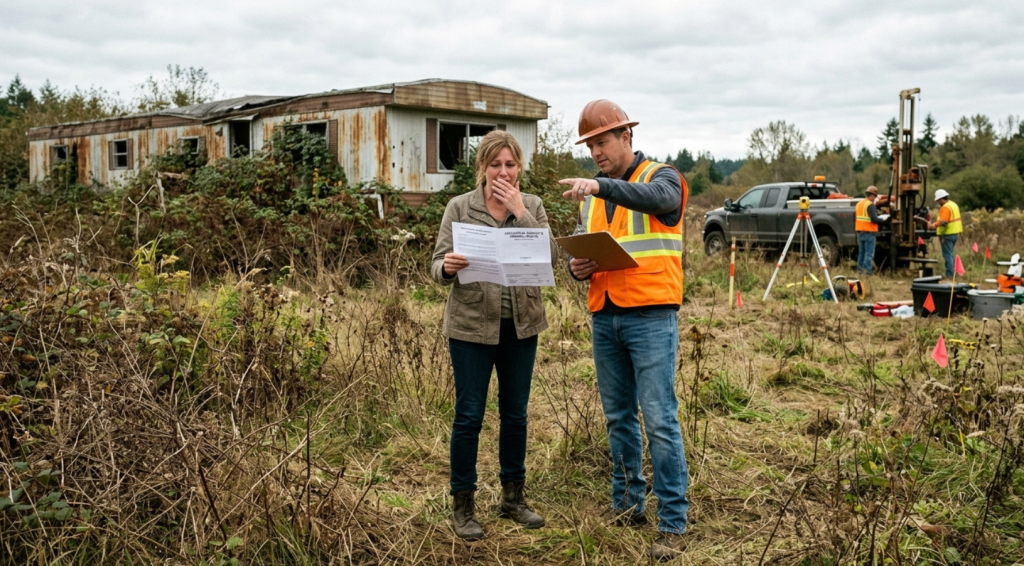
The property looked exactly as I remembered.
Dead grass.
Overgrown bushes.
The trailer leaning slightly to one side.
The windows were covered with plywood.
A rusted mailbox stood near the road.
I parked beside the trailer.
The air smelled of wet earth and pine.
For a few minutes, I simply stood there.
Then I noticed something I had never noticed before.
A fresh tire track.
Someone had recently driven onto the property.
I followed it.
The tracks disappeared behind the trailer and continued toward the creek.
I walked through the weeds.
About fifty yards from the trailer, I found a wooden stake in the ground.
It wasn’t old.
It had been freshly painted red.
And attached to it was a small metal tag.
SURVEY MARKER — DO NOT REMOVE.
I stared at it.
Why would anyone be surveying Walter’s abandoned land?
Then I heard an engine.
I turned.
A black pickup truck was coming down the dirt path.
I couldn’t see the driver clearly.
The truck stopped.
The window rolled down.
Aaron.
He stared at me.
“What are you doing here?”
I looked at the survey marker.
“What are you doing here?”
His jaw tightened.
“I came to check something.”
“What?”
“Dad’s property.”
“My property.”
He smiled.
“Technically, yes.”
I didn’t like the way he said technically.
Aaron got out.
He walked toward me.
“Linda, I’m going to give you some advice.”
“I don’t need advice.”
“You should.”
He pointed toward the trailer.
“That land isn’t worth anything.”
“I know.”
“Then there’s no reason for you to spend time here.”
“Maybe I like it.”
He laughed.
“You don’t.”
“You don’t know what I like.”
His smile disappeared.
For several seconds, he said nothing.
Then he looked toward the creek.
“You found the markers.”
It was a statement.
Not a question.
My stomach dropped.
“What markers?”
He realized his mistake immediately.
“Nothing.”
I stepped closer.
“You knew they were here.”
Aaron rubbed his forehead.
“Linda, just listen to me.”
“No.”
“Dad didn’t tell you everything.”
“Apparently.”
“He wasn’t exactly thinking clearly toward the end.”
I stared at him.
“He wrote me a letter.”
Aaron froze.
“What?”
I didn’t answer.
His eyes changed.
For the first time since Walter died, I saw genuine fear on his face.
“What did he write?”
“That doesn’t concern you.”
He stepped toward me.
“Linda—”
I raised my hand.
“Don’t.”
Something in my voice stopped him.
I walked back toward my car.
Behind me, Aaron called out.
“You’re going to regret this.”
I stopped.
I turned around.
“Regret what?”
He didn’t answer.
He got into his truck and drove away.
I watched until the dust settled.
Then I looked at the survey marker again.
That night, I called Samuel Price.
He answered on the third ring.
“Linda?”
“I need to ask you something about Walter’s property.”
There was a pause.
“Which property?”
“The ten acres.”
Another pause.
This one was longer.
“What about it?”
“Was Walter planning to sell it?”
“No.”
“Was someone surveying it?”
Silence.
“Samuel?”
He exhaled slowly.
“Linda, I think you need to come to my office tomorrow morning.”
My pulse quickened.
“Why?”
“Because there’s something Walter asked me to explain to you personally.”
“What?”
“I can’t discuss it over the phone.”
“Is it about the land?”
“Yes.”
I closed my eyes.
“What did Walter know?”
Samuel’s voice softened.
“More than he ever told his children.”
I barely slept that night.
The next morning, I arrived at Samuel’s office before nine.
He had already prepared a folder.
He closed the door.
Then he placed the folder on his desk.
“Linda, before I explain anything, I need you to promise me something.”
“What?”
“If Melissa or Aaron approaches you about selling the land, you do not sign anything.”
“I won’t.”
“Not even a preliminary agreement.”
“I understand.”
“Not even if they tell you the property is worthless.”
I stared at him.
“What is on that land?”
Samuel opened the folder.
Inside was a copy of a survey.
A much newer survey than the one Walter had hidden.
I looked at the map.
My eyes moved across the ten acres.
Then stopped.
There was a large shaded area marked in blue.
“What is that?”
“Underground.”
“Underground what?”
Samuel leaned back.
“Water.”
I frowned.
“It’s just a creek.”
“No.”
He pointed to the map.
“I’m talking about an underground aquifer.”
I stared at him.
Samuel continued.
“Several years ago, a regional development company began purchasing property in that area. They wanted access to a large groundwater reserve.”
My mouth went dry.
“Walter knew?”
“He knew before they approached him.”
“Did he sell?”
“No.”
“Why?”
Samuel looked directly at me.
“Because the company offered him $1.2 million.”
I couldn’t breathe for a second.
“One point two million?”
“Yes.”
“And he refused?”
“He refused every offer.”
“Why?”
Samuel opened another document.
“Because the original purchase agreement contained something Walter didn’t like.”
“What?”
“They didn’t just want to buy the land.”
He pushed the document toward me.
“They wanted permanent water rights.”
I looked at the page.
There it was.
The company wanted control over the underground water beneath the property and the right to drill wells.
Samuel continued.
“Walter believed the water would become extremely valuable once the county approved the new industrial development project.”
“How valuable?”
He looked at me.
“Potentially several million dollars.”
I sat back.
The room seemed suddenly too small.
“Then why did Walter leave it to me?”
Samuel was quiet.
Then he said,
“Because he knew his children would sell it.”
I looked down at the document.
“Melissa and Aaron?”
“Yes.”
“He didn’t trust them.”
“He loved them.”
“That isn’t what I asked.”
Samuel removed his glasses.
“Walter loved his children. But he didn’t trust their judgment when money was involved.”
My eyes filled with tears.
“He could have told me.”
“He wanted to.”
“Then why didn’t he?”
Samuel’s expression changed.
“Because someone found out.”
“Who?”
“That’s the part I don’t know.”
I stared at him.
“What do you mean?”
Samuel opened another folder.
Inside was a copy of an old email.
The sender was a development company.
The message was dated three months before Walter died.
The subject line read:
FINAL OFFER — BENNETT PROPERTY
I read it.
They were offering $2.8 million.
Not $1.2 million.
$2.8 million.
I looked up.
“Walter rejected this too?”
“Yes.”
“Why?”
Samuel’s answer was quiet.
“He believed the property would eventually be worth far more.”
I swallowed.
Then I remembered the trailer.
The abandoned building.
The creek.
The survey marker.
The warning.
Do not sell it.
I looked at Samuel.
“There’s something else, isn’t there?”
He didn’t answer.
“Samuel.”
He reached beneath his desk.
Then he placed a small metal box in front of me.
My name was engraved on the lid.
LINDA.
My hands began trembling.
“What is this?”
“Walter left instructions that I give you this only after probate was accepted.”
I looked at him.
“Open it.”
Inside was a key.
A USB drive.
A photograph.
And another note.
I picked up the photograph first.
It showed Walter standing beside a much younger man.
I didn’t recognize the man.
But behind them was the trailer.
And the date printed on the back was twenty-eight years earlier.
I turned it over.
Written in Walter’s handwriting were seven words:
“He knows where the first one is.”
I looked at Samuel.
“Who is this man?”
Samuel stared at the photograph.
“I was hoping you would know.”
I shook my head.
“I’ve never seen him.”
Samuel went pale.
Then he whispered,
“Then we have a much bigger problem than the land.”
My phone began ringing.
Melissa.
I ignored it.
It rang again.
Then again.
Finally, a message appeared.
Linda, call me immediately. It’s about Dad’s property.
A second message arrived.
Someone has made an offer.
Then a third.
And I think you need to hear it before it’s too late.
PART 3
The message from Melissa arrived at 9:17 that morning.
Someone has made an offer.
I stared at those words while Samuel watched me from across his desk.
“Don’t call her yet,” he said.
“Why?”
“Because I want you to understand something first.”
He picked up the photograph again.
“The man standing beside Walter was named Daniel Cross.”
“Who was he?”
“An environmental engineer.”
I frowned.
“Was he involved with the water project?”
Samuel nodded.
“Twenty-eight years ago, Daniel worked for the county. He discovered the underground aquifer beneath several properties in this area.”
“And Walter?”
“Walter was one of the first landowners he contacted.”
I looked at the photograph again.
“So they knew each other.”
“Yes.”
“What happened to Daniel?”
Samuel’s expression became uncomfortable.
“He disappeared.”
I felt a chill move through me.
“Disappeared?”
“Twenty-seven years ago.”
“Was he murdered?”
“No body was ever found.”
I looked at the USB drive.
“What does that have to do with Walter?”
Samuel leaned back.
“That is what you’re going to find out.”
He slid the USB drive toward me.
“Walter specifically instructed me not to access this.”
“You never looked?”
“No.”
“Why?”
“Because he was my client, Linda. And because he told me that if something happened to him, the drive belonged to you.”
I took it.
“What should I do with it?”
“Whatever you decide.”
I put it into my purse.
Then I stood.
“I want to see the property again.”
Samuel nodded.
“And Linda?”
I turned.
“Don’t go alone.”
I almost smiled.
“After everything I’ve heard today, I wasn’t planning to.”
But I did go alone.
Not because Samuel’s warning didn’t matter.
Because I needed to see the land differently.
For fourteen years, I had looked at those ten acres as an abandoned piece of Walter’s past.
Now I wondered whether Walter had spent all those years protecting my future.
When I reached the property, I noticed something immediately.
The trailer door was open.
I knew I had locked it.
I parked and walked toward it slowly.
The inside smelled like dust and old wood.
Furniture was covered with torn sheets.
A broken lamp hung from the ceiling.
The kitchen cabinets were empty.
Then I heard a noise.
A metallic scrape.
I froze.
Someone was outside.
I moved toward the window.
A man stood near the shed.
He was wearing a dark jacket and baseball cap.
He was digging.
I grabbed my phone.
Before I could call anyone, he saw me.
He dropped the shovel and ran.
I chased him for several yards before realizing how foolish that was.
He disappeared into the trees.
I went back to the trailer.
My hands were shaking.
Then I noticed something behind the old refrigerator.
A loose floorboard.
I pulled it up.
Underneath was a small metal box.
The same kind of box Samuel had given me.
Except this one was covered in mud.
I opened it.
Inside was a cassette tape.
An old photograph.
And a folded newspaper clipping.
The headline read:
LOCAL ENGINEER MISSING AFTER WATER SURVEY
Daniel Cross.
The date was twenty-seven years old.
I turned the photograph over.
This time, there was writing.
Walter, if anything happens to me, don’t trust the company.
My blood ran cold.
I drove straight home.
I didn’t tell Melissa.
I didn’t tell Aaron.
I called Samuel.
He came to my house within an hour.
When I showed him the cassette, he went completely silent.
“Do you have a tape player?” I asked.
He shook his head.
“I know someone who does.”
Two hours later, we were sitting in a small electronics repair shop.
The old cassette crackled.
Then a man’s voice came through.
“Walter, it’s Daniel.”
I closed my eyes.
The recording was poor, but the voice was clear enough.
“They’re watching me.”
Static.
“I found the drilling reports. The company isn’t telling the county the truth. The water supply is larger than they claim, and if they control it, they can control every development project in this region.”
Another burst of static.
“I copied everything.”
Then Daniel’s voice became quieter.
“If I disappear, don’t go to the police until you know who is involved.”
Samuel looked at me.
The recording continued.
“There’s someone inside the county office helping them.”
My heart began pounding.
“Walter, I trusted you because you refused their money. Don’t let them take your land.”
The tape ended.
Nobody spoke.
Finally, Samuel said,
“Linda, you need to understand something.”
“What?”
“Walter wasn’t protecting ten acres.”
I looked at him.
“He was protecting evidence.”
That evening, Melissa arrived at my house.
She didn’t knock.
She walked in carrying a folder.
“We need to talk.”
I stood in the kitchen.
“About what?”
“The land.”
“I’ve already told you I’m not selling.”
She put the folder on the table.
“You haven’t even heard the offer.”
“I don’t need to.”
“Three million dollars.”
I stared at her.
“For the property?”
“Yes.”
“Who made the offer?”
She hesitated.
“Bennett Development.”
My stomach tightened.
“That company?”
“You’ve heard of them?”
“Yes.”
“Then you understand why this is a good opportunity.”
“For whom?”
“For everyone.”
“No.”
Her face hardened.
“You don’t even know what you’re doing.”
“I know Walter didn’t want me to sell.”
“He was sick.”
“He was still my husband.”
Melissa slammed her hand on the table.
“You don’t understand!”
I stared at her.
She was breathing hard.
Then she lowered her voice.
“Dad was obsessed with that land.”
“Why?”
She didn’t answer.
“Melissa.”
She looked away.
“He thought someone was trying to steal it.”
“Who?”
She said nothing.
Then I realized something.
“You knew.”
Her eyes returned to mine.
“You knew what the land was worth.”
“I knew Dad was difficult.”
“You knew about the water.”
Her face went pale.
“How?”
I didn’t answer.
She stepped backward.
“Linda, please.”
That word surprised me.
Please.
Melissa had never said it to me before.
“Who is pressuring you?” I asked.
“Nobody.”
“Then why are you afraid?”
“I am not afraid.”
“You are.”
She grabbed her purse.
“I came here to help you.”
“No. You came here because someone wants me to sign something.”
She turned toward the door.
Before leaving, she stopped.
“My father loved you.”
I said nothing.
“He really did.”
Then she walked away.
For the first time, I wondered whether Melissa wasn’t my enemy.
Maybe she was trapped too.
The next morning, I called her.
She didn’t answer.
I called again.
Nothing.
Then Aaron called me.
His voice was low.
“Linda, where are you?”
“Home.”
“Stay there.”
“Why?”
“Someone broke into the office.”
My stomach dropped.
“What office?”
“Dad’s old office.”
“You mean the one at the house?”
“Yes.”
“What was stolen?”
He hesitated.
“Nothing.”
“That doesn’t make sense.”
“They went through everything.”
“Then something was stolen.”
Another pause.
“Dad’s old property records.”
I closed my eyes.
“Who has them?”
“I don’t know.”
“Did you call the police?”
“No.”
“Why not?”
“Because I found something.”
“What?”
“A note.”
My pulse quickened.
“What did it say?”
Aaron whispered,
“Ask Linda about Daniel.”
The line went silent.
An hour later, Aaron came to my house.
For the first time in fourteen years, he sat across from me without anger.
He looked exhausted.
“I’m sorry,” he said.
I wasn’t prepared for that.
“For what?”
“Everything.”
I waited.
He looked down.
“Dad told me once that you saved his life.”
I frowned.
“What?”
“When his kidneys got bad, he told me you were the reason he lived long enough to see his grandchildren.”
I swallowed.
“He never told me that.”
“He didn’t want you to think he was grateful for taking care of him.”
I almost laughed through my tears.
“That sounds like Walter.”
Aaron nodded.
Then he pulled a folded paper from his pocket.
“Dad gave me this six months ago.”
I opened it.
It was a handwritten statement.
Walter’s handwriting.
Aaron,
If you’re reading this, something has happened to me.
Your sister will tell you I was stubborn.
She is right.
But I need you to understand why I refused the money.
The land isn’t just land.
Someone tried to force me to sell it years ago.
I refused.
They threatened me.
I never told you because I wanted you and Melissa away from it.
Linda knows nothing about this.
If I die, protect her.
Don’t let anyone take the property.
Aaron looked at me.
“I should have believed him.”
“You didn’t?”
“I thought he was paranoid.”
“What changed?”
He pulled out his phone.
“Yesterday, someone followed me home.”
I stared at him.
“Who?”
“I don’t know.”
“Why didn’t you tell Melissa?”
“I did.”
“And?”
“She told me to stay quiet.”
I looked at him.
“Why?”
“Because she has been getting calls too.”
Suddenly, everything made sense.
Melissa wasn’t trying to push me off the property because she wanted money.
She was scared.
But why?
Aaron stood.
“Linda, there’s something else.”
“What?”
“Three days before Dad died, he changed his will.”
I froze.
“What?”
“He changed it after someone visited him.”
“Who?”
Aaron looked at me.
“A man named Robert Hale.”
Samuel had mentioned the development company.
But that name was new.
“Who is Robert Hale?”
Aaron shook his head.
“I don’t know.”
That afternoon, Samuel called.
“Linda, I found something.”
“What?”
“Walter’s original will.”
“You said the will we read was the final one.”
“It was.”
“Then what did you find?”
“A handwritten codicil.”
My heart stopped.
“What does it say?”
“I think you should see it in person.”
I drove to his office.
Samuel placed the document in front of me.
It was signed by Walter.
And notarized.
It said:
In the event that I die before the county completes the environmental review of the Bennett property, my wife Linda shall retain full ownership of the ten acres and all mineral, water, access, and development rights associated with the parcel.
No beneficiary may sell, transfer, lease, mortgage, or otherwise encumber the property without Linda’s written consent.
If anyone attempts to pressure my wife into surrendering these rights, she should immediately contact Samuel Price and the county sheriff.
I stared at the page.
“He knew.”
“Yes.”
“He knew someone would try.”
“Yes.”
“Why didn’t you tell me?”
“Because he ordered me not to.”
I looked at Samuel.
“Did he know he was dying?”
Samuel’s eyes filled with sadness.
“He suspected he wouldn’t have much time.”
That hurt more than I expected.
Walter had been planning for my future while I had been worrying about his next doctor’s appointment.
I covered my mouth.
“He left me a puzzle.”
Samuel nodded.
“No.”
I looked at him.
“He left you protection.”
Two days later, the sheriff came to my house.
His name was Sheriff Tom Reynolds.
He brought a detective with him.
They asked me about the break-in.
I told them everything.
The property.
The survey markers.
Daniel Cross.
The cassette.
The development company.
Robert Hale.
When I finished, the sheriff sat quietly for several seconds.
Then he said,
“I know that name.”
My heart sank.
“How?”
“Robert Hale was the county development liaison twenty-seven years ago.”
Daniel Cross’s employer.
“The same man?”
“Yes.”
“Where is he now?”
The sheriff looked at me.
“Vice president of Bennett Development.”
I felt cold.
The sheriff continued.
“And there is something you should know.”
“What?”
“Daniel Cross’s case was reopened last year.”
I stared at him.
“Why?”
“Human remains were discovered near the old quarry.”
I couldn’t breathe.
“Were they identified?”
“Not yet.”
The sheriff stood.
“But the investigators found something with the remains.”
“What?”
“A watch.”
I knew before he said it.
“Daniel’s?”
The sheriff nodded.
“Engraved on the back were the initials D.C.”
Three days later, the county confirmed it.
Daniel Cross had been dead for twenty-seven years.
He had been murdered.
And the investigation uncovered financial records linking Robert Hale to the company that had tried to buy Walter’s land.
But there was more.
The original drilling records were found hidden in a storage unit.
The records showed that the aquifer was significantly larger than the company had reported.
The property was potentially worth more than $15 million.
Not three million.
Not one million.
Fifteen million.
And because Walter had refused to surrender the water rights, Bennett Development couldn’t access the reserve without my approval.
The three-million-dollar offer suddenly made sense.
It wasn’t generosity.
It was desperation.
The final confrontation came on a rainy Thursday afternoon.
Robert Hale came to my house.
He was an elegant man in his seventies.
Gray hair.
Expensive coat.
Polished shoes.
He smiled as though we were old friends.
“Mrs. Bennett.”
“How did you get my address?”
He smiled.
“Small town.”
I didn’t invite him inside.
“You should sell the property.”
“No.”
“You’ve been given misinformation.”
“No.”
“You don’t understand the legal complications.”
“I have an attorney.”
His smile faded.
“Mr. Price won’t be able to protect you forever.”
I looked directly into his eyes.
“Is that a threat?”
“No.”
“Good.”
He stepped closer.
“Walter was stubborn.”
“He was.”
“He cost himself millions.”
“He chose not to sell.”
“He could have left his children a fortune.”
“He left them something more important.”
“What?”
“The truth.”
For the first time, Robert Hale looked frightened.
Then he whispered,
“What did Walter leave you?”
I smiled.
“Enough.”
He turned and walked away.
The sheriff was waiting at the end of my driveway.
Robert Hale was arrested that evening.
Not for threatening me.
For conspiracy connected to Daniel Cross’s murder.
Additional evidence was found linking him to the cover-up of the environmental reports.
The investigation continued for months.
Bennett Development collapsed.
The county canceled the original development agreement.
And the water rights remained mine.
Six months later, Melissa and Aaron came to the property.
We stood beside the creek.
The land was no longer covered in weeds.
I had cleared part of it.
A small garden grew near the trailer.
Walter’s old fishing chair sat beneath an oak tree.
Melissa looked around.
“Dad would have loved this.”
“He would.”
She took my hand.
“I was horrible to you.”
I squeezed her fingers.
“You were grieving.”
“For fourteen years?”
I smiled sadly.
“People can carry grief for a long time.”
Aaron looked at the trailer.
“Are you really keeping this place?”
“Yes.”
“What will you do with it?”
I looked toward the creek.
“Something Walter would have wanted.”
The property eventually became the center of a community conservation project.
I kept the water rights.
I leased part of the land to the county for environmental research.
The money was substantial.
More than enough for me to live comfortably.
But I didn’t keep it all.
I created a scholarship fund in Walter’s name for local students studying environmental science and public service.
The first scholarship went to a young woman whose father worked two jobs to keep her in college.
When she thanked me, I thought of Walter.
He had never cared much about impressive things.
He cared about leaving something better than he found it.
A year after Walter died, I returned to the old trailer alone.
I had repaired it.
Not completely.
I wanted some of the old imperfections to remain.
I sat at the kitchen table where I had once found the first envelope.
Then I opened the final letter Samuel had kept for me.
It was dated two weeks before Walter’s death.
Linda,
If you’ve reached this point, then I know I didn’t get to tell you everything.
I’m sorry.
You always deserved the truth.
I knew my children would look at the money and the house and think they had won.
I also knew they would laugh at the land.
That’s why I left it to you.
Not because I thought you needed money.
Because I knew you would protect something simply because it mattered.
That’s who you are.
You stayed beside me when staying was difficult.
You loved me when I was sick.
You never asked what you would receive in return.
So I wanted to give you the one thing money can’t buy.
A chance to choose your own future.
Don’t spend your life thinking you got the worthless part of my estate.
You got the part I trusted you with.
And Linda…
Don’t ever let anyone convince you that being underestimated is a weakness.
Sometimes it is the greatest advantage a person can have.
I love you.
Walter.
I couldn’t see the final words through my tears.
I folded the letter carefully.
Then I walked outside.
The sunset was spreading gold across the water.
For fourteen years, Walter’s children had made me feel like an outsider.
For fourteen years, I had accepted their judgment because I loved their father.
And after Walter died, they thought they had inherited everything.
The house.
The boat.
The money.
The things everyone could see.
I had been left ten acres of weeds and an abandoned trailer.
At least, that’s what everyone thought.
But Walter knew something they didn’t.
The most valuable things in life don’t always look valuable at first.
Sometimes they look like dirt.
Sometimes they look like an old trailer.
Sometimes they look like a forgotten piece of land nobody wants.
And sometimes the thing everyone laughs at is the very thing that saves you.
I stood beneath the oak tree and looked toward the creek.
“Thank you, Walter,” I whispered.
The wind moved through the branches.
For just a moment, I could almost hear his voice.
I told you it wasn’t worthless.
I smiled.
Then I turned toward the little house we had built together.
It wasn’t the brick house.
It wasn’t worth hundreds of thousands of dollars.
It wasn’t what Melissa and Aaron had inherited.
It was mine.
Completely mine.
And for the first time in fourteen years, I wasn’t standing behind someone else’s family.
I wasn’t sitting in the second row.
I wasn’t the guest.
I wasn’t the outsider.
I was home.
And that, in the end, was the greatest thing Walter had ever left me.